Read summarized version with


Consider a practical manufacturing GenAI scenario: a plant manager opens the morning shift report on her phone and asks, in plain English, “what changed on Line 4 last night, and why.” Within seconds, the answer is on screen, cited to the historian record, the maintenance ticket, and the SOP. That is generative AI in manufacturing working the way it should – a thin, citation-driven layer over the data the plant already owns. Most GenAI programs in this industry miss that target because they treat the model as the destination instead of the front door to governed plant data. Before a pilot gets funded, we test generative AI for manufacturing use cases against ROI, architecture, governance, and readiness.
GenAI Pilots for Plant Operations
We design GenAI pilots for plant operations – RAG, hybrid search, access-control lists (ACLs), reviewer queues, and incident-response plans – backed by data engineering for manufacturers since 2009.
Key Takeaways
- The cleanest manufacturing GenAI wins come from document and knowledge work, with a governed source behind each answer.
- Predictive maintenance, computer vision, and optimization are not automatically GenAI. Generative models can explain their outputs, but should not replace their deterministic or predictive layers.
- Retrieval-augmented generation (RAG) is the baseline pattern for cited answers over plant knowledge. Its quality depends on parsing, metadata, access controls, retrieval, and source freshness.
- Safety-critical control loops should remain outside autonomous LLM control. High-impact actions need a named reviewer and an enforced approval boundary.
- Data readiness, ACLs, lineage, and source freshness should be checked before model selection.
- A first pilot needs a named reviewer, a baseline KPI that can move within 90 days, and explicit exit criteria.
- ROI should be measured at workflow level, not inferred from generation speed alone.
- Production rollout begins only when quality, security, adoption, and economic gates pass together.
What Manufacturing GenAI Means
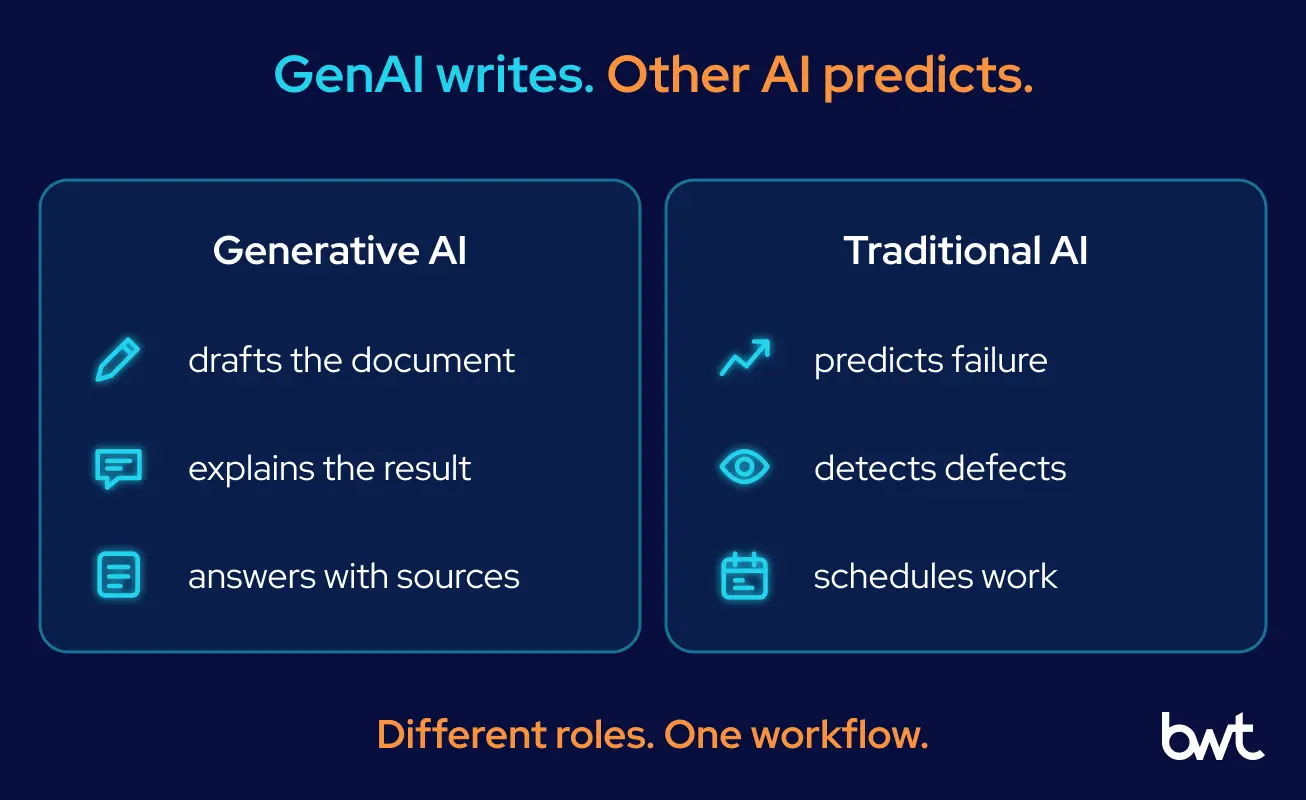
Manufacturing GenAI produces language artifacts – answers, structured drafts, summaries, classifications, or plans – through LLMs paired with retrieval, agents, or multimodal inputs. A person or downstream system acts on the result. The large language model (LLM) writes the text. Retrieval finds the source material first. Predictive maintenance estimates failure risk. Computer vision spots defects, while optimization engines schedule work. Those patterns sit beside GenAI; the broader AI in Manufacturing playbook covers that predictive, vision, and optimization layer in full. GenAI in modern manufacturing writes or explains. Traditional AI does different work: prediction, detection, classification, and optimization. Mix the two layers up, and the business case starts with the wrong promise. Token probability tells you how the LLM formed its text. It does not measure plant risk.
How It Differs From Traditional ML and Computer Vision
| AI pattern | Best suited for | Key control |
| LLM (text generation) | Drafting, summarizing, plain-language Q&A over text | Human review for safety-critical or operational instructions; automated handling only within validated low-risk boundaries |
| RAG (retrieval-augmented generation) | Grounded answers over manuals, SOPs, engineering docs | Source citations and access control |
| Copilot (LLM + UI) | Decision support for engineers, planners, supervisors | Risk-based confirmation before write-back |
| Agent (multi-step LLM workflow) | Multi-document processes with tool calls (ERP, MES, email) | Tool permission scopes and risk-based approval gates |
| ML + GenAI | Prediction plus explanation, anomaly plus narrative | Model monitoring for both layers |
| Vision + GenAI | Detection plus written investigation note | Image validation and reviewer queue |
Most use cases below stack two or three patterns. Only 24% of respondents in the Deloitte 2025 Smart Manufacturing and Operations Survey reported GenAI running at facility or network level. Another 38% remained in pilot mode. That gap between “piloting” and “deployed at scale” is where the operational questions in this article matter. The generative AI in manufacturing market is crowded with platform claims, so treat the generative AI in manufacturing examples below as pilot candidates to validate, not as a vendor shopping list.
GenAI in modern manufacturing helps five functional areas where the work is text-heavy, document-heavy, or knowledge-heavy and the answer must be cited: engineering and product development, production and plant operations, maintenance and field service, quality and compliance, supply chain and procurement. It does not help where the answer is a number to act on autonomously – closed-loop control of actuators, real-time safety interlocks, or any decision that bypasses the engineer on call.
Generative AI Use Cases in Manufacturing
GenAI wins on text, documents, and structured drafts where a person or a validated workflow stays in the loop. It loses on closed-loop control, real-time guarantees, and any question whose answer must be a calibrated risk score. Ten manufacturing GenAI use cases can enter the shortlist when the data, reviewer, KPI, and risk boundary are known.
Engineering and Product Development
An engineer may need one answer assembled from a design review, a test report, a requirement specification, CAD (computer-aided design) metadata, and a change record. A knowledge assistant can return cited answers from that corpus. Design-comparison support can draft a rationale and surface similar designs for an engineer to assess. Engineering-change support can prepare an impact note and controlled documentation, but the responsible engineer still approves the change. The same retrieval shape applies to our engineering document retrieval projects – full context in the case study below.
Production and Plant Operations
A frontline copilot can turn approved plant knowledge into a plain-language briefing or suggested next step. For planners, an MES copilot can condense a shift, changeover, or validated event into one reviewable brief. The numbers come first. Calculations stay deterministic. The analytics layer reads MES (manufacturing execution system), historian, SCADA (supervisory control and data acquisition), or PLC (programmable logic controller) records and identifies the event or deviation before GenAI sees it. The LLM explains those validated results and routes the briefing to a supervisor, but remains outside the real-time control loop.
Maintenance and Field Service
Maintenance is a strong generative AI in manufacturing industry case because the work is document-heavy and the time cost is visible. GenAI can retrieve troubleshooting instructions, explain a predictive or rules-based alert, and draft a work order with cited parts and procedures. A field-service assistant can prepare a reply or parts quote from approved records. It should not predict equipment failure on its own or issue a safety-critical instruction without review.
Quality and Compliance
Quality teams can use an assistant to gather investigation evidence. It may then draft the CAPA narrative or controlled document for review. Each output must cite the plant’s QMS and current procedures, then pass through the responsible quality reviewer. GroupBWT’s cosmetics product-line case proves the underlying data discipline through SKU matching and pipelines. It was not a GenAI CAPA deployment.
Supply Chain and Procurement
GenAI can generate supply-chain scenarios, process RFQs and supporting documents, or turn approved orders into structured ERP drafts. The cosmetics digital-shelf data platform – 300,000+ products across 30+ locales – shows the data-engineering side of supply-chain work, not a GenAI rollout. Synthetic records and simulated procedures can also support training, provided they are clearly separated from production records and validated before use.
The examples that matter here are workflow shapes, not brand stories: a factory-performance copilot over existing production intelligence, an agentic RAG assistant over heavy-engineering reports, and an order-to-ERP agent for food-manufacturing documents. Before building, name the generated output, reviewer, KPI, permission boundary, and source systems. When the brief asks for an example of a generative ai application in manufacturers, pin it to one of these workflows. Do not begin with a model name. The useful question is narrower: where does generative AI help in manufacturing first? Name the bottleneck that must disappear before a second workflow enters scope.
How to Select the First Use Case
Start with the use case your data can support, a specific reviewer can verify, and a baseline KPI can move within 90 days. We typically run a manufacturing data readiness assessment – one to two weeks of structured interviews, data-source mapping, and a shortlist of two to three candidates. The deliverable is the priority list, source-system map, access-control risk list, pilot KPI baseline, and architecture output, not a model. The assessment also exposes a practical generative ai application in manufacturing that is actually a traditional ML problem wearing the wrong label.
Use a five-point scale for each criterion. The weights keep business value from counting the same as implementation risk. Risk and integration complexity run in reverse: 5 means safer or easier. The weighted total is the Fit score. Hard blockers still override it – no reviewer or an unsafe write-back path means no pilot.
| Criterion | Weight | What a high score means |
| Business value | 30% | The workflow has a costly, measurable bottleneck |
| Data readiness | 25% | Required sources are accessible, current, and governed |
| Reviewer availability | 20% | A named subject-matter expert can assess outputs |
| Integration complexity | 15% | The pilot needs few, well-understood connections |
| Risk | 10% | Errors are reversible and approval boundaries are clear |
Fit score = (business value × 30%) + (data readiness × 25%) + (reviewer availability × 20%) + (integration complexity × 15%) + (risk × 10%).
| Use case | Fit (1-5) | Reviewer | Pilot score |
| Knowledge assistant over engineering docs | 4.4 | Yes | High |
| Maintenance troubleshooting copilot | 4.2 | Yes | High |
| Order-to-ERP automation | 4.0 | Yes | High |
| Quality investigation support | 3.8 | Yes | Medium-high |
| Supply-chain scenario assistant | 3.7 | Yes | Medium-high |
| Predictive-maintenance explanation layer | 3.4 | Yes | Medium |
| Digital-twin conversational interface | 2.8 | Partial | Defer |
| Synthetic data for defect augmentation | 2.7 | Partial | Defer |
These are illustrative prioritization scores, not universal ratings. “Defer” means the workflow needs more data work, a narrower risk boundary, or a stronger reviewer chain before it deserves a pilot slot.

LLMs, RAG, Copilots, and Agentic AI: Which Pattern Fits Which Manufacturing Workflow
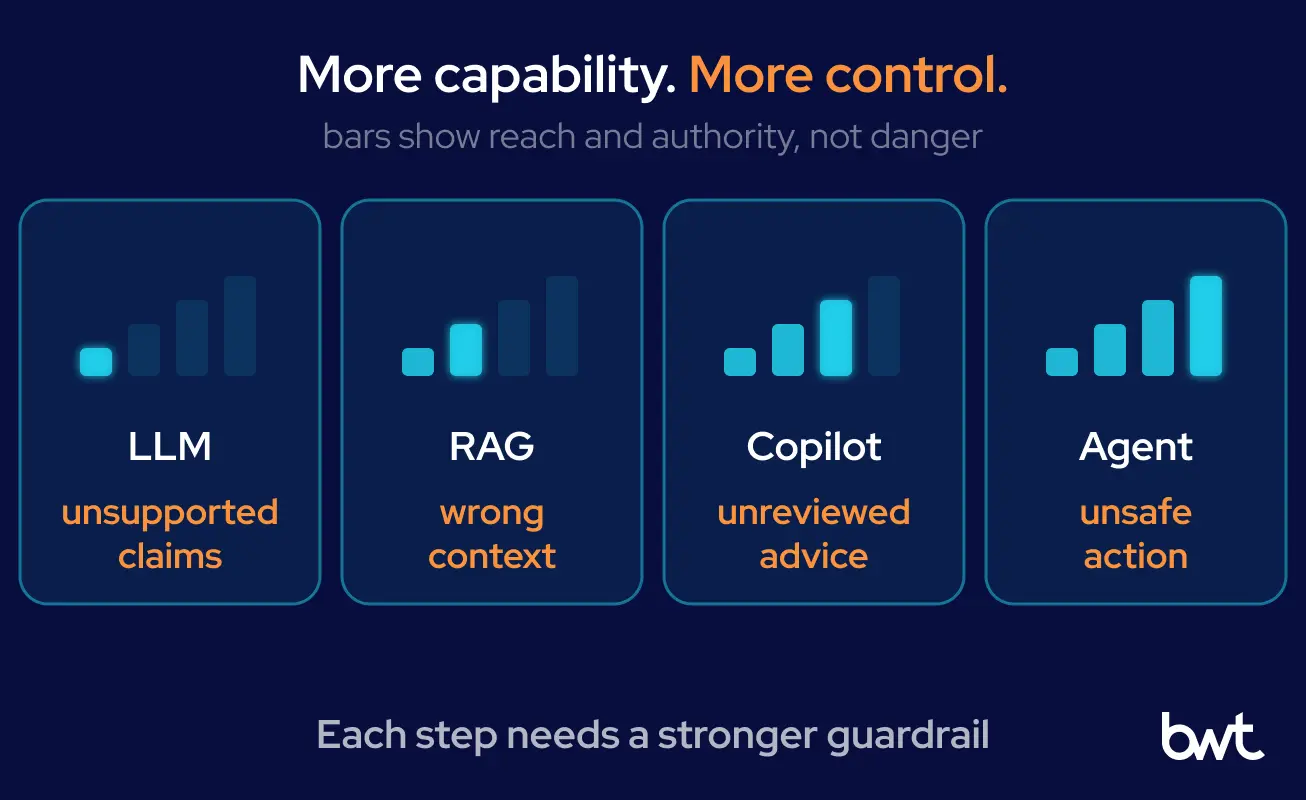
| Pattern | Best fit | Main requirement | Main risk |
| LLM | Controlled drafting | Human review | Hallucinations |
| RAG | Knowledge retrieval | Governed corpus | Bad retrieval |
| Copilot | Human decision support | Reviewer workflow | Automation bias |
| Agent | Multi-step execution | Tool permissions | Unsafe actions |
| ML + GenAI | Prediction plus explanation | Monitoring for both model layers | Compounded errors |
When to Use RAG
RAG is the default for document-heavy deployment. Retrieval-augmented generation searches approved material before the model writes. A retrieved passage can still be wrong, stale, or irrelevant. Drawings and scans test the parser first. Then come chunking, metadata, ACLs, and source freshness. Retrieval has its own moving parts: hybrid search blends keywords with vectors, reranking sorts the passages, and query transformation repairs a vague question before search. Evaluation datasets and citation validation must test the complete chain. Our engineering data management case shows this pattern in actual engineering records. The search crosses 3,600 motor variants and roughly 600 R&D folders, then reconciles SAP, SolidWorks CAD, Microsoft 365, and an ad-hoc AI tool. A CAD table-extraction pipeline leaves SAP as the system of record.
“In engineering, an AI that’s confidently wrong is worse than useless. So every number we surface links straight back to the original drawing, and anything the model isn’t sure about goes to an engineer to confirm before anyone trusts it.” — Alex Yudin, Head of Data Engineering at GroupBWT
When to Use a Manufacturing Copilot
For generative AI for manufacturing, a copilot is a UI over an LLM that turns queries into suggestions a person confirms when the risk class requires it. A useful copilot explains where the answer came from, presents a default action and an alternative, and makes the approval rule visible. It fits maintenance, planning, quality, and engineering workflows where the person remains responsible for the decision.
When Agentic AI Makes Sense
An agent makes sense when the workflow requires several bounded steps or tool calls across ERP records, work orders, or email. Tool scopes should be narrower than a human’s. Every safety-critical or irreversible action needs an enforced approval gate, every reversible low-risk action needs policy validation, and every run needs an audit log. A raw LLM with unrestricted tools is not an agent architecture.
When to Combine GenAI With Predictive ML or Vision
Use ML or deterministic analytics to predict, detect, classify, or calculate. Use GenAI to retrieve context, explain the result, and draft the next artifact. Multimodal models can interpret drawings, photographs, audio of a running motor, or vibration spectrograms, but the predictive or vision result and the generated explanation need separate validation because errors can compound.
Data Readiness: What Manufacturing GenAI Actually Needs Before the First Pilot
A manufacturing GenAI project fails most often not because of model quality but because of data readiness. Five categories of input have to exist before a pilot is worth running: documents and engineering knowledge (manuals, SOPs, drawings, change orders); operational data sources (ERP for business records, MES for production execution, SCADA for machine telemetry, PLM for product lifecycle data, QMS for quality records, and CMMS for maintenance work orders – incremental connectors, bidirectional integration only when the workflow must write back); asset, sensor, and historian context (a deterministic analytics layer calculates events and deviations before GenAI turns them into a cited explanation); metadata and access control (without permission-aware retrieval, GenAI returns either too little or too much); lineage and refresh cadence (every corpus needs a refresh schedule and a “retired” flag). The AI-ready data pipeline guide details the quality gates behind this foundation. Disconnected systems raise a sequencing question: which source comes first? The multi-source data pipeline playbook gives the decision method. Governed lineage and repeatable transformations belong underneath that pipeline. The ETL and data warehousing playbook maps how lineage and repeatable transformations support that layer. The readiness checklist later in this article gives the team a stop/go decision, not another discussion prompt. Several high-risk gaps mean the data work comes first.
The Manufacturing GenAI Architecture, End to End
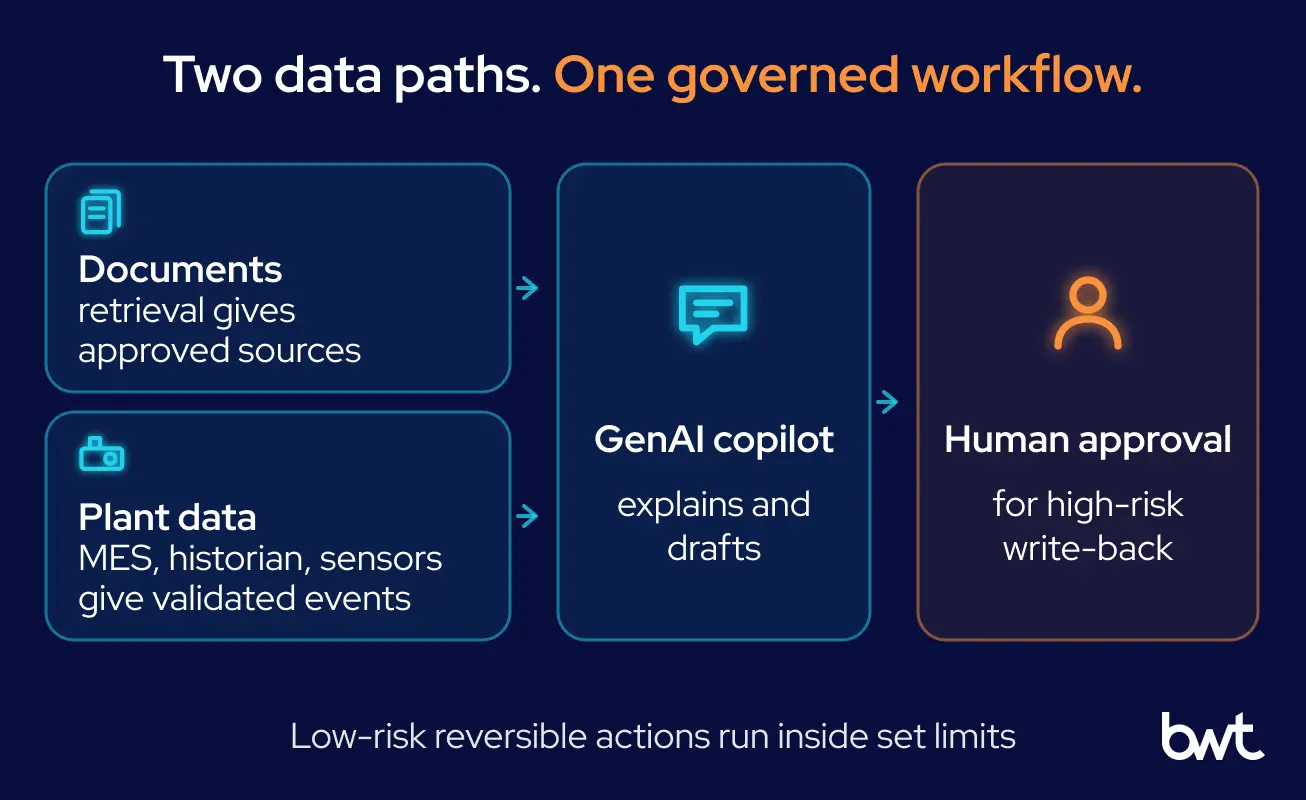
A production-grade manufacturing GenAI stack is one governed flow with two processing branches. The document branch moves manuals, SOPs, PLM, and QMS records through parsing, chunking, metadata, ACL propagation, and a hybrid index before RAG retrieves cited evidence. The operational branch moves MES, SCADA, historian, and sensor data through deterministic analytics before a validated event or deviation reaches the GenAI explanation layer. Both branches converge at reviewer approval, audit, monitoring, and a controlled write-back boundary.
Five control points a plant must own, not the vendor: identity and ACL propagation, source citations, an evaluation layer before production, approval gates enforced by architecture (not the prompt), and a defined write-back boundary. Safety-critical, financially material, customer-facing, or irreversible write-back to ERP / MES / CMMS requires human approval and an audit trail; reversible low-risk actions can be automated only inside a validated permission and policy boundary.
“A retrieval architecture that copies files into a vector index without carrying source-system access controls exposes material a competitor would pay for.” — Alex Yudin, Head of Data Engineering at GroupBWT
What a 2-Week Assessment Delivers
During week 1, the team traces sources and access rules, inventories the document corpus, follows the real workflow, and records its current KPI. By week 2, only 2-3 use cases remain. Each has a reviewer by name. That second week sets the exit ranges and exposes integration risks. It also fixes the 90-day scope and draws the full route: source, retrieval, reviewer UI, audit log, write-back boundary. The team leaves with a priority list, budget envelope, architecture diagram, and go / no-go decision. Model selection and production access come later. The honest output is often “not yet” – when the data is locked in vendor screens, the asset hierarchy is undocumented, or no one can be named as the reviewer.
ROI Worked Example: Knowledge Assistant for a Motor Engineering Team
Illustrative ROI model – not a client result or an industry benchmark. Replace every assumption with your own workflow data before making an investment decision.
Inputs (motor engineering team, 40 engineers):
  Search time saved    25 min / engineer / working day (≈ 0.42 hrs)
  Loaded labor cost    $60 / hour
  Working days / year  220
  Realized adoption    50%
  Build cost           $120,000    Annual run cost  $48,000

Year 1
  Annual benefit       = 40 × 0.42h × $60 × 220 × 0.50 = $110,880
  Year-1 total cost    = $120,000 (build) + $48,000 (run) = $168,000
  Year-1 cash ROI      = ($110,880 − $168,000) / $168,000  ≈ −34%

Three-year cumulative
  Three-year benefit   = $110,880 × 3 = $332,640
  Three-year cost      = $120,000 + ($48,000 × 3) = $264,000
  Three-year ROI       = ($332,640 − $264,000) / $264,000  ≈ 26%
  Annual net inflow    = $110,880 − $48,000 = $62,880
  Payback period       = $120,000 / $62,880 ≈ 1.9 years (about 23 months)
Pilot Exit Criteria: Six Numbers
One good metric cannot carry a rollout. The agreed numbers must pass together. These are GroupBWT planning ranges for scoping discussions, not universal industry benchmarks or contractual guarantees. Final thresholds depend on the systems, sites, users, and risk class in scope. Start measuring in week 1. For a live knowledge assistant, citation accuracy often starts at ≥90%, while unsupported answers may need to stay at ≤5-10%, depending on risk. Back-office reviewer acceptance commonly starts at ≥70% on the first pass. Set latency from the actual retrieval depth and tool calls; a floor copilot cannot inherit a back-office target. Weekly adoption commonly aims for ≥60% by week 6. Unauthorized retrieval stays at zero. A high-risk miss at week 8 stops the rollout. Extend the pilot and repair the gap.
Variables You Should Replace With Your Own Data
The ROI model changes with six inputs: number of users, minutes saved per user, loaded labor cost, realized adoption, build cost, and annual operating cost. Capture the baseline before the pilot and calculate benefits from accepted outputs, not generated outputs. That keeps faster drafting from being counted as value when reviewers reject or rewrite the result.
Benefits of Generative AI in Manufacturing You Can Measure in the First 90 Days
In selected pilots from our work, teams spent less time searching or drafting, and reviewers cleared more items. Exact gains depend on the workflow, baseline, adoption, source quality, and risk requirements. These benefits appear at the task layer first; plant-wide savings arrive later. Measure the task before checking whether the operational metric follows. A practical GenAI application in manufacturing should make the pre-pilot KPI visible before it promises plant-wide savings.
Risks, Security, and Governance Controls in One Section
A hallucinated instruction and a missing audit log are the same production blocker wearing two uniforms. Each risk below names the control that closes it; each control has a named owner – a person, not a vendor – listed in the assessment deliverable. Modern manufacturing programs cannot reach production without the relevant controls in place for that workflow’s risk class. A low-risk drafting tool may need only part of this control set. Safety-critical, regulated, and write-back work needs much more of it.
- Hallucinated, outdated, or out-of-context answers – a model returns a work order naming a part number that does not exist, a RAG corpus returns a 2018 SOP at high confidence, or a generic LLM misses your plant’s naming conventions. Control: tie every citation to its document and version. Give the corpus a refresh owner and a “retired” flag, retrieve only governed plant data, structure the context, and use fine-tuning only when terminology or output format warrants it.
- IP leakage and unsafe autonomous actions – a vendor copies your documents into an uncontrolled index; an agent calls a tool that posts a work order or sends a customer email. Control: private deployment covers only part of the security model. Do not fine-tune on customer data without a contract clause. RAG (retrieval-augmented generation) must mirror source-system permissions, and the architecture must block safety-critical, financially material, customer-facing, or irreversible actions until a person approves them. Reversible low-risk actions may be automated inside validated permission and policy boundaries.
- Prompt injection, vendor model drift, and workforce overreliance – an instruction hidden in an inbound email becomes a tool call; a model provider changes behavior between contract and pilot; the team stops checking citations. Control: restrict tools with an allowlist and validate every argument before execution. Pin the model version. Keep a golden test set with known questions and acceptable answers. The contract should require notice of behavior changes, while monitoring shows whether reviewers still follow policy.
- Latency, safety-critical loops, residency, audit logs, and incident response – edge lines do not always have reliable cloud connectivity; EU, medical-device, or aerospace rules require explicit data-residency clauses; regulators cannot reconstruct what the model said without an audit log; a bad output in production requires containment. Control: GenAI never enters the safety-critical loop. A deterministic or approved manual path remains available. Write the residency location and audit-log retention period into the contract. After an incident, quarantine the output first. Suspend only the affected workflow, preserve its input, then restore the last tested model, prompt, or retrieval configuration.
Readiness Checklist: Is Your Manufacturing Data Actually Ready for Generative AI?
Score each item Yes / Partial / No / N/A. Two or more No answers usually means the data work comes before the model, but the final decision depends on which gaps affect the selected workflow and risk class: required documents are accessible through governed, version-aware retrieval, whether centralized or federated; ACLs that mirror source systems; incremental ERP / MES / PLM / QMS / CMMS connectors; documented asset hierarchy; queryable historian and sensor data with known latency and retention; a named reviewer per generated artifact type; refresh cadences owned by a person; audit logs retained for the regulator-required period; a privacy-safe supplier-side or customer-side corpus for testing when the use case needs it; the pilot’s KPI measured today, before the pilot starts.
How to Take Manufacturing GenAI From Assessment to Production
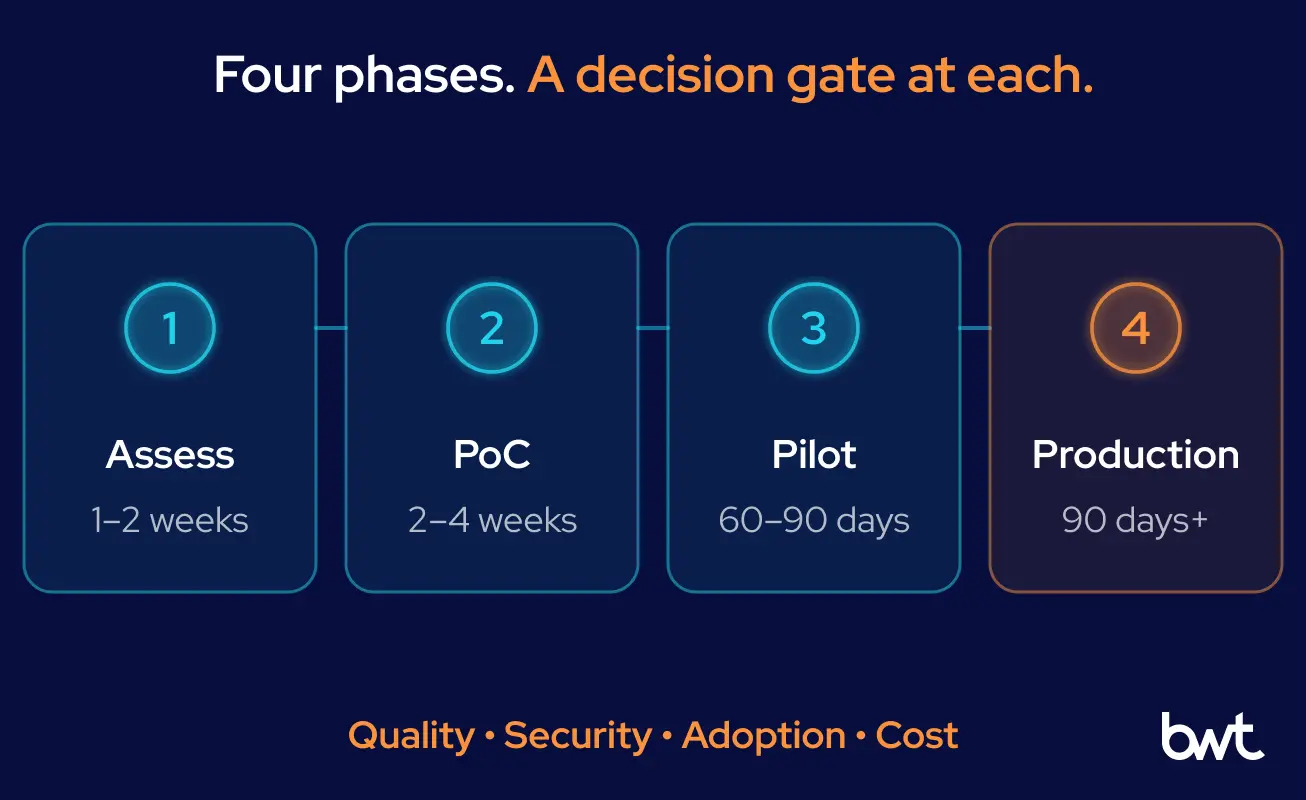
The client-side team needs a workflow owner, a plant or maintenance engineer, a data or integration owner, a security representative, and the reviewer who will accept or reject generated outputs. GroupBWT data and AI engineers pair with that team to connect sources, build retrieval and evaluation, set approval gates, and monitor the workflow. If an owner is missing, narrow the scope until someone can own the decision.
| Phase | Goal | Deliverable | Exit gate |
| 1. Readiness assessment – 1-2 weeks | Decide whether the workflow deserves a pilot | Source map, ACL matrix, KPI baseline, priority score, architecture, budget envelope | Data, reviewer, KPI, and risk boundary are known |
| 2. Proof of concept – 2-4 weeks | Prove the pattern on a representative, access-controlled sample | Working retrieval or tool-call path, initial evaluation set, observed failure modes | The approach meets minimum quality and security requirements on sample data |
| 3. 60-90 day pilot | Test the real workflow with the actual reviewer | Integrated pilot, audit trail, monitoring, weekly scorecard | Quality, security, adoption, and economic criteria pass together |
| 4. Production rollout | Harden one validated workflow | Production access controls, incident response, refresh ownership, support model | The workflow operates within approved service and risk limits |
| 5. Multi-plant scaling | Extend a proven pattern without copying local assumptions | Site-specific source mappings, access reviews, evaluation updates, operating playbook | Each additional site passes its own readiness and acceptance gates |
This staged path is the smallest one we have seen reach production for generative AI in manufacturing companies: choose the workflow and KPI, fix the data gaps, build the guardrailed architecture, run the bounded pilot, then scale only after the agreed gate clears.
Final Thoughts: Why Workflow and Data Beat the Model Every Time
The model is the last decision, not the first. Plants that move GenAI from pilot to production start with the workflow, prove the data path, assign the reviewer, and measure one KPI before they scale. For the predictive, vision, and optimization layer that sits beside GenAI, see the AI in Manufacturing playbook.
Build a Manufacturing GenAI Pilot That Can Reach Production
Generative AI in modern manufacturing companies reaches production when the architecture, the reviewer chain, and the agreed exit-criteria numbers clear for the same workflow. Generative ai for manufacturing use cases share a control base, whether the workflow is a knowledge assistant, maintenance copilot, order-to-ERP agent, or supply-chain scenario tool. Approval rules change with the risk class. Bring one workflow, its trusted sources – ERP, MES, PLM, SCADA, QMS, or manuals – and the KPI that must move. Plan Your Manufacturing GenAI Pilot – typical next step is the 2-week assessment, not a 6-month build.
Also Read: Data Readiness for AI: A Practical Guide for Data Leaders
An LLM writes the answer, draft, summary, or plan. Retrieval, agent tools, and multimodal inputs shape what it can use before a person or system acts. Predictive maintenance, vision, and optimization-based scheduling are the adjacent traditional-AI layer, detailed in the AI in Manufacturing playbook. In practice, GenAI is a thin layer over the systems a plant already runs – knowledge assistants, work-order drafting, CAPA support, supply-chain scenarios, order-to-ERP automation – with human review or automated handling set by the workflow’s risk class.
A candidate survives only when the source data works, a reviewer or policy boundary has an owner, the KPI is measurable, and the safety boundary is explicit. After that filter, the shortlist is usually small: engineering knowledge search, maintenance troubleshooting, quality investigation support, supply-chain scenarios, plus one document-heavy workflow unique to the plant. Predictive maintenance is mostly classic ML. GenAI retrieves the context, explains the sensor anomaly, and drafts the work order a technician can review.
Measure in three time horizons. Start with search time, first-pass acceptance, and citation accuracy. Then watch weekly active use and override rates. Longer-term evidence comes from mean time to repair (MTTR), investigation cycle time, and cost-to-serve. Day 90 tells you whether to keep testing. The 12-month operational metric answers the harder question: did the gain hold under normal plant conditions?
Read summarized version with
GenAI Pilots for Plant Operations
We design GenAI pilots for plant operations – RAG, hybrid search, access-control lists (ACLs), reviewer queues, and incident-response plans – backed by data engineering for manufacturers since 2009.