



background

Smarter Healthcare Decisions Powered by Data Engineering and AI

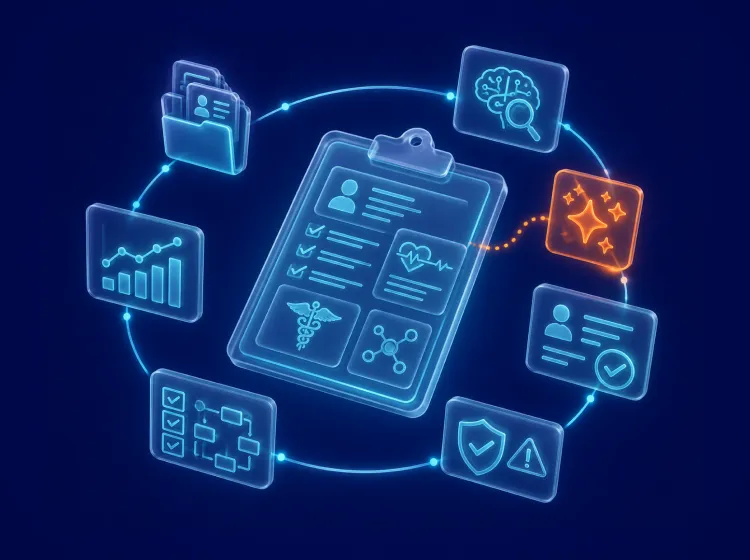
Bring legacy EHR data into a foundation your teams can use for modern analytics and AI. That foundation supports clinical documentation, claim checks, and a clearer view of patient care.

Book a Data Strategy Session
100+
software engineers
15+
years industry experience
$1B-$100B
client annual revenue range
Fortune 500
clients served

We are trusted by global market leaders

Logo PricewaterhouseCoopers
Logo Kimberly-Clark
Logo UnipolSai
Logo VORYS
Logo Cambridge University Press
Logo Columbia University in the City of New York
Logo Cosnova
Essence logo
Logo catrice
Logo Coupang

Healthcare Data and AI Challenges We Solve

Patient records remain disconnected

Patient files, laboratory results, and billing records often sit in separate systems. Staff lose time reconstructing the full picture. GroupBWT connects approved medical and financial data so teams have one dependable place to look.

Clinical documentation consumes staff time

Typing notes pulls doctors and nurses away from patients. AI-assisted documentation turns spoken consultations into structured drafts for clinical review and approval.

Claim errors delay reimbursement

A missing detail or coding mistake can send a claim back. Pre-submission validation helps billing teams find and correct exceptions before they delay payment.

Staffing plans miss demand changes

A poor forecast creates uncovered shifts, overtime requests, or another call to a temporary agency. Patient-flow forecasting gives leaders a firmer basis for schedules and payroll decisions.

Missed appointments leave capacity unused

A missed visit leaves a room unused and a gap in the day’s revenue. AI voice assistants handle confirmations and rescheduling while staff manage conversations that need a person.

Outdated data delays operational decisions

Bed use, staffing, and patient flow can change before an overnight update lands. Data pipelines refresh each dashboard or alert at the cadence its decisions require.

Operational Friction Holding Back Healthcare Performance

Healthcare leaders have more important work than chasing paperwork, delayed reimbursements, and scattered records. The following use cases address the friction each clinical and executive role sees in daily operations:

For Doctors & Clinicians (Physicians & Medical Staff)

Cut Paperwork & EHR Fatigue: Say the note once. An AI scribe structures the dictation for the chart. That saves 1-2 hours of typing each day.

Instant Full Patient History: Open the timeline during the visit. The history, lab results, and earlier appointments are already together.

Smarter Clinical Decision Support: A critical risk or drug interaction stands out instead of joining another wall of popups

For the Chief Operating Officer (COO)

Reduce Staff Burnout: A nurse enters the detail. The back office enters it again. That duplicate work drains both teams. Automating them puts that time back into the working day.

Maximize Diagnostic Equipment Utilization: Capacity planning catches an empty CT, MRI, or operating-room slot while the schedule can still be changed.

Smarter Workforce Scheduling: Expected patient peaks go into the rota before shifts are assigned. The schedule is less likely to end with a gap or an overtime request.

For the Chief Financial Officer (CFO)

Drastically Lower Claim Denials: Before the clinic submits a claim, its code and supporting detail are checked against the payer rule. A coding error can then be fixed before it delays payment.

Eliminate Cash Flow Gaps: Track expected and actual cash flow by department, then find reimbursement delays before they widen.

Predictable Return on IT Investment: Put the financial case in writing before the budget is committed. Do not call the return at launch. Whether the investment paid off becomes clear over the following 6 to 18 months.

For the Chief Medical Officer (CMO)

Single Unified Patient View: The timeline opens with the EHR history, lab results, and imaging record in place. Everyday clinical work does not need to stop.

Proactive Readmission Prevention: Higher-risk patients surface while the care team still has time to act on a possible 30-day readmission.

Enhanced Care Quality & Accuracy: Current information reaches clinicians where care happens. Documentation errors fall, and the patient experience becomes clearer

background

How We Work: 3 Steps to Implementation

Design

Audit & Security Guardrails: The review maps the current software estate, data silos, and the privacy controls required for protected health information. Actionable Roadmap: You receive an integration plan ordered by operational impact.

Build

Data Unification: Secure pipelines bring patient, financial, and laboratory records into one reporting environment. Workflow Automation: Staff keep their familiar workspace while AI tools, billing checks, and predictive scheduling run behind it.

Scale

Staff Onboarding: Doctors learn their workflow. Administrators learn theirs. 24/7 Optimization: Ongoing support can include performance monitoring, workflow tuning, and updates to assigned controls as the organization grows.

background

From Fragmented EHRs to Enterprise AI in 90 Days

Modernize the healthcare data layer in controlled stages, with audit records and operational results tracked throughout the work.

Talk to us:
Write to us:
Contact Us

Why Partner With GroupBWT

01/05

Healthcare-Domain Data Mastery

Healthcare knowledge informs the data engineering work. EHR workflows and clinical terminology shape each record, while the selected FHIR and HL7 interfaces govern how it moves between systems.

Compliance & Security by Design

The client’s legal and compliance teams determine which requirements apply. GroupBWT maps its assigned controls into the pipeline design, including access rules, encryption, tokenization, and audit logging where required.

Zero-Downtime Modernization

Modernization plans account for clinical continuity and data reconciliation across EHRs, databases, and claims pipelines. Staged releases and recovery steps protect access to patient records during the change.

Measurable Financial & Clinical ROI

Claim denials, clinical notes, and workforce plans are practical places for the work to begin. This work has a practical test. It should lower operating costs, take clerical work off clinicians, or shorten reimbursement time.

End-to-End Partnership from Audit to Scale

Delivery can continue beyond the strategy stage into implementation, production release, and maintenance. The same team can handle an infrastructure audit, cloud deployment, staff onboarding, and ongoing support.

01/05

What Our Clients Say

Inga B.

What do you like best?

Their deep understanding of our needs and how to craft a solution that provides more opportunities for managing our data. Their data solution, enhanced with AI features, allows us to easily manage diverse data sources and quickly get actionable insights from data.

What do you dislike?

It took some time to align the a multi-source data scraping platform functionality with our specific workflows. But we quickly adapted and the final result fully met our requirements.

Catherine I.

What do you like best?

It was incredible how they could build precisely what we wanted. They were genuine experts in data scraping; project management was also great, and each phase of the project was on time, with quick feedback.

What do you dislike?

We have no comments on the work performed.

Susan C.

What do you like best?

GroupBWT is the preferred choice for competitive intelligence through complex data extraction. Their approach, technical skills, and customization options make them valuable partners. Nevertheless, be prepared to invest time in initial solution development.

What do you dislike?

GroupBWT provided us with a solution to collect real-time data on competitor micro-mobility services so we could monitor vehicle availability and locations. This data has given us a clear view of the market in specific areas, allowing us to refine our operational strategy and stay competitive.

Pavlo U

What do you like best?

The company's dedication to understanding our needs for collecting competitor data was exemplary. Their methodology for extracting complex data sets was methodical and precise. What impressed me most was their adaptability and collaboration with our team, ensuring the data was relevant and actionable for our market analysis.

What do you dislike?

Finding a downside is challenging, as they consistently met our expectations and provided timely updates. If anything, I would have appreciated an even more detailed roadmap at the project's outset. However, this didn't hamper our overall experience.

Verified User in Computer Software

What do you like best?

GroupBWT excels at providing tailored data scraping solutions perfectly suited to our specific needs for competitor analysis and market research.

What do you dislike?

Given the complexity and customization of our project, we later decided that we needed a few additional sources after the project had started.

Verified User in Computer Software

What do you like best?

What we liked most was how GroupBWT created a flexible system that efficiently handles large amounts of data. Their innovative technology and expertise helped us quickly understand market trends and make smarter decisions.

What do you dislike?

The entire process was easy and fast, so there were no downsides.

Inga B.

What do you like best?

Their deep understanding of our needs and how to craft a solution that provides more opportunities for managing our data. Their data solution, enhanced with AI features, allows us to easily manage diverse data sources and quickly get actionable insights from data.

What do you dislike?

It took some time to align the a multi-source data scraping platform functionality with our specific workflows. But we quickly adapted and the final result fully met our requirements.

Catherine I.

What do you like best?

It was incredible how they could build precisely what we wanted. They were genuine experts in data scraping; project management was also great, and each phase of the project was on time, with quick feedback.

What do you dislike?

We have no comments on the work performed.

Susan C.

What do you like best?

GroupBWT is the preferred choice for competitive intelligence through complex data extraction. Their approach, technical skills, and customization options make them valuable partners. Nevertheless, be prepared to invest time in initial solution development.

What do you dislike?

GroupBWT provided us with a solution to collect real-time data on competitor micro-mobility services so we could monitor vehicle availability and locations. This data has given us a clear view of the market in specific areas, allowing us to refine our operational strategy and stay competitive.

Pavlo U

What do you like best?

The company's dedication to understanding our needs for collecting competitor data was exemplary. Their methodology for extracting complex data sets was methodical and precise. What impressed me most was their adaptability and collaboration with our team, ensuring the data was relevant and actionable for our market analysis.

What do you dislike?

Finding a downside is challenging, as they consistently met our expectations and provided timely updates. If anything, I would have appreciated an even more detailed roadmap at the project's outset. However, this didn't hamper our overall experience.

Verified User in Computer Software

What do you like best?

GroupBWT excels at providing tailored data scraping solutions perfectly suited to our specific needs for competitor analysis and market research.

What do you dislike?

Given the complexity and customization of our project, we later decided that we needed a few additional sources after the project had started.

Verified User in Computer Software

What do you like best?

What we liked most was how GroupBWT created a flexible system that efficiently handles large amounts of data. Their innovative technology and expertise helped us quickly understand market trends and make smarter decisions.

What do you dislike?

The entire process was easy and fast, so there were no downsides.

Blog articles background
background

Discover the Hidden Cost of Fragmented Data in Your Clinic

You do not need technical expertise or software access for the first conversation.

Our Awards and Partnerships

AWS Partner
Databricks Brickbuilder Partner Network Bronze
Snowflake AI Data Cloud Services Partner Select
G2 Winter 2026 Leader
G2 Fall 2025 High Performer
Clutch 2026 Top Big Data Marketing Company
Clutch 2026 Top B2B Big Data Company
Clutch 2026 Top Power BI & Data Solutions Company
Award from Goodfirms
GroupBWT recognized as TechBehemoths awards 2024 winner in Web Design, UK
GroupBWT recognized as TechBehemoths awards 2024 winner in Branding, UK
GroupBWT received a high rating from TrustRadius in 2020
GroupBWT ranked highest in the software development companies category by SOFTWAREWORLD
ITfirms

FAQ

How do you guarantee HIPAA compliance and safeguard sensitive patient data (PHI)?

The first architecture session covers privacy and security. One scope may require encryption at rest and in transit. Another may also need role-based access, audit logs, or PHI tokenization. Your legal and compliance teams determine which obligations apply. GroupBWT implements the assigned technical controls and tests them against the agreed performance needs.

Will integrating new data pipelines disrupt our daily clinical workflows or legacy EHRs?

The implementation plan is designed to limit disruption to active clinical workflows. Existing systems can remain in place while new data-access layers are built and tested, where their supported interfaces allow it. Release happens in controlled stages, with validation and recovery steps matched to the systems in scope.

What is the expected Return on Investment (ROI) and payback timeline?

Launch day is too early to judge the return. Measurement continues over an agreed period after release. The business case can track monetized changes in denied claims, bed use, and contract overtime against the full implementation and operating cost.

How do your AI solutions reduce clinician burnout and administrative paperwork?

Routine non-clinical work goes first. Automating it gives clinicians more time with patients. A physician speaks the note once; the AI voice assistant structures it for the EHR. The time returned can reach 2 hours a day. Automated prior-authorization and billing checks tackle a separate delay between providers and payers.

How do you ensure AI accuracy and prevent clinical or financial errors?

The responsible clinician or administrator keeps the decision. AI supplies support. An AI-generated summary, alert, or billing code stops for review before reaching the permanent record. A clinician or administrator makes that call. After release, monitoring makes drift visible to the review team.

What does the typical project roadmap look like from start to finish?

There are three working stages:

Design: The current infrastructure is assessed, high-ROI use cases are chosen, and the roadmap records the main risks.

Build: Data pipelines and cloud warehouses are connected before the required AI models go live.

Scale: Staff come onboard while monitoring and 24/7 technical support keep the system running

background