
Read summarized version with


A healthcare GenAI system does one bounded job. A model drafts a note from a transcript and approved patient context. The system checks sources, routes conflicts to a clinician, writes back the approved note, and confirms EHR receipt. You buy the governed workflow.
GroupBWT’s closest evidence is a delivered medical-record summarization assistant: by building adjudicated evaluation sets and a reviewer audit trail, GroupBWT achieved a current 95% no-edit rate. This is one assistant’s result, not a clinical benchmark.
Start with a GenAI Readiness Assessment
Bring one healthcare workflow. GroupBWT will assess its data, risk, review path, integration needs, and measurable pilot scope.
Key Takeaways
- Start with a bounded, measurable artifact and a qualified reviewer.
- Classify intended use before choosing architecture or thresholds.
- Separate the model from access, retrieval, approval, and write-back.
- Measure total handling, safety, and cost against a baseline.
What Healthcare GenAI Actually Means
Healthcare GenAI uses foundation models to draft, summarize, retrieve, or transform information. Predictive models score risk; deterministic rules calculate exact results. It fits document-heavy work when a named reviewer can check the output.
A production system determines sources, permissions, thresholds, approval, and failure handling. Generative artificial intelligence in healthcare pays off when those decisions are explicit. Applications of generative AI in healthcare make sensible first projects when input and output are bounded and the current process is measurable.
The WHO guidance on large multi-modal models warns that capability does not establish task reliability. In 2026, healthcare GenAI should have explicit permissions, refusals, and escalation. Those choices will shape its future.
Where Healthcare GenAI Creates Measurable Value
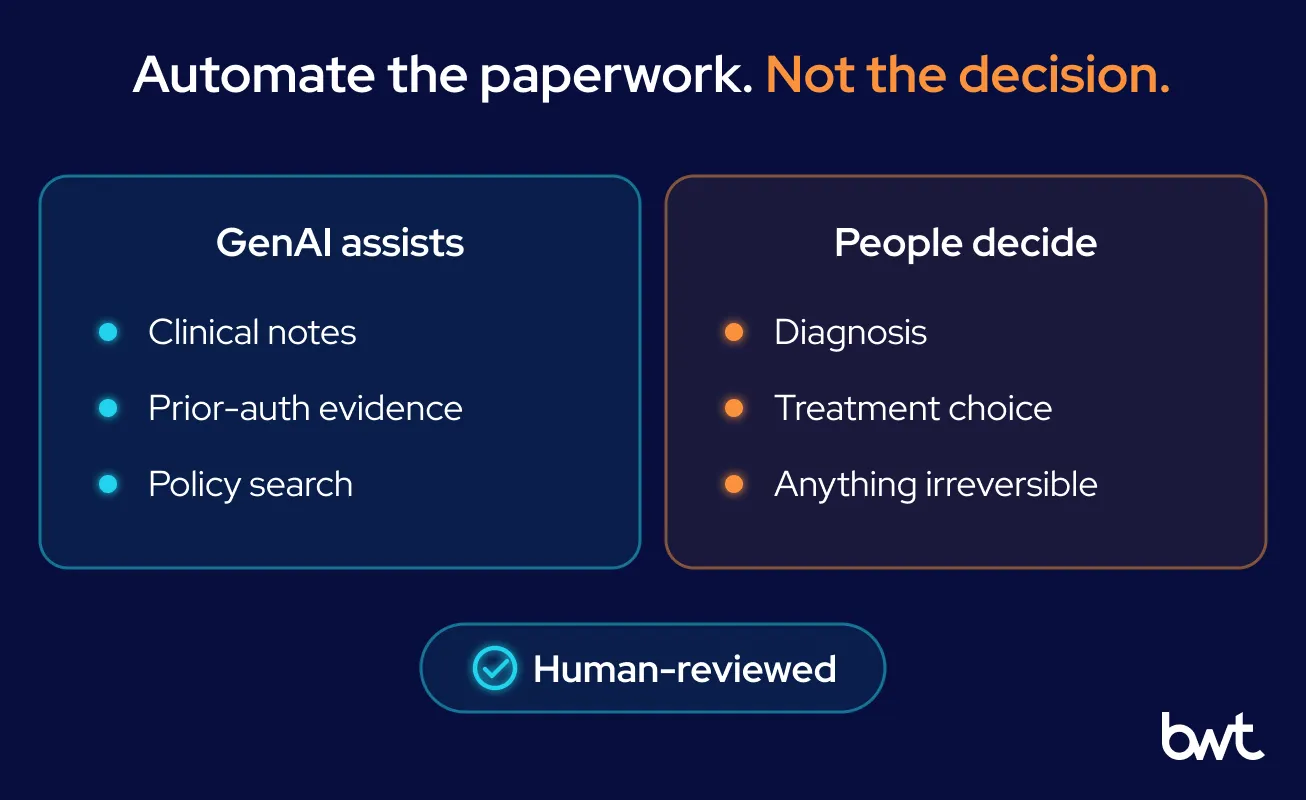
The benefits of generative AI in healthcare arise from reducing skilled effort per acceptable artifact. Documentation, evidence assembly, controlled search, and regulated writing offer visible review points. Diagnosis, treatment selection, benefit determination, and irreversible action require a different risk posture.
The generative AI in healthcare market spans clinical and operational products. Fund work that consumes qualified time, exposes errors before harm, and has a suspension path.
Also Read: AI Training Data: Limits, Shortcuts, and Biases in Reasoning
Ten Bounded Healthcare GenAI Use Cases
These ten generative AI use cases in healthcare are practical only when each has an owner, boundary, and metric.
Clinical Documentation and Record Summarization
A clinician reviews notes or chart summaries drafted from permitted records. The system may flag conflicts; it must not infer diagnosis or treatment. Measure end-to-end time, correction, no-edit rate, and critical omissions.
Prior Authorization and Revenue Cycle Support
Revenue-cycle staff review evidence, missing-item flags, appeal drafts, and policy summaries. The system must not invent support, alter coding, or submit without authorization. Measure preparation, missing evidence, exceptions, and payer rework.
Clinical Knowledge and Decision Support
A clinician or pharmacist reviews an answer grounded in dated guidelines or procedures. It must not convert a summary into diagnosis, treatment, or an order. Measure supported-answer time, citations, abstention, and rejection. GroupBWT applies this pattern in an AI knowledge assistant.
Care Management and Population Health
A care manager reviews program summaries and follow-up drafts. The system must not determine care eligibility or replace validated risk segmentation. Measure review, correction, completion, and missing context.
Pharmaceutical Research and Pharmacovigilance
Qualified staff review literature summaries, case narratives, and controlled drafts. The system must not determine causality or approve submissions. Measure source coverage, omissions, corrections, review, and audit completeness.
Healthcare Knowledge Assistants
Authorized staff query controlled documents. The assistant retrieves only permitted sources, cites them, and abstains without support. Measure supported answers, citation accuracy, denials, and escalation.
Patient Communication and Message Drafting
Staff review instructions, portal replies, and follow-up drafts. The system must not add clinical advice or send without approval. Measure response time, edits, escalation, comprehension, and complaints.
Medical Coding and Claims Documentation Support
Certified staff review summaries and code-support evidence. The model must not choose a final code or alter a claim autonomously. Measure review, unsupported suggestions, corrections, denials, and audit findings.
Clinical Trial and Research Document Processing
Research teams review protocol summaries, document checks, and evidence extraction. The system preserves source and version context; it must not determine eligibility. Measure completeness, discrepancies, effort, and traceability.
Provider Operations and Administrative Knowledge Work
An operations owner reviews credentialing, scheduling, procurement, or policy drafts. The system must not override policy, approve access, or execute without authorization. Measure resolution, exceptions, corrections, and handoffs.
These generative AI in healthcare examples span care delivery and research, so generative AI in healthcare and life sciences is not one product category. The reviewer, evidence standard, and cost of error change with the task. They support generative AI for healthcare professionals; they do not replace professional judgment.
LLMs and Generative AI for Healthcare: Model vs System
The model drafts content. The application controls sources and workflow state. Integrations move approved outputs. Evaluation tests the system. GroupBWT separates these layers so generative AI for healthcare can change models without rebuilding EHR connections.
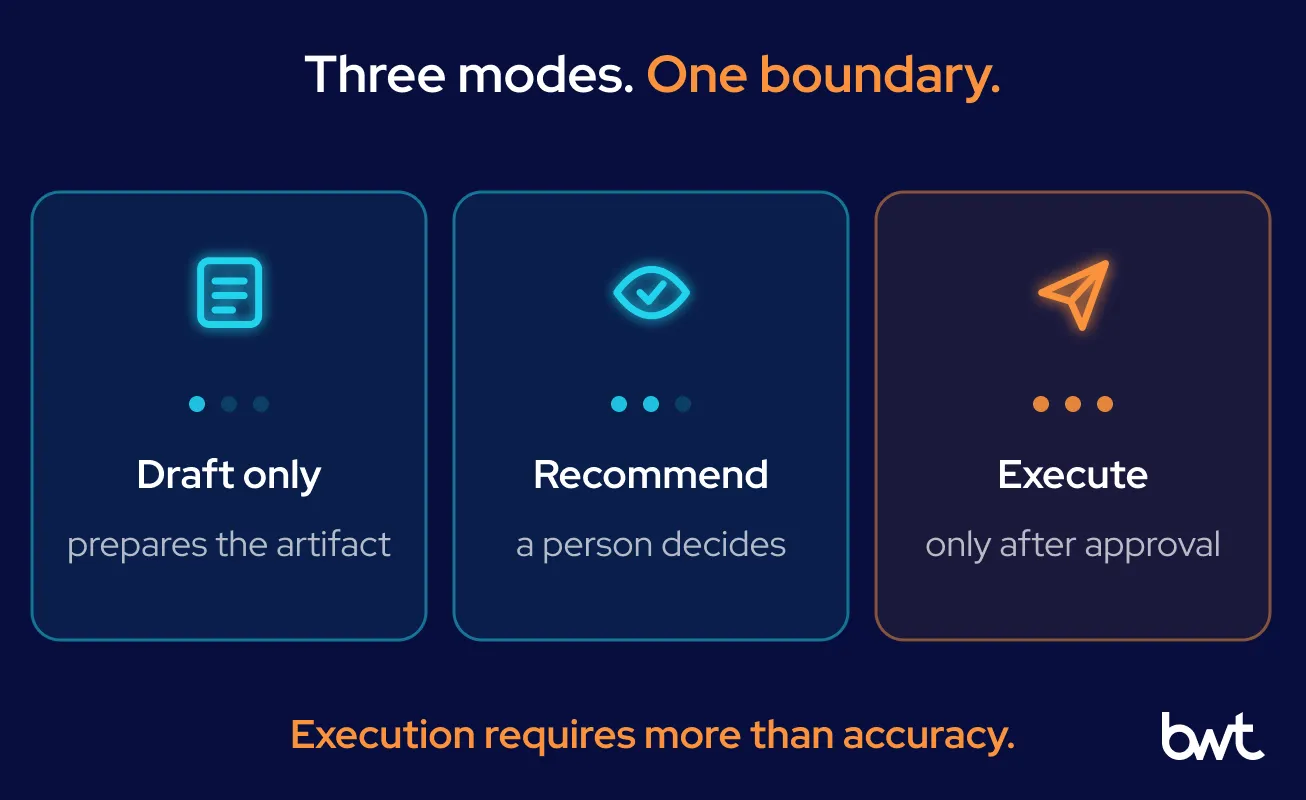
Generative AI for healthcare automation starts in three modes. Draft-only prepares an artifact. Recommend-and-review proposes an action while a person decides. Execute-with-approval performs a downstream action only after explicit approval. Clinical, payment, and regulatory outputs cannot move to unsupervised execution merely because average accuracy looks high.
Data Foundation and Architecture for Healthcare GenAI
Batch and real-time are workflow decisions. Use batch for scheduled indexing, historical claims, reports, and known refresh windows. Use event-driven paths when orders, identity, consent, or workflow state can change the safe answer. For real-time claims, define freshness, late-data handling, fallback, and reconciliation.
flowchart LR
  A[EHR / Claims / Labs / Policies / Documents] --> B[Access + Data Quality + Provenance]
  B --> C[Structured Data / RAG Retrieval]
  C --> D[Application & Orchestration Layer]
  D --> E[LLM]
  E --> F[Evaluation / Guardrails / Human Review]
  F --> G[Approved Output]
  G --> H[EHR / CRM / Claims / Workflow System]
  X[Identity | Audit Logs | Monitoring | Versioning | Incident Response] -. cross-cutting controls .-> B
  X -. cross-cutting controls .-> D
  X -. cross-cutting controls .-> F
  X -. cross-cutting controls .-> H
Healthcare Data Sources
EHR records, claims, labs, policies, and documents need an owner, permission, freshness, provenance, retention, and missing-source rule. Use enterprise data readiness for AI before a pilot.
Permission-Aware Retrieval
RAG supplies approved passages at answer time. Check access before retrieval. Filters need identity, role, organization, patient relationship where applicable, document version, and effective date.
Model, Application, and Orchestration
The application assembles context, validates input and output, routes review, and records state. Choose the model by quality, privacy, latency, deployment, and cost.
"Schema decisions made under deadline pressure become the bottlenecks everyone blames the pipeline for six months later." — Dmytro Naumenko, CTO at GroupBWT
Healthcare Integrations
FHIR, HL7, identity, queues, and databases connect work. Write-back requires authorization, duplicate protection, confirmation, reconciliation, and recovery. GroupBWT’s HIPAA-compliant EHR platform case demonstrates this foundation; our healthcare software development services cover the application.
Regulatory and Compliance Requirements for Healthcare GenAI
Classify Intended Use Before Designing the Architecture
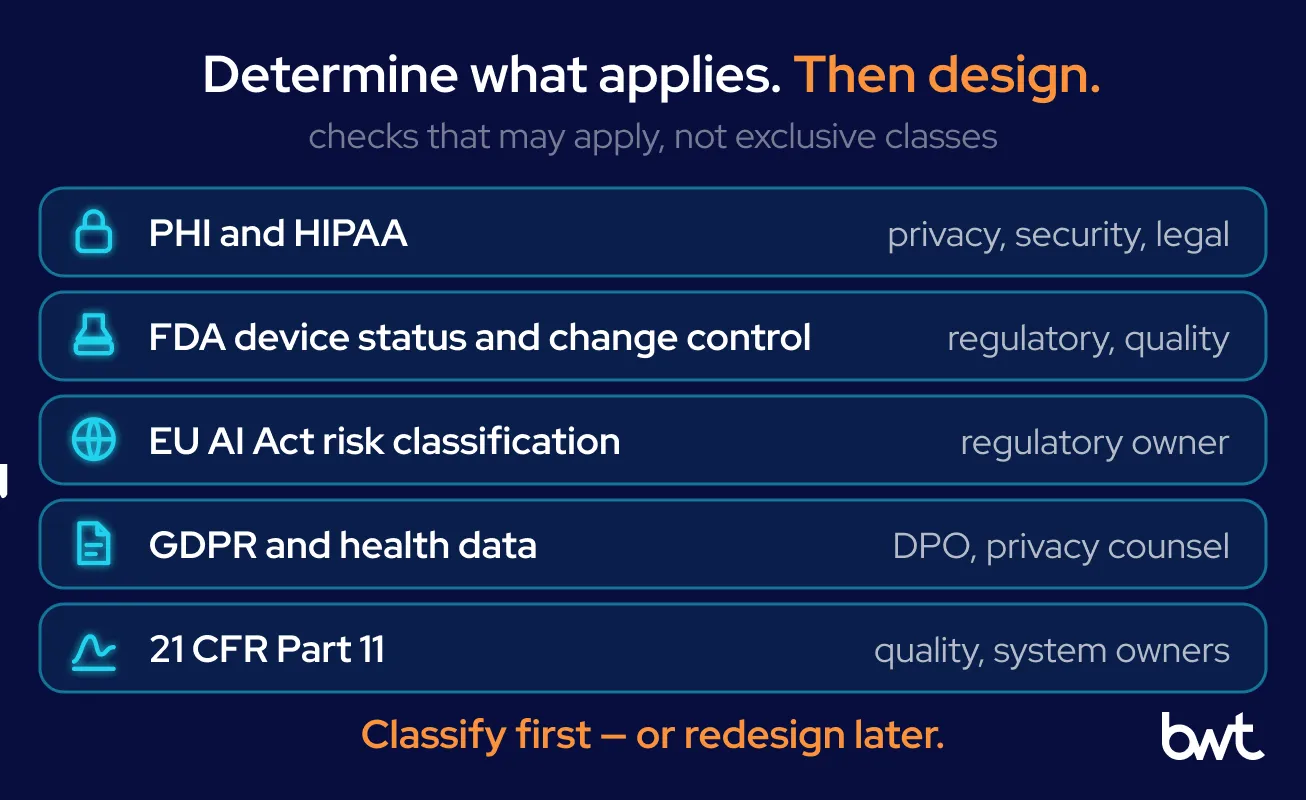
Record the system’s action, user, data, output, and influence on care, payment, safety, or regulated records. Accountable regulatory, privacy, security, clinical, quality, and legal owners classify it before architecture is fixed.
| Decision area | Design consequence | Who decides |
| PHI / HIPAA | Lawful purpose, minimum access, safeguards, agreements, audit, incidents | Privacy, security, legal, covered-entity owner |
| Medical-device status | Clinical claims may invoke device rules | Regulatory, clinical, legal owners |
| FDA change control | Validated requirements, release evidence, controlled changes, monitoring | Regulatory and quality owners |
| EU AI Act / GDPR | Lawful basis, subject rights, risk, transparency, human oversight | DPO, privacy counsel, regulatory owner |
| 21 CFR Part 11 | Validated controls, authority checks, audit trails, record integrity | Quality, regulatory, system owners |
Evidence follows risk. A regulated workflow may need quality procedures, representative validation, traceable requirements, change control, and post-market monitoring.
Measure ROI Before and After the Pilot
Generative AI ROI for healthcare operations compares the total work needed for an acceptable outcome against its fully loaded cost.
Annual ROI contribution = annual capacity value + avoided rework – operating cost – amortized implementation cost.
What to Measure Before the Pilot
Record annual volume; handling, review, and correction time; queue delay; escalation and rework rates; quality failures; critical omissions; staff cost; and downstream consequences. Use representative cases, medians, and difficult-case spread. Define counting and ownership.
What to Measure After the Pilot
Measure generation, review, correction, exceptions, failed integrations, fallback, no-edit or acceptance, adoption, latency, unit cost, and the same quality outcomes. Compare matched cases and include infrastructure, support, evaluation, security, monitoring, and change control.
| Narrative | Before | After | Decision test |
| Safety | Critical omissions, unsupported claims, escalations | Same rates plus abstentions and reviewer overrides | Capacity improves without a worse safety distribution |
"Anyone can deploy a chatbot; the question is what percentage of its drafts move forward without human edits." — Oleg Boyko, COO at GroupBWT
Never convert a pilot delta into guaranteed annual savings.
What You Actually Buy With a Healthcare GenAI Engagement
The real build scope includes:
- Intended use, prohibited actions, reviewers, KPIs, and regulatory classification.
- Permission-aware sources with quality, freshness, provenance, and retention rules.
- Structured-data and RAG paths fitted to evidence needs.
- Review, escalation, abstention, and approved write-back.
- EHR, CRM, claims, identity, and queue integrations with recovery.
- Evaluation data, release thresholds, security tests, and audit evidence.
- Monitoring, versioning, incident response, rollback, and handover.
This is why Generative AI software development in healthcare cannot stop at a prompt. GroupBWT builds generative AI solutions for healthcare as operated systems, not demonstrations.

Prioritize Use Cases With a Buyer Decision Framework
Score candidates for safe value, then validate the leader with data, workflow, risk, and budget owners.
| Criterion | Weight | Stop signal |
| Measurable value | 25% | No baseline or accountable outcome |
| Data readiness | 20% | Unknown rights or unstable evidence |
| Safety and compliance | 20% | Unbounded consequential decision |
| Workflow fit | 15% | Hidden or open-ended action |
| Integration readiness | 10% | No safe destination or fallback |
| Operating ownership | 10% | No production owner |
Reject candidates without a reviewer, lawful data, stable evidence, baseline, or suspension path.
Real-World Healthcare GenAI Examples and Transferable Patterns
Three classifications keep evidence boundaries clear for generative AI for healthcare solutions.
| Classification | Evidence | Boundary |
| Direct healthcare GenAI | Medical-record summarization assistant with a current 95% no-edit rate on adjudicated samples | Direct workflow evidence; not a clinical benchmark or autonomous-care claim |
| Adjacent regulated GenAI | Regional insurer assistant with claims and policy support plus audit logs in a delivered insurance case | Transferable governance pattern; not proof of a clinical deployment |
| Healthcare engineering foundation | HIPAA-oriented EHR platform, identity, integrations, and controlled data flows | Production foundation only; not represented as delivered GenAI functionality |
"The first no-edit rate we trusted came from a system with a real audit trail and a real reviewer. Without the audit trail, the number is theatre. Without the reviewer, it is unsafe." — Alex Yudin, Head of Data Engineering at GroupBWT
Security and Privacy for Healthcare Generative AI
Minimize data to task-required fields and policy-approved retention. Enforce PHI access through identity, role, context, and least privilege. RAG permissions filter before retrieval so a model cannot cite documents the user cannot open.
Treat prompt, context, output, source, reviewer, and disposition logs as sensitive. Encrypt data in transit and at rest, define residency and keys, and document third-party retention and training use. Mask PHI where permitted; use a private environment when risk requires it.
Audit and incident response connect identity, versions, sources, approval, detection, containment, notification, and recovery. Secure EHR write-back needs authorization, validation, duplicate protection, confirmation, reconciliation, and rollback. Hashing alone is not HIPAA de-identification. Use HHS OCR guidance with accountable owners.
How to Evaluate Generative AI in Healthcare
Evaluate the workflow with routine cases, edges, source gaps, permission failures, adversarial instructions, and integration failures. Set thresholds first and preserve model, prompt, source, application, and evaluation-set versions.
| Metric | What it measures | Release implication |
| Task accuracy and completeness | Required facts and fields are correct and present | Must meet task-specific threshold |
| Unsupported claims / hallucinations | Claims lack authorized evidence | Critical clinical claims may be zero-tolerance |
| Citation / source support | Citation points to the supporting passage and correct version | Unsupported or inaccessible citations fail |
| Critical-omission rate | Safety- or workflow-critical evidence is absent | Exceeding limit blocks release |
| No-edit / acceptance | Qualified reviewer accepts unchanged or approves | Interpret with case mix and reviewer time |
| Subgroup performance | Quality differs across defined populations or document types | Material gaps require mitigation or narrower scope |
| Abstention / escalation | System refuses and routes uncertain or prohibited cases correctly | Too little or too much abstention needs correction |
| Latency / cost | End-to-end response and unit economics | Must fit workflow and operating budget |
| Human-review metrics | Review time, corrections, overrides, disagreement, fatigue | Gains must survive the control workload |
Named owners monitor these measures with pause, rollback, and incident thresholds. Permission failure exposes data; an incomplete corpus lacks the answer. Prompt tuning fixes neither.
Risks of Generative AI in Healthcare and How to Control Them
| Risk | Control | Owner |
| Unsupported clinical statement | Required citations, claim-to-source checks, abstention threshold | Clinical safety owner |
| Missing or stale evidence | Source coverage tests, effective dates, freshness alerts | Data owner |
| PHI exposure | Minimum access, masking where appropriate, private environment, retention controls | Privacy and security owner |
| Permission leakage in RAG | Identity-aware filtering before retrieval, access-denial tests | Identity and application owner |
| Prompt injection or unsafe tool use | Untrusted-source handling, tool allowlists, argument validation, approval | Security owner |
| Silent write-back failure | Confirmation, reconciliation, retry limits, rollback | Engineering owner |
| Model or source drift | Continuous monitoring, version comparison, pause criteria | Model and quality owner |
| Unsafe uncertainty | Explicit abstention and escalation to a qualified reviewer | Workflow owner |
| Automation bias | Reviewer training, override tracking, periodic audit | Quality owner |
Route breaches, regressions, repeated abstentions, and integration failures to named owners with response times, fallback, and suspension authority.
When Healthcare GenAI Is Not the Right Solution
Use rules for exact calculations and stable checks, predictive models for validated scoring, and better search when evidence is incomplete. Do not automate without qualified review or when errors cannot be caught before consequential action.
How to Implement Healthcare GenAI Step by Step
1. Select a Bounded, Measurable Use Case
Deliverable: one artifact, owner, action boundary, volume, and outcome.
2. Establish the Baseline and Success Metrics
Action: record time, review, correction, exceptions, quality, cost, and safety distribution.
3. Classify Intended Use and Regulatory Risk
Deliverable: an approved intended-use statement and obligations map.
4. Inventory the Minimum Required Data
Action: document required sources, owners, permissions, quality, freshness, provenance, and retention.
5. Define Human Review and Escalation
Deliverable: reviewer authority, approval, abstention, escalation, fallback, and suspension.
6. Design the Data and Integration Architecture
Action: choose cadence, data paths, identity controls, destinations, reconciliation, and recovery.
7. Choose the Model and Retrieval Approach
Deliverable: a decision on quality, privacy, deployment, latency, cost, citation, and vendor change.
8. Build a Production-Shaped Pilot
Action: implement real access, data, review, logging, integrations, and failure handling.
9. Evaluate Quality, Safety, and Workflow Performance
Deliverable: holdout results for routine cases, edges, failures, subgroups, permissions, abstention, cost, and review.
10. Validate Security and Compliance Controls
Action: test identity, retention, encryption, provider handling, audit evidence, incidents, and write-back.
11. Deploy With Monitoring and Change Control
Deliverable: thresholds, dashboards, owners, versions, rollback, incident response, and controlled updates.
12. Measure ROI and Scale Gradually
Action: compare matched cases, include control costs and residual risk, then expand after thresholds hold.
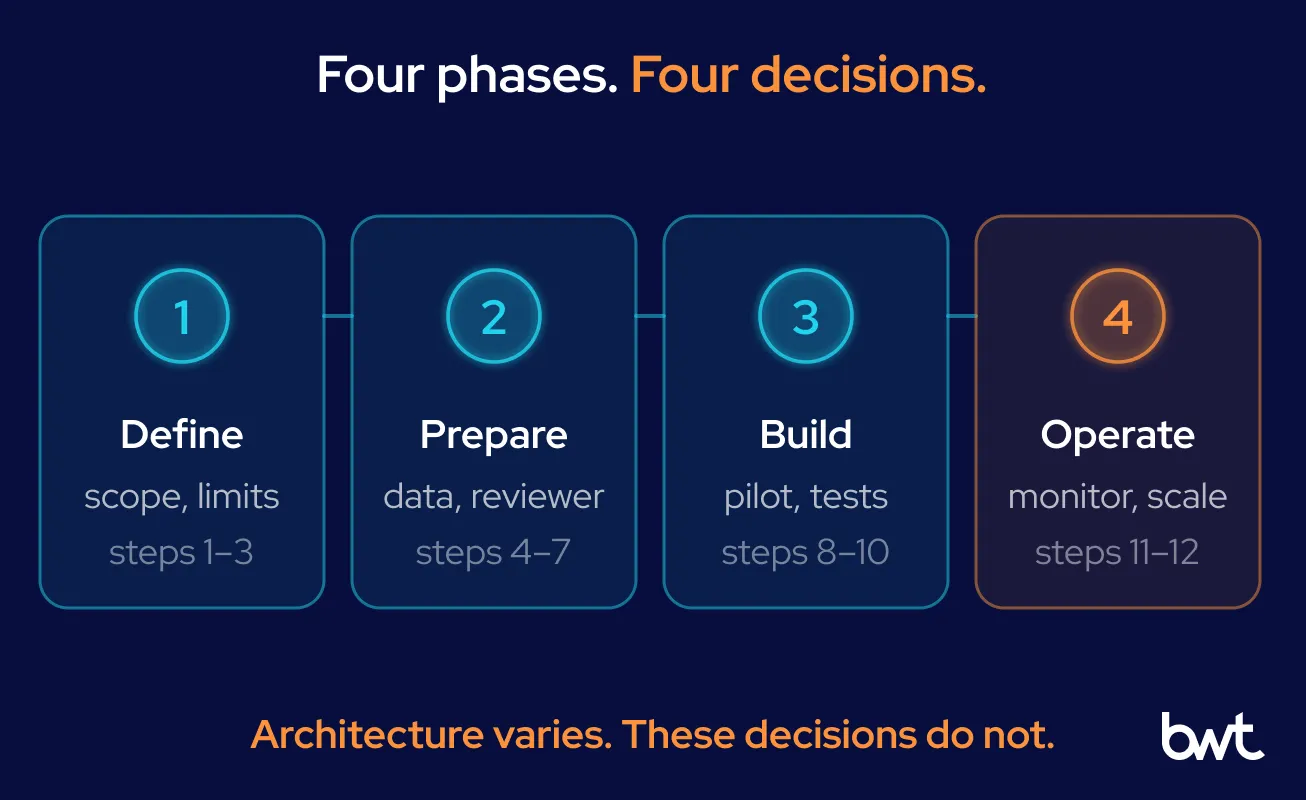
Architecture varies; these decisions do not. GroupBWT delivers Generative AI applications in healthcare through evaluation and integration. The client receives operable code, configuration, tests, access rules, logs, and recovery procedures. Our custom generative AI development services support that route from bounded pilot to operated product.
Final Thoughts: Healthcare GenAI Value Starts With the Workflow and Data
Generative AI for healthcare is useful for bounded knowledge work with reliable evidence and qualified review. Output affecting care, payment, regulated records, or safety needs additional controls. Rules, predictive models, search, or data repair are safer when exactness or source completeness dominates.
Put use case before model, data before scale, accountability before automation, and ROI before rollout. Match controls to error consequences.
Build a Healthcare GenAI System That Users Can Trust
GroupBWT turns fragmented healthcare data and isolated pilots into secure generative AI for healthcare workflows with grounding, evaluation, access controls, and monitoring. Define the workflow through our AI consulting services. Build the foundation with how to build an AI-ready data pipeline and a data engineering services company.
It uses foundation models to draft, summarize, retrieve, or transform information. Uses include note drafts, evidence assembly, controlled summaries, and knowledge search. Predictive scoring uses different models. Production boundaries depend on evidence, review, and error consequences.
Yes, healthcare GenAI fits reviewable documentation and knowledge work. It can reduce handling when staff compare output with authorized sources. It is a poor fit for exact calculations or autonomous consequential decisions. Measure the whole workflow before scaling.
Generative AI in healthcare industry deployments draft notes, assemble evidence, summarize documents, and support search. Providers prioritize documentation, payers packet preparation, pharma regulated writing, and healthtech staff assistants. Each needs permissions and review. Compare outcomes with the prior process.
Start with a bounded artifact, approved sources, least privilege, and qualified review. Require citations and abstention when support is weak. Test routine cases, feared failures, subgroups, permissions, and integrations. Monitor with named escalation and suspension owners.
Use task-required data only. Establish ownership, access, freshness, provenance, retention, and coverage. Decide whether the application needs structured records, retrieval, or one document. Repair stale, inaccessible, or incomplete sources before tuning.
Read summarized version with
Start with a GenAI Readiness Assessment
Bring one healthcare workflow. GroupBWT will assess its data, risk, review path, integration needs, and measurable pilot scope.