Read summarized version with


Introduction
Most AI projects do not fail on the model, but rather on getting data ready for AI. A Director of Data at a European beauty & personal care brand we work with said it plainly in a kickoff: “I want my team on 20% data prep and 80% real data science.” Almost every team we meet runs the opposite ratio. The architecture of the model matters far less than whether the data feeding it is correct, complete, and connected. Google Cloud, citing a Deloitte survey in Building a data strategy for the AI era, found that 55% of organizations avoid certain generative AI use cases because their data isn’t ready.
What It Means When Data Is AI-Ready
Volume is not the answer. We have seen six-petabyte estates that were not AI-ready and 200-gigabyte estates that were. The work is closing the gap between records sitting in your warehouse today and a dataset a model can train on, fine-tune from, or query without producing nonsense.
Microsoft framed the shift well in its next-gen AI readiness post for Fabric: “Centralizing data, once the finish line, is now the starting point.” A tidy warehouse is the bare minimum. AI-ready means records are deduplicated, labeled, traceable, refreshed at the cadence the model needs, and governed for the use case. Raw business data is what your finance team imports; AI-ready data — the building blocks of data for AI — is the same content reshaped into a specification a model can rely on.
“The biggest misunderstanding I see is treating AI-ready and analytics-ready data as the same artefact. They are not. An analyst forgives a 95%-complete column. A model trained on the same column quietly learns the wrong distribution and embarrasses you in production”
— Alex Yudin, Head of Data Engineering at GroupBWT

Why AI Projects Stall Before the Model Is Picked
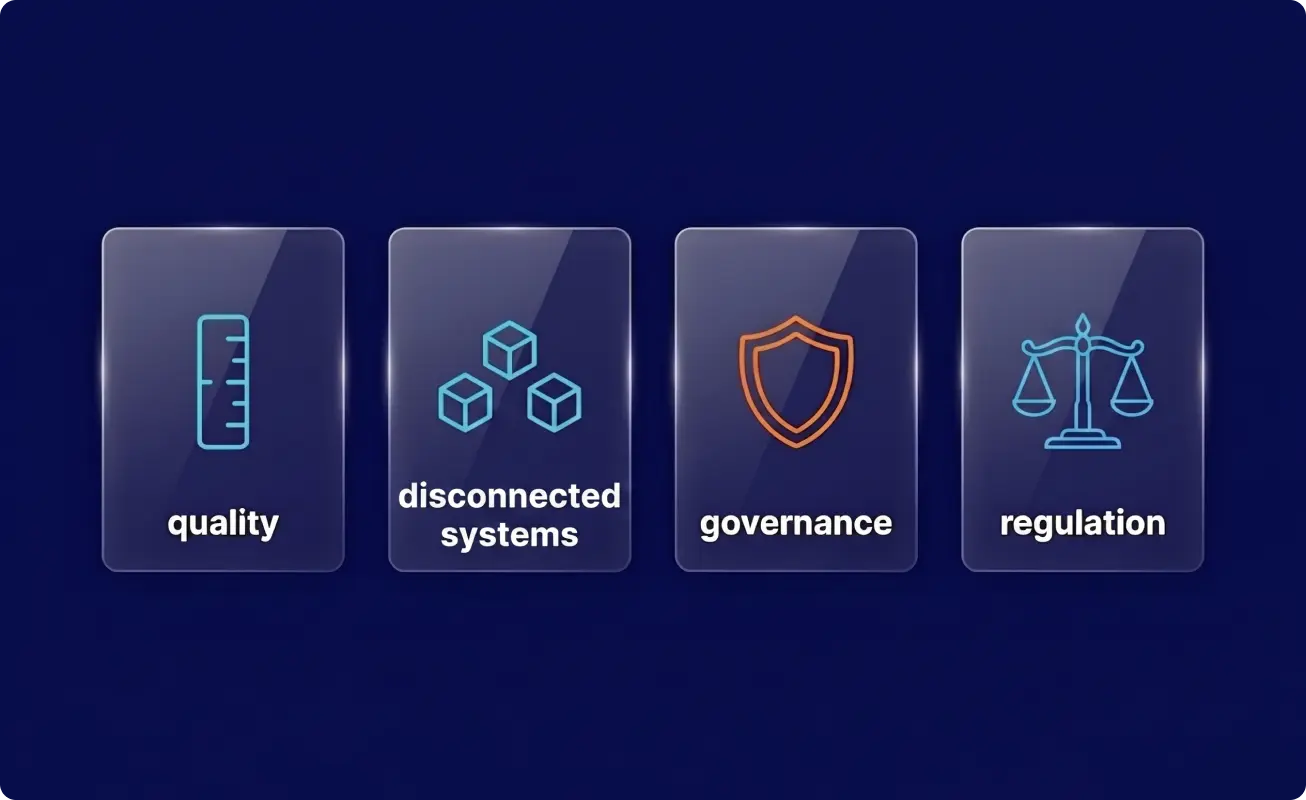
Poor quality kills more AI projects than poor algorithms. We rebuilt a dataset for a European fiber-coverage analytics firm after its scraper reported 98% address coverage. A field-level audit told a different story: the real fiber-to-the-home figure was 0.6% — 7,610 records out of 1.24 million. Train a forecast on that 98% headline, and every number downstream of it inherits the error.
Disconnected systems are the second problem. One client came to us with more than 20 source systems, 6,000+ tables, and 295 Power BI reports — and every team reading them had its own version of yesterday’s revenue. If no two people agree on what the data says, a model trained on it cannot be trusted either.
Governance gaps are the third. When no one owns a column, no one notices when its values drift away from what the model was trained to expect. NIST makes the same point in Challenges to the Monitoring of Deployed AI Systems: it names performance degradation and feedback-loop drift — the slow erosion of accuracy as inputs change — as the leading post-deployment failure modes. Both are root-caused upstream, in data nobody curated.
Regulation adds a fourth failure mode that did not exist five years ago. The EU AI Act and similar frameworks now require bias controls, representation checks across protected attributes, and impact assessments for high-risk systems. Those reviews fail the same way data audits do — by going through fields nobody bothered to check. Deduplication and clean schemas are not enough on their own; bias mitigation is a distinct discipline that lives on top of the same data foundation.
Also Read: AI-Ready Data Pipeline: Architecture, Components, and Best Practices
The Five Pillars of Data Readiness for AI
| Pillar | What “ready” looks like | What “not ready” looks like |
| Quality and consistency | Validation checks on every batch, a written ≥98% accuracy commitment, and field-level audits before sign-off | “The warehouse looks fine.” No measurement, no thresholds, and no one paged when accuracy drifts in production |
| Availability and access | Pipelines deliver inside the model’s freshness window through automated jobs that the AI team can self-serve | Analysts pull spreadsheets by hand and email them around, so the model trains on data that is already 24 hours stale |
| Structure and labeling | One unified schema, with the source, lineage, and label semantics of every value tracked | Each source uses its own column names, dates arrive in three formats, and “status” means a different thing in every system |
| Governance and compliance | Anonymization, retention, audit trail, and representation checks across protected attributes are built into the pipeline by design, before any sensitive field is written to disk | Sensitive fields live in production with no access controls, no retention policy, no bias review, and no record of who read what |
| Scalability for AI workloads | Throughput grows with usage, no rewrites needed when volume goes up tenfold | The pipeline that runs at 100k records breaks at 1M, and the team rebuilds it from scratch every twelve months |
One Brand, Five Pillars: A Through-Line Example
Theory generalizes too easily. Here is the same set of pillars answered for a single engagement — a European beauty & personal care brand whose internal generative AI team needed weekly normalized retail data across dozens of retailers and locales. Same client, same stack, every pillar in one picture.
- Quality. We deduplicate hundreds of thousands of product records every week against the global trade item number (GTIN, the barcode used worldwide to identify a product). For retailers that hide the GTIN, we recover it through a third-party product-review API. The pipeline reports a high-90s success rate batch over batch, and manual operations dropped from roughly a full work week per month to a single day.
- Availability. The same dataset feeds Tableau dashboards on day one and the GenAI team on day two, through three controlled environments (lab, staging, production) wired with continuous deployment. The AI team queries the same sources marketing already trusts.
- Structure. The warehouse follows Data Vault 2.0 — the official specification, not a vendor variant — across three layers: Raw Vault, Business Vault, and Data Domains. When a new retailer joins, it connects to hubs and links that already exist, so the schema stays put instead of being reworked.
- Governance. Lineage is recorded for every transformation. Sensitive fields are isolated by the environment. The internal AI team can prove, per record, where a value came from, when it was refreshed, and which transformations touched it.
- Scalability. The architecture that fed Tableau on day one now feeds the GenAI team without re-architecting the core, while volume keeps climbing.
One client, five pillars, one stack. The same disciplines play out in every industry we work in — only the order of the bottlenecks changes.
Same Pillars, Different Industries
Three quick examples make the point.
- Quality, UK HR analytics. 60–80,000 vacancy postings a day, salary fields in ten formats, including the occasional £500M typo. Anomaly checks the gate every batch, and exports only fire when at least 70% of fields are populated. Data quality for AI-engineered, not assumed.
- Availability, Korean e-commerce. Pricing decisions inside a 60-second response window, with throughput growing by four orders of magnitude on the same architecture core in just over a year. The pipeline was designed for that cadence from the first batch — availability for AI is not “the data exists,” it is “the data exists when the model asks.”
- Governance, North American clinical care. A separate logging service strips protected health information (the patient-identifying fields regulators guard) before any record is written to disk, with an audit trail and 6+ year retention. Same shape as clinical trial data: separation of sensitive fields is the precondition for applying AI at all.
The pillars are universal; the relative weight shifts by industry. Financial institutions lean hardest on signed inputs and audit trails. Real estate work hinges on deduplicated addresses across listing sources where the same property shows up under three slightly different formats. Technology companies mature fastest because the analytics foundation was already in place when the AI conversation started. Same five pillars, different remediation order.
How to Audit Data Readiness for AI
Before you commit budget to any AI initiative, run this six-step audit. It is meant to be a short sprint, not a polished deliverable.
- List every data source the use case will touch — including the ones no one on the AI team has heard of yet.
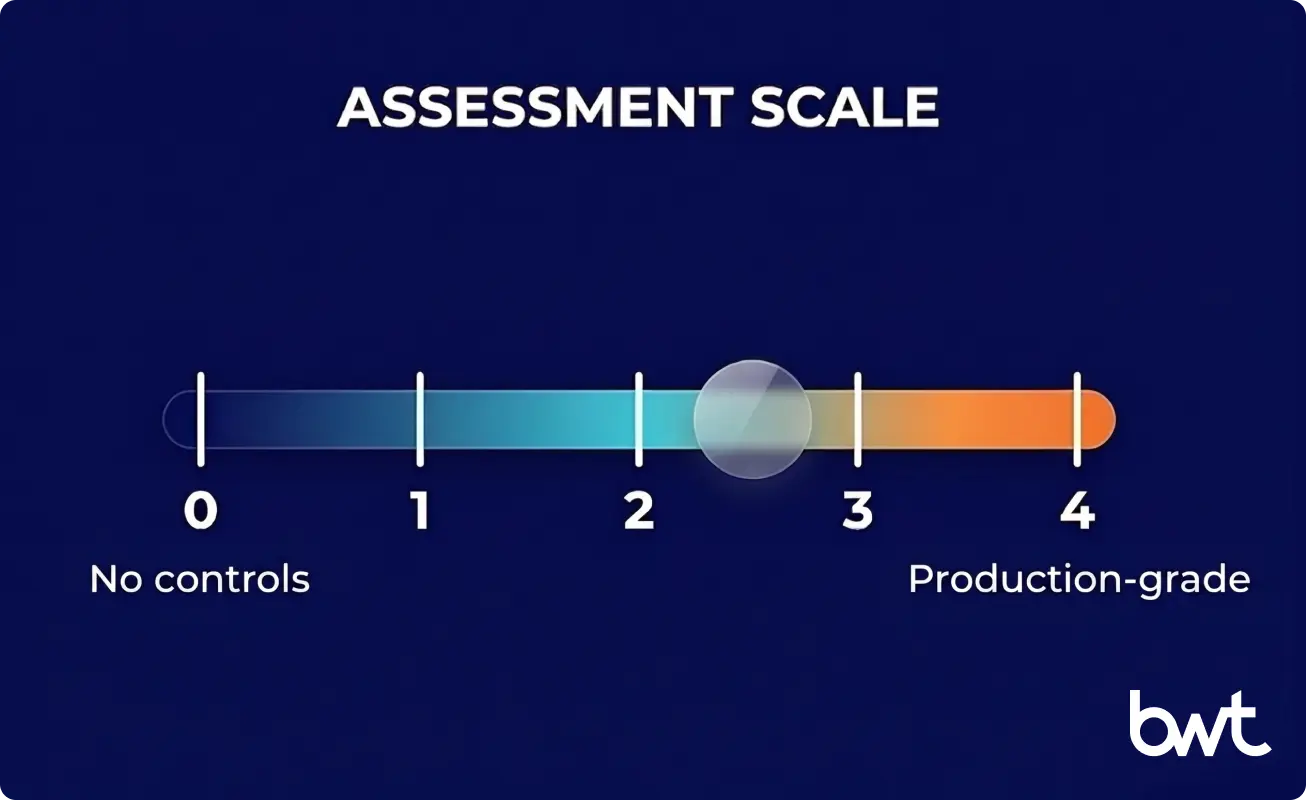
- Score each source on the five pillars on a 0–4 scale, where 0 is “no controls,” and 4 is “production-grade with monitoring.”
- Flag any source scoring below 2 on quality, governance, or labeling. Those are blockers.
- Map the lowest score across the source set. That number is your readiness ceiling.
- Estimate remediation time per blocker, then sequence by impact, not by ease.
- Re-run the score every quarter. Readiness decays.
AWS recommends a 6 to 8 week readiness sprint (AWS, 2025) that covers data evaluation, use cases, technology, governance, and measurement. For one mid-complexity domain, that window is realistic. For a corporate estate with hundreds of source systems and thousands of legacy tables, eight weeks barely scratches the surface — there, plan a phased program: each domain runs its own audit, and the individual scores roll up into one estate-wide view.
One caveat, honestly stated: a rubric only catches what you thought to measure. We have seen a source score 4 on every pillar and still sink a model, because no one questioned the upstream label semantics — and the rubric had no line for that. Treat the score as the start of the conversation, not the whole of it.
Inventory Every Data Source
Most teams find two to three times more sources than they expected. Shadow spreadsheets (the unsanctioned Excel files teams keep on their laptops) count too. So do third-party SaaS exports nobody documents, and the legacy report layer that quietly stops being maintained the day someone retires. The first deliverable of any audit is the source list, not the score.
Score Completeness and Accuracy
Use field-level audits, not row counts. The fiber-coverage example earlier shows why row counts lie: a 98% headline coverage masked a real 0.6% on the field that actually mattered. Pick the three to five fields the model will treat as ground truth, sample 200 records per source, and grade each by hand. That hour of manual work saves a quarter of model rebuilding.
Find Gaps in Schema and Metadata
Hunt for columns that describe the same business thing under different names from source to source — order_dt, created_at, and purchase_date all standing in for the order date. Clean up the column dictionary first; deduplicating rows comes after that. Watch the fields that look numeric but actually encode meaning: status codes, region IDs, version flags. Those are the column models silently mislearned.
Measure Readiness Across Teams
A pillar scoring 4 in engineering and 1 in legal averages 2.5. And 2.5 is not AI-ready. Cross-functional readiness is the floor.
“On every audit, the highest-impact finding is something nobody on the team thinks to check. A field that drifts silently. A join that loses 3% of rows. A label that means two different things on Mondays. Score honestly or don’t score”
— Dmytro Naumenko, CTO at GroupBWT
The Hardest Data Problems Every AI Team Runs Into
Unstructured and fragmented data is the loudest problem. We rebuilt a 12-year-old SQL Server estate for a US agriculture operator into a Databricks lakehouse (a storage layer that gives a model the flexibility of a data lake and the query speed of a warehouse), refactoring 6,000+ tables and 295 Power BI reports into the runway for farm-wide AI.
Inconsistent naming is quieter but more corrosive. A US e-commerce control firm collects 350,000 offers a day across eight Amazon locales, with different ZIP formats, currencies, and page layouts unified into one schema. Skip that step, and the model learns the formatting differences instead of the pricing signal.
Missing labels and thin metadata are where most generative AI projects quietly die. One Canadian healthcare-data provider grew its specialist database from roughly 119,000 records to about 302,000 — and did it by deduplicating without any shared unique ID to lean on. Metadata work was 80% of the effort.
Legacy systems are hardest because the constraints are political. Encrypted views, undocumented column meanings, retiring engineers — none of those live on a Jira board; they live in a budget conversation.
Getting Data Ready for AI: The Operational Workflow
Standardize Across Systems
A global micromobility operator codified what AI-ready means directly in the contract, with explicit Data Integrity vs Data Quality definitions agreed before delivery began. Pre-delivery alignment of that depth is rare.
Clean, Deduplicate, Enrich
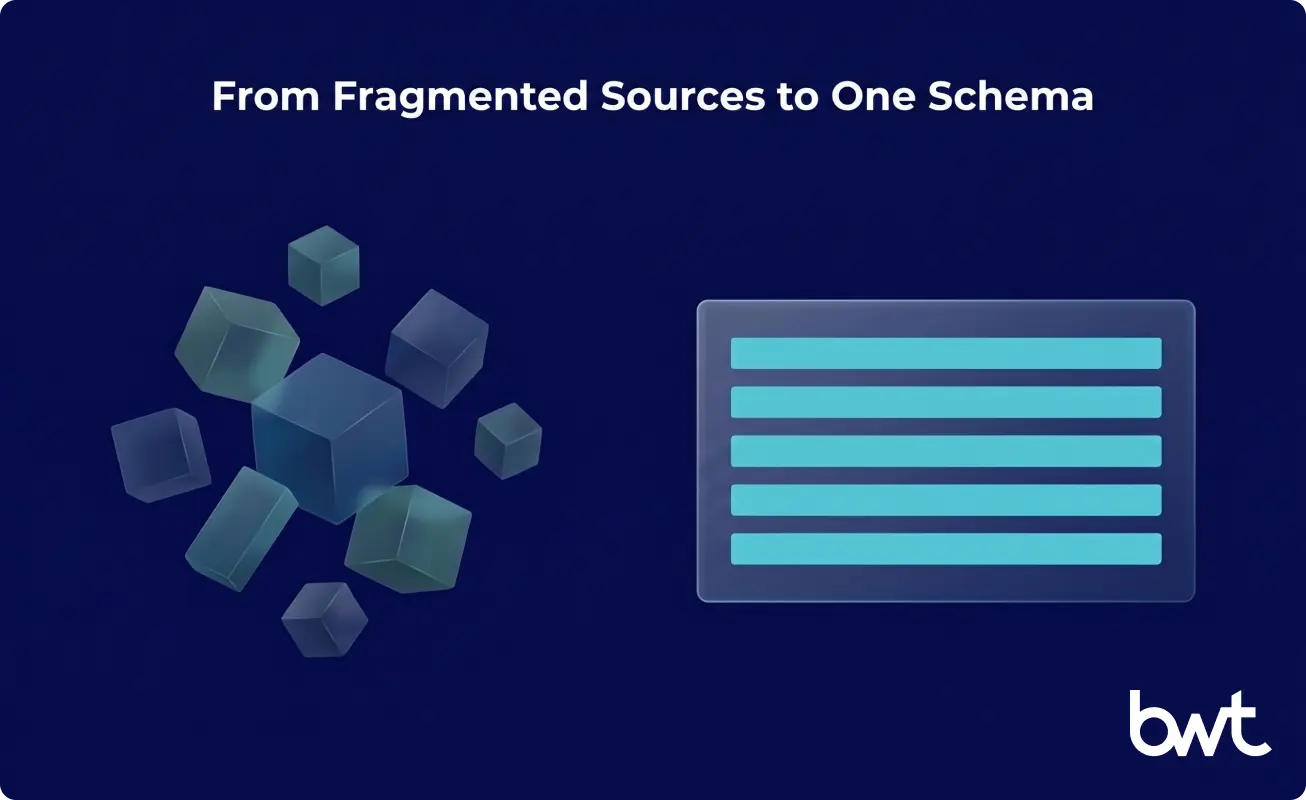
Every client scraper writes its CSV-to-S3 uploads through one shared Python library. Because that standardization lives in a single place rather than being rebuilt per scraper, onboarding a new source takes hours instead of days. Enrichment — joining in external attributes such as firmographics or geocoding — sits on top of the cleaned base, never on the raw input.
Build Pipelines for AI Workloads
A public-sector tender intelligence platform funnels 100+ scrapers into a single warehouse, all using one shared schema across every government portal. Every field carries a tag for its source, its original value, and the trail of every transformation applied to it. That source-tracking is what lets a classification model retrain safely without learning from its own past mistakes. (See our deeper write-up on pipeline patterns for AI workloads.)
Set Governance and Access Rules
For pre-sale demos in regulated industries, we offer synthetic data so the AI workflow can be reviewed before any real record leaves the customer perimeter — which keeps initial reviews short. Governance rules belong in code, not in a Confluence page nobody reads. Make access denial the default, then grant explicit roles per use case.
Prepare for Real-Time and Batch
The same dataset can serve both timings. For a UK hospitality SaaS, we unified three different ways the source sites expose their pricing — a structured API, raw HTML, and pages only reachable through region-specific browsing — into one normalized schema. Each of the three needs its own collection method, and the model can only compare prices across them if the output schema is identical. The hard part, then, is the unification work — not the collection. That single pipeline now takes in 335 million pricing records a month, and the same underlying dataset powers two things at once: an AI dynamic-pricing engine and a live competitor-rate benchmark.
What AI-Ready Data Looks Like by Workload
The dataset shape changes per workload, and so does the readiness bar.
| Workload | Required dataset shape | How fresh it must be | Most common failure |
| ML model training | Labeled, balanced across classes, deduplicated | Days to weeks | Mislabeled minority classes |
| Generative AI and LLMs | Cleaned text with metadata and source tracking | Weeks to months | Training data overlapping the test set; leakage of personally identifiable information (PII) |
| Predictive analytics | Time-aligned, gaps filled in | Hours to days | Look-ahead bias (the model peeking at future rows through a bad join) |
| Recommendation | A matrix of users by items they have touched | Minutes to hours | Cold start (no prior history for new users or items) |
| Fraud detection | Real-time, tamper-evident, signed | Seconds | Drift in patterns outpaces the rules set |
How Each Workload Fails Differently
What that preparation discipline looks like depends on the workload. ML training: audit labeling quality on the minority classes before you train — on the rarest classes, we routinely find 8–15% annotator disagreement, and a model reads that disagreement as noise. With generative AI and LLMs, provenance has to be in place from the first batch; without it, training and evaluation sets quietly overlap, and the redaction pipeline cannot tell which rows hold personal data. Predictive analytics lives or dies on time-aligned joins, since look-ahead bias slips in whenever a join pulls a future field into the present — back-testing on rolling windows catches it before a dashboard does. Recommendation engines need a content-based fallback for cold-start users at launch, then a switch to collaborative filtering once the interaction matrix fills out. And for fraud detection, sign every input that reaches the model in real time, then feed confirmed cases back into retraining within hours rather than weeks.
The arXiv survey Data Readiness for Scientific AI at Scale proposes a useful two-dimensional framing: Data Readiness Levels from raw to AI-ready, mapped to processing stages from ingest to fully partitioned storage. The same idea works in commercial settings.
Data Readiness Is Not AI Readiness
| Data readiness | AI readiness | |
| What it covers | The asset layer: pipelines, schemas, labels | The organization: skills, budget, governance |
| Owned by | Data engineering, data governance | CIO/CTO, AI council |
| Failure mode | Models trained on bad data | Good models built that nobody uses |
Mixing up the two is one of the most common mistakes we see in board decks. Data readiness comes first — it is the precondition. AI readiness is what gets built once that precondition holds. A strategy with no solid data foundation for AI under it does not produce results; it produces unused tools and pilots that stall.
When AI-Ready Is Worth the Spend
It is worth being direct: getting to AI-ready is expensive, and doing it across the whole estate is rarely the right call. Internal dashboards, BI, and low-stakes reporting run perfectly well on analytics-ready data — pushing those to AI-ready is over-engineering. Save AI-ready for the cases where a model’s decisions carry a real cost per error: pricing engines, fraud detection, clinical workflows, and compliance review. The ROI test is blunt. What does one wrong decision cost, and how many decisions will the model make a day? Multiply the two. If the number is small, analytics-ready is enough, and the budget should go somewhere else.
The Tooling Stack Behind AI-Ready Data
The working stack breaks into four categories.
- Data integration: Fivetran, Airbyte, dbt, and Temporal, plus custom Python scrapers for the cases where no off-the-shelf connector exists. Most of these run ETL or ELT — Extract-Transform-Load, or the inverse, Extract-Load-Transform.
- Quality and observability: Great Expectations, Monte Carlo, Metabase alerts, and regular-expression validators, each tuned to its source.
- Storage: Databricks, Snowflake, BigQuery, S3 with Apache Parquet, and lakehouse architectures — plus Snowflake’s streaming layer (Snowpipe Streaming, Dynamic Tables) when freshness has to land inside seconds.
- Metadata and cataloging: Unity Catalog, Collibra, or Atlan — or, for a smaller estate, a disciplined schema repository kept in Git.
For greenfield work, our default is Databricks, dbt, Great Expectations, and Unity Catalog. That is not a verdict against the alternatives — Snowflake, Airflow, Monte Carlo, and Collibra are all sound — it is that we have run these particular four in production for years and know which alert fires first when something breaks. Every one of them carries a cost: Databricks is pricier than self-managed Spark, dbt pushes teams with heavy Python logic into SQL-first transformations, and any validation suite rots quickly once no one maintains it. We avoid no-code ETL tools for AI workloads. They are fine for a CRM-to-spreadsheet job, but the moment a model needs reproducible lineage, they become the bottleneck. Inheriting an existing stack is a different conversation: we rebuild around what is already paid for, unless a specific tool is the actual block.
This default fits enterprise-scale workloads. Smaller teams and SMBs can reach the same five pillars on a much lighter stack — PostgreSQL plus dbt plus a metadata convention kept in Git often covers the first 80% of value. Over-tooling is its own failure mode; the question is the workload, not the brand on the invoice.
Four Engineering Habits Behind Every AI-Ready Dataset
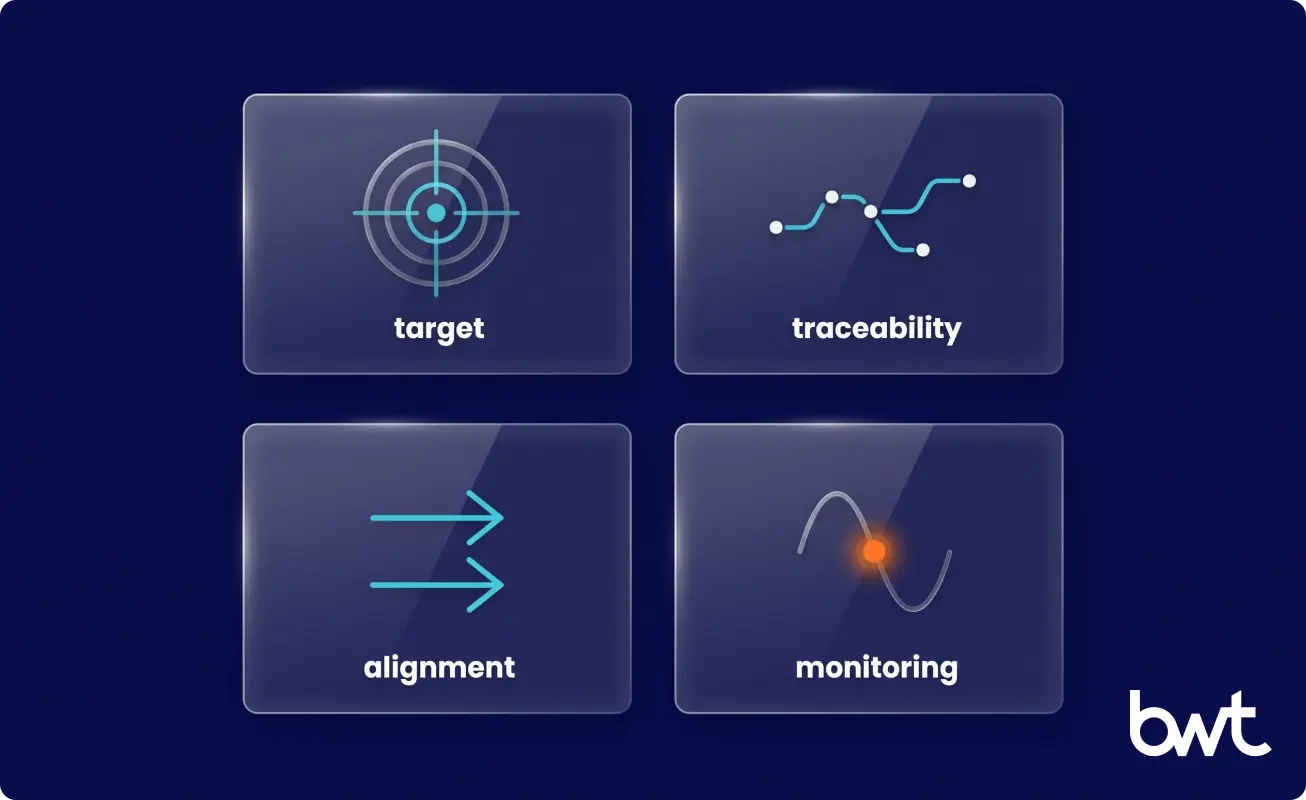
Start with the Use Case, Not the Tool
We have walked into projects where Snowflake was bought before the AI use case was even defined, and Snowflake never solved the actual problem. The use case dictates the freshness window, the labeling burden, and the governance bar; tooling follows.
Design for Traceability
Provenance, the record of where each value came from, is cheap to add at the first batch and expensive to retrofit a year later. Every transformation should be reproducible from the raw source.
Align Engineering with AI Objectives
If the model needs minute-level freshness and the pipeline runs nightly, the model loses. Engineering and AI roadmaps belong in the same planning meeting, not in two parallel decks owned by separate VPs. Ask the AI lead to read the data team’s quarterly objectives out loud; when half the items are unfamiliar, the alignment is theoretical.
Monitor Quality Continuously
The drift you measure is the drift you can fix. Treat monitoring as a real system with an owner and a budget, not an alert thread someone glances at when they remember. Define what “normal” looks like per source, set thresholds, page someone when they break, and review those thresholds every quarter, because normal also drifts.
When to Bring in a Data Engineering Partner
Signs Your Data Is Not There Yet
You probably need outside help if any of these apply.
- Your data lives in a 10+ year-old system nobody documented, and the engineers who built it have moved on.
- You have more than five sources and no canonical layer (a single agreed-on version of each entity, like one definition of “active customer” the whole company shares).
- Your last AI proof-of-concept failed for “data reasons” nobody could pinpoint, and the next round of budget will not survive a second one.
- Your AI team and data team report into different VPs and have separate roadmaps that meet at the steering committee, not before.
- You have already bought a warehouse, a catalog, and an observability tool, and the AI use case is still blocked.
This kind of outside help exists for one reason: the cost of the second failed proof-of-concept is what finally moves the budget.
What a 6–8 Week Readiness Sprint Delivers
The sprint is fixed-scope and fixed-output. By the end, the data leader has the artifacts they need to fund (or defund) the AI use case with confidence.
- Week 1–2. A complete inventory of every source the use case will touch, including the shadow ones. A 0–4 score per pillar per source, run by our engineers, not handed to your team as a survey.
- Week 3–4. A written blocker list with effort estimates per item, sequenced by impact, not by ease. The blockers we can fix inside the sprint, we fix.
- Week 5–6. A reference pipeline running on one domain, with validation and lineage in code, plus the accuracy commitment we use as our delivery standard.
- Week 7–8 (optional). A second domain onboarded against the same standard, or a remediation roadmap for the rest of the estate that your team can execute alone.
What the data leader walks away with: a scored estate, a working pipeline on the priority domain, the rubric to re-run quarterly, and a defensible answer to “is the data ready?” — not a slide deck. Every case in this article is a production system we built, monitor, and still operate; the lead engineers behind those builds are the same people who join your kickoff, not a delivery pool the partner hands the work to after signing.
A direct note on conflict of interest: the same engineers who score the estate would also be the ones offered for remediation, and a reader is right to ask what that incentive does to the audit. The rubric is the same whether we run the remediation or another partner does. You can take the scored estate and the blocker list to anyone — the audit is not gated to our delivery contract. If we are wrong about the priorities, a second pair of engineering eyes will say so, and that is the right outcome for the buyer.
Whatever firm you are evaluating, the signals to look for are the same. They should show you a rubric on the first call. They should name the failure modes before they promise any wins. And the statement of work should carry a written accuracy commitment. Anyone who skips those is selling consulting hours, not data engineering.
“The right partner takes a day to tell you what is broken and a week to tell you what you cannot fix without rebuilding. The wrong one books a quarter and presents a roadmap. We have inherited too many of the second kind”
— Oleg Boyko, CCO at GroupBWT
Where to Start
The hardest part of data readiness for AI is rarely the engineering. It is the political conversation about what the team will stop doing to make room for it. The Director of Data, quoted at the top of this article, wanted his team to focus on 20% data prep and 80% real data science. Eighteen months in, he is closer to 30/70. Progress is measurable; the destination is not.
Pick one AI use case and one data domain. Run the 0–4 audit on it this week. Score honestly. Sequence the blockers. The score will probably embarrass you the first time, and that is the point. If the lowest pillar lands at 2 or below, the model is not your bottleneck — the data underneath it is, and the next quarter is data engineering work, not data science.
If you want a second pair of eyes on the score, book the one-hour readiness call. We will run the rubric on one of your sources live, name the top three blockers, and tell you whether the AI use case is six weeks away or six quarters away — no deck, no discovery sales process.
Probably not, at least not for every use case. Most teams have data that is analytics-ready, which is a lower bar. AI-ready means deduplicated, labeled, traceable, refreshed inside the model’s freshness window, and governed for the workload. Score yourself on the five pillars and find the lowest one. That number is your starting line, not your finish.
Inventory the sources, score them on a 0–4 rubric across quality, accessibility, structure, governance, and scalability, then sequence remediation by impact. The work itself is engineering: standardize schemas, deduplicate records and track where each came from, build pipelines that fit the workload, add monitoring and alerts. Plan 6 to 8 weeks of focused sprint work for one domain, longer for cross-functional teams.
Score every source on a 0–4 scale across the five pillars, then take the minimum, not the average. The minimum reflects the bottleneck the model will hit. Field-level audits beat row counts. Re-score every quarter because data drifts.
Models memorize the data they are given, including their mistakes. A 2% mislabel rate in training data becomes a 2% confidence ceiling in production, and you will never know which 2%. That is why getting your dataset right is the highest-impact investment in the entire AI stack.
Analytics-ready data answers one defined question for one human. AI-ready data trains, fine-tunes, or grounds a model that will make many decisions you do not review. The bar is higher on labeling discipline, freshness, provenance, and bias controls. The mental shift is from “is this number correct?” to “is the distribution we are training on representative of what we will see in production?” Different question, different stack. In practice, a team coming in with analytics-ready pipelines should plan six to eight weeks of remediation per domain before AI workloads can run on top of them safely.
Read summarized version with
Data Engineering: From Raw Web to Data Product
We develop and manage custom data solutions, powered by proven experts, to ensure the fastest delivery of structured data from sources of any size and complexity.
We offer:
- Custom Web Scraping & Development
- 15+ Years of Engineering Expertise
- AI-Driven Data Processing & Enrichment