Read summarized version with


Open five vendor guides on data analytics outsourcing. Most still start with payroll math: shave 30 to 50 percent off the analytics talent bill. It reads well. It also compares your fully loaded internal cost to a vendor’s raw rate and ignores the half of the engagement that actually decides it, which is the data foundation under your dashboards. The projects we were called in to rescue had all broken one layer down. Rarely in the dashboard. Down in the pipelines, in the silent exceptions nobody caught until a board report came out wrong.
So this guide starts there. When to outsource data analytics, what to hand off, how to pick the team and model, what really drives the cost, and the risks the other guides leave out. GroupBWT has been building data platforms since 2009 across manufacturing, retail, travel, telecom, and pharma. The patterns below come out of that work, not a survey.
Data Engineering: From Raw Web to
We develop and manage custom data solutions, powered by proven experts, to ensure the fastest delivery of structured data from sources of any size and complexity. We offer:
- Custom Web Scraping & Development
- 15+ Years of Engineering Expertise
- AI-Driven Data Processing & Enrichment
Key Takeaways
- Outsourced analytics breaks fast when the warehouse, pipelines, or KPI definitions are shaky. Fix the foundation first.
- Data maturity, scope clarity, and what you want to own at the end pick the model — not the other way around.
- Staff augmentation buys you capacity. Managed services hand off the operational responsibility itself.
- Strategy, business-critical logic, and data ownership usually stay in-house.
- Cost tracks team composition, source complexity, platform, support, and security requirements.
- Knowledge transfer, access control, SLAs, and exit terms belong in the contract before delivery starts.
- A parallel run reduces the risk of replacing trusted reports with inconsistent numbers.
Why Companies Outsource Data Analytics
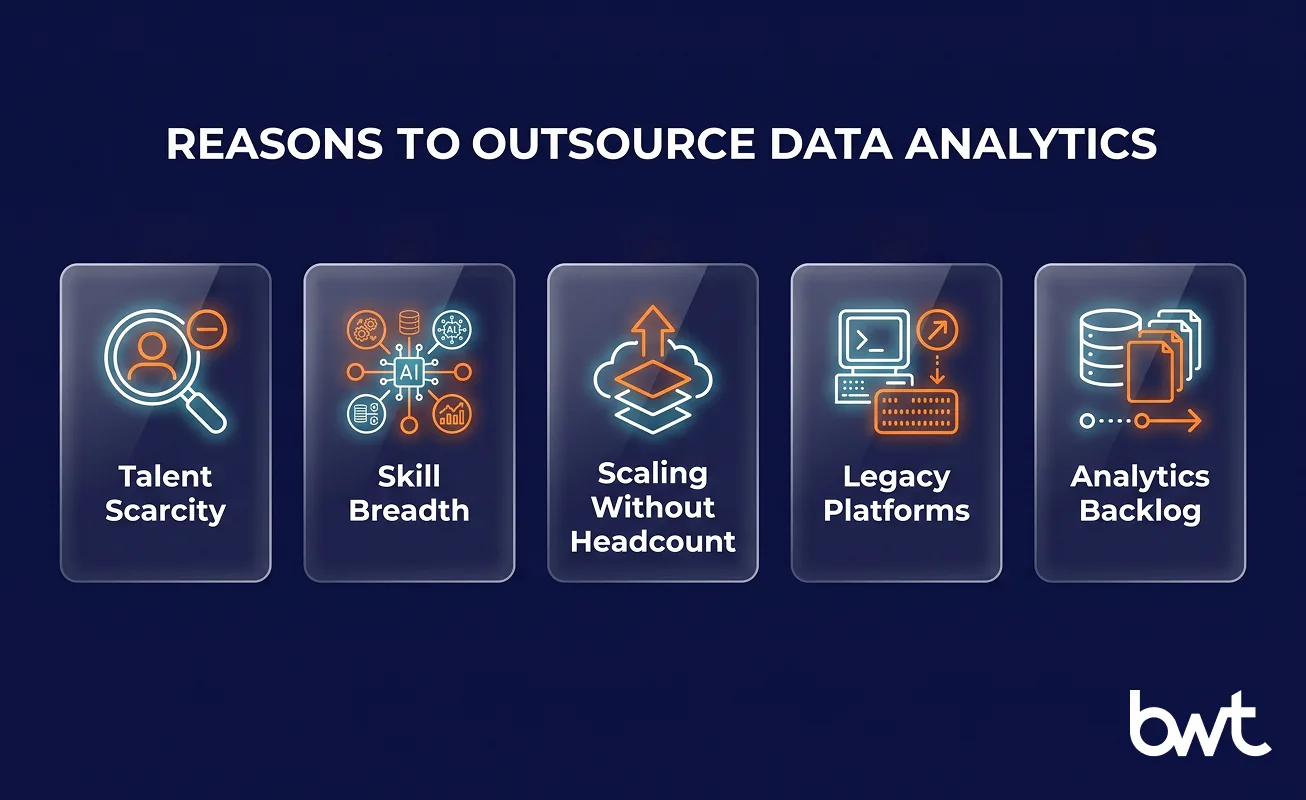
The CTO usually hears the call to outsource data analytics after the reporting backlog has already hurt a planning cycle. The triggers rarely arrive one at a time. A hiring freeze, a stalled dashboard, and the one engineer who knows the warehouse giving two weeks’ notice — those tend to land in the same quarter.
- Talent scarcity. The U.S. Bureau of Labor Statistics forecasts 34% growth in data-scientist jobs from 2024 to 2034 — roughly 23,400 openings a year, and that’s just the one title (BLS). That is the market you are recruiting into. Outsourcing skips the search, not the skill.
- Skill breadth. A modern stack wants a model layer, a semantic layer, an orchestrator, and AI-readiness all at once. One hire covers maybe two of those. A partner team already carries the set.
- Scaling without headcount. Adding seats to a delivery team is faster than opening requisitions, and you scale back down when the project ends.
- Legacy platforms and bus factor. Much enterprise analytics runs on an undocumented warehouse held together by one person weeks from a new job.
- Analytics backlog. The dashboard and churn model that should have shipped last year are a capacity ceiling, not a planning failure.
What Data Analytics Services Can Be Outsourced?
Almost all of it moves, but not all of it is engineering. The foundation still matters because a KPI is only as trustworthy as the source feeding it. But the buyer is usually outsourcing for the decisions on top: where margin is slipping, which inventory risk is building, why forecast accuracy dropped, and what finance needs before the next board pack.
Start below the dashboard:
- Collection and integration from ERPs, CRMs, SaaS tools, and external signals. This is the layer that often breaks first, usually without noise.
- Data engineering and pipelines that turn raw ingestion into tables the business can trust. The data engineering layer is where the program either holds or cracks.
- Warehouse and lakehouse builds on Snowflake, Databricks, BigQuery, or Redshift, with the modeled layer your analysts query every morning.
- Data quality and data governance. Contracts, validation, lineage, monitoring. MIT Sloan puts the cost of bad data at 15% to 25% of revenue, two-thirds of it removable (MIT Sloan).
Then the analytics layer, where the work should sound less like a platform build and more like operating the business:
- Analytics roadmap and KPI design. The partner turns business goals into a ranked analytics backlog: faster reporting for finance, margin visibility for leadership, inventory risk for operations, and forecast accuracy for planning.
- Business analysis and decision support. Analysts trace where a number will be used before they model it, so the dashboard answers a real decision instead of becoming another report nobody opens.
- Business intelligence and executive reporting. Outsourced business intelligence services reach from semantic modeling up to the board-level views of revenue, margin, and inventory a CEO checks on a Monday morning.
- Forecasting, experimentation, and predictive analytics. Demand forecasts and inventory forecasts. Pricing tests. Procurement tests. Anomaly detection. And the adoption work that makes planning teams trust the forecast rather than exporting it back to spreadsheets.
- Self-service models and CoE guardrails. Give your analysts the models and documentation once, so a filter change does not turn into another vendor ticket.
Best Outsourcing Solutions for Data Analytics
The best outsourcing solutions for data analytics match the engagement shape to the problem in front of you. In practice, five models cover a wide range of cases. Three things decide which one: how mature your data is, how well-defined the project is, and what you want to still own the day it ends.
- Project-based. Fixed scope at a fixed price: a warehouse, a migration, a dashboard set. Works when the scope is genuinely understood. Fails the moment the scope turns out to have been a guess.
- Dedicated team. A multi-role team billed monthly, with a lead reporting into your data leadership. Often the right shape for multi-quarter builds, though not always the cheapest one.
- Staff augmentation. Individual engineers placed inside your team. Lower per-seat spend, and it works only when your team has the seniority to direct them. If internal seniority is thin, the math flips and dedicated team often lands cheaper.
- Managed services. The vendor owns outcomes, not hours: SLAs, on-call, cost targets. Best when the internal team is small or absent.
- Hybrid. Internal owns strategy and the business-sensitive logic; the partner owns delivery velocity. Often the long-term shape once the program is past the first year.
Which one fits depends mostly on where your data sits today. A company running the business off spreadsheets has a different first move than one already forecasting demand on a live warehouse. Match your stage to what to hand off first, and the model tends to pick itself.
| Where you are | What to hand off first | Model that fits |
| Running on spreadsheets, no warehouse | First reporting model, source cleanup, and the warehouse behind it | Project-based |
| BI live but reports drift, no governed source | KPI definitions, reporting ownership, and the data contracts behind them | Project or dedicated team |
| Warehouse in place, analytics demand outgrowing the team | Analytics roadmap, executive reporting, forecasting, and adoption | Dedicated team |
| Mature stack, pushing into AI and prediction | Forecasting models, experimentation, analytics CoE, and day-two operations | Managed service or hybrid |
| One capability missing, seniority in-house to direct it | A single specialist seat | Staff augmentation |
Advantages of Outsourcing Data Analytics
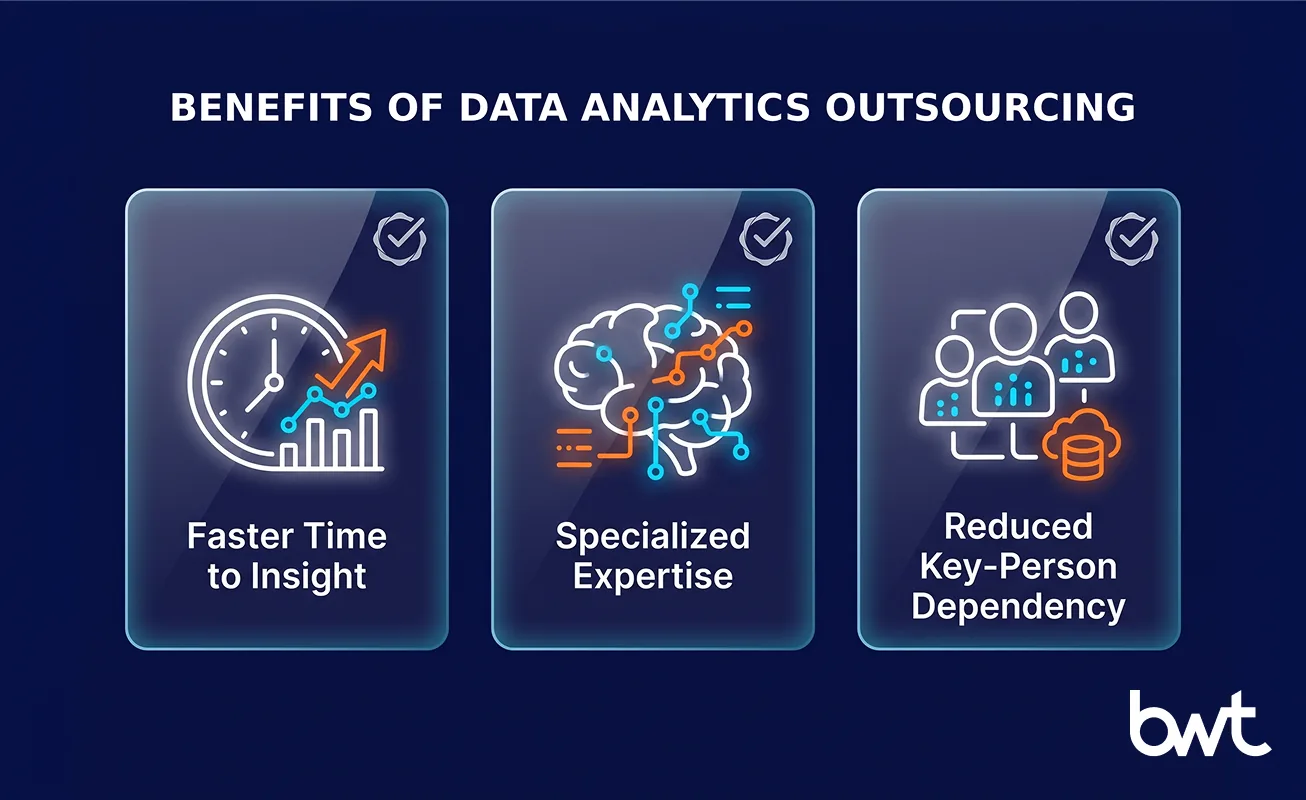
Three advantages carry most engagements, and each one has a trade-off worth naming up front.
- Faster time to insight. A delivery team is past the learning curve a first hire would spend a quarter climbing. The first dashboard ships in weeks. Trade-off: speed is real, but you inherit the team’s assumptions about your data until they learn your business.
- Specialized expertise. A partner team carries the modeling, dbt, and data-quality seats in parallel; one hire rarely covers all three. Trade-off: shared expertise is real, but you still need one internal translator who owns the roadmap and the decisions.
- Reduced key-person dependency. A documented team plus enforceable data-quality controls replaces the single seat that holds the whole warehouse. Trade-off: dependency risk falls, but only if documentation and ownership transfers are written into the contract from day one.
Outsource Data and Analytics Teams: Which Roles Do You Need?
When you outsource data and analytics teams, the role you skip becomes the single point of failure six months in. Staff the full set below, not just the visible ones.
| Role | What it owns | Skip it and… |
| Data engineer | Pipelines, ingestion, transformation | Nothing else ships |
| Analytics engineer | The modeled layer, dbt models, data contracts | Reports drift from the source |
| BI developer | Dashboards, self-serve, adoption | The business can’t read the data |
| Data architect | Platform direction, governance posture | The build has no north star |
| ML engineer / data scientist | Predictive models in production | AI stays a pilot |
| Delivery lead / data product owner | Roadmap, scope, stakeholders | The team builds the wrong thing |
The delivery lead is the role engagements try hardest to cut, and regret first.
How to Evaluate and Assemble an Outsourced Analytics Team
There is no single best way to hire a dedicated outsourced data analytics team. One reliable approach is less dramatic: spend the first two weeks setting scope, then move fast once the roles are clear.
- Define the business decisions the program must answer in the next two quarters.
- Audit existing sources and architecture. A two-week audit surfaces what skipping it surfaces in month three.
- Identify roles and seniority. Discovery needs a senior engineer and an architect; a build needs four to eight.
- Weigh vertical experience over vendor logos. A team that has shipped a pharma warehouse delivers a regulated engagement faster.
- Run a paid discovery, and treat a vendor’s refusal to run one as a warning sign, especially when the architecture or source landscape is not yet understood.
- Pin down ownership, SLAs, and metrics before anyone starts. Add seats only after the first deliverable proves the setup works.
What Determines the Cost of Outsourcing Data Analytics?
There is no honest single rate, but there is an honest way to bracket it. The variables below move the number, and the list is short enough to hold a vendor to. Quote a flat rate without naming these, and you are guessing.
As a rough ordering, a paid discovery is the smallest line, a fixed cost measured in weeks. Staff augmentation is the lowest ongoing entry point, since you pay for one or two seats. A dedicated multi-role team billed monthly is the largest recurring line, and a managed service lands near it once day-two operations are folded in.
| Buying situation | Cost shape | Why it moves |
| Need a diagnosis before committing | Low fixed discovery | One senior engineer and one architect test the sources, decisions, and risks before the build starts. |
| Need one missing expert | Lower monthly spend | Staff augmentation adds one specialist, but your team still owns direction and review. |
| Need a new analytics capability | Higher recurring spend | A dedicated team carries roadmap, reporting, modeling, and delivery roles together. |
| Need the function operated after launch | Highest ongoing commitment | Managed service includes monitoring, on-call, change requests, cost control, and adoption support. |
Where you sit inside each band comes down to the variables that follow.
- Team size and seniority. A senior engineer costs two to three times a mid-level one, and out-delivers by more than that gap. The cheapest team is rarely the cheapest engagement.
- Data complexity and source count. Ten clean sources is one project. Forty sources with undocumented APIs and three legacy ERPs behind them is another one entirely.
- Cloud platform. Snowflake, Databricks, BigQuery, and Redshift tend to punish different mistakes: compute burn, storage-tier creep, idle clusters, or egress fees that did not make it into the budget. The exact mix depends on workload shape.
- Pricing model. Project pricing shifts scope risk to the vendor; dedicated pricing shifts it to the client.
- Day-two operations. Support, monitoring, and maintenance typically run 20% to 35% of build cost.
- Hidden costs. Internal stakeholder time, source access, and security reviews land on the client’s books, not the vendor’s invoice.
On return, the math shifts depending on the gap you are closing. A partner team tends to be productive inside the first month. A senior hire usually needs three to nine months to reach the same point on a new environment. The firms that get their data house in order pull away from the ones that don’t — and the gap is documented. The same gap shows up outside our work. In a 2023 study with HBR Analytic Services, Google Cloud reported 81% efficiency gains for data-and-AI leaders versus 58% for peers; revenue growth was 77% versus 61%.
In-House vs Outsourced Data Analytics: Which Model Fits?
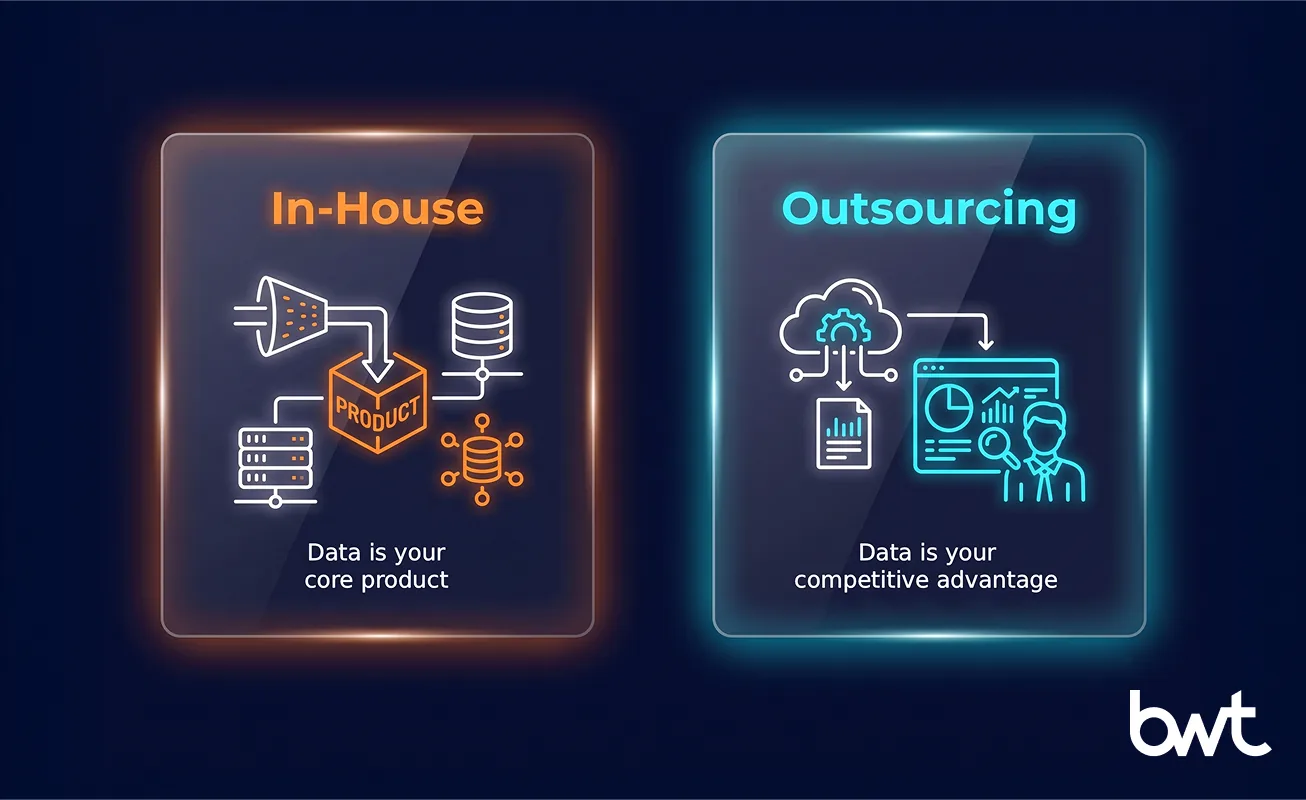
Rarely is the honest answer all-in or all-out. When data is the product you sell, build in-house — no partner’s marginal speed returns the product context you would be handing over. When data is instead a capability that feeds decisions across the business, outsourcing wins on speed and on breadth of skill.
There are cases where outsourcing is the wrong call, and a good partner will say so before you sign. If analytics is your core IP, and the models themselves are what customers pay for, keep that work close. If you already run mature data leadership and a staffed team, and the gap is workload rather than capability, a couple of internal hires often land cheaper than a vendor. The line shifts when the internal team lacks seniority to direct them, which is exactly the case staff augmentation is built for. And if regulation or a contract forbids external access to the data at all, the question answers itself. A partner who names these before you do is worth more than one who doesn’t.
Ownership changes the odds. Deloitte‘s 2025 work on digital operating models found that firms with one clear owner for data and analytics reach expected value more often than firms where the function sits inside another executive remit. The outsourcing evidence points the same way: a 2022 Journal of Business Research meta-analysis found a positive performance link, strongest when the work sits away from the company’s core (Lahiri et al.). For most buyers, that leaves one boundary: strategy, data ownership, and business-critical logic stay inside; selected engineering and operations move to the partner.
How to Choose a Partner and Avoid the Common Risks
Certifications and location tell you less than a few concrete signals do. Look for production data engineering experience, not a portfolio of dashboards. Look for your exact stack too: a team that has already built four Snowflake warehouses delivers the fifth in half the time. Then ask for a real migration, with its sources and its cutover, and ask whether they measure outcomes or hours.
Most engagements that fail, fail on risks you could have named up front. The most expensive one is building dashboards before the data foundation underneath them is fixed. Each risk below closes the moment its control goes into the contract.
| Risk | Early warning sign | Contract or delivery control |
| Vendor lock-in | Proprietary models and undocumented logic | Client-owned repositories and exportable artifacts |
| Knowledge loss | One person owns critical logic | Continuous documentation and paired handover |
| Weak data security | Broad production access | Least privilege, audit logs, environment isolation |
| Misaligned KPIs | Vendor measures tasks, not outcomes | Named business metrics and acceptance criteria |
| Hidden costs | Quote excludes support and internal time | Three-year TCO and explicit exclusions |
| Poor data quality | Dashboards built before source validation | Quality gates and parallel reconciliation |
| Unclear ownership | No named owner after launch | RACI and operating model in the contract |
“The first question is always whether the underlying data can be trusted. If the answer is no, no dashboard, no model, and no AI feature will save the project. We have walked into more engagements that failed for that reason than for any other”
— Alex Yudin, Head of Data Engineering at GroupBWT

Example Eight-Week Analytics Outsourcing Transition Plan
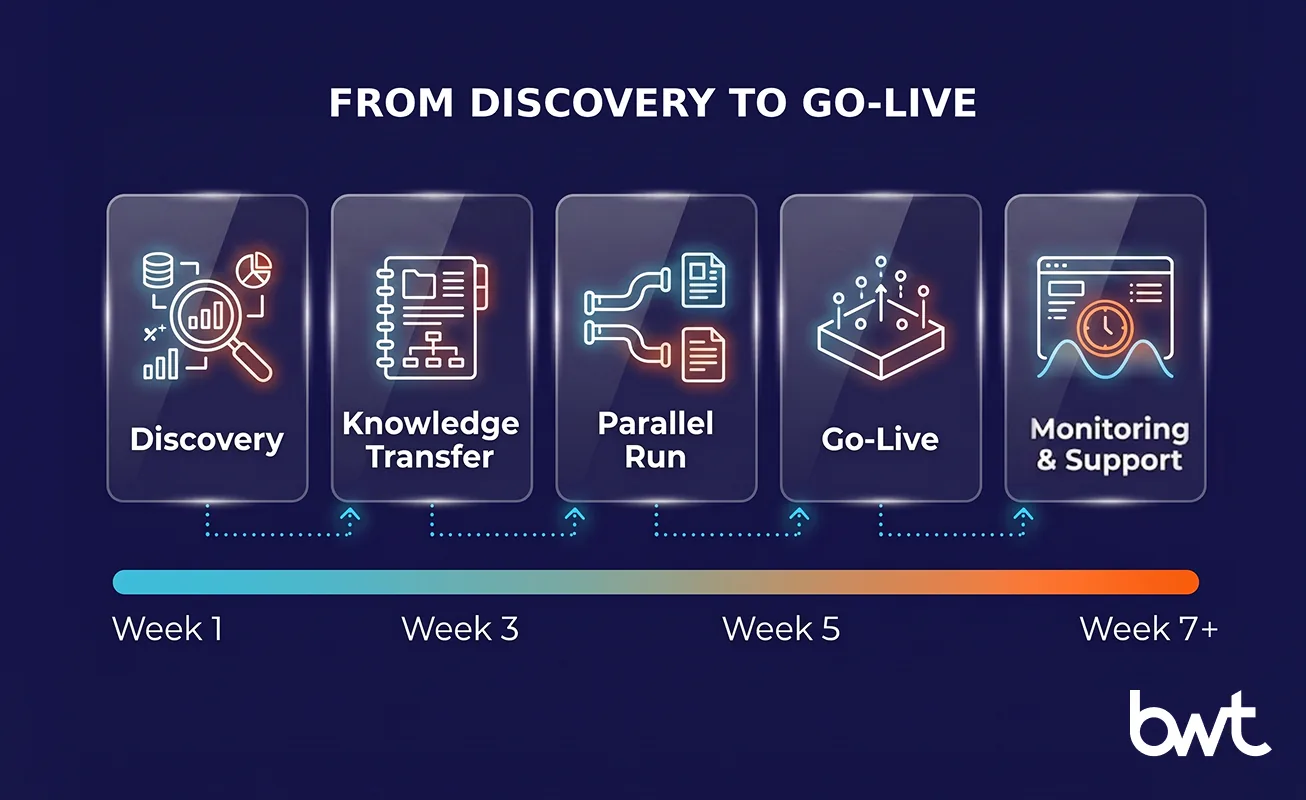
Most of the anxiety about outsourcing lives in the switch itself — and that is the part the sales page skips. Done right, onboarding is a schedule, not a leap of faith. Treat the eight-week shape below as illustrative, not a fixed term:
- Week 1, discovery. The partner maps sources, current reports, owners, and the decisions the business is waiting on: revenue leakage, margin variance, stockouts, forecast misses, finance close delays. No delivery yet.
- Week 3, knowledge transfer. Undocumented logic gets written down, access is granted under real controls, and the outgoing owner’s knowledge moves into a place the team can keep.
- Week 5, parallel run. Keep the new pipelines beside the old reports until revenue, inventory, margin, and forecast numbers reconcile. This is where silent exceptions surface before the board pack does.
- Week 7, go-live. The business reads its numbers off the new foundation, and the old path is retired once finance and operations agree the outputs are usable.
- After go-live. Monitoring, on-call, adoption, and change requests stop being project work and become the weekly operating rhythm. Platform ownership follows the name written in the contract.
Actual duration depends on source count, documentation quality, security approvals, report criticality, and whether the old and new environments must run in parallel for a full reporting cycle. The sequence generally holds even as the timing moves. Skip the parallel run to save two weeks and you buy a board report that disagrees with last quarter’s.
How to Measure Analytics Outsourcing Success
A signed contract only starts the work. Before the first sprint, pick the few numbers that will tell you whether the engagement is earning its keep.
| Success signal | How to read it |
| Time to first production deliverable | How fast the team turns access into something the business can use |
| Analytics backlog reduction | Whether the capacity ceiling that triggered the engagement is actually lifting |
| Data freshness and pipeline SLA compliance | Whether numbers arrive on time and pipelines hold under load |
| Dashboard adoption | Whether decision-makers use the outputs or export back to spreadsheets |
| Data quality incident rate | How often the business finds an error before the pipeline does |
| Forecast accuracy | Whether predictive work is trusted enough to plan against |
| Mean time to detect and resolve failures | How quickly a broken number gets caught and fixed |
| Cost per pipeline or analytics product | Whether spend tracks delivered value, not headcount |
| Knowledge transfer and documentation coverage | Whether the client could run the platform if the vendor left tomorrow |
| Stakeholder satisfaction | Whether finance, operations, and leadership trust what they receive |
Named metrics also double as your exit insurance: a team measured on documentation coverage and adoption leaves a platform the client can own, not a dependency.
Why Companies Choose GroupBWT for Data Analytics Outsourcing
GroupBWT has built data platforms since 2009: more than a hundred projects, 140+ production data systems, clients from Fortune 500 to growth stage. Every engagement starts with the data layer, because the cost of a wrong number is higher than the cost of a slower project.
One recent client, one of the largest potato growers in the US, came to us with a twelve-year, undocumented SQL Server warehouse whose only expert engineer had resigned with two weeks’ notice, and 260+ Power BI artifacts of unknown status. By auditing all 18 sources and mapping a Medallion architecture (a staged raw-to-clean-to-business layout that quarantines bad data before it reaches a report) with a validation layer, the GroupBWT team delivered a full migration roadmap in three weeks, sorted the artifacts to the 155 in scope, and replaced reactive exception emails with proactive checks. Our data warehouse services center on this kind of migration.
For a multinational pharmaceutical company, the GroupBWT team mapped 22 source schemas from seven disconnected clinical and safety pipelines into one governed layer with field-level access controls, cutting regulatory reporting time roughly 77%, from 18.2 days to 4.1, and making safety queries five times faster. Senior ETL consulting teams do this work daily.
Our data analytics services run the full span: analytics roadmap, KPI design, executive reporting, forecasting, BI adoption, and the data foundation under it. Hand that to one team and the hand-off risk goes away. When you outsource data & analytics work this way, the people shaping the business outcome also know where the number came from.
"Our hardest failures were never technical. They were about ownership: who owns the warehouse after the vendor leaves, who owns the data contract, who owns the on-call rotation. Get ownership right at the contract stage and most of the risk disappears." — Oleg Boyko, COO at GroupBWT
"The right engagement shape depends on what you want to own when it ends. Want to own the platform? Build with a partner who hands you the artifacts. Want to own the outcomes? Hire one who owns the operations." — Dmytro Naumenko, CTO at GroupBWT
Also Read: Data Analytics for Startups — From Zero to Scalable in 2026
Final Thoughts
Cost per head is rarely what the decision to outsource data analytics turns on. What matters is whether the program can deliver the business outcomes the company needs: faster reporting for finance, cleaner margin views for leadership, better inventory decisions for operations, and forecasts the planning team will actually use. The real question is not "can we afford to outsource" but "what does the program need that we don’t yet have, and what is the fastest way to get it."
The next step is a paid discovery that names the data-foundation risks in your environment and the team shape your program needs. Talk to a GroupBWT data and analytics lead.
Fit decides it. Here, “best” means fit: the partner can work at your data maturity, use the stack you already run, and leave behind the pieces your team wants to own. If your first cloud warehouse is still ahead of you, ask for proof they have shipped that platform before — and that every artifact will stay with your team. Price follows that fit. It does not lead.
Start with the decisions the program has to support, then work backward. Inventory the data you already hold. Name the roles that close the gap between those sources and those decisions. Give two or three vendors the same paid-discovery brief, two to four weeks each, and choose the one that finds the data-foundation risks the others walked past.
There is no single rate. What you pay tracks team size and seniority, how messy your sources are, the cloud platform, the pricing model, and day-two operations, which alone add 20% to 35% on top of build cost. Any flat quote that skips these variables is a guess dressed as a number.
Choose an outsourced model when speed and specialized skill matter more than owning every seat, or when hiring cannot keep pace with the roadmap. One exception: when data is the product you sell, keep it home. In practice, most companies getting data analytics outsourced for the first time land on a hybrid: internal strategy, outsourced delivery. It holds up.
Yes. It is often the long-term shape once the engagement is past its first renewal. The internal team keeps strategy and the business-sensitive logic; the partner takes delivery velocity and the on-call rotation. Write that boundary into the contract, and it stays a division of labor instead of turning into friction six months on.
Read summarized version with
Data Engineering: From Raw Web to
We develop and manage custom data solutions, powered by proven experts, to ensure the fastest delivery of structured data from sources of any size and complexity. We offer:
- Custom Web Scraping & Development
- 15+ Years of Engineering Expertise
- AI-Driven Data Processing & Enrichment