Read summarized version with


The public 2026 guides from Leanware, Alice Labs, and Nicklpass tell a consistent early-stage story. A bounded diagnostic, assessment, or strategy engagement costs tens of thousands of dollars. Alice Labs and Nicklpass extend that ladder. Their published proof-of-concept band is about $50,000-$150,000; production implementation starts near $150,000 and may top $500,000.
How Much Does AI Consulting Cost in 2026?
These are directional market ranges, not our rates. How much do AI consulting services cost? Expect roughly $5,000-$25,000 for readiness and $15,000-$100,000 for strategy. A proof of concept moves into the $50,000-$150,000 band. Production implementation begins around $150,000 and can pass $500,000. Enterprise programs can exceed that. The actual budget depends on delivery stage, data and integrations, team, controls, acceptance criteria, and post-launch ownership.
Use the ranges to decide which stage needs funding, not to predict a final proposal from one number. A readiness engagement identifies constraints. Strategy sets priorities and sequencing. A proof of concept tests one bounded workflow. Production pays for the integrations, access controls, evaluation, monitoring, recovery, and operating responsibility needed to keep that workflow useful after launch.
Build the Data FoundationYour AI Models Need
We develop and manage custom data solutions, powered by proven experts, to ensure the fastest delivery of structured data from sources of any size and complexity.
We offer:
- Custom Web Scraping & Development
- 15+ Years of Engineering Expertise
- AI-Driven Data Processing & Enrichment
Define what the engagement must prove before choosing a contract structure. GroupBWT’s AI consulting services from strategy through implementation cover strategy, architecture, and system delivery. Each proposal states the deliverables, exclusions, and implementation work that would follow.
AI Consulting Costs Make Sense Only Beside a Defined Outcome
A rate card cannot tell you whether an estimate is sensible. An expensive specialist may settle one architecture question faster than a cheaper team working without clear scope. A production system usually needs several disciplines, so one consultant can become a delivery bottleneck.
Market benchmarks need visible boundaries
The ranges below are directional references, not an independent survey or a GroupBWT fee schedule.
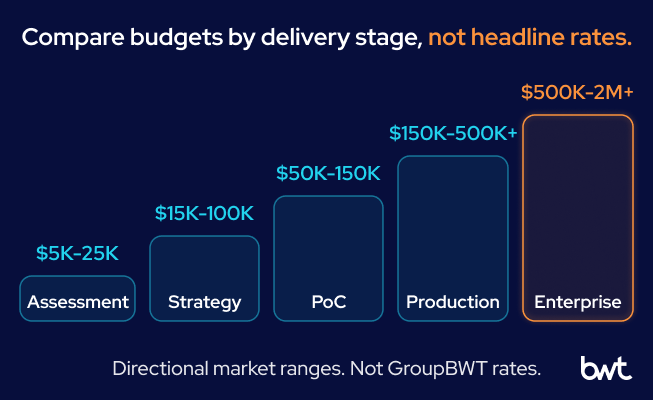
Sources: Readiness and diagnostic ranges draw on Leanware and Alice Labs. Strategy ranges draw on Leanware, Alice Labs, and Nicklpass. Alice Labs and Nicklpass support the proof-of-concept and production bands, while Nicklpass publishes the enterprise-program range.
The providers define scope differently. Match deliverables, timing, team, assumptions, controls, exclusions, acceptance criteria, and post-launch duties before comparing ranges.
AI Consultant Hourly Rates Need Delivery Context
Public rate cards are useful only when the work behind them is comparable. Across the reviewed guides, independent specialists are commonly placed around $150-$350 per hour and boutique specialists around $250-$500. Published rates for larger strategy and consulting firms vary more widely, reaching $500-$1,000+ per hour at senior levels in some benchmarks. Leanware publishes a lower band for Big Four and strategy firms, while Nicklpass places senior AI experts around $200-$450+ per hour.
| Delivery type | Directional market reference | What to verify |
| Independent specialist | $150-$350/hour | Scope, seniority, individual capacity, and operating responsibility |
| Boutique consultancy | About $250-$500/hour | Named team, blended rate, and which roles actually deliver |
| Large strategy or consulting firm | About $350-$1,000+/hour depending on firm tier and seniority | Partner time versus delivery-team time and subcontracting |
These are market references, not GroupBWT rates. How much does an AI consultant cost? Who does the work matters. So do their seniority and location, the surrounding team, the delivery model, and who accepts the result. Use the AI consultant cost to control time-and-materials work, not to forecast the complete project budget.
A prototype and a production system are different purchases
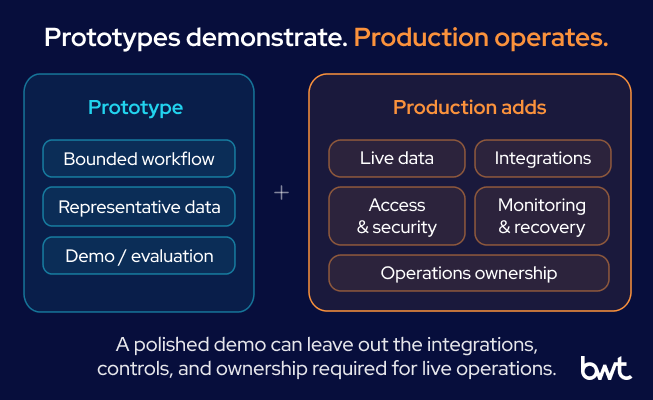
The cost of AI consulting services rises when advice becomes a working prototype, then rises again when that prototype must operate inside the business. Each step adds work that a polished demonstration can hide.
A published AI executive dashboard prototype case makes the boundary concrete. GroupBWT delivered three high-fidelity views and a hosted demo in seven working days for a consulting pre-sale. The displayed states defined product behavior, while the production path was documented separately.
The production side is visible in the AI credit analyst agents for SMB loan underwriting. We connected five agents to the lender’s loan-origination and document-processing systems, added policy checks, surfaced reasoning for analyst review, and kept the final credit decision with a person. Integration, exceptions, policy checks, and analyst review made this a different commercial product from a demo.
How AI Architecture Changes Consulting Cost
The delivery stage sets the broad budget band. The architecture determines which extra workstreams enter it.
| AI pattern | Additional cost drivers |
| Classical ML | Labels, feature engineering, validation, and retraining |
| GenAI | Evaluation, model selection, guardrails, and variable inference use |
| RAG | Source preparation, retrieval design, permissions, and retrieval evaluation |
| Agents | Tool integrations, permissions, retries, action evaluation, and orchestration |
| Computer vision | Image or video labeling, model validation, and edge hardware where required |
| Fine-tuning | Training data, compute, evaluation, and model lifecycle management |
"You can compress what people see in a demo. You cannot compress the controls that make production trustworthy. If the estimate leaves out access, monitoring, recovery, or ownership, expect that work to return on a later invoice."
— Dmytro Naumenko, CTO at GroupBWT
AI Consulting Pricing Models Allocate Uncertainty Differently
AI consulting pricing determines who carries the budget risk when requirements, data, or integrations differ from the proposal.
Time and materials works when learning is still part of the job
Hourly or daily billing fits architecture reviews, technical due diligence, and early work that cannot yet be defined reliably. It gives the client flexibility but increases budget variance. Longer time-and-materials work needs a ceiling, either in time or money. Name the roles and watch the burn. Once the ceiling is reached, make an explicit choice: stop, re-scope, or continue.
Fixed price works for a stable output
A fixed fee works when inputs, deliverables, review rounds, dependencies, and acceptance criteria are written down. “Build an AI assistant” is not fixed scope. A controlled prototype against an agreed document set and evaluation cases can be. Read the assumptions, exclusions, and change-control terms before comparing totals.
Milestones split a fixed fee into inspectable outputs: approved scope, validated prototype, integrated pilot, or production acceptance. “Model complete” is not useful until the proposal defines what correct means.
Retainers fit named post-launch duties such as optimization, monitoring, or support. Outcome-linked fees need a baseline, an attribution method, a measurement period, and enough provider control over the result. Revenue-linked fees are hard to defend when sales behavior, policy, or market demand also shape the outcome.
As uncertainty falls, early capped work can move to fixed milestones.
Build an AI Consulting Budget From Workstreams, Not One Rate
To estimate the budget for your organization, turn the use case into a small set of inputs. This is a planning framework, not a formula for an exact project price.
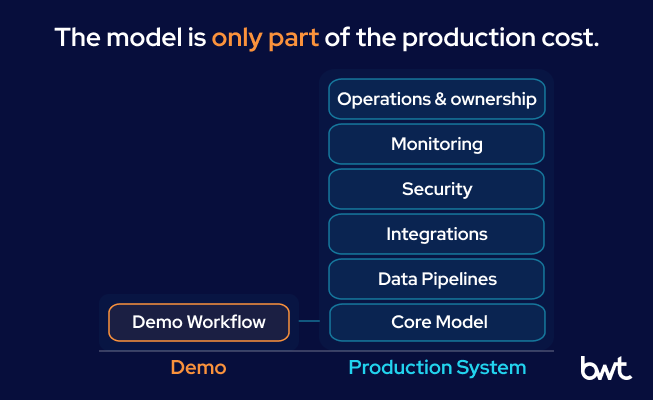
Agent timelines vary with the workflow. Our guide to AI-agent delivery timelines shows where that time goes instead of forcing every project into one estimate. Sometimes the model is not the expensive part. A data-readiness review for AI can reveal that source preparation consumes most of the first implementation budget.
A contingency line needs a named exposure behind it. Common examples are delayed access, an undocumented integration, poor source data, or evaluation requirements that remain unsettled. Before funding model work, inspect the fields, labels, or documents it will use, their update cadence, and who owns quality issues.
"If nobody has inspected the source data, the model estimate is two estimates pretending to be one. Price cleanup and pipeline work separately, or a model sprint becomes a costly way to find a missing field or broken join."
— Alex Yudin, Head of Data Engineering at GroupBWT
AI consulting services pricing should therefore show data preparation as its own workstream. Otherwise, a low model-only estimate understates the total when preparation and integration appear later.
What Comes Before the First Paid Phase
Our initial AI readiness assessment is free and typically takes up to one week. It identifies the workflow, target outcome, major constraints, and recommended next engagement. It is not implementation.
The first paid phase may be a proof of concept, pilot, production engagement, or foundational data work. The proposal should name deliverables, systems, responsibilities, acceptance criteria, and exclusions. Later work needs separate scope or explicit change control.
Example: How an AI Document-Review Scope Expands
This illustrative example shows how one workflow changes across stages. It is not a package or quote.
| Phase | Included scope | What adds cost | Explicitly excluded |
| Assessment | One workflow, three data sources, an initial security and access review, and evaluation-set design | Source access, sample quality, exception mapping, and reviewer time | Working model, live integrations, and deployment |
| Pilot | 100-200 representative documents, one reviewer workflow, and agreed evaluation cases | Document variation, retrieval setup, prompt and model testing, and review cycles | Production write-back, SSO/RBAC, monitoring, and support |
| Production | Three live integrations, SSO/RBAC, monitoring, audit log, exception workflow, deployment, and an agreed post-launch support period | Security testing, failure recovery, operating documentation, and knowledge transfer | New workflows, additional systems, and support beyond the agreed period |
The example exposes exclusions before price comparison. It also stops a successful pilot from becoming a promise to support every document type, business unit, and integration.
Forecast the Costs That Continue After Consulting Ends
A long-term cost forecast separates the one-time engagement from total cost of ownership. The invoice may end at handoff. The operating bill does not: compute, inference, storage, licenses, data refresh, monitoring, incident response, evaluation, and internal ownership may continue.
The 2025 AWS guidance on generative AI cost draws the same line. Initial development sits apart from compute, storage, education, and monitoring. AWS also recommends unit economics such as cost per text summary or generated image.
Model low, expected, and peak volumes before launch. Measure cost per approved underwriting memo, resolved support case, or accepted report. Include failed calls, retries, tokens, priced cache operations, storage, logging, and network transfer where relevant.
| Cost line | One-time or recurring | Measurement basis | Accountable owner |
| Inference or API use | Recurring | Cost per accepted business output, including failed calls and retries | AI product or platform owner |
| Cloud infrastructure | Recurring | Compute, storage, networking, and log volume per month | Cloud or platform owner |
| Source data and pipelines | One-time and recurring | Collection setup, license period, refresh cadence, and pipeline operation | Data owner |
| Evaluation and operations | One-time and recurring | Evaluation cycle, monitoring period, and incident-handling effort | AI operations or platform owner |
| Governance and controls | One-time and recurring | Access reviews, retention requirements, audit evidence, vendor reviews, and compliance activities | Security and governance owner |
| Adoption and ownership | One-time and recurring | Training cohort, workflow redesign, and internal product-owner allocation | Business owner |
One travel-platform project shows how architecture changes recurring AI costs. We used a lightweight layer for bulk language detection and sentiment analysis, reserving the LLM for final editorial content. The AI travel platform MVP reports about $49 per refresh across more than 30 cities, under $6 for language detection, and 70% lower AI processing costs than routing all processing through LLMs. These are single-engagement architecture results, not consulting-fee benchmarks.
Normalize Every Quote Before Comparing the Total
A quote should expose its assumptions. If two proposals define pilot, production, or support differently, their totals are not comparable.
| Comparison field | What to request | Warning sign |
| Scope and output | Named artefacts, systems, workflows, and exclusions | “AI solution” with no accepted end state |
| Team | Role, seniority, allocation, and accountability | Blended rate with no visibility into role mix or accountability |
| Dependencies | Data, access, APIs, reviewers, and client duties | Provider assumes every input is ready |
| Acceptance | Acceptance criteria, measures, reviewer, and release decision; evaluation set where relevant | Demo approval presented as production acceptance |
Then compare the commercial mechanics. Which work is fixed, capped, or variable? Who pays when an interface is undocumented? Does the price include security review, deployment, knowledge transfer, and support? What starts a change request? Work across several systems may need a short assessment; a well-understood feature may need only a scoped technical review.
Freelancers fit one specialist question, an independent review, or work an internal team can coordinate. A consulting company fits projects where several disciplines must work together under one accountable party. The cost of enterprise AI consulting services can include that coordination and delivery continuity, not only hourly labor.
Oleg Boyko’s commercial test is deliberately blunt:
"A low total is not a bargain when the hard work sits in the exclusions. Put the assumptions, acceptance criteria, and post-launch owner side by side. Only then are both providers pricing the same finish line."
— Oleg Boyko, CCO at GroupBWT
Also Read: AI Strategy Consulting: Build a Practical AI Roadmap
Reduce Spend by Removing Uncertainty, Not Necessary Controls
The cleanest savings happen before engineering. Narrow the use case, prepare representative data, secure access, name reviewers, document exceptions, and agree on success. This reduces diagnosis and rework without weakening the system.
A pilot should end in a decision: stop, revise, or proceed. Fund production only after testing representative data and defining the operating owner. Scope security, evaluation, monitoring, and recovery in proportion to risk.
AI implementation services become relevant when advice turns into integrated delivery. If the work needs production pipelines and source integration, budget data engineering separately rather than hiding it in the model estimate. That work may sit within implementation or require broader data engineering services.
Sometimes the right consulting budget is zero. Keep the work in-house when your team knows the problem, has delivered this pattern, and controls the required data. Buy an established product for a standard workflow unless ownership creates a real advantage. Pause when nobody owns the outcome or can define success.
A small organization should first ask whether it needs custom AI at all. A short expert review may be enough. For lower-complexity options and adoption trade-offs, see our guide to AI consulting for small businesses.
The Right AI Consulting Costs Are the Ones You Can Defend
Published bands cannot define one typical AI consulting engagement cost across advice, prototypes, production systems, and enterprise programs. The typical cost of AI consulting engagement means little until the finish line is fixed. To set a defensible budget, define the outcome, acceptance test, exclusions, and post-handoff operations.
Use market bands to test whether a proposal is plausible, not to replace scoping. Bring your scope and assumptions to GroupBWT. We will show where assessment ends, what implementation needs, and which costs and exclusions belong in the proposal.

The reviewed guides put an independent specialist’s hour between $150 and $350. Boutique consultancies sit higher, near $250-$500. The top end jumps sharply. Published benchmarks put some senior MBB and Big Four consultants or partners at $500-$1,000 or more. These are directional references, not GroupBWT rates. Do not multiply a rate by hours yet. First find out who is actually assigned, where they work, and whether that team owns delivery and signs off on acceptance.
The least expensive item in the reviewed guides is a small readiness or diagnostic engagement, starting near $5,000. A wider assessment can cost five times that amount. A narrow strategy brief may begin at $15,000. Broader roadmap work reaches $100,000. The next jump is substantial. The published proof-of-concept band runs from $50,000 to $150,000. Production is a different purchase. It begins near $150,000 and moves past $500,000 at the upper end. Crossing workflows, business units, or governance regimes takes the budget into enterprise territory and can push it higher still. An average cost of AI consulting services means little unless the projects share a finish line.
One quote may stop at advice or a controlled prototype. The other may carry the same idea through live data, integrations, security, evaluation, deployment, monitoring, and support – easily enough scope to create a six-figure gap. Team seniority, data condition, client dependencies, and acceptance criteria move the total too. Put included work beside exclusions first. Compare the headline prices last.
A usable proposal names the deliverables and systems first. The team plan comes next. It should name every role, then show the dependencies, assumptions, exclusions, acceptance criteria, and rules for changes. For a team billed on time and materials, check how much of each role you are buying. Recalculate the blended rate yourself. Fixed, capped, and variable work must be visibly separate, with an owner for deployment and post-launch support. Otherwise, the quoted AI consulting services cost cannot be compared reliably.
Post-launch costs follow the design you choose. That design decides what remains on the monthly bill. The list can include model or API use, cloud infrastructure, data refresh, licenses, evaluation, monitoring, incident response, governance, training, and an internal owner. Forecast low, expected, and peak usage, then track both total spend and cost per accepted output. The monthly amount depends on volume and architecture, so test the system with representative workloads before fixing an operating budget.
Read summarized version with
Build the Data FoundationYour AI Models Need
We develop and manage custom data solutions, powered by proven experts, to ensure the fastest delivery of structured data from sources of any size and complexity.
We offer:
- Custom Web Scraping & Development
- 15+ Years of Engineering Expertise
- AI-Driven Data Processing & Enrichment