Read summarized version with


Once scope and required access are understood, a bounded proof of concept can land in about 2-4 weeks, a pilot on a real workflow often runs 4-8 calendar weeks, and a production-ready deployment commonly runs 8-16 calendar weeks. Unresolved access, approval, and security dependencies add waiting time, while complex programmes can run longer. For anyone asking how long does it take to build an AI agent, the gap between those ranges is mostly explained by scope, data readiness, integration depth, and how much of the production layer has to ship in the first release.
Book Your AI Readiness Assessment
Book Your AI Readiness Assessment
Start with a focused review of the workflow, risks, data, access, and integrations that shape a credible delivery estimate.
The assessment includes:
- Workflow and risk assessment
- Data, access, and integration review
- Recommended delivery scope and timeline
Pick the Delivery Outcome Before You Estimate the Weeks
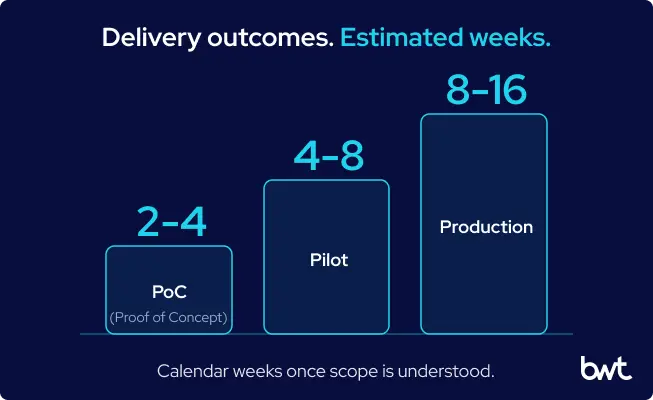
Most timeline arguments collapse because the buyer and the engineer are answering different questions. One is asking how long a working demo takes; the other is asking how long a system that survives production takes. The first answer can be days. The second can take several months, and complex programmes may run longer. Both can be correct within their respective definitions. The relevant timeline depends on which row of the next table the engagement lands in.
This article covers the path from a bounded PoC to a production-ready AI agent. Each range starts once the scope and required access are understood; unresolved access, approvals, and security dependencies add waiting time to the calendar estimate.
An AI Implementation company may also support organizational adoption beyond the first workflow. For the estimate below, match the range to the required production controls for one bounded agent workflow.
| Delivery outcome | Planning range | What it proves | What it does not prove yet |
| Proof of concept (PoC) | About 2-4 weeks | One bounded workflow runs on prepared inputs under controlled access | Reliability on live traffic, production security, monitoring at scale |
| Pilot | 4-8 calendar weeks | The workflow runs against representative data with defined evaluation cases, named reviewers, and a controlled go-live | Stable operation at full volume across every exception |
| Production-ready deployment | Commonly 8-16 calendar weeks | The system meets agreed reliability, security, observability, recovery, and ownership requirements | Expansion to other workflows, business units, or geographies |
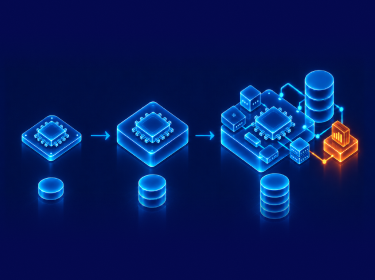
The delivery path is PoC → Pilot → Production. A PoC tests feasibility with prepared data and controlled access. A single-workflow pilot then uses representative data, named reviewers, evaluation criteria, and a controlled go-live. Production adds enterprise integrations, tool-call reliability, monitoring, failure recovery, security, audit logging, and an operational owner. Access, security, legal review, and reviewer availability can delay any stage, so the deployment timeline must show those dependencies separately from engineering work.
How GroupBWT Derived These Timeline Ranges
These ranges draw on GroupBWT delivery and planning engagements for bounded enterprise workflows. They exclude unresolved waiting for access, security, legal review, or stakeholder decisions and are not published industry benchmarks. The underlying sample size is not disclosed. Complex regulated or multi-system programmes can run several quarters. Multi-agent architecture is not itself a timeline stage: it changes the estimate only when orchestration, shared state, evaluation, or additional failure paths create more work.
Separate the four axes the buyer must define
Estimates break when one axis answers for the others. Hold them apart explicitly.
- Delivery stage: PoC, pilot, or production-ready deployment. This describes what has been tested and what operating controls exist.
- Architecture: single-agent or multi-agent. This describes how responsibilities are divided inside the system.
- Risk and controls: read-only guidance, reversible actions, or high-risk writes. This determines the minimum approval, security, recovery, and audit requirements.
- Organizational maturity: how broadly AI is connected across the company. This is not a synonym for agent architecture.
Our AI implementation page uses Individual AI, Connected AI, and Unified AI as an organizational maturity model. That taxonomy does not apply to agent architecture.
Also Read: AI Knowledge Assistant Architecture: A Practical Vision for Internal Company Q&A
What Changes From PoC to Production?
| Area | PoC | Pilot | Production |
| Data | Prepared cases | Representative workflow data | Production data and access rules |
| Integrations | Limited and controlled | Required systems in a controlled go-live | Full agreed scope with live dependencies |
| Evaluation | Feasibility checks | Acceptance cases and named reviewers | Regression testing and monitoring |
| Security | Controlled access | Reviewed permissions and action boundaries | Production controls and audit logging |
| Recovery | Manual stop | Defined escalation | Tested rollback and incident response |
| Ownership | Project team | Named reviewers | Operational owner |
How Fast Can You Build an AI Agent, and What Can Two Weeks Prove?
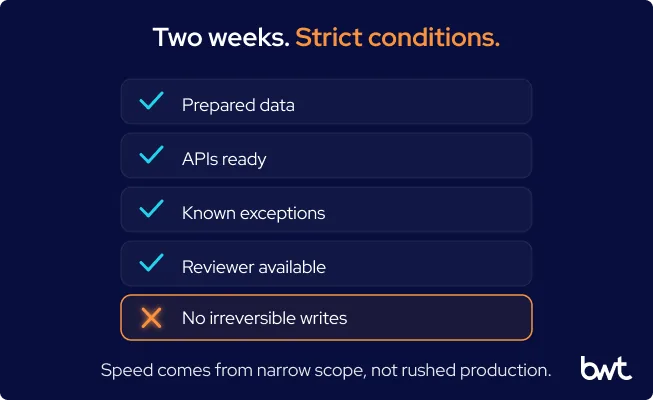
The fastest credible delivery is a bounded PoC. Teams who want to build an AI agent in 2 weeks need prepared representative data, available tools or APIs, a named reviewer, and a bounded, documented set of known exceptions. The PoC avoids irreversible production writes and states what remains untested. If those conditions hold, two weeks can establish technical feasibility and surface the hard exceptions. Speed comes from narrowing the scope, not from presenting unfinished production work as a pilot.
GroupBWT uses about 2-4 weeks as a planning range for tightly bounded PoCs with prepared inputs. To build AI agent fast without disguising unfinished work as production, the team must narrow the workflow, permissions, integrations, and acceptance boundary together. The range is not a benchmark drawn from an individual engagement.
Exclusions a 2-week scope must state in writing
A team targeting a 2-week delivery should write the exclusions first. The exclusions below describe conditions that usually move the work outside a credible two-week deployment scope. If any of these are in the first release, the target is more likely to be a discovery or PoC milestone than a deployment date.
- Live write actions that move money or change customer records.
- Broad exception coverage beyond the documented branches.
- Strict response times or SLAs.
- Unresolved authentication, access, or write dependencies in required source systems.
This is also the boundary for a 2-week AI agent: it can establish technical feasibility and expose the hard exceptions, but it cannot stand in for production resilience. A regulated-industry sandbox or synthetic-data PoC may fit the same window. Production access to regulated or sensitive data requires authentication, authorization, least-privilege access, privacy controls, and audit logging before launch.
What Determines an AI Agent Development Timeline?
At an executive level, the practical answer is that every estimate combines scope, data readiness, access, integrations, exceptions, and the controls the organization can accept. The table below pairs each variable with the engineering work it triggers.
Seven variables commonly shape the estimate. None turns into a fixed week count alone. Each creates a workstream with a minimum control level and, in some cases, separate waiting time. A credible agentic AI development timeline accounts for both the work and those dependencies.
| Variable | Estimate impact |
| Action risk and reversibility | High-risk writes require approval, audit, reconciliation, and recovery work on top of the model |
| Exception diversity | Each exception family needs a stop, escalation, or recovery path designed in advance |
| Data readiness | Representative development cases should be available early, with a separate holdout acceptance set defined before final acceptance testing |
| Integration difficulty | A documented read-only API takes less time than one legacy system with brittle write behavior |
| Evaluation readiness | Several metrics (task completion, factual accuracy where applicable, tool success, escalation, latency, cost, safety) usually combine into the release gate |
| Reviewer availability | Slow feedback from domain reviewers extends elapsed time even when engineering is on schedule |
| Deployment and compliance | Security review, vendor approval, audit, legal sign-off, and any applicable residency requirements add calendar time before production |
The highest-risk action in scope sets the minimum control level. It does not automatically dictate the architecture or the week count. In one anonymized engagement, more than 20 access requests extended the schedule by over six weeks because permissions were granted reactively as each access failure surfaced. The reusable lesson is to start access work before the build.
Production acceptance should include sustained-run testing, a separate holdout set, and case-specific stop and alert thresholds. Define measurable release criteria and failure behavior before development starts.
Engineering Time vs Calendar Time
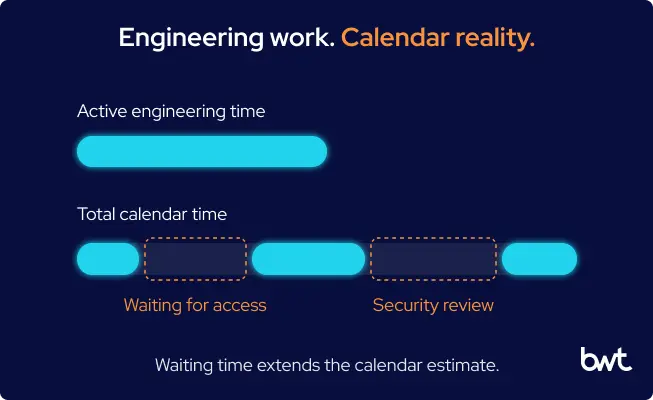
Active engineering time and elapsed calendar time are not the same. Validation, commercial alignment, access preparation, and security review often start before the build and include waiting that is not engineering effort. This distinction belongs in any AI agent development timeline in 2026, especially when an agentic AI development timeline spans several systems or approval teams.
Before the Build
| Activity | Elapsed period | What must be ready |
| Initial readiness assessment | Typically within one week | Workflow, target outcome, major constraints, recommended next engagement |
| Post-assessment scope and commercial alignment | Project-specific | Deliverables, responsibilities, decision path, and terms |
| Identity and access management (IAM) and environment preparation | Project-specific | Accounts, permissions, deployment route, sample data |
Commercial alignment is not a build stage. Access and environment work can run alongside it, but any waiting belongs in the calendar estimate. AI consultancy services can define the workflow boundary, risk level, and delivery outcome before engineering starts.
Agent Development Workstreams, Without Fixed Durations
When the project is genuinely an AI agent build, plan for the rows below. The table shows what each workstream contributes. Durations depend on scope, data, integration, evaluation, and the operating controls the organization accepts at launch. Teams that lack the required engineering capacity can hire AI developers for these workstreams rather than stretching an internal team across every layer.
| Workstream | Agent-specific contribution |
| Workflow and tool design | Actions, tool contracts, branching, escalation |
| Model and prompt behavior | Instructions, outputs, development-case tuning |
| Tool integration and deployment | Authentication, execution, automated deployment, environment setup |
| Monitoring and run tracing | Logs, metrics, alerts, records of agent actions and tool use |
| Holdout evaluation and UI integration | Acceptance tests, reviewer workflow, regression checks |
| Incident and recovery hardening | Failure paths, manual emergency override, rollback rehearsal |
The rows overlap, so the totals must not be added as person-weeks. The wider guide to how to use AI in software development explains where this work fits across discovery, development, testing, deployment, and maintenance.
What Makes a Production AI Agent Take Longer to Build?
Production readiness is not a polish pass on a working demo. Each requirement below adds implementation and verification work that must appear in the estimate.
Traceable Answers and Quality Controls
If an answer must cite the source record, the team has to design provenance, retain the right run data, and test whether the citation actually supports the claim. In regulated finance, traceability also affects audit review and escalation. Groundedness is an evaluation and data-design task, not a prompt adjective.
Tool Failure and Recovery
If the agent cannot reach the CRM, ERP, or another required system, it needs defined retry, stop, escalation, and user-notification behavior. An automated stop with a documented manual recovery route is one option, not a requirement for every design.
Latency and Cost
Production estimates should include load testing and cost validation under representative run volumes. The team needs to measure latency, throughput, and per-run cost before setting response targets or launch limits.
Approval, Reconciliation, and Rollback
Risky writes add approval before execution, reconciliation after execution, compensating actions, and rehearsed recovery. The estimate needs to cover who receives an alert, who can override the workflow, what can be reversed, and how a previous version is restored. Human approval reduces action risk; it does not replace access controls.
Live ERP Actions Add Approval and Recovery Work
The published GroupBWT AI-assisted RFQ sourcing case shows what expands production scope beyond a PoC: connecting a live ERP workflow, requiring approval before execution, handling exceptions, and validating human-in-the-loop review.
Why AI Agent Projects Slip
Six recurring schedule risks appear across the engagements GroupBWT has seen. They are especially relevant to the timeline for developing and deploying industrial agentic AI systems, where production approval may span several technical and business owners.
- Scope changes after evaluation begins. Adding another workflow, system, or high-risk write introduces new behavior and controls.
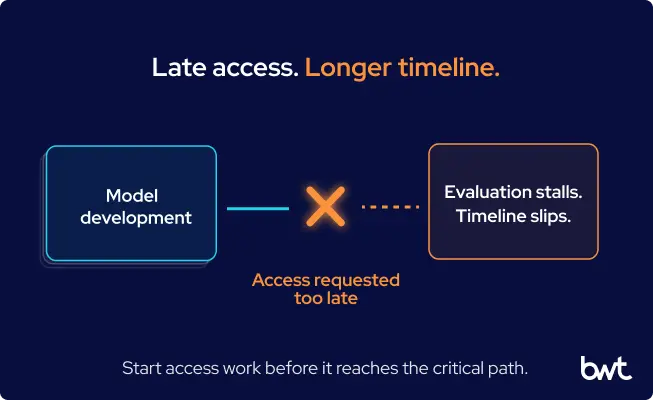
- Access starts too late. IAM, sample data, vendor approval, and security review start only after model work instead of earlier or in parallel where dependencies allow.
- The source-data foundation requires a separate workstream. Development may be complete enough for controlled testing, but production validation cannot finish until representative records, identities, and permissions are available.
- Exceptions were not mapped. Missing replies, unsupported files, policy conflicts, and unavailable APIs each require a designed outcome.
- Slow feedback or shifting acceptance criteria. If reviewers answer days later or redefine “correct” after each demonstration, evaluation becomes a stop-start loop.
- No operational owner exists. In one case, an internal AI build survived only a few months because competing use cases kept pushing maintenance down the priority list.
Match the mitigation to the risk: freeze the first-release scope, start access and data work early, agree the evaluation and review cadence, log exception families, and assign a named operational owner before production launch.
Self-Estimation Worksheet for Your AI Agent Timeline
The same inputs can also frame an AI agent MVP timeline, provided “MVP” is translated into a defined delivery outcome rather than treated as a fourth stage. Use the table below to match your current situation to a likely starting band and see what that band does not yet prove.
| Your current situation | Likely starting point | What remains unproven |
| Prepared data, one bounded workflow, controlled access, no irreversible writes | PoC: about 2-4 weeks | Live reliability and production controls |
| Representative workflow data, named reviewers, defined evaluation, controlled go-live | Pilot: 4-8 weeks | Full-volume reliability and exception coverage |
| Production writes, SLAs, audit requirements, recovery, and named ownership | Production-ready deployment: commonly 8-16 weeks once scope and required access are understood | Expansion beyond the agreed workflow |
| Missing data, access, evaluation cases, or operational ownership | Timeline is not reliable yet | Start with the readiness assessment |
The highest-risk action in scope sets the minimum control level. The overall timeline still depends on scope, access, data, integrations, evaluation, reviewer availability, and deployment constraints. If these inputs are unknown, the timeline cannot yet be estimated reliably.
An initial readiness assessment can identify the workflow, target outcome, major constraints, and a suitable next engagement, typically within one week. The next step may be a PoC, pilot, production-ready engagement, or foundational data work. GroupBWT offers this initial assessment at no charge.
When Custom AI Agent Development May Be the Wrong Choice
Custom development may be the wrong choice when deterministic automation handles the workflow reliably, a proven product already covers the need, the data foundation must be repaired first, or no team can own production operations. In those cases the better next step is workflow automation, a packaged product, a data project, or a pause. When the need extends beyond one agent into custom models, retrieval, or multimodal workflows, generative AI software development may be the better scope. We sometimes recommend a small data project before agent work when the source foundation cannot support reliable evaluation.

Three Decisions to Make Before Starting AI Agent Development
- Define the delivery outcome. State whether the contract ends with a PoC, a pilot, or a production-ready deployment. Document the architecture separately.
- Lock the acceptance plan. Name the development set, holdout set, required metrics, safety thresholds, and acceptance date. Do not reduce a production decision to one number.
- Assign operational ownership. Identify who will own monitoring, incidents, approvals, and changes before production launch.
Conclusion
A roughly two-week PoC can be credible when the workflow, data, actions, and exceptions are deliberately narrow. The answer to how long does it take to build an AI agent changes at production because security, integration, evaluation, observability, recovery, and ownership must work together. GroupBWT shortens avoidable waiting by starting access, data preparation, and evaluation early rather than removing production safeguards.
The workflow boundary, representative data, required access, named reviewers, and acceptance criteria must be clear enough to estimate. A separate holdout acceptance set should be defined before final acceptance testing. Unknown access or approval dependencies should appear as calendar risks rather than being hidden inside the engineering estimate.
Yes, when the target is a bounded PoC with prepared data, accessible tools, a documented exception set, and no uncontrolled production writes. The result remains a PoC until it passes production acceptance and operating controls. Human review can constrain risky actions, but it does not replace authentication, authorization, privacy controls, or audit logging.
A single-workflow production-ready deployment commonly falls in the 8-16-week planning range once scope and required access are understood. Complex programmes may run several quarters when they span multiple systems, business units, or control regimes. Production scope matters more than agent count alone.
Access, data preparation, integration, review cycles, and production controls often take longer than the first model and prompt iteration. A difficult behavior or evaluation problem can still dominate when integrations are ready. Estimate active work and external waiting separately.
Name the workflow owner, prepare representative data, map exception families, and start identity, access, and security work early. Define measurable acceptance criteria and decide which actions require approval or recovery. This exposes unknowns before they reach the critical path; it does not guarantee a fixed delivery date.
Read summarized version with
Book Your AI Readiness Assessment
Book Your AI Readiness Assessment
Start with a focused review of the workflow, risks, data, access, and integrations that shape a credible delivery estimate.
The assessment includes:
- Workflow and risk assessment
- Data, access, and integration review
- Recommended delivery scope and timeline