
Read summarized version with


A clean validation score can still leave the maintenance crew with nothing useful to do. It may warn too late, omit inspection context, or use telemetry mapped to the wrong asset record.
AI for predictive maintenance works when evidence arrives early enough to change the work. The model may spot degradation, identify a likely fault, estimate failure risk, or predict remaining useful life. Too late is useless.
Key Takeaways
- Define the failure mode and maintenance decision before selecting a model.
- Some predictive-maintenance programs work without AI.
- Anomaly detection, diagnosis, failure risk, and RUL answer different maintenance questions.
- Warning quality includes lead time and false-alert burden, not just accuracy.
- Production data must preserve asset identity and operating context.
- A warning creates value only when it enters the maintenance workflow in time to act.
- Scale only after shadow validation proves the warning is usable.
Related AI & Data Services
Turn Equipment Signals Into Maintenance Decisions
GroupBWT connects industrial data, predictive models, and maintenance workflows around one critical asset and a result your team can validate. The engagement can cover:
- Asset and failure-mode scoping
- Sensor, maintenance & operating-data pipelines
- Model validation and CMMS integration
Predictive maintenance with AI begins with an equipment problem, not a model catalog. Name the asset, failure consequence, and decision window. Then test whether the available data can produce a warning the team can use. GroupBWT connects industrial data, model development, and monitored delivery while maintenance engineers retain control of the action.
How AI Predictive Maintenance Works
AI in predictive maintenance starts with a failure decision. Reactive maintenance waits for failure. Scheduled preventive maintenance follows a calendar or usage interval. Predictive maintenance adjusts timing from measured condition and estimated risk.
| Approach | Trigger | Strong fit | Main trade-off |
| Reactive | Equipment failure | Non-critical, replaceable assets | Accepts interruption and secondary damage risk |
| Scheduled preventive | Calendar or usage | Age-driven wear and mandated inspections | May replace healthy parts or miss early degradation |
| Predictive | Condition and estimated future risk | Assets with detectable failure precursors | Needs trustworthy data, validation, and response ownership |
Predictive maintenance without AI remains valid. Threshold alarms and statistical monitoring can identify known abnormal states. AI-powered predictive maintenance goes further when the team needs to track changing risk, distinguish degradation from normal variation, diagnose likely faults where evidence supports it, or estimate a failure window or remaining useful life.
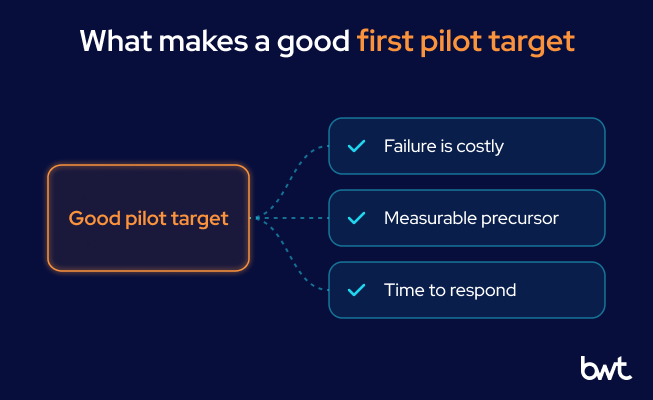
Start with one question: what maintenance action would change if the warning were trustworthy? A good first target has three traits: failure is costly, degradation leaves a measurable precursor, and maintenance has time to respond. Four Manufacturing AI Use Cases That Pay Off, And One That Doesn’t gives similar advice. Its author, Accedia founder and Managing Partner Dimitar Dimitrov, recommends proving the model on the machine whose failure hurts most before expanding.
The failure mode shapes the project. A model trained across mixed states can mistake a legitimate speed or load change for degradation. Scope the asset family, target mechanism, operating context, and maintenance decision – not simply “the factory.” Keep required inspections where regulation, safety policy, age-driven wear, or weak predictive evidence justifies a fixed interval. Teams sometimes call this combination AI preventive maintenance. Scheduled work stays where the predictive evidence is weak or the inspection is mandatory.
AI-Driven Predictive Maintenance Turns Equipment Data Into a Warning
A production workflow can connect several steps, from trustworthy asset signals to a warning whose outcome can be checked.
- Sensors and controllers record condition and operating context.
- The pipeline aligns timestamps, units, asset identities, and production regimes.
- Anomaly detection learns comparable normal behavior; other models learn task-specific fault, risk, or degradation relationships.
- The model detects an anomaly, distinguishes a known condition, or estimates failure risk or remaining useful life.
- Workflow logic combines the output with asset consequence, uncertainty, and response time.
- The maintenance owner reviews the recommendation in the CMMS, EAM, or a connected workflow.
- The evaluation uses the technician’s findings and recorded action. Retraining follows only when that evidence justifies it.
A 2025 peer-reviewed industrial compressor implementation shows the path in hardware: temperature probes, pressure transmitters, and current transformers fed a Siemens S7-1200 PLC. An Ewon Flexy 205 gateway carried them into SQL storage.
Useful condition signals range from vibration and acoustic data to current, pressure, flow, temperature, and oil measurements. Load, speed, product recipe, ambient conditions, startup state, and recent maintenance explain why the same reading can mean different things. Sampling should follow the signal dynamics and diagnostic objective; maximum-rate collection can raise cost without improving the warning.
A single-state baseline can produce false positives after speed, product, or load changes. Segment normal behavior by operating regime, or condition the model on variables such as speed, product, or load. Then record what technicians inspected, what action they took, and whether they confirmed the suspected condition or predicted fault.
“A sensor timestamp is not enough. The pipeline must map each reading to the right asset and operating state, then add the maintenance context the modeling question needs. Otherwise, it gives precise numbers to the wrong operating story.” — Alex Yudin, Head of Data Engineering at GroupBWT
Identifiers, lineage, and source repair are covered in our guide to AI ready data for manufacturing. Sensor readings, work orders, and operating records often arrive from different systems. A data engineering service provider can join them into a governed dataset for model development and production use. For this workflow, the test is narrower: can every warning be traced to the correct asset, operating regime, evidence window, and recorded disposition or maintenance outcome?
Which AI Models Are Used for Predictive Maintenance?
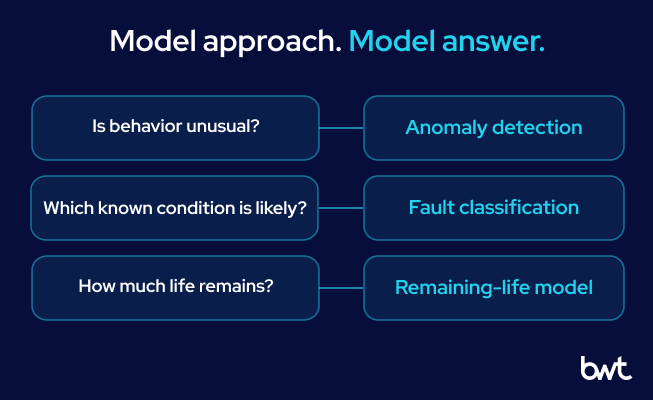
Choose the model by the maintenance question. Using AI for predictive maintenance starts with the output the team can use because different models answer different questions and need different evidence.
| Maintenance question | Typical approach | Output | Main limitation |
| Is this behavior unusual? | Anomaly detection | Anomaly score or flag | Does not identify the fault automatically |
| Which known condition is likely? | Fault classification | Fault or condition class and confidence | Needs reliable labeled examples |
| How likely is failure in a period? | Failure-risk model | Risk over time | Needs representative failure and operating history, with not-yet-failed assets handled where applicable |
| How much useful life remains? | Remaining-life model | Time or cycles remaining | Accuracy can degrade when future operating conditions shift |
Anomaly detection often fits early programs because it can learn normal operation without a large labeled failure library, although people must still review alerts. In an AI based predictive maintenance program, a fault classifier needs reliable labels that distinguish actionable conditions; “motor issue” is usually too vague.
A remaining useful life (RUL) estimate helps scheduling, but future load may differ from training history. Report a prediction interval rather than one confident countdown. Hybrid models can add engineering rules when failure data are sparse, but still need validation on the actual asset population.
When the maintenance question requires a custom model, machine learning consulting services can cover selection, validation, deployment, and production monitoring.
“Choose the output the maintenance team can use, then work backward to the model. An anomaly score, a fault class, and a remaining-life estimate trigger different decisions. Treating them as interchangeable is how technically good models end up ignored.” — Dmytro Naumenko, CTO at GroupBWT
What Data Is Needed for AI Predictive Maintenance?
Production evidence needs more than sensor history. How to use AI for predictive maintenance depends on the target failure and available evidence. The data requirements for predictive maintenance using AI vary by model: a frequent, well-recorded event may need less history than a rare failure spread across asset versions.
A production evidence pack combines stable asset identities, synchronized timestamps and units, operating regimes, and healthy periods. The rest depends on the question. Fault and risk models may need work orders, inspection notes, failure codes, replacement records, technician findings, and a history of sensor changes.
Tune features and thresholds on one set, then run final acceptance evaluation on a later period, different assets, or another site. Randomly splitting neighboring readings can place nearly identical behavior on both sides and inflate performance.
Equipment, sensors, loads, products, and maintenance practices evolve. Monitor whether performance changes with the data distribution. The pipeline can flag delayed feeds, missing values, unit shifts, and asset-ID mismatches; data and maintenance owners then determine whether the cause is equipment, instrumentation, or the data path. Diagnose the shift first. A broken sensor is not training data.
How to Evaluate Predictive Maintenance Model Performance
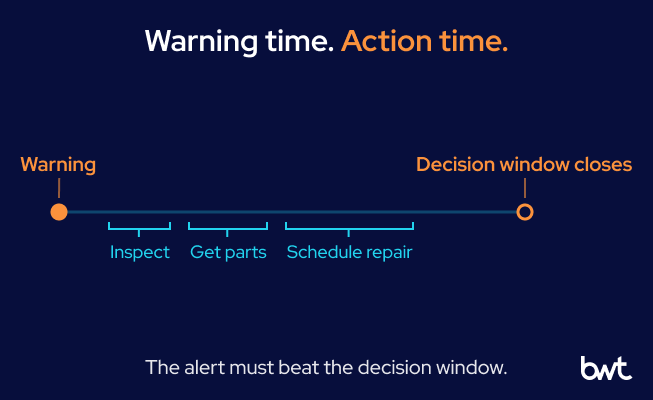
AI in predictive maintenance must beat the decision window. A plant needs enough lead time to inspect the asset, obtain a part, schedule labor, and work around production. A correct alert delivered after those choices close has little value.
Measure both error types. False alerts waste inspection time and teach technicians to ignore the system. A missed failure carries the opposite risk: unplanned downtime or secondary damage. Thresholds may need to differ when assets have different consequences and response windows.
| Signal | What it reveals | Maintenance response |
| Confirmed-alert precision | Share of evaluated alerts for which inspection or subsequent evidence confirmed a relevant condition | Adjust threshold, context, or review route |
| False alerts per asset-month or per 1,000 operating hours | Avoidable review work relative to asset exposure | Check whether alert volume is operationally tolerable |
| Missed-failure rate | Share of eligible failure events with no qualifying warning inside the defined warning window | Revisit evidence, labels, model, or coverage |
| Operational lead time | Time from the first qualifying warning to the start of maintenance intervention | Check whether labor and parts can respond |
| Observed failure lead time | Time from the first qualifying warning to failure in historical or non-intervened events | Test whether the model warns early enough |
| Post-maintenance confirmation | Whether inspection confirmed the suspected condition or predicted fault, where applicable | Feed verified outcomes into evaluation |
Alert fatigue can appear as declining review rates, delayed responses, repeated dismissals, or workarounds. Track these signals instead of assuming that normal batch review proves fatigue.
An actionable warning should identify the asset, evidence window, operating regime, deviating signals, uncertainty, and – where supported – the likely failure mode.
How to Integrate AI Predictive Maintenance With CMMS, EAM, ERP, and MES
Maintenance-system integration turns an accepted warning into work. The workflow places a model’s score, classification, or estimate where planners manage assets, parts, labor, and work orders.
A controlled handoff can carry the asset ID, evidence window, deviating signals, uncertainty, severity, suggested inspection, and a suspected failure mode where supported. Deloitte’s predictive-maintenance perspective also combines sensor evidence with ERP, repair, production, and field records before routing insights into a workflow. The maintenance owner accepts, modifies, rejects, or escalates the recommendation.
Before suggesting a repair window, the workflow can check enterprise resource planning (ERP) inventory and the manufacturing execution system (MES) schedule. This does not always require agentic AI development services. Stable rules suit deterministic workflows. An agent becomes useful when the system must interpret variable inputs across sources, compare constraints, prepare a recommendation, and route exceptions.
“A warning creates little operational value unless someone can act before the failure and record what happened next. Connect the model to the maintenance process, but keep the owner visible. Otherwise, the plant has another dashboard and no different decision.” — Oleg Boyko, CCO at GroupBWT
One Delivered Case Shows the Full Decision Path
At a European industrial pump manufacturer, equipment telemetry lived in the supervisory control and data acquisition (SCADA) system. Repair history sat in SAP ERP; Siemens Opcenter MES held the production schedule. The split prevented maintenance teams from matching emerging risk with parts, labor, and a safe repair window.
GroupBWT built anomaly detection and two connected agents. One checked parts, prior work, instructions, and technician availability before drafting a task. The second reviewed orders, deadlines, and spare capacity before recommending a repair window. Engineers retained approval over work-order release and schedule changes.
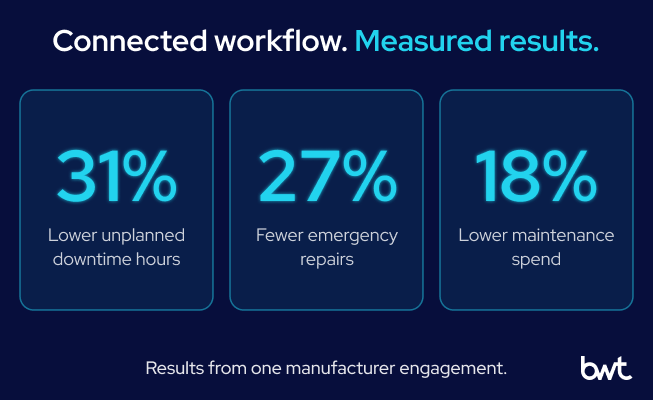
By connecting warnings with controlled maintenance planning, GroupBWT helped reduce unplanned downtime hours by 31% across 14 monitored lines versus the previous six-month period, according to the AI agents for predictive maintenance case. The same connected workflow helped the manufacturer reduce emergency repairs by 27% and maintenance spend by 18%.
In this case, anomaly detection and execution remained separate control layers: the model flagged unusual behavior, while the workflow and engineer determined the action. Production value depended on connecting the warning, repair decision, schedule, approval, and outcome.
Pilot One Asset Family Before Scaling Predictive Maintenance
For a first pilot, start with one asset family and one target failure mode with measurable consequences, evidence, and response. Use shadow mode when it fits the operating context, keeping the existing process authoritative while owners agree on acceptance, escalation, and fallback.
What a first predictive-maintenance pilot includes
| Stage | Work | Client deliverable |
| Scope | Select one asset family, failure mode, and maintenance decision | Agreed use case and success criteria |
| Data check | Audit signal quality, asset identity, operating context, maintenance history, and the outcome labels required by the selected modeling question | Data-readiness findings and a remediation plan for critical gaps |
| Baseline and prototype | Record the current maintenance baseline and build the simplest model that reliably answers the selected question | Warning prototype with documented assumptions |
| Shadow validation | Test warnings without making the model authoritative, set acceptance thresholds, and design the maintenance-system or workflow handoff | Validation results, thresholds, and integration design |
| Scale decision | Compare warning quality, lead time, maintenance response, integration effort, and operating cost | Evidence showing whether the predictive maintenance AI use case is worth scaling |
A plant with a suitable asset family, accessible history, and in-house reliability and data expertise may run the pilot internally. In McKinsey’s 2025 survey of 101 senior operating executives at manufacturers with at least $1 billion in annual revenue, 46% reported data or IT/OT limitations. The survey covers manufacturing AI overall. Outside support helps when the team lacks industrial integration, model-validation, deployment, or maintenance-system expertise.

Measure Maintenance Value Without Turning Proxies Into ROI
Keep model and business measures separate. Precision and prediction error describe model behavior; lead time, accepted warnings, emergency work, downtime, spend, and availability describe operations. Set the asset group, operating hours, production volume, maintenance policy, and comparison period first. A quiet quarter does not prove that a model prevented failures.
For project ROI, subtract relevant costs from monetized benefit, then divide net benefit by the defined investment cost base for the same period. Include required sensors, infrastructure, compute, storage, licenses, integration, model work, validation, deployment, monitoring, technician review, retraining, and support. If avoided downtime cannot be monetized defensibly, report operational and cost measures separately.
GroupBWT provides AI consulting services manufacturing teams can use to prioritize the use case and evidence before a model build. If maintenance is not the best first use case, compare it against quality, production planning or forecasting, and process optimization before committing to the model.
Also Read: How AI in Manufacturing Cuts Downtime, Lifts Quality, and Sharpens Forecasting
Make the Warning Change a Real Maintenance Decision
The role of AI in predictive maintenance is to produce evidence that changes a real decision. Start with an asset family, meaningful failure consequence, and target failure mode. Connect trustworthy condition data with operating and maintenance context, select the model by its question, and test whether the warning provides enough evidence and lead time.
Keep the maintenance owner visible, return technician findings to evaluation, and separate model measures from plant outcomes. Scale only after a bounded pilot shows that the team can trust, act on, and reconstruct warnings.
The output depends on the maintenance question. AI may flag unusual behavior, identify a fault pattern, estimate failure risk, or forecast remaining useful life. Operational value starts when that output reaches the right asset record before the decision window closes. The CMMS, EAM, or connected workflow then records the decision and what the technician found.
Anomaly detection finds behavior outside a learned baseline. Classification distinguishes known fault classes, survival models estimate failure risk, and regression or sequence models estimate remaining useful life. Hybrid approaches add engineering constraints when historical data are limited.
For anomaly detection, trustworthy healthy-condition data may be enough to start, provided each reading is tied to the correct asset, time, and operating context. Supervised fault models need reliable labels. Failure-risk models need event data and correct treatment of assets still operating. Remaining-life models need degradation trajectories or run-to-failure histories.
Scheduled preventive maintenance follows a calendar or usage interval. Predictive maintenance uses condition and degradation evidence to estimate when work is likely to be needed. AI is one way to produce that prediction. It is not mandatory.
No universal accuracy figure applies. Evaluate confirmed-alert precision, false alerts by asset-time or operating-time exposure, missed failures within a defined warning window, lead time, and confirmed findings. Calculate ROI only when benefits and costs cover the same period.
Read summarized version with
Related AI & Data Services
Turn Equipment Signals Into Maintenance Decisions
GroupBWT connects industrial data, predictive models, and maintenance workflows around one critical asset and a result your team can validate. The engagement can cover:
- Asset and failure-mode scoping
- Sensor, maintenance & operating-data pipelines
- Model validation and CMMS integration