Read summarized version with


This guide is for the plant manager, operations lead, or data owner deciding where AI in manufacturing pays off first — and whether their factory is ready to try. By the end you will know the highest-return use cases, the exact data each one needs, when a pilot is realistic, and when the honest answer is “not yet.” Every point is drawn from manufacturing AI implementation work GroupBWT has done for asset-heavy and multi-site producers, not vendor theory.
Manufacturers hold the densest operational data of any industry, yet adoption of AI in manufacturing trails the rest of the economy. Knowledge sectors like information now report around 37% AI use; manufacturing sits below the national average, even as it posts among the fastest year-over-year growth of any sector, per the Business Trends and Outlook Survey (U.S. Census Bureau). The gap is not ambition. It is getting messy plant data into a shape a model can use. So how is AI used in manufacturing, and what does it take to see a return?
Build the Data FoundationYour AI Needs
We design and build manufacturing data platforms — from ERP and MES integration to governed lakehouses — so your AI models train on connected, trustworthy data.
We offer:
- Manufacturing Data Engineering
- Lakehouse Architecture (Databricks)
- AI Readiness Assessment
In Short
- Best first use cases: predictive maintenance on a critical line, automated quality vision, and AI demand forecasting. They tie to a clear cost and pay back fastest.
- What data you need: ERP and MES business data, high-frequency sensor and PLC streams, and quality and maintenance records that label good from bad — joined into one trusted source.
- When a pilot is realistic: when that data is exportable and someone already watches its quality. A working model on one line usually lands in 8–12 weeks.
- When the answer is “not yet”: when downtime is already low, rejects are stable, and the data sits locked in vendor screens. The right first project is then a data-readiness check, not a model.
Why AI Matters in Manufacturing
Unplanned downtime is the quiet tax on every plant. The world’s 500 largest manufacturers lose an estimated $1.4 trillion a year to it — about 11% of revenue (The True Cost of Downtime 2024, Senseye/Siemens). AI changes the moment you get to act. A machine no longer has to fail before you respond, because the model flags the fault while there is still time to fix it. And the number you act on is live, not a spreadsheet from the last shift. The intent is there. In Harnessing the AI Revolution in Industrial Operations: A Guidebook (World Economic Forum, 2023), 89% of executives called AI essential, but only 16% had scaled it across operations. The plants that close that gap treat AI as a layer on clean, connected data — not a bolt-on tool.
"Most manufacturers we talk to don’t have an AI problem. They have a data-access problem wearing an AI costume. The model is fine; it’s starving on data trapped in twenty systems that were never built to talk to each other."
— Oleg Boyko, CCO at GroupBWT

How AI Is Used in Manufacturing
So how is AI used in manufacturing? AI applications in manufacturing cluster into six jobs, each running on data a plant already generates.
| Use case | What the AI does | Data it needs | Typical outcome |
| Predictive maintenance | Flags a failing part before it breaks | Sensor, vibration, runtime logs | Fewer unplanned stops |
| Quality control | Spots defects on the line in real time | Camera images, inspection records | Less scrap and rework |
| Production planning | Balances throughput and changeovers | MES, machine state, orders | Higher line utilization |
| Supply & inventory | Forecasts demand and lead times | Sales, supplier, catalog data | Fewer stockouts and overstock |
| Energy & sustainability | Tunes consumption per unit | Meter, fuel, environmental data | Lower cost per unit made |
| Prescriptive optimization | Finds the best plan under constraints | Recipes, schedules, capacity, costs | Lower cost per plan, faster planning |
Key AI Use Cases in the Manufacturing Industry
The strongest AI use cases in manufacturing replace a human guess with a measured signal.
Machine Learning for Predictive Maintenance
A model learns a machine’s normal vibration, temperature, and current. Then it flags drift toward a known failure mode — the most mature industrial application, per a peer-reviewed survey in Frontiers in Mechanical Engineering (2025). The payoff runs up to 50% less downtime and 10–40% lower maintenance costs (McKinsey, 2015; still reported in Deloitte’s Industry 4.0 research). It learns from confirmed failures — alerts tied back to work orders — so if you have no failure history yet, start with unsupervised anomaly detection, which needs no labels, then graduate to predicting specific failure modes as work orders accumulate.
Computer Vision for Inspection and Quality Assurance
Cameras with deep-learning models check every unit instead of a sample. They catch hairline defects a tired eye misses, and they grade a part the same way at 2 a.m. as at noon. When this goes wrong, the cause is almost always the data plumbing — dropped frames, inconsistent labels — not the model.
AI for Demand Forecasting and Production Scheduling
For a European cosmetics manufacturer, GroupBWT is consolidating 13 retail sources into one governed platform — 300,000+ products, 30+ locales, one clean feed that merchandising has relied on for three years. Merchandising now reads one clean feed of price, assortment, and stock signals instead of chasing thirteen — the same foundation demand-forecasting models read from downstream.
Anomaly Detection, Decision Support, and Document AI
Anomaly detection watches the whole operation for the reading no one wrote a rule for — a slow throughput leak, a batch drifting out of spec — increasingly through an assistant a line lead can question in plain language. Those assistants also read documents: pulling fields from certification records, shift reports, and SOPs, then assembling QA or compliance paperwork that used to cost an engineer hours. A person still makes the call. The AI just surfaces the right numbers sooner and raises the alert faster.
Prescriptive Optimization and Scheduling
Prediction tells you what will break or sell. Prescriptive optimization tells you what to do about it. Built on operations research, not ML forecasting, it finds the lowest-cost plan under real constraints — blending a recipe to spec, sequencing jobs across lines, simulating load before committing. It turns days of manual Excel into minutes, so it often shows the fastest, clearest ROI on the floor.
Which Use Case to Start With: A Quick Comparison
The three most common starting points trade speed of payback against how hard the data is to assemble. Read this before you scope a pilot:
| Use case | Data complexity | Speed of ROI | Best fit for |
| Predictive maintenance | Medium — needs sensor streams plus a failure history to learn from | Fast on a critical line, once history exists | A plant where one machine’s downtime is the top cost |
| Quality vision | Low to medium — cameras and labeled images, no plant-wide integration | Fastest where scrap is already visible | A line with measurable scrap or rework on one product |
| Demand forecasting | High — clean sales, supplier, and catalog data across systems | Slower, but compounds across planning | A producer bleeding cash on overstock and stockouts |
Quality vision usually gives the quickest win because it needs the least integration. Demand forecasting is the hardest to feed, but it reaches the widest once the data is clean. Predictive maintenance falls in the middle. It pays off well, but only after work orders give the model real failures to learn from.
What to do first: pick the one use case whose failure already costs you the most, then check whether its data exists. If you want the fastest proof, start with quality vision. If downtime is your biggest line item and you have a failure history, start with predictive maintenance. Leave forecasting until your sales and supplier data are clean.
Benefits of AI in Manufacturing
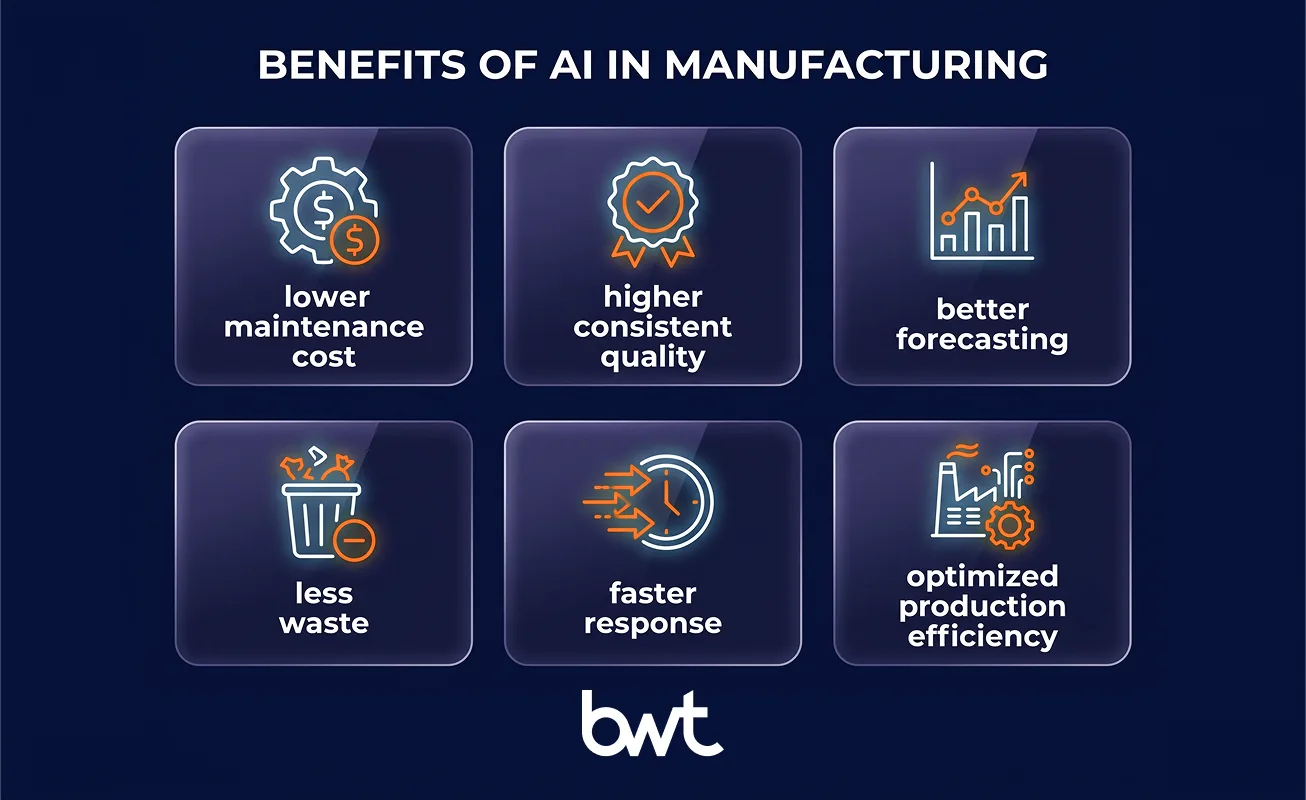
The benefits of AI in manufacturing are concrete when the data foundation holds:
- Less downtime and maintenance cost — failures caught days early become scheduled repairs, not lost shifts.
- Higher, more consistent quality — inspecting every unit narrows the variance behind warranty claims and recalls.
- Better forecasting and visibility — one trusted view of demand and capacity ends the spreadsheet arguments between planning and the floor.
- Less waste — tuning energy and material per unit trims cost across every shift.
- Faster response — when a feed breaks or a batch drifts, the right person hears in minutes.
In Deloitte’s 2025 Smart Manufacturing and Operations Survey, about two-thirds of manufacturers (66%) say AI is already improving productivity and efficiency — early use usually pays off; rolling it across every site is the rare part.
Data and Systems Required for AI in Manufacturing
This is where projects live or die. A useful model needs three data layers stitched together:
- ERP, MES, and SCADA — orders, line state, and machine state, each in its own format, rarely sharing a key for “machine 12” or “batch 4471.”
- Machine, sensor, and IoT — PLC streams, vibration sensors, optical sorters, telematics; on a large asset-heavy plant that is billions of readings a day and tens of terabytes, arriving fast and dirty.
- Quality, maintenance, and asset — inspection results and work orders, the labels that teach a model what “failure” and “defect” mean.
The hard part is joining them. Take one asset-heavy food producer running 12 sites across 8 U.S. states. Its data sat in 6,000+ tables across roughly 20 databases, fed by more than 20 sources, with 295 Power BI reports built on top. GroupBWT is re-architecting it into one governed lakehouse so the next ten use cases read from one place, with validation gates requiring exact row-count matches and value reconciliation against source before any record reaches a report.
"On a plant floor, the model is the last 10% of the work. The first 90% is making a four-minute PLC stream, an ERP export, and a maintenance log agree on what ‘machine 12’ means at 2 a.m."
— Alex Yudin, Head of Data Engineering at GroupBWT
What to remember: the model is the easy part. Manufacturing AI readiness is decided in the data layer — three sources that agree on the same keys. Get that wrong and even a strong model learns the wrong lessons.
Is Your Plant Ready for AI?
Before scoping a model, run a five-point check — the more you can tick, the shorter the path to a pilot:
- ERP data is accessible — exportable, not locked in a vendor screen.
- MES or line data exists — you can see what each line ran, when, and how fast.
- Sensor or PLC data is captured — stored somewhere, even if unused.
- Maintenance history is recorded — failures and work orders logged (and if not, start with anomaly detection, which needs no labels).
- Data quality is monitored — someone catches missing or duplicate records before they spread.
Three or more yes usually means a use case is reachable in a quarter; mostly no means the right first project is a data-readiness assessment, not a model.
- Start here if: ERP data exports cleanly, you have some machine or sensor history, and someone already watches data quality. A pilot is within reach this quarter.
- Not ready if: data lives locked in vendor screens, there is no maintenance history to learn from, and no one owns data quality. Fix the foundation first — a readiness assessment, not a model.
Also Read: Big Data in Manufacturing: From Fragmented Plant Data to Decisions You Can Act On
Challenges of AI Adoption in Manufacturing
Most plants stall on the same things. Old equipment was never built to hand out its data. Connecting a proprietary controller to a modern pipeline means crossing the line between plant systems and IT systems, which each team guards for good reason. And if you feed a model inconsistent units and duplicate records, it learns the wrong lessons. Without validation at ingestion, “garbage in” becomes confident wrong predictions out. Rolling one pilot across many plants multiplies the integration and governance work — which is exactly why so few plants scale AI past a first site. The output is probabilistic, too, tuned to the cost of error: push precision up and alerts are trustworthy but some real failures slip through; push it down and you catch more at the cost of false alarms. Set that balance deliberately. Don’t expect a model to catch everything. And some plants aren’t ready at all: if downtime is already low and rejects stable, the honest answer is sometimes “not yet.”
What to remember: most AI projects fail on data access and integration, not on the model. Put your first effort into connecting and validating the data. Decide the precision-versus-recall balance on purpose. And when a floor is already running lean, be ready to walk away from the use case.
How Manufacturers Implement AI Successfully
The plants that get past the pilot follow a recognizable path:
- Start with one high-impact use case tied to a clear cost — downtime on a critical line, scrap on one product.
- Assess data readiness first. A two-to-four-week check now saves a six-month surprise later.
- Pilot on real plant data. A working model on one line in 8–12 weeks beats any slide deck.
- Integrate with existing systems — read ERP, MES, and sensors, write back where operators already work.
- Measure against a business KPI agreed up front, so success is a number, not an opinion.
The best programs also leave the internal team self-sufficient — a self-service platform and real knowledge transfer, not a permanent dependency on the vendor.
| Use case | Pilot timeline | Where ROI shows first |
| Predictive maintenance | 8–12 weeks | Avoided downtime hours on a critical line |
| Quality vision | 6–10 weeks | Reduced scrap on one product family |
| Demand forecasting | 10–14 weeks | Lower overstock and fewer stockouts |
| Lakehouse foundation | 4–6 weeks (assessment) | Unlocks 5–10 downstream use cases |
The Manufacturing AI Maturity Model
Most plants can find themselves on this five-stage curve. Knowing your stage tells you what the realistic next step is.
| Stage | What it looks like | What unlocks the next stage |
| 1. Reporting | Numbers arrive a shift or a day late | Connect sources into one place |
| 2. Integrated data | ERP, MES, and sensors share one source | Add validation and history |
| 3. Predictive models | Models flag failures and forecast demand | Move scoring closer to real time |
| 4. Real-time AI | Decisions are scored live on the floor | Let models act within set limits |
| 5. Autonomous operations | Bounded actions run with no human in the loop | Continuous monitoring and governance |
The first payoff is reaching stage 2 — in practice a weeks-to-months data-engineering effort, not a model project, and most of it can be scoped in a short assessment first.
What to do first: scope one use case tied to a named cost, run a two-to-four-week data-readiness check, then pilot on real plant data from a single line. A successful manufacturing AI implementation is a sequence — one line, one KPI, one number to show — not a plant-wide launch.
What Does AI in Manufacturing Cost?
Cost tracks scope, not licenses: how much data has to be connected and how many sites the use case touches. A pilot (one use case, one line) is a scoped proof, usually weeks of work. A single-plant build connects one facility’s ERP, MES, and sensor data with one or two use cases in production. A multi-site rollout reuses that foundation across plants, where most of the cost is integration and governance, not rebuilding each model.
Get a manufacturing AI readiness assessment, not a demo. Pick one:
- Scope one pilot on your highest-cost line — the single use case where downtime or scrap hurts most.
- Validate whether your plant is AI-ready in 2–4 weeks, before committing to any model.
- Get an honest “not yet” if the data isn’t there, with the shortest path to fixing it.
Bring your messiest data source, and GroupBWT will tell you what a first AI use case really takes.
AI in Manufacturing Industry Trends
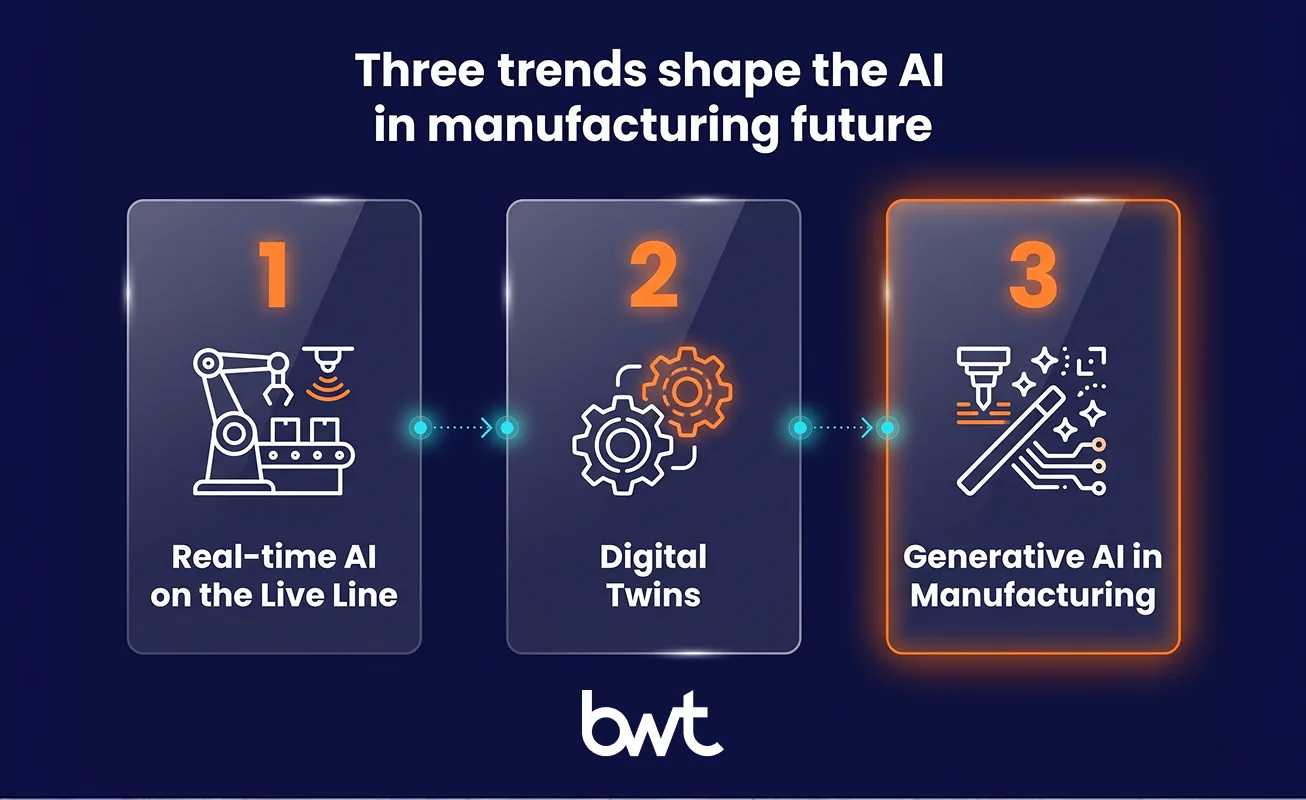
Three forces shape the AI in manufacturing future. The first is real-time AI on the live line, where the shift from batch to streaming is less about the model than about sustaining far higher data volume with a quality gate on every stage. Edge AI is already part of that, not a forecast: models are compressed and embedded straight into cameras and controllers on the equipment, so a fault is caught in milliseconds instead of after a round trip to the cloud — shipping today, scaling tomorrow.
The second is digital twins. A twin mirrors a line in software, fed live sensor and MES data, so an AI model can rehearse a changeover or a maintenance window overnight before anyone touches the real equipment, turning expensive trial-and-error into cheap simulation — only as honest as the data behind it.
"A digital twin is only as honest as its slowest sensor. Push AI decisions to the edge and you stop asking the cloud what happened five seconds ago. You act on it before the next part comes down the line."
— Dmytro Naumenko, CTO at GroupBWT
The third is generative AI in manufacturing — past chatbots now, into assistants a technician can question in plain language and into document work: drafting shift reports, extracting fields from certification and QA records, summarizing them in minutes instead of hours. The next step, agentic AI in manufacturing, lets those assistants take bounded actions like scheduling an inspection when a reading drifts. All of it depends on the same connected data, which is why the data layer comes first, not the copilot.
AI in Manufacturing Industry Examples
The pattern repeats across the AI in manufacturing industry. A B2B auto-parts company building an AI parts-ordering system had GroupBWT stand up the pipeline behind it — up to 100,000 records a day of OE part numbers, applicability, and category data across ten brands in one clean source, so its team makes faster sourcing decisions on a single trusted catalog instead of reconciling vendor data by hand. The multi-site food producer above, through a data warehouse migration to Databricks, is turning month-end report-stitching into a single cross-facility query. For a European electric-motor manufacturer running 3,600+ product variants, GroupBWT built an AI-assisted search layer over six disconnected engineering systems — SAP, CAD files, and file servers — so an engineer now finds any drawing or data sheet in seconds instead of the up-to-an-hour folder search it took before. These AI in manufacturing examples share one precondition: live, complete, trusted data, not a cleverer model.
When to Partner With an AI Provider for Manufacturing
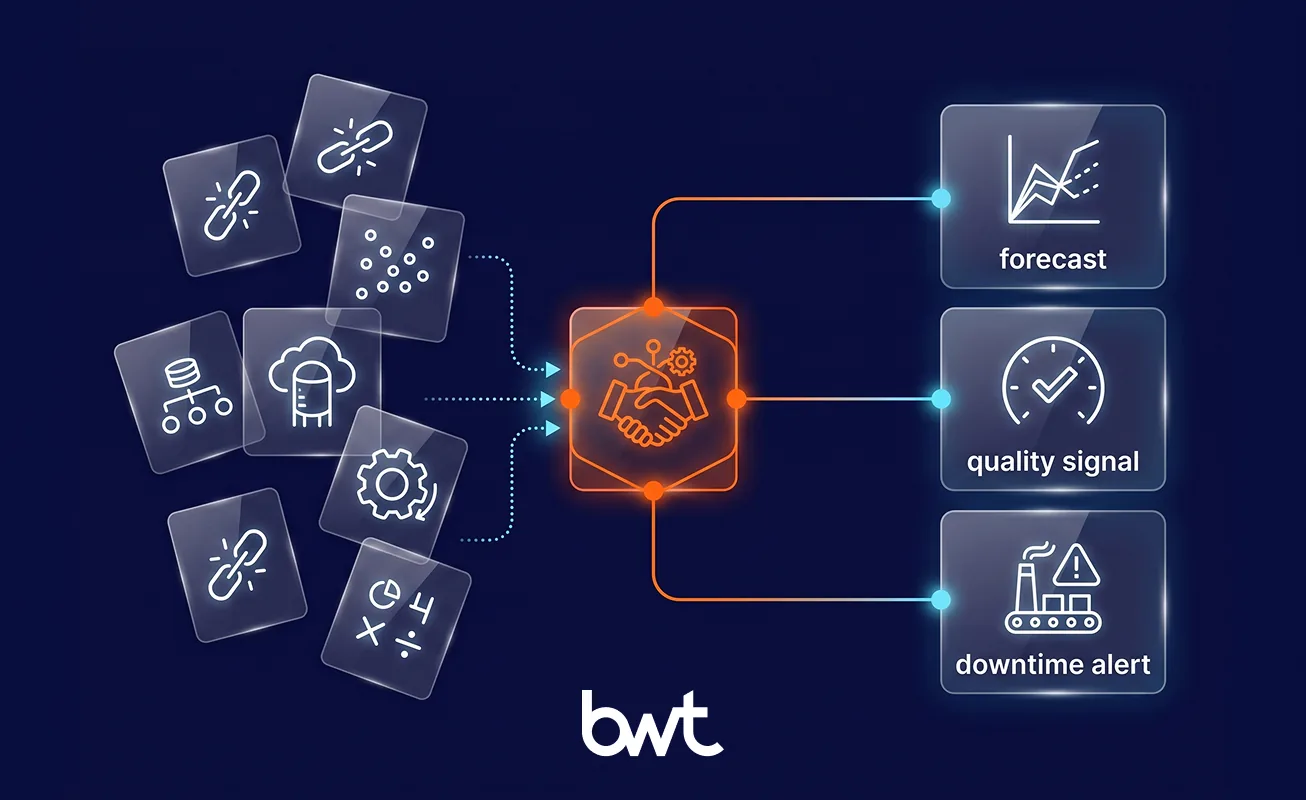
If your data lives in twenty systems that don’t talk, a pilot has stalled for months, or your engineers know controls but not data pipelines and ML, outside help pays for itself. A strong partner builds the connected data foundation first, then the models: pipelines off your ERP, MES, and sensors; a governed lakehouse or customer data platform; and the data analytics services and solutions that turn it all into forecasts, quality signals, and downtime alerts. Look for industrial data experience over AI hype, honesty about limits, and a partner who leaves your team able to run the system without them — worth more than one who makes you dependent. GroupBWT scopes a manufacturing readiness assessment before promising any model.
Build a Smarter AI Strategy for Manufacturing
The plants pulling ahead aren’t the ones with the fanciest models. They fixed their data first, proved one use case on a real line, and scaled with a number to show for it. If your data is scattered across systems that were never meant to talk, that is where AI in manufacturing starts — the foundation GroupBWT builds, from data pipelines and a governed lakehouse to the manufacturing data analytics on top, before a single model is trained.
Using machine learning, computer vision, and related techniques to analyze plant data and inform or take operational decisions — predicting failures, inspecting quality, forecasting demand, optimizing production. The AI is the part you see. The connected data underneath it does most of the work.
Predictive maintenance, automated quality inspection, demand forecasting, and constraint-based optimization return the most. Predictive maintenance usually pays back within the first year on a critical line. Vision inspection pays back fastest where scrap costs are already visible.
By shifting decisions from reactive to predictive and from sampled to complete — a repair scheduled before a breakdown, every unit checked instead of a sample. The gain tracks data quality closely: on messy, disconnected data, even a strong model underdelivers.
Business data from ERP and MES, high-frequency machine data from sensors and PLCs, and quality and maintenance records that label good and bad. The hard part is integrating them into one trustworthy source with consistent keys, which is why data engineering comes before any model.
Start with one high-impact use case tied to a clear cost, then check whether its data is available and trustworthy. Pilot on real data from one line before you scale it wider. Integrate with the systems operators already use, and measure against a business KPI you set in advance.
Read summarized version with
Build the Data FoundationYour AI Needs
We design and build manufacturing data platforms — from ERP and MES integration to governed lakehouses — so your AI models train on connected, trustworthy data.
We offer:
- Manufacturing Data Engineering
- Lakehouse Architecture (Databricks)
- AI Readiness Assessment