
Read summarized version with


The demo worked. It answered staged questions, the forecast looked plausible, and the boardroom leaned in. Then security or the data owner asked how it would run next month. The room went quiet.
Build the Data Foundation
We develop and manage custom data solutions, powered by proven experts, to ensure the fastest delivery of structured data from sources of any size and complexity.
The MIT NANDA initiative put a number on that stall: about 95% of enterprise generative-AI pilots deliver no measurable profit-and-loss impact. Microsoft enterprise leadership put the fix in execution. AI strategy consulting earns its fee only when it turns “do something with AI” into a plan that survives production. This guide follows GroupBWT’s sequence: readiness, prioritization, ownership, data, architecture, and ROI.
Key Takeaways
- AI strategy should start with business problems and readiness, not model selection.
- Every AI use case needs a measurable KPI, a named owner, and a production route.
- Data readiness often determines which use cases should be funded first.
- A practical AI roadmap connects use cases to data, architecture, governance, budget, and delivery dependencies.
- Pilot success does not prove production readiness.
- AI ROI should be measured through business outcomes and total operating cost, not model accuracy alone.
Why most AI initiatives stall before production
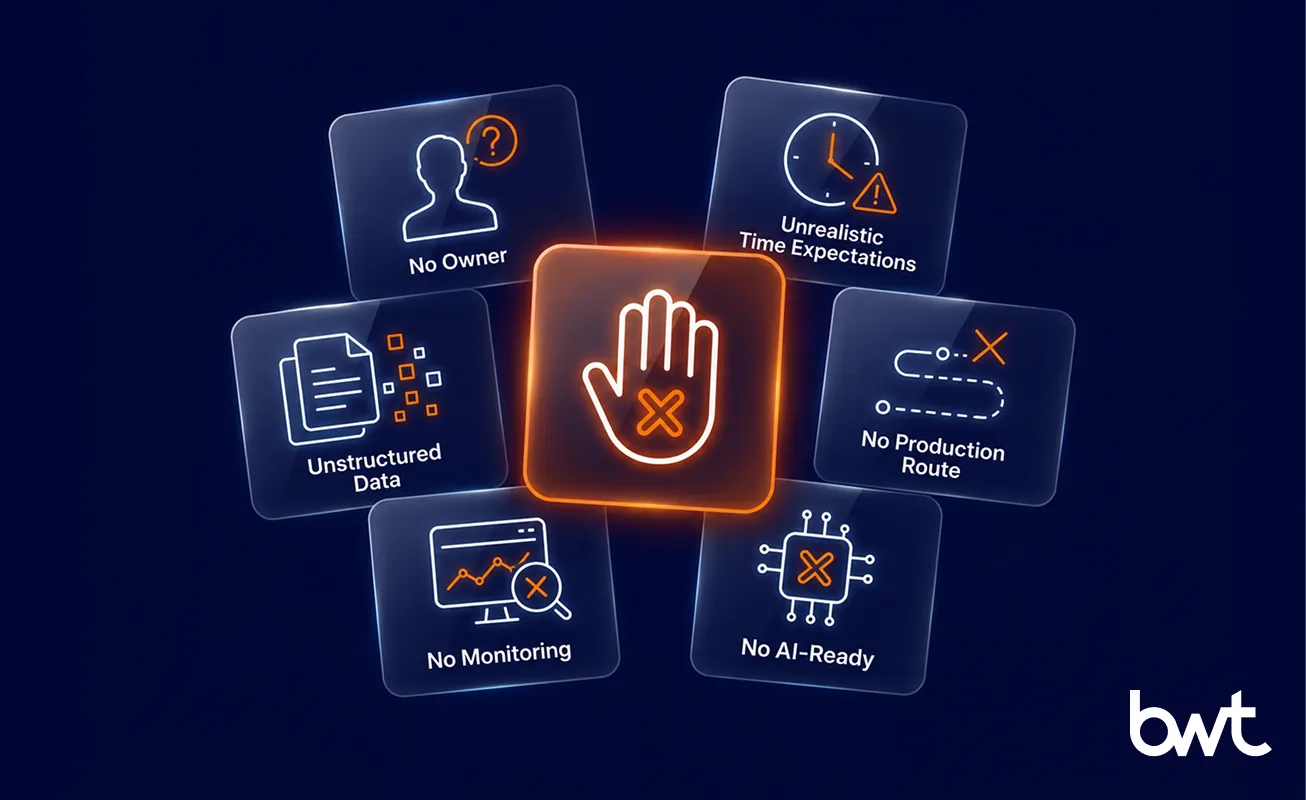 The model takes the blame because everyone can see it. The break sits earlier. RAND found that 84% of interviewed engineers and data scientists blamed leadership over technology: goals nobody agreed on, and success never defined. Six patterns hurt:
- No owner and no success metric. The pilot has no one to ship it, pause it, or shut it down.
- Expectations outrun the calendar. A board may fund one quarter of patience for work that still needs integration, sign-off, and adoption. Gartner saw the same pattern: 57% of I&O leaders reported at least one AI failure, often from expecting too much, too fast.
- Use cases are chosen backwards. A team falls for the technology it wants to try, then hunts for a business problem.
- The pilot has no production route. It runs on a laptop and a cleaned spreadsheet. Nobody has scoped refreshes, monitoring, permissions, or integration.
- The data is not AI-ready. It is siloed, unlabeled, missing lineage, or defined differently in every system.
- The model gets funded before the plumbing. Money goes into the visible piece while the system that carries its output remains imaginary.
Good artificial intelligence strategy and consulting names those failures before a line of model code is written.
AI readiness: the six dimensions to check before you scale
Before prioritizing use cases or drawing a roadmap, check whether the organization can actually carry AI. Readiness is not one score. It is six separate questions, and a weakness in any one of them caps what the others can achieve.
AI strategy consulting starts with a readiness check
- Business readiness. Can one sponsor name the problem, target number, and accountable owner?
- Data readiness. Is the data integrated, labeled, and traceable — or split across systems under conflicting definitions?
- Technology readiness. Can the current stack serve a model in production, or does it need the upgrade Google Cloud found 83% of organizations still need to run agentic AI?
- Team readiness. Who operates the system after launch, and do they exist yet?
- Governance readiness. Are access, audit, and privacy controls in place before sensitive data reaches a model?
- Operational readiness. Can the business absorb the change into daily work, or will people route around it?
Data readiness is where many programs discover they are not as ready as they thought. One European bank found the same customer living as four records across CRM, core banking, servicing, and support. Its Head of Digital Banking described the fix in plain terms: “There’s one profile now, and it’s the one everyone trusts.” GroupBWT built that single Customer 360 profile before any model could depend on it.
How an AI strategy engagement works
 A useful engagement produces more than a document. It produces decisions a delivery team can act on the next morning: what to build, in what order, on what data, owned by whom. That is where AI strategy consultation becomes useful, and it is the practical value of AI strategy and consulting.
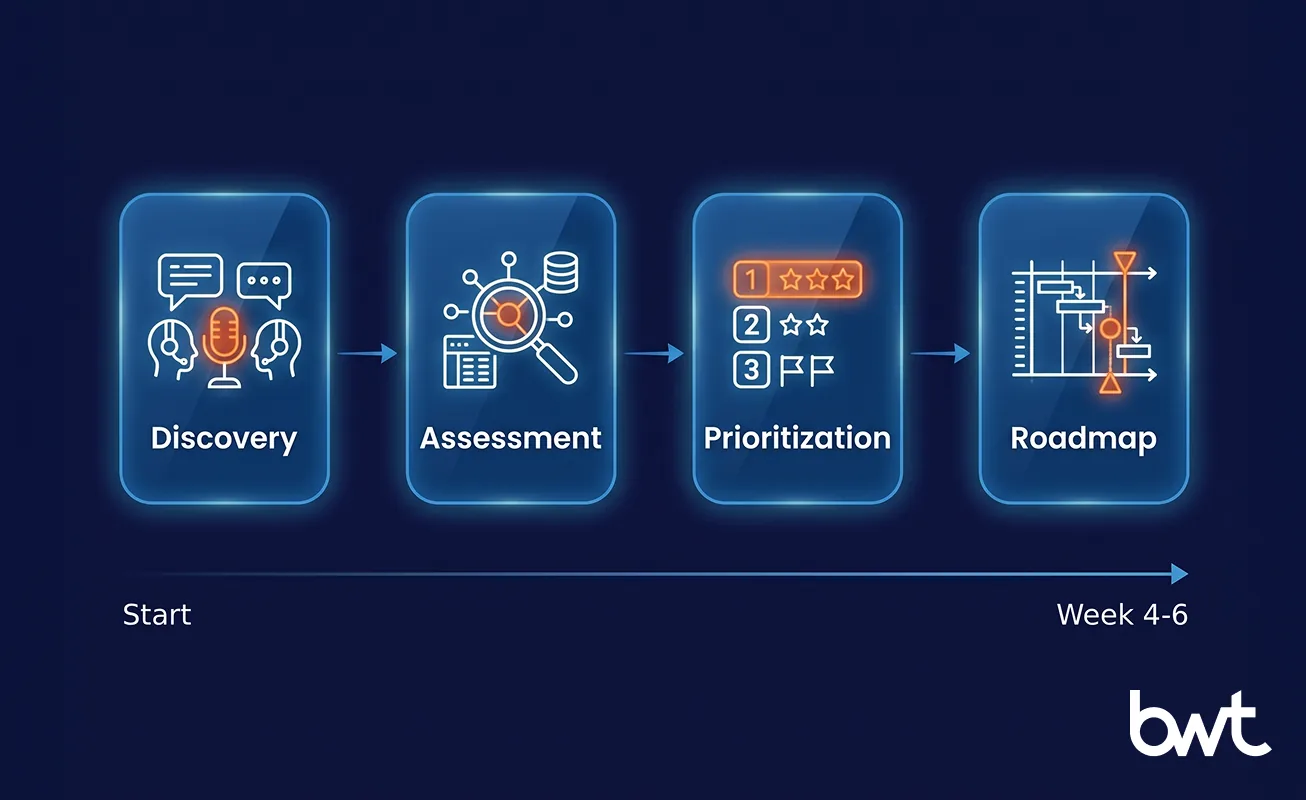
Four to six weeks is typical, with timing adjusted to data readiness and scope:
- Discovery. Executive interviews, stakeholder map, and target business numbers.
- Assessment. Data audit, architecture review, and six-dimension readiness check.
- Prioritization. Use-case workshops, scoring, and ranked shortlist.
- Roadmap. Executive roadmap, budget assumptions, owners, dependencies, and build order.
A serious engagement should leave six artifacts: readiness report, opportunity map, prioritized roadmap, architecture blueprint, ROI model, and board-ready presentation. AWS reported that 65% of its Generative AI Innovation Center customer projects moved from concept to production, some in 45 days. The same compression shows up when the foundation is ready. For one consulting firm preparing a pre-sale, GroupBWT built a high-fidelity executive dashboard — three views plus a conversational query screen — in seven working days because the data foundation had already been handled.
What a practical AI roadmap should include
A roadmap is not a list of ideas. It tells a sponsor what can be funded and tells delivery what can start. It should name business objectives, target KPIs, prioritized use cases, data gaps, architecture decisions, governance requirements, owners, budget, milestones, adoption work, and ROI gates.
| Roadmap horizon | Primary goal | Typical output |
| 0–30 days | Validate readiness and priorities | Assessment, shortlist, owners |
| 30–90 days | Prove one use case | Controlled pilot with measurable KPI |
| 3–6 months | Productionize | Integrations, governance, monitoring |
| 6–12 months | Scale | Additional workflows, teams, and business units |
These horizons are planning ranges, not guarantees. A clean data foundation can pull work forward; missing ownership, fragmented sources, or regulated data can move the same use case back.
Building the AI portfolio: scoring and prioritizing use cases
Most enterprises have dozens of AI ideas. A raw to-do list multiplies pilots without shipping. Sort ideas into Quick Wins, Strategic Bets, Innovation, and Moonshots. Then score each use case with enough dimensions to expose the trade-off.
Priority should combine expected value, data readiness, delivery feasibility, risk, ownership, and time to value. A use case with no owner or usable data should not enter the first pilot batch.
Part 1: Value & Feasibility
| AI use case | Business value | Data readiness | Delivery complexity |
| Predictive maintenance | High | High | Medium |
| Customer-support assistant | High | High | Medium |
| Internal knowledge assistant | Medium | High | Low |
| Autonomous decision agent | High | Low | High |
Beyond value and feasibility, evaluate each use case against risk, implementation speed, and ownership to determine final priority:
Part 2: Risk, Speed & Governance
| AI use case | Risk and compliance | Time to value | Owner / Priority |
| Predictive maintenance | Medium | Short | Operations / High |
| Customer-support assistant | Medium | Short | Customer service / High |
| Internal knowledge assistant | Low | Short | Knowledge management / High |
| Autonomous decision agent | High | Long | Not assigned / Low |
The autonomous decision agent is the instructive row. Its business value is high, yet it stays low priority because readiness is low, risk is high, and ownership is blank. Predictive maintenance lands high only because sensor and maintenance-log history already exist. Without that data, the same use case slides down.
Prioritization also depends on honest scoping. In a US retailer’s product-matching program with millions of SKUs, GroupBWT separated exact matches from like-item matches on day one. Own-brand products became their own retrieval problem, and accuracy was reported by category on held-out data instead of hidden behind one flattering number.
Who owns AI: the operating model and change management
 A roadmap answers *what* and *when*. It still has to answer *who*. Without that owner, the program drifts between sponsors, data teams, legal, and whichever department is loudest that month.
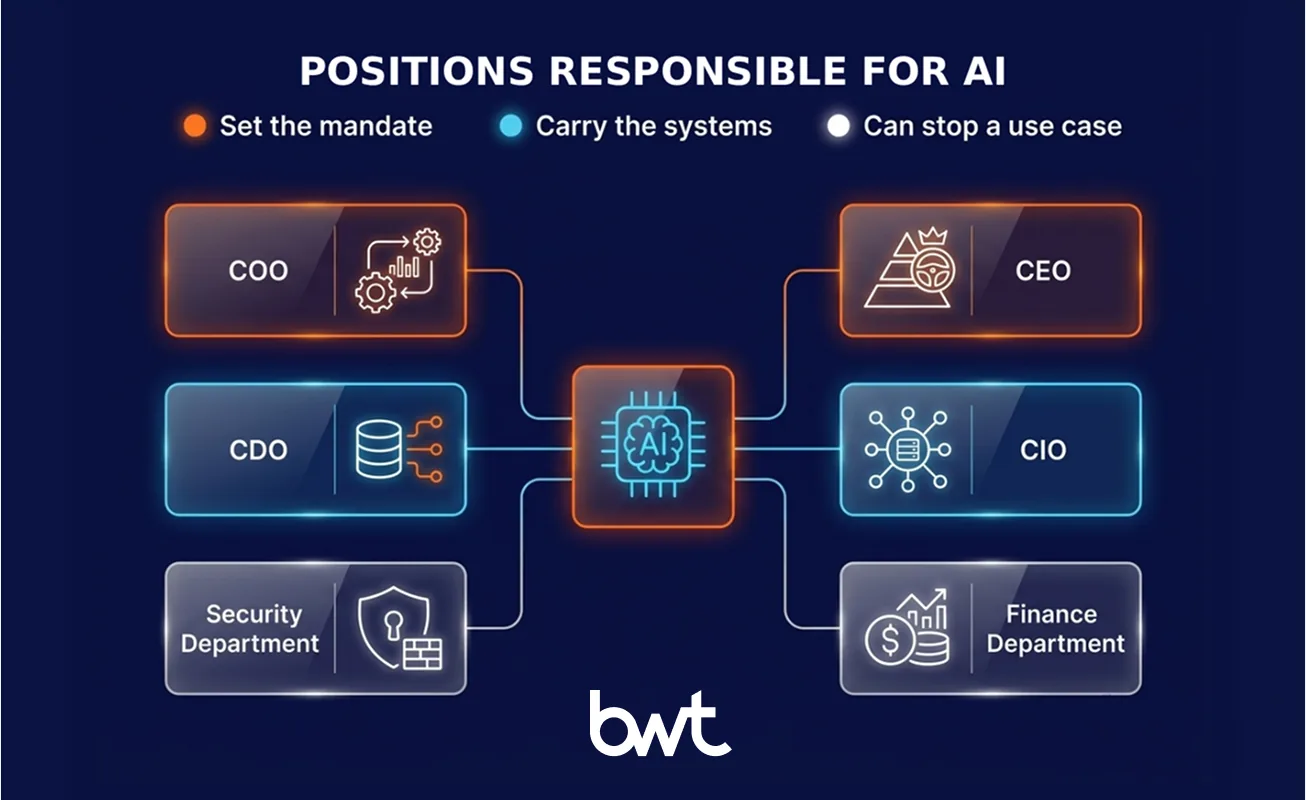
The first map is not technical. It is the veto map. An enterprise AI initiative pulls in the CEO and COO who set the mandate, the CIO and CDO who carry the systems, and finance, legal, and security, who can each stop a use case for a different reason. Alignment is a named decision path.
Then comes adoption. An accurate model still gets ignored if people distrust a recommendation they cannot interrogate. Put ownership, training, human review, and a staged rollout into the roadmap. The Customer 360 work above was as much an alignment win as a technical one. Once relationship managers stopped arguing about which record was true, adoption followed.
Also Read: Data Readiness for AI: A Practical Guide for Data Leaders
The data foundation behind every AI strategy
This is where strategy touches engineering without becoming a data-engineering brief. Does the organization have data a model can use tomorrow — integrated, clean, traceable, and served in the shape the use case needs? If not, the roadmap has to fund that work before another model.
The electric-motor manufacturer is the clean example. Its engineering knowledge sat across six disconnected systems, more than 3,600 motor variants, CAD files, R&D folders, spreadsheets, and Microsoft 365. Engineers could lose an hour looking for one drawing, and critical CAD parameter tables were stored as graphics. Its Technical Director put the risk plainly: “If I close my eyes, the data is all in my head — but it’s nowhere else.” GroupBWT started not with a model but with one search layer across all six systems, because knowledge had to become usable before AI could reason over it.
In regulated work, the same decision shows up as auditability. For a multinational pharmaceutical company, GroupBWT unified seven pipelines and 22 source schemas into a pharma-grade warehouse with full audit lineage. The reporting cycle moved from 18.2 days to 4.1 days. LLM pilots for protocol Q&A and safety-signal validation could then run on traceable data instead of scraped folders.
“A strategy that skips the data layer is a wish list,” says Dmytro Naumenko, CTO at GroupBWT. “We start with the foundation because that is the only thing every later decision — the model, the architecture, the governance — has to stand on. Fix the data, and mediocre models start earning their keep. Skip it, and the best model on the market produces confident nonsense.”
AI architecture decisions to make early
Architecture becomes urgent when a pilot has to touch customer data, stay inside a region, answer in three seconds, or explain itself to security. Google Cloud also found that 79% of technology leaders name security, governance, and MLOps as their top scaling-inference challenge. The roadmap does not solve every design question. It names the choices that change budget or risk.
| Approach | When it fits | Trade-off |
| Suite-embedded assistant | Generic capability already lives inside a tool you own | Little control, little differentiation |
| Vertical SaaS module | A vendor already solves the workflow | You inherit their data model and roadmap |
| Custom RAG on proprietary knowledge | Your advantage is your own documents and data | You own quality and upkeep |
| Custom ML model | The problem is specific and no product fits | Highest cost and talent need |
The shortlist should read like a risk register, not a model leaderboard. Data residency decides where the system can run. Cost per task decides whether it can run often. Latency decides whether users wait. Lock-in decides whether the next model swap is a weekend task or a procurement fight.
From pilot to production: where strategy is really tested
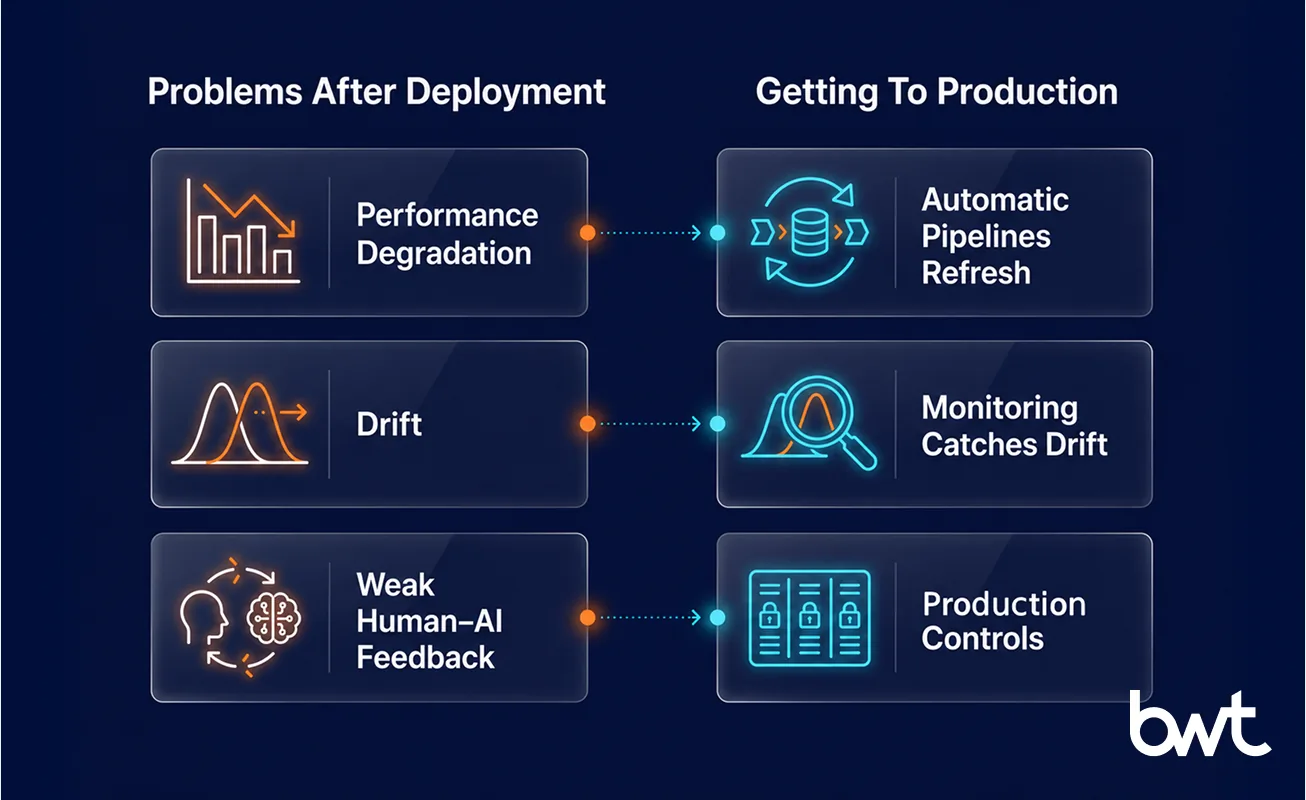 A pilot proves an idea can work once. Production proves it keeps working on Monday, on real data, under load, when the person who built it is on vacation. [NIST](https://www.nist.gov/news-events/news/2026/03/new-report-challenges-monitoring-deployed-ai-systems) names the hard monitoring problems that show up after deployment: performance degradation, drift, and weak human–AI feedback loops.
Getting to production means planning pipelines that refresh without a human, monitoring that catches drift, controls an auditor will accept, and a named owner after launch. Sometimes the right strategic answer is that a system should stay a prototype. The demo-safe credit-scoring tool GroupBWT built for a regulated-finance advisor — a working prototype on synthetic behavioral data — was designed to prove a point in the room, not to run bank decisions.
“Most teams design for the demo and discover production the hard way,” says Alex Yudin, Head of Data Engineering at GroupBWT. “The questions that decide whether a model survives — where does the data come from tomorrow, who notices when it drifts, who owns it at 2 a.m. — never come up in a pilot. We put them in the roadmap on purpose, because that is the day the model actually has to earn its place.”
AI governance: scaling without losing control
Governance gets real in the audit room. Compliance has to replay the decision: source value, data touch, fired rule, and reason for the recommendation or escalation. The pharma warehouse could answer because every value traced back to a source, timestamp, and transformation. A bank’s fraud-review pipeline earned a spot in a Tier-1 compliance stack the same way: every classification carried trace metadata a regulator could inspect, and reviewers spent their time on the risky 1% instead of combing through noise. Under the EU AI Act and GDPR, that evidence stretches into representation checks, impact assessments, and access controls. For heavily regulated work, GroupBWT treats artificial intelligence strategy consultation as the place to name those duties before the pilot starts.
Measuring ROI from AI
Start with the business metric, not model accuracy. AI ROI = measurable business value − implementation, infrastructure, maintenance, adoption, and risk costs. Optimizing for accuracy alone is a documented trap: a peer-reviewed evaluation framework found that accuracy-first agents can be 4.4 to 10.8 times more expensive than cost-aware alternatives.
| AI use case | Primary business KPI | Cost metrics | Risk metric |
| Support assistant | Resolution time, ticket deflection | Cost per resolved request | Incorrect-answer rate |
| Fraud detection | Review time, losses prevented | Cost per transaction reviewed | False negatives |
| Predictive maintenance | Downtime avoided | Cost per monitored asset | Missed failure rate |
| Document assistant | Search time saved | Cost per accepted answer | Citation accuracy |
| Forecasting | Forecast error, inventory reduction | Cost per forecast run | Over/under-forecast risk |
Measured this way, the numbers get concrete. For a European cybersecurity provider, GroupBWT replaced rule-based detection with AI triage that cut false alerts by 85% and reduced operational costs by 18% within a year. The value was noise removed and money saved, not a prettier model score. In banking, GroupBWT’s multilingual NLP pipeline cut fraud-review time by 61% across more than two million daily transactions and five languages; reviewers focused on the small share that carried real risk.
What shapes the engagement scope and how to choose a partner
What changes the scope of work
Two companies can ask for the same roadmap and buy different work. Spend changes with readiness depth, business-unit count, architecture complexity, compliance load, and where the handoff stops. A strategy-only engagement is lighter up front and heavier later. A delivery-tied AI strategy consultancy costs more because it prices the production route, not just the workshop.
Common engagement models
The common models are a readiness assessment, opportunity workshop, enterprise roadmap design, and strategy-to-implementation partnership. A narrow AI strategy consultation fits when usable data, named owners, and governance constraints are already clear.
In-house vs external strategy help
| Factor | In-house | External consultant | Hybrid |
| Business context | Strong | Requires discovery | Strong |
| Technical breadth | Depends on team | Broad | Broad |
| Speed | Often slower | Faster | Fast |
| Independence | Internal bias possible | Higher objectivity | Balanced |
Mature AI teams often need a second opinion, not a replacement team. Early teams need outside breadth because they have not built the patterns internally. Hybrid usually lasts longest: the external partner brings the frame, and an internal owner learns enough to keep the roadmap moving.
Choosing an AI strategy consulting company
Production evidence is the strongest signal. Ask a partner to walk through one AI project that reached production and explain the unglamorous parts: who owned the pipeline, how monitoring worked, what changed after the roadmap, and who carried delivery. The real test is what still runs after sign-off.
Questions to ask before hiring
Before signing with any AI strategy consultant, ask five questions out loud. Which use cases would you fund first? What data has to be fixed before the first pilot? How does a demo become a production system? Which business metric proves ROI? What would make you tell us AI is not the right solution? The motor manufacturer above had licensed a single-user data module and dropped it on GroupBWT’s advice — proof that good AI strategy consultants will talk you out of the wrong tool, not just sell you a new one.
Common mistakes to avoid
Flip the mistakes that kill pilots and you land on the best AI consulting strategies for business growth. Start with problems, not tools. Run a few pilots well rather than many badly. Fix data readiness before scaling. Put an owner on every use case. Track business outcomes, not model accuracy. Budget for integration and maintenance. Decide governance at the first stage, so it never lands as a final-stage patch.
AI Strategy Consulting by Industry
Manufacturing
Retail and E-Commerce
Financial Services and Fintech
Healthcare and Life Sciences
Logistics and Supply Chain
SaaS and Technology
Why GroupBWT starts with data and business value
Every competitor sells AI strategy as a slide deck. Ours has to survive production: readiness before implementation, data before model scaling, business-impact prioritization, architecture for real traffic, governance in the roadmap, and delivery teams tied to the plan. AI consulting & strategy development works only when the plan is written by people who understand the system that will carry it.
The proof is in the work above: a six-system motor-manufacturing search layer, pharma reporting cut from 18.2 to 4.1 days, one trusted Customer 360 profile, a seven-day dashboard because the data foundation was ready, and a credit-scoring prototype kept deliberately out of production.
We are also honest about fit. If you want a sixty-page strategy document with no implementation plan, we are not the right partner.
“The clients who get value from AI treat it as an operating decision, not a science project,” says Oleg Boyko, COO at GroupBWT. “We start with data and business value because that is where the return comes from. A model is a means. The question we keep asking is which business number moves, by how much, and who owns it once the consultants go home.”

Final thoughts
A strong AI program starts by choosing funded problems and proving the data can carry them. The roadmap names owners, sequence, and numbers. Done in that order — readiness, prioritization, ownership, data, architecture, ROI — artificial intelligence strategy consulting stops being a slide deck and becomes the reason your next pilot ships. If that is the gap, AI consulting services built around production evidence start a serious AI strategy consulting engagement.
It turns the AI mandate into a funded build sequence: readiness, use-case ranking, data and architecture design, and ROI before kickoff. A signed strategy proves little until it survives Monday production.
Firms that pair business strategy with real technical delivery. Ask for shipped AI, not a portfolio of pilots.
Large organizations carry heavier legacy systems, governance, stakeholder maps, and procurement. Enterprise strategy needs integration, architecture decisions, and a written operating model before use-case choice.
Firms that treat data readiness and pipeline engineering as the first deliverable. Ask how sources were unified, where lineage lived, and what shape the data had to take before a model could use it.
Choose production evidence, data-engineering depth, architecture judgment, and honesty about when AI is not the right answer. Sales polish is not enough.
Read summarized version with
Build the Data Foundation
We develop and manage custom data solutions, powered by proven experts, to ensure the fastest delivery of structured data from sources of any size and complexity.