Read summarized version with


At the start of a shift, a pump bearing may look normal while its vibration reveals developing wear. That lead time matters only if maintenance can identify the pump, understand its operating conditions, find a feasible window, and know what to inspect.
AI for predictive maintenance in manufacturing works as a connected system, not a model alone. GroupBWT turns equipment, maintenance, and production data into warnings teams can schedule and act on. The system must fit the asset, failure mode, plant systems, and maintenance window.
Manufacturing AI Services
Turn Plant SignalsInto Maintenance Decisions
GroupBWT connects equipment data, predictive models, and maintenance workflows around the assets that put production at risk.
The work can cover:
- Failure-mode and asset scoping
- PLC, SCADA, MES & maintenance-data integration
- Model validation and production monitoring
Factory conditions make this different from a generic prediction problem. Assets fail in different ways, and their readings change with speed, recipe, load, tooling, startup, and changeover. The system must connect plant data and model output to maintenance work. The real test is whether a warning arrives early enough to change work on the floor.
Key Takeaways
- Begin with a costly or disruptive failure. Check that the plant can see it coming and still complete a useful maintenance action.
- Interpret equipment signals inside the current load, speed, recipe, material, shift, tooling, startup, and maintenance context.
- Keep authority where those responsibilities already reside: the control layer runs equipment, while MES, CMMS/EAM, and ERP typically retain authoritative production, maintenance, material, and cost records.
- Measure warning quality, missed failures, lead time, and review workload – not one accuracy score.
- Validate each new line or plant on local evidence before accepting alerts into maintenance work, using time-separated validation where enough history is available.
- Attribute business impact only after a warning changes a completed maintenance action and other plausible causes of the resulting plant outcome have been accounted for.
What Is AI Predictive Maintenance in Manufacturing?
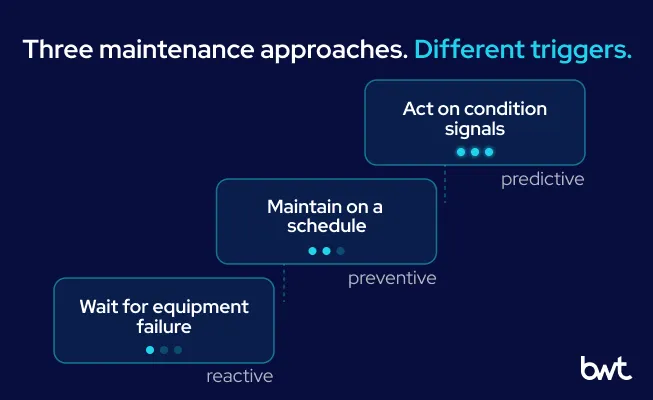
AI for predictive maintenance in manufacturing changes the trigger for work. Reactive maintenance waits for failure. Time- or usage-based preventive maintenance uses a calendar, runtime, or cycle count. Predictive maintenance uses measured condition and estimated risk to adjust when the plant inspects or repairs an asset. It does not always require a remaining-useful-life forecast: anomaly detection can provide an early condition warning, while the maintenance workflow determines whether and how the plant should act.
| Approach | Primary trigger | Best plant fit | Main trade-off |
| Reactive | Equipment failure or unacceptable loss of performance | Cheap, non-critical, replaceable assets | Accepts interruption and possible secondary damage |
| Preventive | Date, runtime, cycle count, or mandated interval | Age-driven wear, inspections, regulated work | Can replace healthy parts or miss early degradation |
| Predictive | Condition signal interpreted against current operation | Critical assets with observable precursors and time to respond | Needs reliable context, validation, and a named response owner |
The three approaches can coexist. Mandated inspections stay on schedule. A low-cost, non-critical asset can run to failure when that failure is safe and unlikely to damage anything around it. Prediction belongs where wear leaves a trace and maintenance still has time to respond.
For plant teams, AI predictive maintenance manufacturing work starts with one choice: which consequential failure should the warning help prevent? The next step is to find the signal that moves first and name the maintenance action it should trigger. If no feasible action changes, the project is monitoring without a maintenance decision.
The broader guide to how AI is used in manufacturing compares predictive maintenance with quality vision, forecasting, and production optimization. This guide stays with the maintenance path from an asset signal to a measured plant outcome.
Dmytro Naumenko frames the decision boundary this way.
"Do not start with the model. Start with the maintenance decision that must change before the line stops. If the plant cannot name that decision and the time available to make it, prediction has no operational target." — Dmytro Naumenko, CTO at GroupBWT
Which Equipment and Failure Modes Fit Predictive Maintenance?
A machine name tells you little about predictive-maintenance fit. Start with the failure that would materially affect production, safety, quality, or maintenance cost. Then ask whether the plant records a reliable early signal and still has time to inspect or repair the asset.
| Equipment and failure mode | Possible observable signals | Operating-context caveat | Maintenance use |
| Motor or pump bearing wear | Vibration spectrum, temperature, current | Speed, load, alignment, lubrication, and mounting change the baseline | Inspect bearing and lubrication before seizure |
| CNC spindle or cutting-tool wear | Vibration, acoustic emission, spindle current, force | Tool type, material, feed rate, and program alter normal behavior | Plan tool or spindle inspection before quality drifts |
| Conveyor belt, roller, or gearbox degradation | Motor current, vibration, temperature, speed | Product weight, jams, starts, and stops create legitimate variation | Inspect drive, alignment, or roller during a planned stop |
| Robot joint or gearbox wear | Torque, position error, vibration, cycle time | Payload, path, acceleration, and end effector affect the signal | Check the joint before precision or cycle time degrades |
| Compressor degradation | Pressure, temperature, vibration, motor current, flow | Setpoint, duty cycle, inlet condition, and ambient temperature matter | Inspect valves, seals, bearings, or the drive system |
| Hydraulic pump, valve, or accumulator degradation | Pressure, flow, temperature, vibration | Duty cycle, fluid condition, load, and ambient temperature matter | Trace leaks, valve wear, or component degradation |
A 2025 Scientific Reports study used 10 kHz vibration for rotary machinery but 100 Hz pressure, temperature, and flow for a hydraulic system. Those experimental rates are not a universal recipe. The study also warns that models trained under specific operating conditions may lose performance in unseen conditions, so each plant must validate its signals and model locally.
This is where predictive maintenance AI manufacturing work earns its depth. Sampling cadence should follow the failure mechanism, not the highest rate the sensing stack can produce. A slow temperature rise may need minutes of history, while a bearing feature may need high-frequency vibration. Maximum-rate collection can raise cost without improving the warning.
An AI predictive maintenance manufacturing example should name the machine, failure, signal, operating context, warning window, and response. “We monitor motors with AI” proves little. A pump-vibration warning evaluated under comparable speed and load, then routed for inspection before a planned stop, is specific enough to test.
Operating Regimes Decide Whether an AI Warning Is Useful
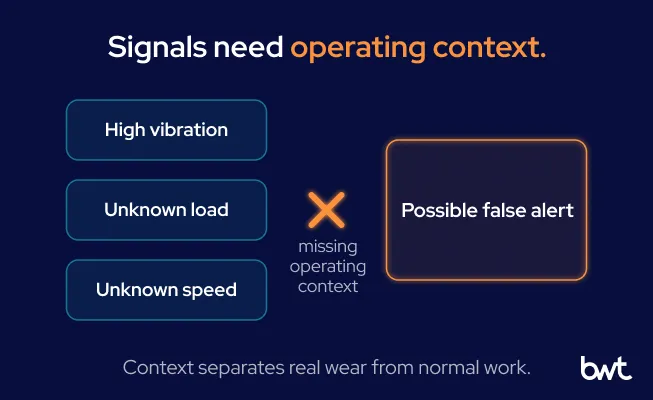
A healthy machine does not produce one permanent baseline. Current, vibration, and compressor behavior change with load, material, feed rate, and operating state. Without that context, routine production shifts can look like wear while genuine deterioration disappears into expected variation.
Separate degradation from a valid production-state change
Build comparable baselines around the states that materially change equipment behavior. This does not require a model for every recipe. It does require enough context to distinguish a signal shift caused by work from one caused by wear. Manufacturing Execution System (MES) events, controller states, and production orders often supply that missing explanation.
"A sensor value becomes useful only after the plant can say which asset produced it, under which load, during which operation, and after which maintenance event. Otherwise, the model is precise about a context nobody can reconstruct." — Alex Yudin, Head of Data Engineering at GroupBWT
Set the required warning horizon around real maintenance constraints
Define the required warning horizon before modeling: how early must the plant know to inspect the asset, reserve a part, assign labor, clear safety requirements, and secure a production window? After deployment, measure the realized warning lead time from the first qualifying warning to the target failure or unacceptable condition. Separately, measure whether the warning arrived before the latest feasible intervention point.
A same-shift warning may help for a stocked part and a quick repair but arrive too late for a custom spindle with a long supplier lead time. What matters is whether the plant can intervene inside the available window.
Measure warning quality and workload, not accuracy alone
Define each measure before the pilot in language maintenance and operations teams can use.
| Measure | Business question |
| Confirmed-alert precision | Of the reviewed alerts, how many pointed to a confirmed condition? |
| Miss rate | How many relevant failures happened without a useful warning? |
| False-alert burden | How often does maintenance investigate behavior that turns out to be normal? |
| Warning lead time | Did the warning arrive early enough to act? |
| Review workload | How much technician time does the system consume? |
Predefine and version the labels, eligible events, exposure basis, and timing endpoints before evaluation so the answers remain comparable. Report how many alerts were actually reviewed, separate still-open work from completed work, and normalize false alerts by monitored exposure rather than presenting a raw count. “Actionable accuracy” can hide those denominators: a confirmed condition may still offer no feasible action, while a sensitive model may swamp maintenance with review work.
How PLC, SCADA, MES, CMMS, and ERP Support Predictive Maintenance
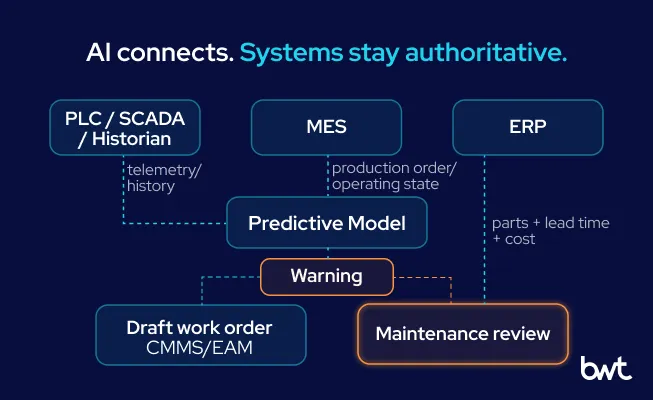
AI in predictive maintenance manufacturing environments crosses systems built for different jobs. Equipment control remains with the Programmable Logic Controllers (PLCs) and Distributed Control Systems (DCSs). Approved interfaces expose the equipment state and process variables needed by the maintenance workflow. Supervisory Control and Data Acquisition (SCADA) is where operators supervise and interact with the process. The historian preserves telemetry over time. MES often explains the job running at that moment. Repair findings typically reside in the Computerized Maintenance Management System (CMMS) or Enterprise Asset Management (EAM) platform, while ERP or the plant’s maintenance/materials system can answer whether the required part is available, its lead time, and its cost.
| System | Contribution to the warning | Responsibility that typically remains there | Common gap |
| PLC or DCS | Equipment state, alarms, setpoints, and process variables | Deterministic control logic; safety functions remain in the designated safety layer | Tags may lack stable asset and operating-regime context |
| SCADA and historian | Supervisory context and time-series operating records | Authorized supervisory operation in SCADA; retained telemetry in the historian | Clock, tag, and asset mappings may not align with production events |
| MES | Production order, route, product, batch, genealogy, changeover, and execution context | Production execution records where MES is the plant’s system of record | MES events may not align cleanly with controller time |
| CMMS or EAM | Work orders, inspections, failure codes, technician findings | Maintenance records and released work where those responsibilities already reside | Labels are vague, late, duplicated, or never closed |
| ERP | Parts, supplier lead time, inventory, purchasing, cost | Material and financial records where ERP is authoritative | Asset and part identifiers differ from plant systems |
Keep records and operational actions in their authoritative plant systems. The predictive workflow should read the required context, preserve source identity, and return its warning through a controlled integration.
In an adjacent AWS case account, investigators in one paint shop worked from SCADA and MES data joined with downtime records, engineering documents, and process documents. For that paint shop alone, AWS reported that investigations which had taken two to four hours were completed in minutes, while mean time to repair dropped by 20%. The figures are not general predictive-maintenance benchmarks.
A first pilot should limit its scope to the inputs needed to detect or explain the target condition, provide the relevant operating context, and confirm the outcome. Resolve asset identity, source quality, and lineage in the separate AI-ready data workstream.
Put processing where the decision requires it
Use edge processing when latency, connectivity, network segmentation, or raw signal volume makes cloud-only processing impractical; Microsoft Research identifies reliable connectivity and local processing as enablers for industrial AI workloads. Central processing remains suitable when strict local latency is not required and the analysis benefits from longer history or data across assets.
Legacy equipment may contribute through an external sensor, approved gateway, or historian export, depending on the failure mode and OT security policy. Safety functions stay in designated control and safety systems; a predictive model is not a safety-control path.
Also Read: AI-Ready Data for Manufacturing: Prepare Plant Data
Turn an Accepted Warning Into Maintenance Work
A warning creates value when it can be reviewed, translated into feasible maintenance work, and fitted around production. The reviewer needs the asset, suspected condition, evidence window, operating regime, uncertainty, consequence of waiting, and latest feasible intervention point.
A controlled workflow can follow this path:
- The model creates a timestamped warning for a named asset and the condition or failure mode it is designed to detect.
- A maintenance owner reviews the evidence and records an accepted, rejected, or escalated disposition with a reason.
- For an accepted warning, the integration creates a draft maintenance notification or draft work order in the CMMS or EAM; it does not release the work automatically.
- Maintenance, production, and, where required, safety and quality roles assess parts, labor, permits or isolation, product risk, and a feasible work window.
- The authorized maintenance role releases the work, while any production-schedule change follows the plant’s designated approval process. In this control pattern, the predictive model does not command equipment or independently alter the production schedule.
- The technician closes the work with findings, applicable condition or failure codes, labor, and parts used. Accepted, rejected, escalated, and completed outcomes return to the evaluation record.
Keep approval responsibility explicit. The model may rank risk and prepare evidence, but shutdowns and schedule changes need the plant’s established authority. Generative AI may summarize service instructions or notes, but it does not validate the warning.
GroupBWT’s predictive-maintenance case for an industrial pump manufacturer shows an engineer-controlled handoff. GroupBWT built on existing SCADA, PLC, and IoT infrastructure; one agent checked SAP for parts and work orders, while another checked Siemens Opcenter MES for production constraints. Neither could release work or change a schedule without approval.
Oleg Boyko captures the business test.
"Downtime does not fall because a dashboard found an anomaly. It falls when maintenance receives enough evidence to act, production can release the asset, and the repair fits a real operating window. Measure that chain, not the alert count." — Oleg Boyko, CCO at GroupBWT
Pilot One Asset Family, Then Validate Every Expansion
A bounded pilot limits the variables the plant has to explain. Choose one asset family, one consequential failure mode, one maintenance response, and one owner. Set the evaluation period, comparison basis, and acceptance measures before tuning the warning threshold.
What the pilot should prove
A practical pilot moves through five decisions:
- Select the asset family, target failure mode or condition, and maintenance action.
- Audit whether the available signals, asset identity, operating context, and outcome records support that question.
- Establish a baseline and validate warnings in shadow mode or another controlled review process.
- Connect accepted warnings to the maintenance system without bypassing plant permissions.
- Decide whether warning quality, realized lead time, review workload, and ongoing operating effort justify expansion.
Pilot timing depends on sensor history, failure frequency, equipment access, and integration scope. When disconnected plant systems are the blocker, GroupBWT is a data engineering company that connects the required equipment, production, and maintenance records. For the broader model lifecycle, ML consulting services cover custom development and production monitoring.
Do not assume the model will work on the next line
A model that works on one motor family does not automatically transfer to another. Firmware, sensor placement, load, product mix, maintenance practice, and environment can move the signal distribution, even between nominally identical machines.
Treat each materially different line, asset population, or plant as a local validation step:
- Confirm the asset version, sensor definitions, units, cadence, placement, and operating regimes.
- Evaluate the frozen model on held-out local data before tuning it, using time-separated data where enough history is available, and identify missing signals or operating conditions the first deployment did not contain.
- Review alerts and relevant failures with the local maintenance team. If too few events exist, report insufficient evidence instead of a confident percentage.
- Tune only on a designated period, confirm the result on separate data, and continue monitoring after production changes, sensor replacement, firmware updates, or major repair.
At multi-line or multi-plant scale, predictive maintenance gains leverage from repeatable data definitions and evaluation rules, not from copying one model everywhere. Shared features or model components may transfer, but operational acceptance should be based on evidence from the population where the system will run.
Cross-plant scale also depends on consistent asset, failure, and work-order definitions. The guide to data management in manufacturing covers the broader asset, identifier, governance, and cross-system consistency required for that scale. Here, the narrower requirement is that every warning and outcome maps to the same equipment identity and failure definition across the population being compared.

How to Measure Predictive Maintenance ROI and Plant Impact
AI predictive maintenance manufacturing benefits should follow a causal chain. Start with warning quality and lead time. Confirm that maintenance accepted the finding, completed a different action because of it, and recorded the condition found. Only then attribute changes in downtime, repair type, labor, parts, or production outcomes to the predictive-maintenance workflow.
| Measurement layer | Useful measure | What it answers | Attribution caution |
| Warning | Confirmed-alert precision, adjudication coverage, miss rate, false alerts per 1,000 asset-hours, warning lead time | Did the system find relevant conditions early enough? | Predefine and version labels, denominators, exposure basis, and warning window before evaluation |
| Maintenance action | Accepted dispositions, warning-to-action conversion, completed interventions within a defined window, open-work share, emergency repair share | Did the warning change maintenance work? | Separate condition confirmation, acceptance, and completion |
| Asset reliability | Downtime hours, Mean Time Between Failures, Mean Time to Repair | Did the asset fail less often or recover faster? | Record production and maintenance changes outside the model |
| Plant result | Availability, throughput, quality, Overall Equipment Effectiveness | Did production improve? | OEE also includes performance and quality losses unrelated to maintenance |
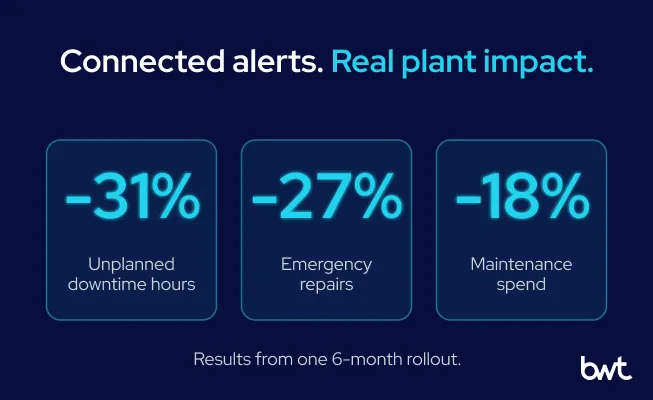
In the published pump-manufacturer predictive-maintenance case, GroupBWT’s two agents turned equipment alerts into repair work that fit the production schedule. Connecting those alerts to schedulable repair work helped the manufacturer cut unplanned downtime hours by 31% across 14 monitored lines against the previous six-month period. That connected workflow also helped the manufacturer complete 27% fewer emergency repairs and lower maintenance spend by 18%. The manufacturer reached its downtime and maintenance-cost targets six months into this rollout. These are results from one engagement, not industry benchmarks.
For predictive maintenance AI ROI manufacturing teams should separate absolute value from percentage return. Net benefit is monetized benefit minus total program cost over the same period; ROI divides that net benefit by the cost base. Do not monetize downtime, throughput, or OEE movement without a defensible financial consequence. Include integration, deployment, monitoring, and operating costs from the measured period.
The system should not receive credit for every change after launch. A redesigned preventive schedule, new spare-parts policy, production slowdown, or overhaul can move the same measures. Keep a baseline, record interventions, and compare periods or asset groups with similar exposure, product mix, and production conditions. A bounded rollout with a comparable observation group or later cohort strengthens attribution.
AI for predictive maintenance in manufacturing should scale only when warnings lead to feasible maintenance actions and the evidence supports an operational benefit. If the system produces interesting scores but does not change inspections, planning, or maintenance work, fix the workflow or reconsider the use case.
Planning a predictive maintenance pilot? Bring one critical asset family, its failure history, available signals, and the systems holding maintenance and production context. GroupBWT provides ai consulting for manufacturing to assess whether that evidence supports a useful warning and define the next validation step.
A factory needs condition signals tied to stable asset identities, timestamps, and relevant operating states. Maintenance records add inspections, failure codes, actions, and technician findings; production systems explain load, product, batch, and schedule. Parts and cost data matter when the warning affects purchasing or ROI. The target failure and maintenance decision define the minimum dataset.
Look for an asset whose failure has a meaningful consequence, leaves a recordable early signal, and allows time to act. That can fit a pump, CNC spindle, conveyor, compressor, or robot, but the machine category alone proves nothing. A cheap, non-critical motor may safely run to failure, while one bottleneck spindle can justify detailed monitoring. Start with the consequence and warning window.
Time- or usage-based preventive maintenance is triggered by a calendar date, accumulated runtime, or completed cycle count. Predictive maintenance changes the timing using measured condition and estimated risk. Plants often need both because mandated inspections and age-driven tasks remain scheduled even when equipment is monitored. Prediction earns its place where degradation is observable and timing can change safely.
No universal percentage makes a warning useful. Evaluate confirmed-alert precision with review coverage, miss rate over eligible failures, false alerts per monitored exposure, warning lead time, and workload. An occasional alert may be acceptable for a critical asset but overwhelm maintenance across hundreds of non-critical assets. Validate the decision, not one model score.
Some bounded pilots fit an 8-12-week plan, but the range is not a universal commitment. Timing depends on sensor history, failure frequency, equipment access, label quality, and integration scope. A pilot should end when enough warnings and relevant failures have been reviewed to judge lead time, workload, and maintenance usefulness.
Not always. Fixed thresholds, statistical condition monitoring, or deterministic rules may be enough for stable failure signatures. AI becomes useful when signal patterns, operating context, or failure relationships are too variable for simple rules. The plant should choose the least complex method that produces a reliable warning early enough to change maintenance work.
Read summarized version with
Manufacturing AI Services
Turn Plant SignalsInto Maintenance Decisions
GroupBWT connects equipment data, predictive models, and maintenance workflows around the assets that put production at risk.
The work can cover:
- Failure-mode and asset scoping
- PLC, SCADA, MES & maintenance-data integration
- Model validation and production monitoring