Read summarized version with


The pilot looked ready. A predictive-maintenance model, trained on two years of sensor history, caught a failing bearing in the demo, and the plant signed off. Three weeks into production it went quiet. The math was fine. The break was in the names: “machine 12” pointed at one asset in the ERP, a different one in the maintenance log, and nothing the PLC stream recognized when it fed the model at 2 a.m.
That gap is where most factory AI stalls. The model is the last 10% of the work; the first 90% is getting a plant’s systems to agree on what happened. AI-ready data for manufacturing is plant data connected across systems, then cleaned, labeled, and governed to the point where a model — or the analyst double-checking it — trusts the number without re-opening the source. That is a data engineering job long before it is a data-science one. It is the part GroupBWT builds for manufacturers: the integration layer, the governed store, and the validation gates that pull ERP, MES, and plant-floor sensor data into one foundation a model can stand on.
Build the Data FoundationnYour AI Models Need
We develop and manage custom data solutions, powered by proven experts, to ensure the fastest delivery of structured data from sources of any size and complexity.
We offer:
- Custom Web Scraping & Development
- 15+ Years of Engineering Expertise
- AI-Driven Data Processing & Enrichment
The guide runs in order. Why AI projects fail on data before they fail on models. What data a plant actually needs. The requirements that make it usable, the architecture that holds it, and seven steps to prepare it. A checklist at the end lets you grade your own floor. Read it as a working definition of data readiness for AI in manufacturing, not a vendor pitch.
Key Takeaways: What Manufacturers Need Before AI Can Work
- Connected systems. Before a model reads anything, the ERP, MES, SCADA, PLC, historian, and IoT feeds have to land in one place. AI-ready manufacturing data starts with integration, not algorithms.
- Clean, governed data. A validation gate that blocks a bad reading before it reaches a report matters more than a bigger model does.
- Historical depth with labels. A predictive model learns from confirmed failures. No failure history means starting with anomaly detection instead.
- The right latency per decision. A safety interlock needs sub-second data; an OEE dashboard does not. Cadence follows the decision, not a default.
- Clear ownership and lineage. Every number an executive or a model trusts should trace back to a source. A manufacturing data foundation is only as reliable as its worst-governed feed.
Why AI Projects in Manufacturing Fail Without the Right Data Foundation
When an AI initiative dies on a factory floor, the autopsy rarely blames the algorithm. It blames data nobody could stand behind. Adoption is still early across the whole economy — the Federal Reserve’s Monitoring AI Adoption in the U.S. Economy (FEDS Notes, April 2026) puts it at roughly 18% of firms by late 2025 — and on a factory floor the shortfall is less about ambition than about data. A weak data foundation for AI in manufacturing fails in a few predictable ways, and they compound on each other.
Disconnected systems come first. When GroupBWT began a lakehouse assessment for a multi-site agricultural producer supplying industrial food manufacturers, running 12 sites across 8 U.S. states, discovery surfaced more than 6,000 tables spread across roughly 20 databases, grown organically over 12 years on aging SQL Server. No model reads that cleanly, and an analyst can barely troubleshoot it. In practice, every cross-site question took days of manual reconciliation before anyone would sign off on the answer.
Then quality. The same producer relied on “exception reports” — SQL queries that email an alert after a bad number has already landed in a dashboard. The team wanted the opposite: a gate that blocks bad data before it reaches a report, so a decision is never made on a figure the system already knew was wrong.
Definitions break trust more quietly. When two plants count “downtime” differently, or an asset ID in the ERP doesn’t match the one in the historian, every cross-site number needs a human to reconcile it. A model trained on that mismatch learns the wrong pattern, and it does so with total confidence.
Missing labels block prediction outright. At one multi-plant continuous-process manufacturer, SCADA and PLC systems were running on the lines, but the OT data was never collected — an entire layer of machine behavior sitting outside BI and AI. It is a typical picture we see on the floor, and the honest first move is a readiness assessment, not a model trained on signals that were never recorded.
Weak governance is the last one and the most expensive. In that producer’s environment, the critical transformation logic sat inside encrypted SQL views. Every rule that decided what a reported number meant was locked in a format nobody could open, and the audit turned up a second undocumented server no one had flagged. Then the one engineer who understood it left, three days into the project. The exposure was concrete: no one left could explain, defend, or safely change the figures the company ran on. That is what a governed foundation removes.
These failures explain a wider pattern. Deloitte’s State of AI in the Enterprise (2026 edition, surveyed August–September 2025) found only about 20% of organizations were seeing revenue growth from AI, while 74% were still chasing it. Deployment keeps outrunning value, and on a factory floor the data foundation is usually why.
“The model is the last ten percent. The first ninety is getting a PLC stream, an ERP export, and a maintenance log to agree on the same asset and the same timestamp — and until they do, every prediction is a guess no plant manager will act on. That alignment is what decides whether the AI ships or quietly gets switched off.” — Alex Yudin, Head of Data Engineering at GroupBWT
What Data Manufacturers Need for AI
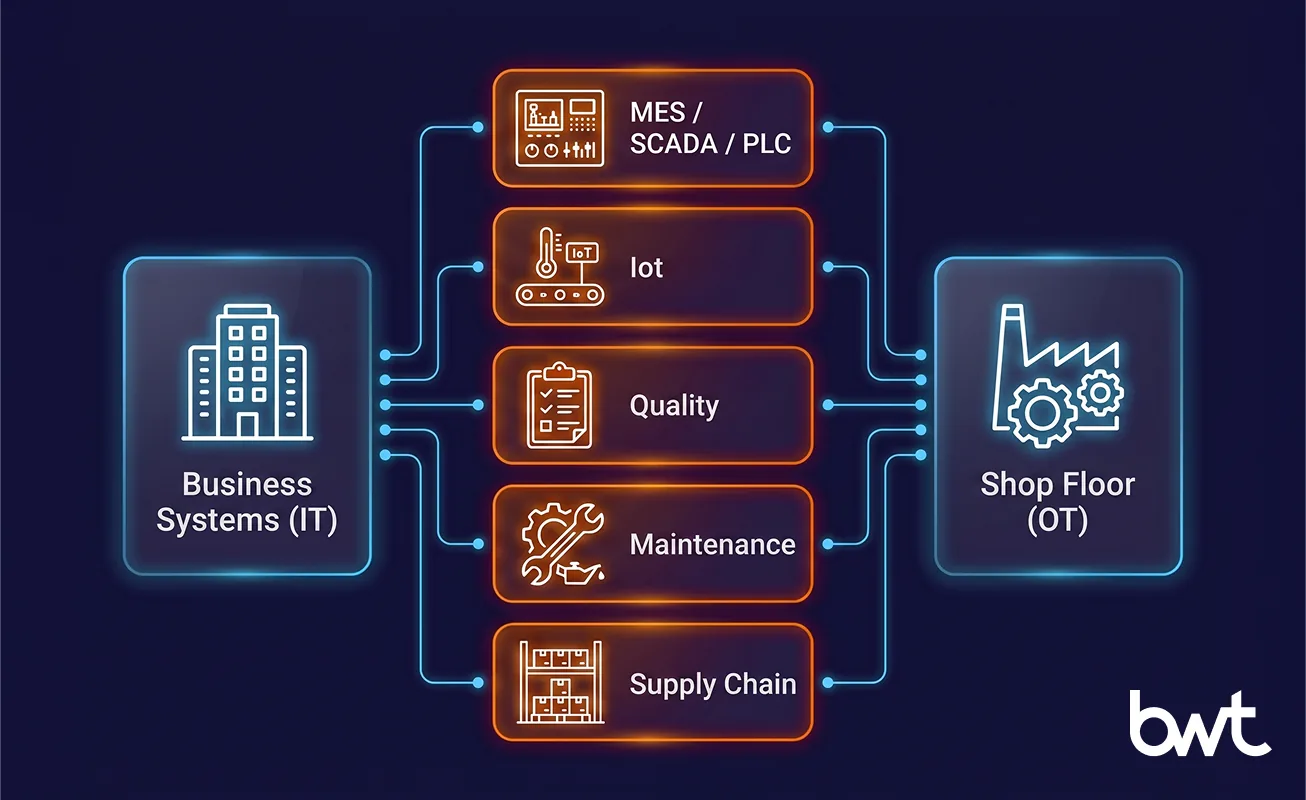
A plant’s data splits into two worlds that were never designed to meet: the business systems (IT) and the shop floor (OT). Manufacturing data integration for AI is mostly the work of joining them. Six categories cover almost every use case a manufacturer funds.
| Data layer | Typical sources | What it contains | AI use cases |
|---|---|---|---|
| ERP & business systems | SAP, Dynamics 365, Oracle | Orders, inventory, materials, cost, suppliers | Demand forecasting, cost and margin analysis |
| MES, SCADA, PLC & historians | OPC-UA, Modbus, routed PLC feeds | Work orders, runtimes, machine states, process values | Throughput, OEE, process optimization |
| IoT, sensor & telemetry | Vibration sensors, temperature sensors, optical sorters, weighing systems | High-frequency machine and environmental readings | Anomaly detection, predictive maintenance |
| Quality & inspection | QA systems, vision, defect logs | Inspection results, defect images, scrap records | Defect detection, root-cause analysis |
| Maintenance & downtime | CMMS, work-order history | Failures, repairs, downtime events | Predictive maintenance labels |
| Supply chain & inventory | WMS, supplier portals, EDI | Stock, lead times, deliveries | Inventory optimization and replenishment |
The IT half is usually reachable through APIs and change-data-capture. The OT half is the hard part — proprietary protocols, isolated networks, and controllers a decade older than the cloud they now have to feed.
AI-Ready Data Requirements for Manufacturing
Connected data is not the same as ready data. Six requirements separate a raw feed from something a model can trust.
Complete Data and Sufficient Historical Depth
A model needs enough clean history to learn a pattern — often one to two production cycles, more for a rare failure mode. Gaps in that history don’t announce themselves; they show up later as a model that misses the very event it was built to catch.
Accurate and Standardized Data
Data quality for AI in manufacturing is decided at ingestion, not in the report. For a global decorative-cosmetics manufacturer, GroupBWT normalized 13 differently-shaped retailer feeds into one schema and de-duplicated products on GTIN — a stable cross-system key some sites hide — so a product meant the same thing everywhere it appeared. Three years on, that pipeline still runs every week, holding a 99% collection success rate even on the retailer feeds that fight back hardest. For the client, that means the pricing team sees competitor products on one consistent schema every Monday and prices on data instead of guesswork.
Data Freshness Matched to the Decision
The data has to arrive before the decision does. A quality alert an hour late is a scrap report, not a prevention.
Labeled Failures, Defects, and Maintenance Events
Supervised models learn from labeled outcomes — a work order that names what failed, an image tagged good or scrap. Strip the labels and the model has a pile of examples with no answer key.
Metadata and End-to-End Data Lineage
Every field should carry its origin and timestamp, so a suspicious number gets traced instead of argued about in a meeting.
Secure, Role-Based Access to Industrial Data
Formulas, costs, and process IP need permissions that a plant-wide data project usually exposes for the first time.
Together these define manufacturing data readiness for AI, and most plants score high on one or two of them and fail the rest.
AI-Ready Data Architecture for Manufacturing
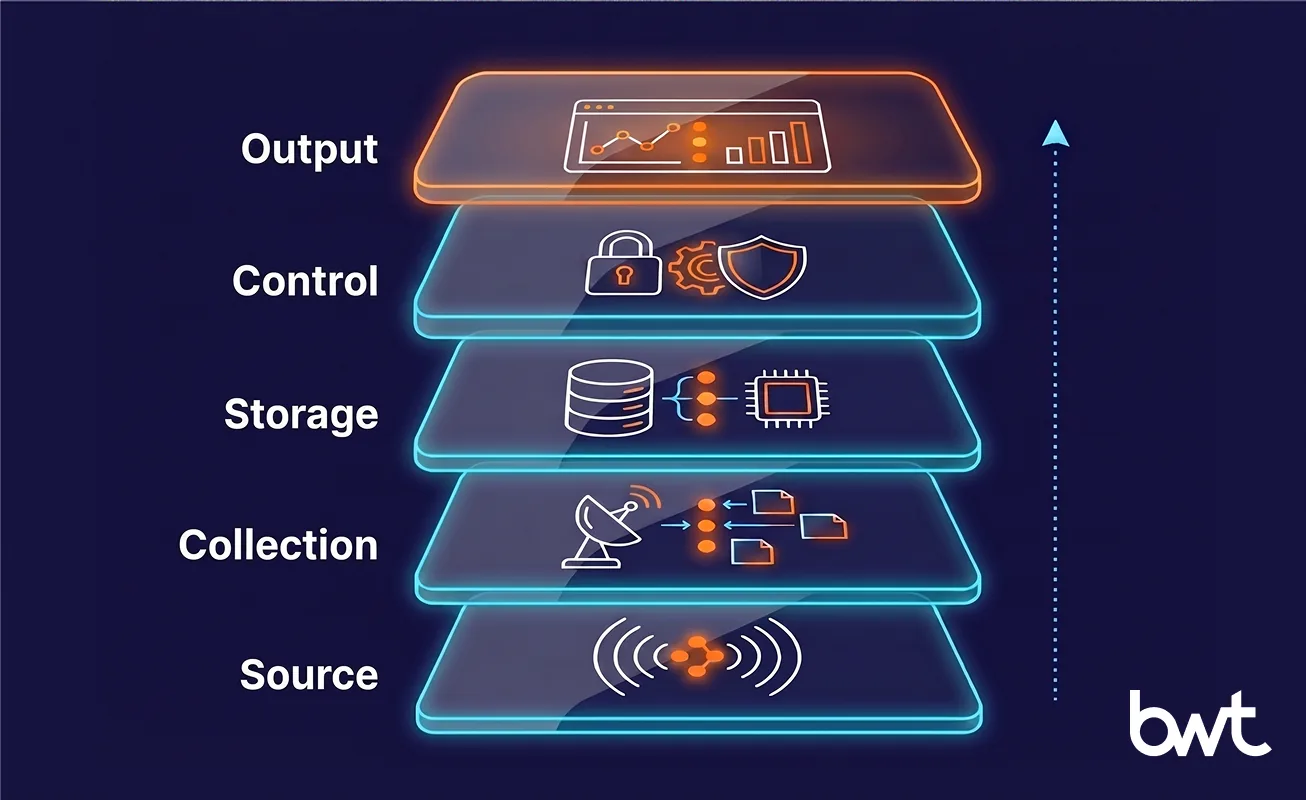
An industrial data foundation is not a single tool; it is five layers, each solving a problem the one beneath it cannot.
The source layer is every system that emits a signal — ERP, MES, SCADA, PLC, historians, IoT sensors, quality systems. The ingestion layer carries it in, and the range is the hard part: in the design for that multi-site producer, change-data-capture pulled some ERP tables every five minutes, PLC sensors streamed every four seconds, and a new weighing line needed a streaming path of its own. Data pipelines for manufacturing AI have to carry batch, streaming, CDC, and the industrial protocols the plant floor speaks (OPC-UA, Modbus, MQTT) without forcing everything into one cadence.
The storage layer is where it lands. GroupBWT designed the migration of the producer’s tangle to a Databricks lakehouse organized in raw, cleaned, and business-ready layers — the Medallion pattern — so the same number means the same thing whether an analyst, a dashboard, or a model reads it. The layering is not about tidiness. It is that a cross-site figure stops getting re-argued every time a new person opens the dashboard. A governed data warehouse, a lake, or a lakehouse can each hold this; workload decides which, not the brochure.
The governance layer wraps all of it — validation, lineage, a catalog, access control. The serving layer hands the ready data to BI, ML models, an AI assistant reading plant documents, or an alert on a live line. Skip either of those top two layers and the model ships on data no one can defend.
How to Prepare Manufacturing Data for AI: 7 Steps
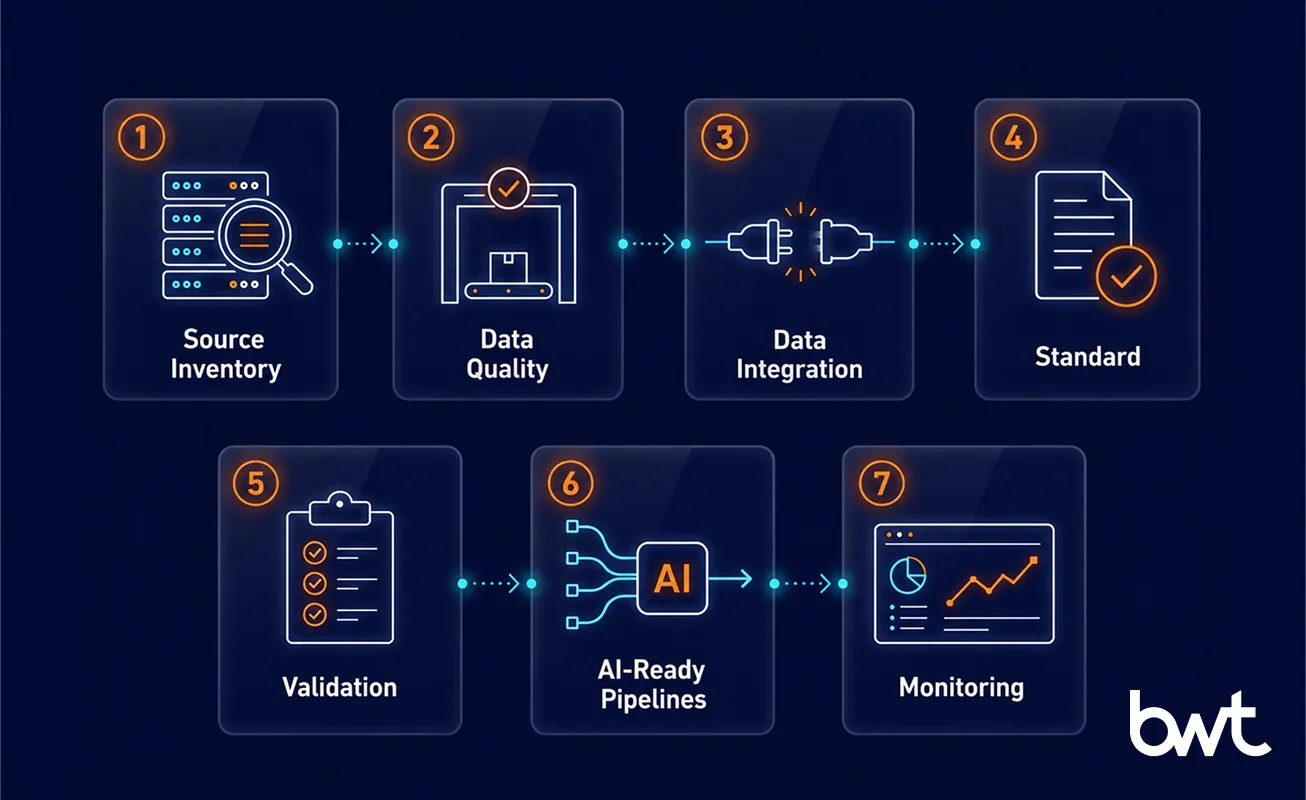
Data preparation for AI in manufacturing follows the same arc whether the first use case is predictive maintenance or demand planning.
Step 1 — Inventory Data Sources and Business Use Cases
Start from the decision, not the data lake. Take a European electric-motor manufacturer building several thousand made-to-order motor types, whose parametric tables sit locked inside CAD files as graphics, across hundreds of R&D folders where finding a document takes 30 to 60 minutes. In a discovery like this, the inventory step is exactly what surfaces problems of that kind before they derail a model.
Step 2 — Map Data Ownership, Quality, and System Dependencies
Name who owns each source and how fresh it is. This is where the bus-factor risk shows up — the system only one person understands.
Step 3 — Connect Plant-Floor and Business Systems
Pull the sources into a governed store, usually with change-data-capture so a model reads a current picture. Bridging OT signals into that store, while respecting the network separation that keeps factory equipment isolated, is where the IT/OT divide gets crossed in practice. Legacy is the normal starting point, which is why this often begins as a data migration, not a rebuild.
Step 4 — Standardize Machine, Product, Batch, and KPI Definitions
Agree on what “machine 12,” “batch 4471,” and “downtime” mean everywhere before a model reads any of them.
Step 5 — Validate Data Quality Before It Reaches Models
Put a gate between ingestion and the warehouse. For a digital-shelf analytics platform whose end-clients are consumer and industrial manufacturers, GroupBWT ran a dedicated data-quality verification system that caught bad sessions before they reached anything downstream, so the manufacturers relying on that platform were never priced or stocked off a corrupted number. That is the same discipline a plant needs on sensor feeds: the gate matters because the decision on the other side of it is real.
Step 6 — Build AI-Ready Pipelines and Feature Layers
Shape the cleaned data into the features a model actually consumes, in a business-ready tier the model and BI both read from.
Step 7 — Monitor Data Drift, Schema Changes, and Model Inputs
A source quietly renaming a column breaks joins with no error at all, so schema and freshness alerts are not optional once real decisions ride on the feed.
Also Read: Big Data in Manufacturing: From Fragmented Plant Data to Decisions You Can Act On
Real-Time vs Batch Data for Manufacturing AI
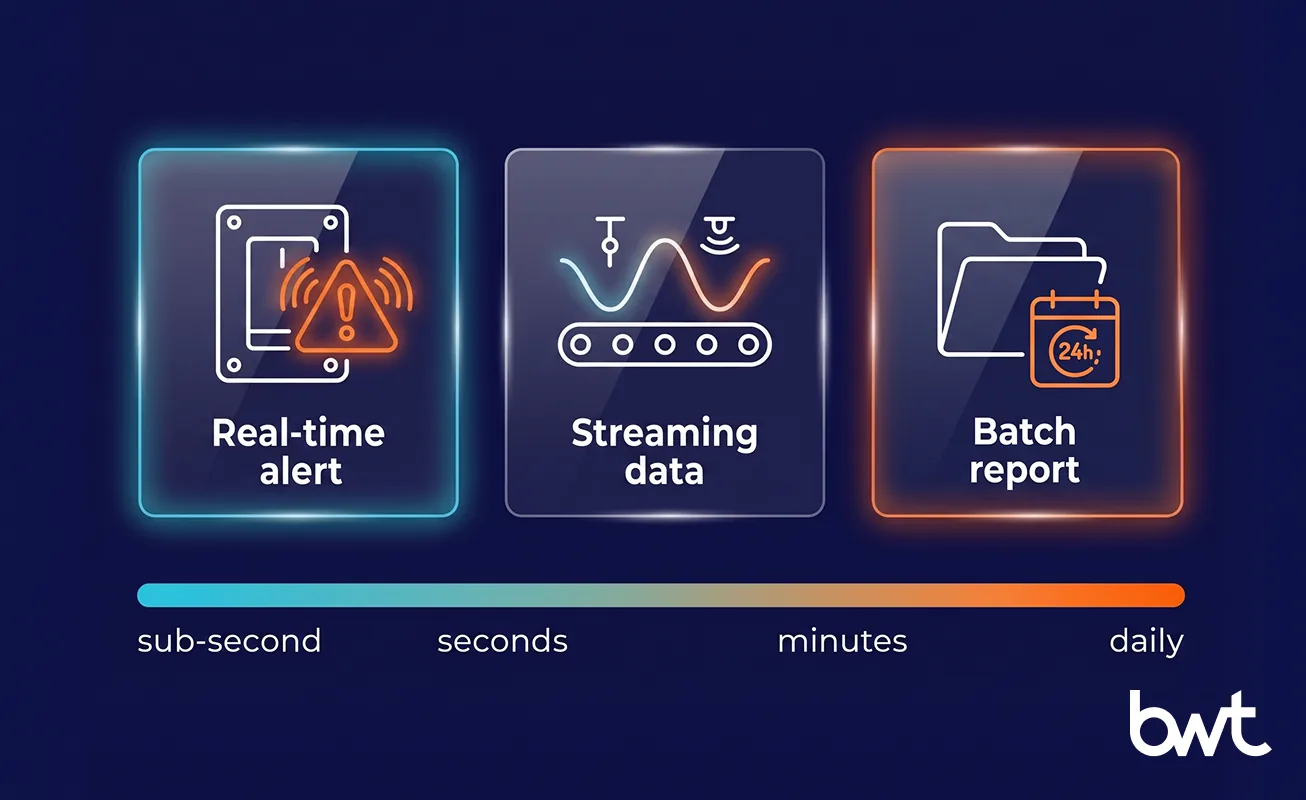
Real-time data feels like the goal until the compute bill arrives, and most manufacturing decisions do not need second-by-second latency. For the multi-site producer, GroupBWT deliberately left always-on environmental monitoring — readings every five minutes, around the clock — on its existing path rather than streaming it into the lakehouse. In that architecture, streaming every sensor would have roughly doubled the infrastructure cost without changing the underlying decision.
Where the cadence does earn its cost, it shows. For a heavy-equipment distributor building a fleet-management product, GroupBWT designed a dispatch interface that puts 50-plus machines on one screen with positions refreshing every five seconds — a real-time operational surface where a delayed truck is a decision, not a log entry. (That engagement was interface design; the streaming pipeline behind it belonged to the client.)
| Manufacturing decision | Typical latency need | Recommended approach |
|---|---|---|
| Safety interlock / live control | Sub-second | Edge processing / real-time streaming |
| Predictive maintenance alert | Seconds to minutes | Streaming or micro-batch |
| OEE / throughput dashboard | Minutes to hourly | CDC or micro-batch |
| Demand and inventory forecast | Daily | Batch processing |
“Cadence is set by the decision, not by a default. A safety interlock needs sub-second data; an OEE dashboard is fine on a five-minute batch. Stream everything and you double the infrastructure bill for data that doesn’t change a single decision on the floor.” — Dmytro Naumenko, CTO at GroupBWT
AI-Ready Data for Predictive Maintenance
Predictive maintenance is the use case most plants ask for first, and the one most exposed to weak data. A model learns to predict a failure from records of past failures — labeled work orders, scrap events, the maintenance log — joined to the sensor history around each event. AI-ready manufacturing data for this use case means those labels are accurate and actually linked to the machine behavior that preceded them.
When a plant has no failure history yet — the continuous-process manufacturer was running SCADA and PLC but had no OT data to learn from — the honest first move is unsupervised anomaly detection, which flags “this does not look normal” without needing labels, then graduates to prediction as the history builds. A peer-reviewed review of Artificial intelligence and robotics in predictive maintenance (Frontiers in Mechanical Engineering, 2026) reaches the same conclusion: unsupervised methods are what fit the case where labeled data is scarce. Starting the other way around, with a supervised model and no clean labels, produces confident predictions that are simply wrong.
Data Governance for AI in Manufacturing
Governance is what keeps a model trustworthy after launch, not just on demo day. Four questions decide it: who owns each source, where a number came from, who may see it, and whether an AI output traces back to the data behind it.
For the decorative-cosmetics manufacturer, GroupBWT built the pipeline on Data Vault 2.0 — a modeling method that keeps raw, business, and presentation layers separate so every field’s lineage stays explicit — so a suspicious figure in a dashboard traces to the exact source record behind it. For the multi-site producer, reverse-engineering those encrypted views and cataloging them turned invisible business logic into 58 pages of documentation. That knowledge no longer walks out the door when one engineer does.
Manufacturing data governance for AI is not a compliance checkbox. It is the line between a model you can defend to an auditor and one the floor quietly stops trusting.
“A number on a dashboard only matters if someone on the floor will bet a production decision on it. If they can’t see where that figure came from, they fall back on their gut — and the AI you paid for sits idle while the plant runs on instinct.” — Oleg Boyko, CCO at GroupBWT
When to Start — and When Not To
Not every plant needs this. If your downtime is already low, your rejects are stable, and the team just wants a few more BI reports, a platform partner does that at scale and GroupBWT is the wrong call. The work pays off when data is trapped across legacy ERP, MES, PLC, and IoT systems that were never built to talk to each other, and when a wrong or late number reaches production, quality, or revenue.
When that is the picture, the first project is usually a data-readiness assessment, not a model — two to four weeks to grade your sources and hand back a scorecard of what to fix first. Tell us the one line where output, quality, or uptime falls short, plus the systems it touches. An engineer who has scoped this on a real floor comes back inside 48 hours with the use cases worth funding and the data each one needs.

Data Readiness Checklist for Manufacturing AI
Run these seven questions against your own floor. Every “no” is a place AI will break before it helps — the shortest honest test for AI ready data for manufacturing operations:
- Are your critical data sources connected, or still stitched together by hand?
- Are machine, product, batch, and asset IDs standardized across systems?
- Is historical data deep enough for the use case you have in mind?
- Are failures, defects, and maintenance events actually labeled?
- Are validation gates catching bad data before it reaches a report?
- Is sensitive data — formulas, costs, IP — governed and access-controlled?
- Can an AI output be traced back to the source data behind it?
How to Measure Manufacturing AI Data Readiness
A readiness score is more useful than a yes-or-no verdict. Grade six dimensions from red to green and the priorities sort themselves.
| Readiness dimension | Red | Yellow | Green |
|---|---|---|---|
| Source coverage | Critical sources disconnected | Partially integrated | All use-case sources connected |
| Data quality | Validation happens after reporting | Some automated checks | Bad data blocked before consumption |
| Historical depth | Too little history | Partial history or labels | Sufficient labeled history |
| Governance | Ownership unclear | Partial lineage/access controls | Owner, lineage, permissions defined |
| Pipeline reliability | Manual monitoring | Basic alerts | SLA, freshness, and schema monitoring |
| Use-case alignment | No owned decision | KPI identified | Data mapped to a business decision |
Final Thoughts: Manufacturing AI Starts With Trusted Data
The plants that get value from AI rarely own the best models. They own data their model can trust. AI-ready data for manufacturing is the unglamorous 90% — the integration, the validation, the lineage — that decides whether the last 10% ever ships. Start with the source your worst decision depends on, make it trustworthy, and let the model come second.
AI-ready data for manufacturing is plant data connected across ERP, MES, SCADA, PLC, and IoT systems, then cleaned, labeled, and governed so a model or an analyst can trust it without re-checking the source. “We have data” is not the bar — most plants drown in it. The bar is three things: a number you can trace, definitions that match across sites, and bad readings caught before they reach a decision.
Six categories cover most manufacturing use cases: ERP and business-system data, MES/SCADA/PLC and historian data, IoT and sensor telemetry, quality and inspection records, maintenance and downtime history, and supply-chain and inventory data. Predictive maintenance leans on sensor and maintenance data; quality analytics leans on inspection and defect data; forecasting leans on ERP and supply-chain data. What ties them together is one requirement — every system agrees on the same machine, product, and batch identifiers.
They fail because the data is fragmented, inconsistent, or unlabeled long before the model is the problem. Disconnected ERP, MES, and PLC systems feed incomplete inputs; mismatched IDs and KPI definitions leave cross-site numbers no one trusts; and missing failure labels put prediction out of reach. The model is a small share of the work. The integration and validation underneath it decide whether the project ships.
It turns on the use case and how often the event you care about actually happens. A throughput or demand model may work on one to two production cycles; a predictive-maintenance model needs enough recorded failures to learn a pattern, which can mean a year or more for a rare fault. No history yet? Start with unsupervised anomaly detection, and let the model graduate to prediction as labeled failures pile up.
Run a data-readiness assessment that grades source coverage, data quality, historical depth and labeling, governance and access, and pipeline reliability, then map each grade to the specific decision the AI is meant to support. What you want back is a scorecard by source, not a single pass-or-fail. It tells you which feed to fix first — and whether the honest next step is a model or another few weeks of data work.
Read summarized version with
Build the Data FoundationnYour AI Models Need
We develop and manage custom data solutions, powered by proven experts, to ensure the fastest delivery of structured data from sources of any size and complexity.
We offer:
- Custom Web Scraping & Development
- 15+ Years of Engineering Expertise
- AI-Driven Data Processing & Enrichment