Read summarized version with


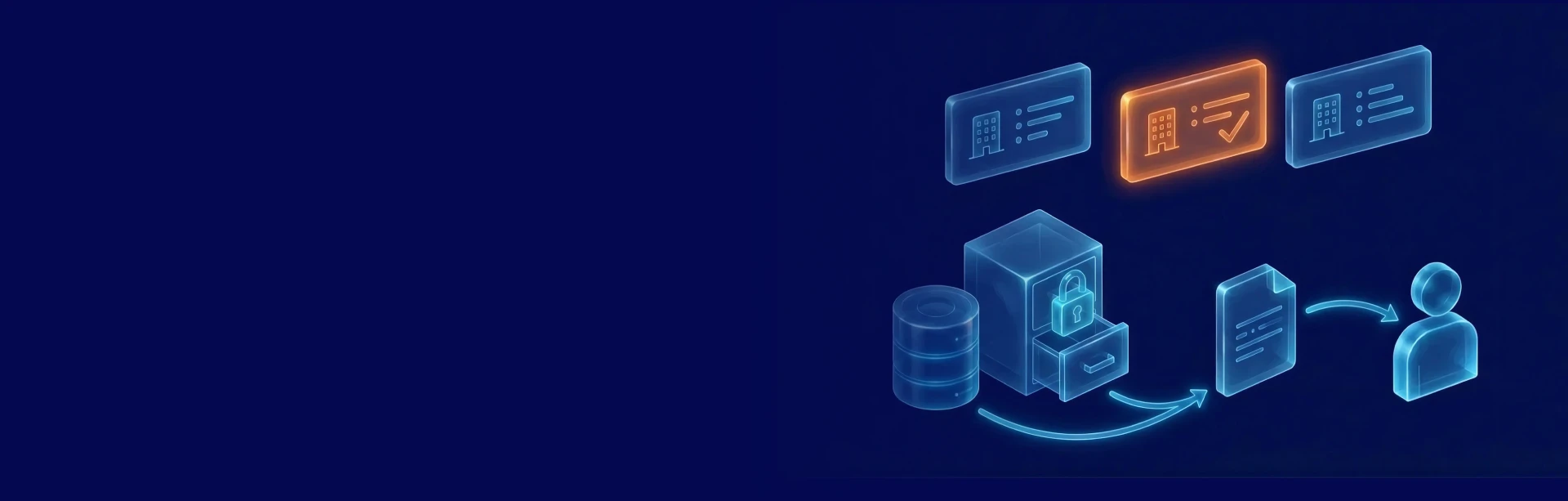
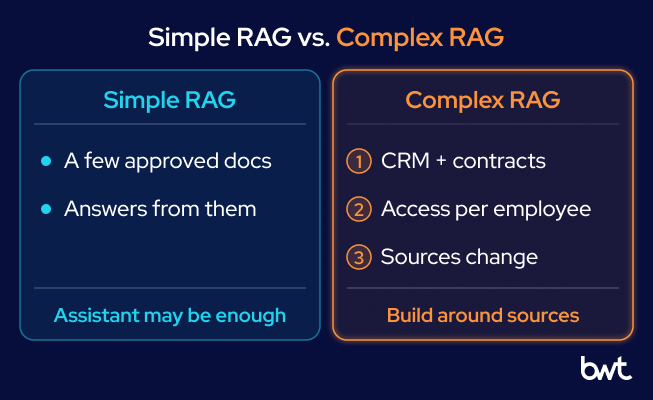
For answers from a few approved documents, a well-built document assistant may be enough. The work becomes harder when one answer needs CRM records and a restricted contract, must respect each employee’s access rights, and must stay correct while sources change. We compared the best RAG development services companies on that harder case: whether each team can build around your sources, access rules, and data changes.
RAG (retrieval-augmented generation) lets a language model answer from passages that a search step has just retrieved from external sources. We describe what each of the ten firms below has built and published instead of ranking the best RAG development companies 2026 has to offer.
Connect Company Knowledgeto a Working RAG Application
GroupBWT combines data engineering and RAG development to connect approved sources, build document-based applications and integrate answers into existing workflows.
The scope can include:
- Source preparation and maintained data pipelines
- Custom retrieval and business-system integration
- Separate quality tests and agreed production support
Best Companies for RAG Development Services: A Quick Comparison
We publish this comparison and are included in it. Neither table ranks the firms.
| Company | Business job | Public evidence or service offering | What to verify |
| Datavid | Connect facts spread across related documents | GraphRAG application offering | Effort of keeping the knowledge graph current |
| Deviniti | Search documents inside approved infrastructure | Self-hosted RAG assistant case and implementation offering | Responsibility for hosting and updates |
| GroupBWT | Make fragmented company data usable in an assistant | RAG development service, insurance-assistant client case, internal data-platform case | Preparation work plus ongoing source ownership |
| Grid Dynamics | Draft responses from business documents | Document-processing starter kit | Reusable components versus custom work |
| Intelliarts | Answer document and table questions through one chatbot | Document-and-table chatbot case, from proof of concept (PoC) to system integration | Keeping both answer paths current |
| Keyhole Software | Test enterprise retrieval before a wider build | Enterprise RAG architecture PoC (case study) | Work remaining after the prototype |
| LeewayHertz | Answer from proprietary compliance information | ZBrain-based compliance information application (case study) | Code ownership and platform licensing terms |
| N-iX | Bring document answers into an employee portal | Implemented knowledge portal (case study) | Identity and existing-application connections |
| ScienceSoft | Add document intelligence to business software | Document-search PoC with hybrid retrieval and source-linked answers | Production readiness and support beyond the PoC |
| Vstorm | Prepare engineering workflows from examples | RAG-backed workflow generation and validation (case study) | Permissions for any executable actions |
The second table adds location, team size, and minimum project size from each firm’s Clutch profile, checked in October 2026. Location is the first office listed, taken from the firm’s website if Clutch lists none, and is not always the legal headquarters.
| Company | Location | Team size | Minimum project size |
| Datavid | London, UK | 50-249 | $25,000+ |
| Deviniti | Wrocław, Poland | 250-999 | $25,000+ |
| GroupBWT | London, UK | 50-249 | $5,000+ |
| Grid Dynamics (AI Engineering unit) | Zug, Switzerland | 250-999 | $25,000+ |
| Intelliarts | Lviv, Ukraine | 50-249 | $50,000+ |
| Keyhole Software | Lenexa, Kansas, US | 50-249 | Not published |
| LeewayHertz | Gurugram, India | 50-249 | $10,000+ |
| N-iX | Malmö, Sweden | 1,000-9,999 | $100,000+ |
| ScienceSoft | McKinney, Texas, US | 250-999 | $5,000+ |
| Vstorm | Wrocław, Poland | 10-49 | $10,000+ |
These Clutch minimums are not RAG-specific prices or confirmed quotes. All Grid Dynamics values refer to its AI Engineering profile rather than the parent company. GroupBWT and ScienceSoft list the lowest minimum, $5,000+.
Use both tables to shortlist the top RAG development service companies whose work and minimum budgets match your project.
How We Selected the 10 RAG Development Companies
We reviewed each provider in October 2026, and each represents a different business scenario. The list is a sample: other top companies in advanced RAG pipeline development are not on it, and leaving a firm out is not a judgment of its work. Each firm openly offers RAG development or has published a relevant technical case. Search products and infrastructure platforms are excluded because buyers license them.
Prototypes and starter kits counted as evidence of technical skill, not of client production delivery. We matched the best RAG development services companies to each scenario by published work and ignored performance scores we could not verify.
For model adaptation or broader AI applications, use the GenAI development company comparison.
“Ask which engineers on the proposed team worked on the reference project, and what they were responsible for. A company can have a relevant case while assigning you a team that still needs to learn its hardest parts.” — Oleg Boyko, CCO at GroupBWT
Top RAG Development Companies for Different Retrieval Workloads
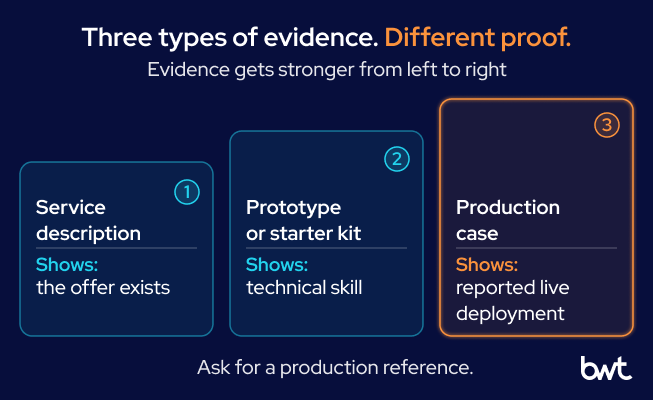
Some providers show implemented applications; others mostly describe services, accelerators, or prototypes.
Datavid: When Answers Depend on How Facts Connect
Fit: Questions that connect facts across documents, where one relevant paragraph cannot answer them.
Scope: Datavid’s GraphRAG service description covers knowledge graphs and multi-hop retrieval, which follow relationships between concepts, along with claim-level citations, access controls, and audit trails.
Evidence: Its semantic search and data platform cases show knowledge-integration experience, but none of the cases we reviewed shows a generative RAG application in operation.
Delivery: Datavid advertises readiness assessment and pilot-fit work before GraphRAG engineering. Ask Datavid to show on your questions where graph retrieval outperforms simpler search, and agree who maintains the graph as sources change.
Deviniti: When Documents Must Stay in Approved Locations
Fit: Company policy restricts internal documents to approved processing locations, and staff need answers from those documents.
Scope: Deviniti’s RAG architecture and implementation offering describes self-hosted assistants that can keep each department’s information in a separate index. Separate indexes isolate the data, while authorization checks control who sees which answer.
Evidence: Deviniti’s case on a self-hosted RAG assistant for contract analysis and legal questions reports no post-launch performance, retrieval benchmarks, or support data.
Delivery: Beyond the latency and retrieval monitoring, patches, and performance optimization in Deviniti’s stated maintenance, self-hosting adds infrastructure management to the project scope and operating budget.
GroupBWT: RAG Development for Complex Enterprise Data
Fit: The answers your staff need sit in fragmented systems and inconsistent records that a chatbot added on top cannot fix.
Scope: Our RAG development services combine data engineering, custom retrieval, CRM/ERP/workflow integration, and pipeline maintenance. In evaluation, we test retrieved evidence, answer support, access, speed, and running cost separately.
Evidence: For a regional insurance platform, GroupBWT built a claims and policy support assistant that cites the clause and document version retrieved from a version-tracked library in each reply. In the client’s routing benchmarks and support logs, the assistant cut average query resolution time from 9.4 to 3.0 seconds while eliminating more than 1,200 repetitive support tickets per month. Both figures cover the whole assistant, not retrieval alone, and have not been independently verified. On-demand answers from Slack, Jira, CRM, and Confluence in our internal company-data platform, built with a similar approach, replaced a weekly sales-funnel review meeting.
Delivery: Under agreed production support, which follows source mapping, an assessment or PoC, and application engineering, we handle failed source refreshes and answer-quality drops.
Grid Dynamics: RAG Inside the Applications You Already Use
Fit: Staff assemble proposal responses from business documents and want drafting inside their existing application.
Scope: Grid Dynamics’ technical material on RAG and document-processing accelerators describes a starter kit that drafts proposal responses for staff review, an intended workflow benefit rather than a measured client result.
Evidence: Because the reviewed material covers only an accelerator, request a client RAG reference that has reached production.
Delivery: Ask Grid Dynamics to separate reused kit components from new work such as connectors, permission controls, or application changes. No standard RAG maintenance package appears in the material, so support needs its own terms.
Intelliarts: Questions Across Documents and Tables
Fit: Employees want one chatbot for questions about documents and numerical data instead of searching each source separately.
Scope: Intelliarts’ data-extraction chatbot case describes routing between text and table sources, so tables are not treated as ordinary prose, plus safeguards against injected instructions and off-topic requests.
Evidence: Intelliarts documents the chatbot only from an early PoC to system integration.
Delivery: Intelliarts’ RAG service offering page offers fixed-price, time-and-materials, and dedicated-team models plus post-launch monitoring, performance tuning, and prompt updates. None of these models guarantees a level of answer accuracy.
Keyhole Software: Testing Enterprise RAG Architecture
Fit: A wider rollout depends on evidence that document-based answers work in your existing application.
Scope: The project in Keyhole’s enterprise generative-AI case paired document ingestion and vector search with safety controls and audit logging. The client’s decision on funding full-scale development drew on the PoC results, according to Keyhole.
Evidence: Keyhole reports no production use and documents only the PoC architecture.
Delivery: Keyhole’s RAG architecture offering runs as outsourced delivery, a dedicated team, fractional advisory work, or staff augmentation, with accountability differing by model, and the case does not show whether production support was included.
LeewayHertz: Grounded Document Applications and Platform-Assisted Builds
Fit: Users need answers from proprietary compliance information instead of locating and interpreting each document manually.
Scope: LeewayHertz’s compliance-information application case describes an LLM-powered application built for Scrut on its ZBrain platform. Users query the application about compliance frameworks and audit processes.
Evidence: The implemented application answers from retrieved documents, but the case gives no answer-quality figures or operating history.
Delivery: Ask LeewayHertz to state the ZBrain licensing costs, export rights, and long-term platform obligations the case omits before committing to its AI development offering, which covers project delivery, team extension, and maintenance.
N-iX: Document Answers Inside the Portal Your Staff Already Use
Fit: Your people want to ask about company documents in the portal where they already work.
Scope: N-iX’s Finance knowledge-portal case describes document context feeding generated answers, with sign-on, application-interface authorization, encryption, and network controls around the assistant.
Evidence: The case gives your evaluators no retrieval results or AI go-live date for the implemented portal.
Delivery: N-iX says its RAG offering begins with a production-oriented PoC on real enterprise data. The PoC compares models and search methods, tests answer quality, and limits each user to permitted documents. The full rollout needs its own estimate from N-iX.
ScienceSoft: When the Assistant Has to Live in Your Business Software
Fit: Your teams want document answers inside business software, under access restrictions a standalone chatbot may not respect.
Scope: ScienceSoft’s AI software-development offering lists source preparation, indexing, access controls, and monitoring for knowledge assistants inside the business application.
Evidence: Its RAG document-search PoC for a security preparedness company combined hybrid retrieval with adapted embeddings, linked each answer to its sources, and evaluated answer quality. The case ends at the prototype stage.
Delivery: The AI offering lets a client start with either a PoC or a minimum viable product. Ask which of ScienceSoft’s general software pricing models (time-and-materials, capped time-and-materials, or fixed price) would cover RAG support.
Vstorm: RAG Within Agentic Engineering Workflows
Fit: Engineers spend time assembling workflows from examples and documentation, not just looking for a written answer.
Scope: Vstorm’s engineering workflow case combines retrieval over workflow examples and documentation with generation and validation. According to Vstorm, the platform reduced workflow preparation from two hours to three minutes.
Evidence: The figure measures the combined workflow and therefore shows little about search quality in a read-only assistant.
Delivery: Vstorm’s RAG service begins with a Proof of Value on the client’s documents and queries, then hands over code, retrieval configuration, evaluation suites, and runbooks, and maintains the index. Executable workflow actions need separate permissions and output checks.
What a RAG Development Project Can Deliver
Expect the best RAG development services companies to ask which business task will change and how you will measure the result before they choose a search architecture. The last column lists targets to test, not guaranteed results.
| Business problem | What the system should do | What to check in a demo or PoC |
| Staff search several systems for one answer | Searches approved sources through one interface and cites supporting material | Time to find a usable answer; follow-up searches needed |
| Support staff cannot find the current policy | Retrieves the current approved policy for a customer question | Answer preparation time; share of answers using the current policy |
| Analysts manually inspect long document sets | Finds evidence across documents and flags missing or conflicting information | Research time; accuracy of source-supported findings |
Our data-readiness guide covers preparing inconsistent sources before retrieval, and AI consulting can define what to build if no workflow is chosen yet. When comparing the best AI consulting companies for RAG development, ask how each ranks candidate use cases by source readiness and business value.
How to Choose a RAG Development Company
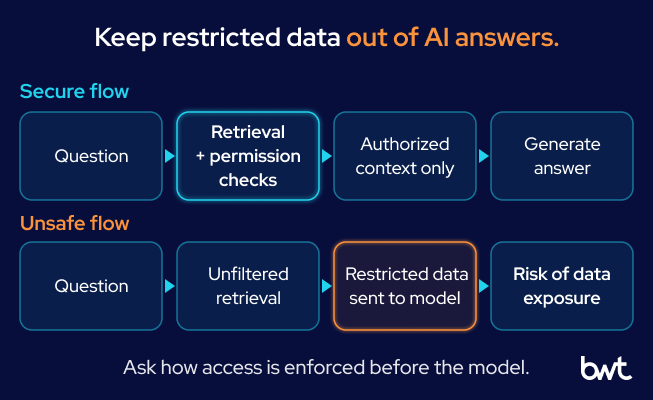
Check five criteria in each company’s published work and proposal before testing.
- Comparable production evidence. Look for an application in production whose sources, users, and access rules resemble yours.
- Source and data fit. The team should have handled sources like yours (scanned contracts, CRM records, spreadsheets) and should scope their preparation.
- Retrieval evaluation. Ask how the company measures whether the right evidence was found, separately from how well the answer reads.
- Permission model. In the proposal, the check of each user’s right to see a document should come before retrieval passes any of that document’s content to the answer.
- Integration, deployment, and support. Connected systems, the hosting location, and the owner of failed refreshes and post-launch quality drops should all appear in the proposal.
How to Test the RAG Vendors on Your Shortlist
Test two or three of the best RAG development services companies whose published work most resembles your project on the same approved or sanitized source sample, access rules, and questions, keeping a second, unshared question set for the final comparison.
- Show supported answers and justified refusals. Each cited passage must support its answer, and some test questions should have missing or contradictory evidence. Record unsupported answers and refusals despite available evidence as failures.
- Show an access change. Revoke a user’s permission, check that fresh searches and cached answers no longer expose the restricted content, and ask how deleted material leaves the indexes.
- Show an update and a failure. Time how long an edited document takes to appear in search, then disconnect a source and check how the failure is detected and fixed.
- Show response time and running costs under load. Run representative questions with concurrent users and calculate the running costs at that load.
- Show how the assistant handles malicious content. Place a hidden instruction in a retrievable document and check whether the assistant follows it or handles it as data. OWASP lists poisoned documents in RAG knowledge bases among prompt injection risks.
Before testing with sensitive company data, clarify who owns each source and which access rules apply. Data governance consulting can help resolve unclear responsibilities. Tool permissions and document access are separate controls, as our AI data-governance guide explains for assistants that run tools.
The ACL 2025 paper Unanswerability Evaluation for Retrieval Augmented Generation proposes a test set of questions that RAG cannot reliably answer. In AWS’s RAG evaluation publication, answer quality and citation accuracy receive separate scores.
“Before tuning retrieval, check whether the required evidence reached the searchable collection. Search cannot recover a document that ingestion missed. Otherwise, you can spend weeks improving rankings while measuring the wrong problem.” — Alex Yudin, Head of Data Engineering at GroupBWT
Estimating RAG Development Cost and Timeline
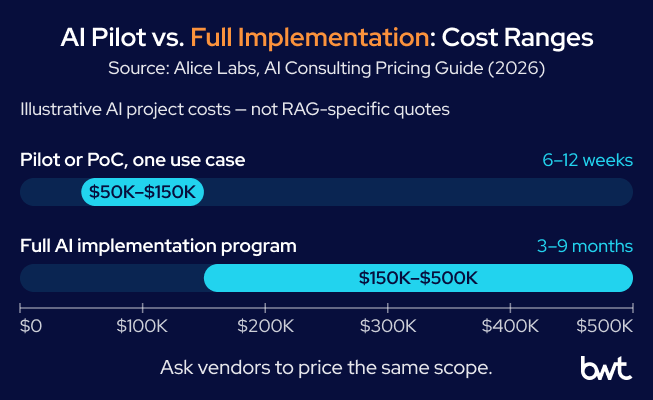
Vendors price a RAG project from the number and condition of sources, access requirements, integrations, expected usage, evaluation depth, and support. Quotes are comparable only when the best RAG development services companies on your shortlist price the same scope.
We prepare each estimate after scoping instead of using a price list. AI prototyping estimates reflect the agreed test, available data, and access. For AI implementation services, we estimate from the application scope, source access, integrations, and release requirements.
Another AI services provider, Alice Labs, cites an April 2026 ClearForge guide on broader AI consulting. For a proof of concept or pilot on one prioritized use case, the guide lists $50,000-$150,000 over 6-12 weeks, compared with $150,000-$500,000 over 3-9 months for a full AI implementation program. Both ranges cover broader AI work rather than RAG alone.
| Phase | Output to agree in the proposal | What can extend the work |
| Source and scope assessment | Source inventory, access confirmation, preparation gaps and an agreed application scope | Unavailable records, unclear source owners, unreadable files |
| Bounded PoC | Working prototype, test questions, results and a list of conditions still untested | Missing source data, failed retrieval on answerable questions, failed acceptance tests |
| Integrated pilot | Connected application for selected users, permission tests and reviewed acceptance results | Connector work, identity integration, security approvals |
| Production rollout | Agreed production environment, monitoring and support procedures, plus documented ownership, access and handover rights for code, configurations and evaluation assets | Load issues, release approvals, incident ownership and unresolved dependencies |
Request effort and calendar estimates per phase, including approval waits, and keep development fees separate from model usage, hosting, refresh, licenses, and maintenance.
“A private deployment is not described by the model endpoint alone. Include the index, backups, logs, monitoring services and operator access in the boundary. Then check which of them actually need to remain inside it.” — Dmytro Naumenko, CTO at GroupBWT
Also Read: RAG Data Pipeline: Build a Production System
Discuss Your RAG Project and the Right First Step
On a first call, we sketch the likely scope with you, say whether the task fits our RAG and data engineering services, and agree on a next step such as a free data audit. The audit shows which sources are ready for retrieval and which need preparation. We base our estimate on its findings.

Yes, if it already handles your sources, permissions, and answer workflows. Before you hire one of the best companies for RAG development services, test the product on your real questions. If it meets those requirements at an acceptable total cost, a custom build may add complexity without enough value.
There is no standard price. A production assistant across several sources with access controls costs more than a bounded prototype. Citing ClearForge, Alice Labs reports $50K-$150K for a pilot and $150K-$500K for a full implementation program, figures for broader AI work rather than RAG alone. Model usage, hosting, and support are billed separately after launch.
Each added source, integration, or approval moves your launch date later. Data owners’ access approvals and your security review usually take the most time. We recommend asking the best RAG development services companies on your shortlist to estimate weeks against one phase template: source access, prototyping, integration, testing, rollout.
With RAG, retrieved passages from your sources accompany each question, whereas fine-tuning retrains the model. We usually start with retrieval for frequently changing records whose answers must cite sources. Fine-tuning fits a fixed task or answer style but leaves document permissions outside the model.
No. Private hosting can satisfy a deployment restriction. Once your legal and compliance teams determine which rules apply, engineers build and test the required controls, and your security team should still review and test data access, processing, logging, retention, operator permissions, cached answers, indexed copies, and source deletion separately.
We ask for one business question for the assistant and notes on where its evidence is stored, who may see which records, and who will use the answers. In our experience, security reviews often set the project timeline, so mention any planned review at the start. Our free data audit, run before any build, shows which of your sources are ready for retrieval.
Read summarized version with
Connect Company Knowledgeto a Working RAG Application
GroupBWT combines data engineering and RAG development to connect approved sources, build document-based applications and integrate answers into existing workflows.
The scope can include:
- Source preparation and maintained data pipelines
- Custom retrieval and business-system integration
- Separate quality tests and agreed production support