Read summarized version with


The vendors behind the label “top generative ai development companies” are not interchangeable. Master of Code Global fits conversational AI. Neoteric and DataRoot Labs fit early product work. Neurons Lab concentrates on agents in regulated workflows. Our team fits enterprise GenAI systems where data quality, retrieval, permissions, integration, evaluation, and production ownership decide whether the system survives its first quarter.
This comparison focuses on engineering and implementation partners globally, with location treated as a selection criterion. Foundation model labs, cloud platforms, pure SaaS tools, hardware vendors, and talent marketplaces are excluded. Public information was verified in August 2026.
Build an Enterprise GenAI SystemYour Team Can Operate
We take enterprise GenAI from a defined use case to a production system connected to your data, permissions, and business workflows.
We offer:
- GenAI strategy and solution architecture
- RAG, copilot, and agent development
- Integration, evaluation, deployment, and support
Choose by workload first. Shortlist two or three vendors, then ask each one for a comparable delivered system, its answer-quality method, its security controls, and the name of the person who owns the system after launch.
Key Takeaways
- The strongest vendor depends on the workload, not on list position. A conversational specialist and a data-heavy retrieval specialist rarely substitute for each other.
- Production evidence beats service menus. Every vendor lists RAG, agents, and copilots; far fewer can show a comparable system running in front of real users.
- Enterprise integration and data readiness cost more effort than model selection, and security, governance, and monitoring belong in the evaluation rather than the renewal conversation a year later.
- A lower hourly rate can still produce a higher total cost through rework, thin data preparation, and missing support.
- Settle ownership, export rights, and exit terms in the contract.
Top Generative AI Development Companies at a Glance
Each vendor is matched to its strongest published evidence and best-fit workload.
| Company | Evidence level | Best for | Strongest public evidence |
| Addepto | Production | Enterprise knowledge bases and agentic retrieval | Agentic RAG platform over industrial technical documentation |
| AI Superior | Production | Feasibility and risk framing before a build | Custom in-house LLM chatbot with source attribution |
| DataRoot Labs | Pilot | Startups and early AI products | Safety-incident classification system for a manufacturer |
| deepsense | Pilot | Technically demanding applied AI | RAG technical-support chatbot delivered as a four-week pilot |
| GroupBWT (publisher) | Production retrieval; architecture-stage GenAI | Enterprise GenAI on complex data estates | Production semantic-search workload plus 2026 AI foundation engagement |
| InData Labs | Adjacent AI | GenAI beside broader data science | Aspect-based NLP analysis across several LLMs |
| LeewayHertz | Production | Broad enterprise application coverage | GPT-4 compliance assistant across security frameworks |
| Master of Code Global | Production | Customer-facing conversational programs | Shopping assistant with a reported 86% correct-answer rate |
| Neoteric | Production | Validating an idea before a larger build | Eight-month generative AI platform build |
| Neurons Lab | Production | Agent systems in regulated workflows | Voice and text cybersecurity assessment agent |
| SoluLab | Architecture | GenAI inside a wider software product | Published multi-agent orchestration architecture |
| Tooploox | Adjacent AI | AI features inside existing products | AI histopathology platform (adjacent to GenAI delivery) |
How We Compared the Top Generative AI Development Companies
A vendor qualifies here when it builds custom generative AI applications, connects models to business systems, designs retrieval and agent workflows, and carries them into production. Foundation model labs, cloud platforms, pure SaaS tools, hardware vendors, and talent marketplaces are absent by design. Buyers filtering for US delivery see the same twelve, narrowed by headquarters and delivery-team presence.
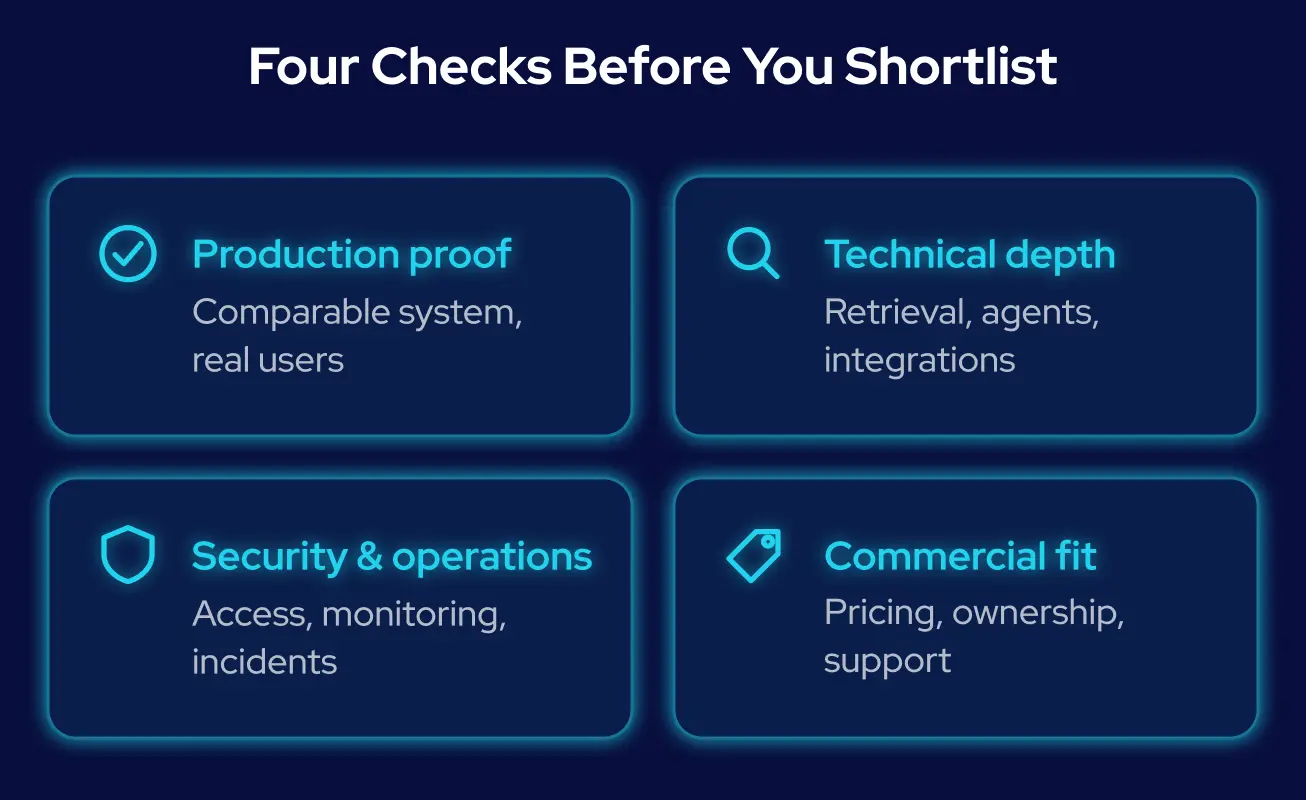
Public service menus reveal little, because most vendors advertise the same capabilities. Four checks separate credible partners from vendors that only list the services.
Verified Production Delivery
Look for a named system, a real user group, and an outcome. A case study that describes technology but never describes who used the result is a portfolio entry, not delivery evidence.
Retrieval, Agent, and Data Engineering
Ask how the team combines exact-term with meaning-based search, how it handles documents that contradict each other, and what happens when a question spans several sources. CRM, ERP, knowledge repositories, and pipelines carry most of the delivery risk.
Security and Monitoring
Role-based access, private deployment options, retention rules, and audit logs should have concrete answers. NIST’s adversarial machine-learning taxonomy gives security teams standard vocabulary for data poisoning, evasion, and model abuse. Evaluation sets, prompt versioning, observability, and incident response decide whether quality holds after month three.
Pricing and Engagement Flexibility
Rates, minimum budgets, and engagement models should map to your risk. A fixed-scope pilot suits an unproven use case; a dedicated team suits a longer program.
Method, Sources, and Our Own Conflict of Interest
We publish no weighted score, because assigning decimal points to twelve companies from public material would manufacture precision we do not have. Verified production delivery carried the most weight, then retrieval and agent depth, then data and integration capability, then security and governance. Sources were company websites, published case studies, Clutch profiles, and public product evidence, checked in August 2026 against the active vendor set for the `top generative ai development companies 2026` field. We own this article and appear in the comparison under the same criteria as everyone else.
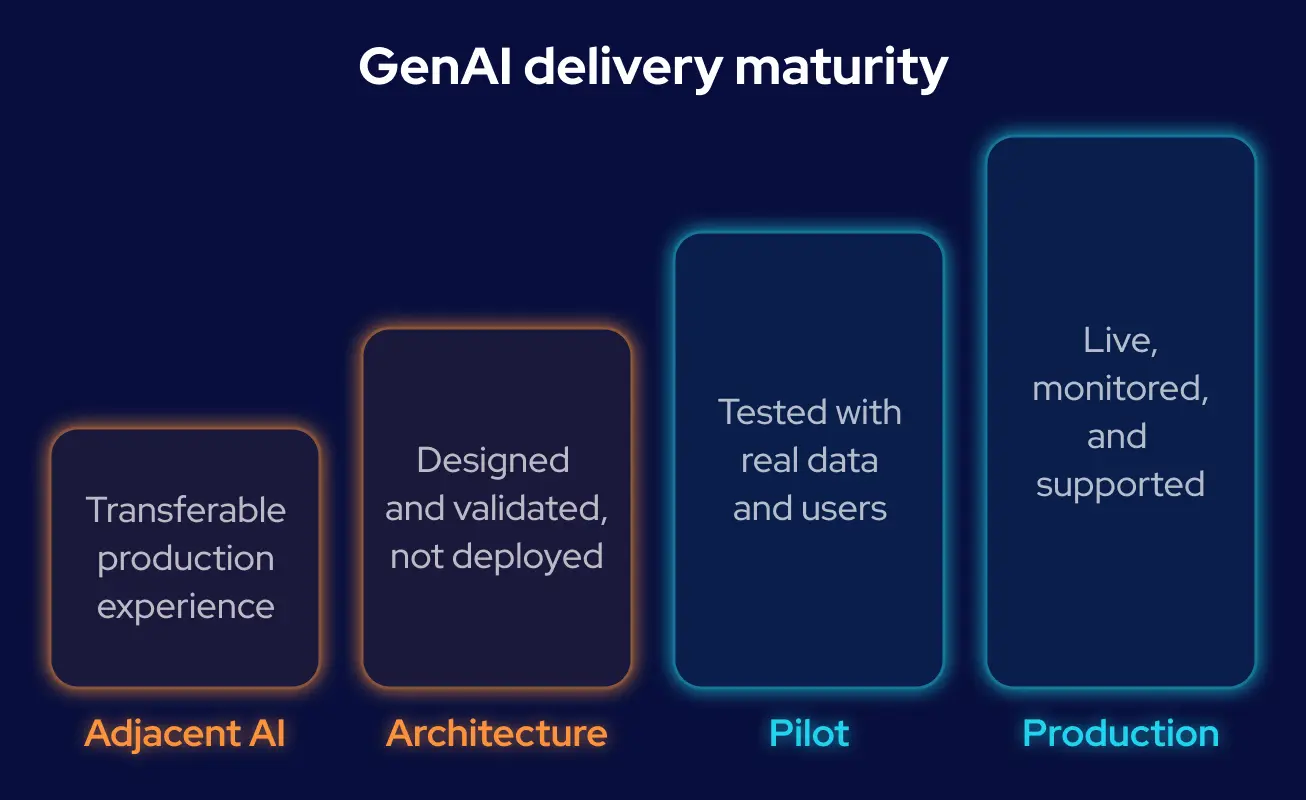
Each profile carries an Evidence Level field, applied consistently across all twelve companies:
| Evidence level | Meaning |
| Production | System is reported as running for real users with a named workflow and outcome. |
| Pilot | Real-data implementation with limited scope, usually weeks long, with measurement. |
| Architecture | Designed, scoped, or in delivery, but not yet running in production. |
| Adjacent AI | Demonstrates relevant engineering discipline, but is not a GenAI delivery in the strict sense. |
Also Read: AI-Enabled Engineering: Transforming Software Development with AI- Accelerated Delivery
12 Generative AI Development Companies: Detailed Vendor Profiles
A useful shortlist does not need an artificial ranking. Profiles are alphabetical, so their sequence implies no score.
Addepto
Evidence level: Production. Agentic RAG case study describes a hosted modular platform for a heavy engineering manufacturer combining layout-aware parsing, fragment-level traceability, and multi-agent reasoning. Our August 2026 public-source check found no company-level ISO 27001, SOC 2, or HIPAA certification.
AI Superior
Evidence level: Production. A custom LLM chatbot case shows a web app where organizations query an in-house LLM and see the supporting sources. No company-level ISO 27001, SOC 2, or HIPAA certification appeared in the public material we checked in August 2026.
DataRoot Labs
Evidence level: Pilot. The AI Safety Incident Classifier sorts raw incident reports using FastAPI, LangGraph, and Azure OpenAI. This vendor also has the lowest published rate band here. Our August 2026 review turned up no public company-level ISO 27001, SOC 2, or HIPAA certification.
deepsense
Evidence level: Pilot. A company-published case covers an industrial measurement chatbot delivered as a four-week pilot, using ragbits, Qdrant, and Azure Kubernetes. A GDPR privacy statement is available. Company-level ISO 27001, SOC 2, and HIPAA certifications were absent from the public sources we reviewed in August 2026.
GroupBWT
Evidence level: Production retrieval and semantic search infrastructure; enterprise GenAI architecture-stage engagement. Semantic search has run in production for more than three years on a public-procurement platform. In a separate 2026 foundation engagement, our team found why natural-language spend questions would fail before choosing a model: only 3.4% of records populated the relevant value field, versus 32.2% and 39.9% for adjacent fields. Related delivery includes the AI travel platform data pipeline. The architecture uses retention, lineage, and jurisdiction filters. The August 2026 public-source review found no company-level ISO 27001, SOC 2, or HIPAA certification.
InData Labs
Evidence level: Adjacent AI. A gaming-community sentiment analysis case combines Claude 3, LLAMA 3, OpenAI o1, and Tableau. GDPR and HIPAA appear at solution level. We saw no public company-level ISO 27001, SOC 2, or HIPAA certification during the August 2026 review.
LeewayHertz
Evidence level: Production. In the published Scrut case, a GPT-4 assistant searches several compliance frameworks at once, including SOC 2, ISO 27001, and GDPR. No other vendor in this comparison publishes as many corporate credentials. The list includes ISO/IEC 27001:2022, ISO/IEC 42001:2023, and SOC 2 Type II. HIPAA and GDPR appear as separate compliance statements.
Master of Code Global
Evidence level: Production. ShopJedAI, a Shopify shopping assistant, reportedly answered 86% of questions correctly and let customers buy inside Apple Business Chat. ISO/IEC 27001:2022 is published at company level. References to HIPAA describe delivery capability rather than a corporate certification.
Neoteric
Evidence level: Production. Neoteric’s US startup case ran for eight months. Its stack was GPT-3.5, AWS, NestJS, React, and Python. We checked the corporate credentials in August 2026 too. None of the public pages showed ISO 27001, SOC 2, or HIPAA certification.
Neurons Lab
Evidence level: Production. In the Xauen case, the agent converts roughly 80 security questions into a voice and text interview. The vendor reports response accuracy above 90%. Governance and traceability sit inside its delivery model. The company-level certificate check was separate. In August 2026, its public material showed no ISO 27001, SOC 2, or HIPAA certification.
SoluLab
Evidence level: Architecture. UpdateIA has a central coordinator that assigns work to more than 14 agents. They cover HR, CRM, finance, legal, and support. On the corporate site, SoluLab claims both ISO/IEC 27001:2022 and SOC 2.
Tooploox
Evidence level: Adjacent AI. Virtum handles digital histopathology, not generative AI. That makes Tooploox the least direct fit in this comparison. The privacy statement deals with GDPR. We also checked its corporate pages in August 2026. ISO 27001, SOC 2, and HIPAA certification were not listed.
Which Generative AI Development Company Is Best for Your Project?
Match the workload to the vendor that does it best.
Best for Enterprise GenAI Programs
LeewayHertz fits multi-department programs where certification breadth shortens security review.
Best for RAG and Enterprise Knowledge Systems
Addepto is the strongest published fit for sprawling technical documentation. Our team competes hardest when the harder problem is source governance and retrieval depth on fragmented data, which is the discipline behind our data governance consulting work.
Best for Conversational AI and Agents
Master of Code Global leads on conversational evidence; Neurons Lab fits agents in regulated environments.
Best for GenAI MVPs and Data-Heavy Projects
Neoteric and DataRoot Labs fit a first product. We fit better when retrieval depends on upstream pipelines, data readiness, and governed access – controls behind our data science work and the acceptance-criteria pattern in our AI travel research platform.
Generative AI Development Services These Companies Provide
Every company here calls itself a generative AI development company. The label covers several distinct services, and few vendors are strong at all of them.
Generative AI Consulting
Turns a vague ambition into a scoped workflow with documented acceptance criteria.
RAG and Enterprise Search Development
The most common enterprise entry point. Source coverage, deduplication, and access controls decide whether the answer is trustworthy.
AI Agent Development
Adds tool permissions, approval gates, escalation logic, and rollback. Microsoft Research’s description of AutoGen’s event-driven multi-agent architecture shows why observability stops being optional once agents communicate asynchronously.
Custom LLM Applications
Wraps models in ordinary software: authentication, API contracts, error handling, release management. Codebase context can matter as much as model quality.
"For me, Claude handles almost every task without extra prompting. The advantage is that it understands the project structure and can navigate files itself. That is what makes it usable on a codebase of this age, not raw model quality." — Dmytro Naumenko, CTO at GroupBWT
Model Adaptation and Fine-Tuning
Adapt models to domain terminology after retrieval is exhausted.
AI Copilot Development
Embed assistance inside existing interfaces.
LLM Integration
Connect models to CRM, ERP, ticketing, and knowledge repositories.
Workflow Automation
Move the system from answering to acting with permissions and approval gates.
Evaluation and Guardrails
Define a correct answer and what happens when no source supports one.
LLMOps and Post-Launch Support
Cover prompt versioning, cost tracking, retrieval fixes, and incident ownership.
How Much Does Generative AI Development Cost?
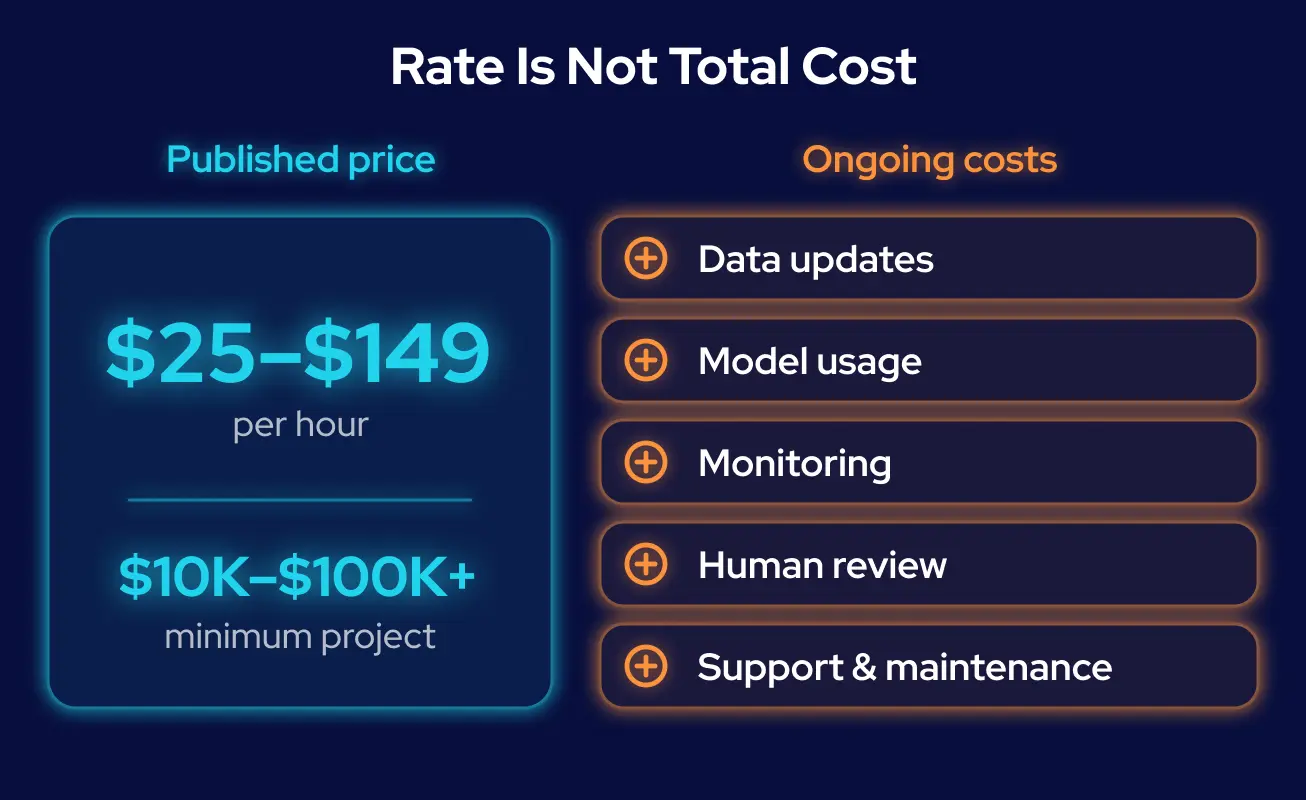
Published rates in this comparison run from $25 to $149 per hour, and minimum projects from $10,000 to $100,000+. Those ranges also apply when buyers search for top generative ai development companies USA; location changes the shortlist, not the evaluation method. Rates frame the first invoice, not the total.
Rates by Region
Central and Eastern European vendors cluster at $25-$99. Western European and United States vendors cluster at $50-$149.
Cost by Project Shape
A proof of concept tests one workflow against real data. An MVP puts that workflow in front of a small user group. A production system adds access control, incident handling, cost tracking, monitoring, and a named maintenance owner. Each stage adds cost categories rather than volume.
Data readiness is the most frequently underestimated of them. The architecture stage can change the bill before a model is chosen: in one public-procurement assessment, our team removed duplicate tender records before calculating the processing load, cutting the proposed one-time embedding set from 7.24 million to 2.91 million records, about a 2.5-times reduction (internal project benchmark, single engagement). The same ownership principle underpins our work on data orchestration as a service and AI in software development.
The Costs That Arrive Later
Inference, embeddings, storage, observability, human review, model migration, and vendor support continue after launch. In Anthropic’s reported multi-agent research implementation, its multi-agent setup used roughly 15 times more tokens than chat.
| Cost driver | What to ask the vendor |
| Assessment | Which business questions can our current sources actually support? |
| Data processing | What can be cleaned or deduplicated before model processing? |
| Agent permissions | Which systems may the agent read, change, or trigger? |
| Model usage | What response-time and usage-cost budget guides the design? |
| Support | Who fixes incidents, cost spikes, or declining answer quality? |
How to Choose a Generative AI Development Company
Start with the business workflow. Verify production projects beyond the case-study headline. Ask how the team measures answer quality. Settle ownership, portability, and exit terms in the contract, and confirm support before the pilot ends.
A hybrid model works well when an outside partner builds the first controlled workflow and hands it to the internal team.
"Every new integration adds complexity. Without a real integration framework, every model you bolt onto a production pipeline makes the next problem harder to solve. AI does not change that law of software." — Alex Yudin, Head of Data Engineering at GroupBWT
Questions to Ask Generative AI Vendors and Red Flags to Watch
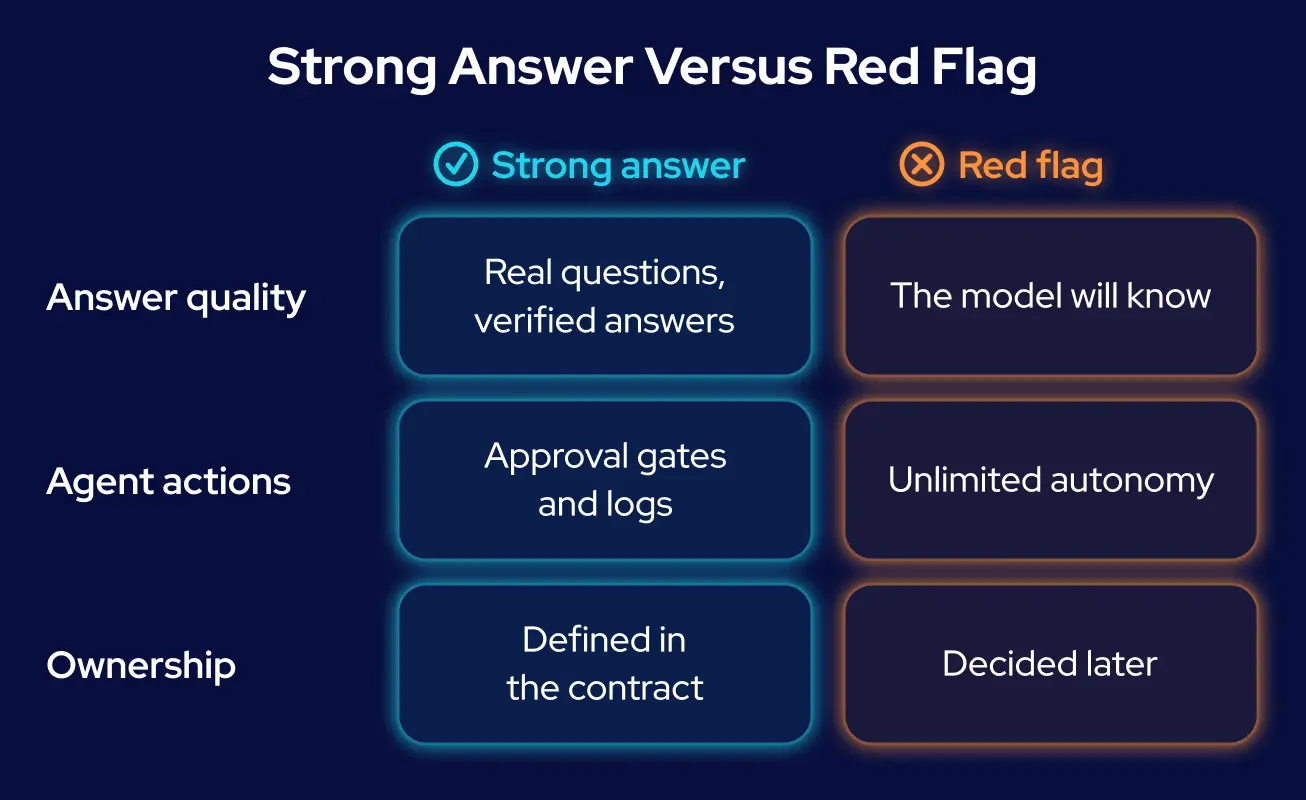
A good evaluation call makes the vendor specific. For European deployments, the European Commission AI Act timeline brings transparency and high-risk duties into the 2026-2027 planning window.
| Question | Strong answer | Red flag |
| How do you measure answer quality? | Real questions, verified answers, human review, records of unsupported answers | Says the model will know |
| What happens when no source supports an answer? | Returns no answer, low confidence, or a coverage warning | Always returns the closest guess |
| How do you test malicious instructions? | Runs attack prompts, checks tool misuse, records the response | Treats security as the model provider’s problem |
| How do you control agent actions? | Names read and write boundaries, approval gates, logs, rollback | Sells unrestricted autonomy as the goal |
| How do you control latency and usage cost? | Assigns models by task and sets a response-time budget | Uses the largest model for every step |
| Who owns code, prompts, logs, and test data? | Contract names ownership and export terms | Leaves ownership for later |
| How do you handle a privacy deletion request? | Names removal process, retention limit, and audit record | Treats search indexes as outside privacy scope |
| Which EU AI Act duties could apply? | Works with your advisers to map classification and evidence | Guarantees compliance without legal review |
Several answers should end a conversation: no verifiable production work; no data readiness step; no evaluation framework; agent capability that exists only in a demo; no named incident owner; unclear ownership of code and data; and no exit or portability plan.
The Shortlist Is the Deliverable
Ignore the list position. Start with three plausible names. On each evaluation call, make the vendor explain its architecture, the condition of your data, its security model, who owns the result, and who supports it. Compare price only after those answers hold up.
A custom build may be unnecessary when the task has structured inputs and stable rules. The custom route earns its cost when simpler tools break on fragmented sources, ambiguous access rules, exact citations, or workflows that must survive changes in models and data.
"Model choice is rarely the hard part; the hard part is the governance contract. We start with buyer-ready acceptance criteria – evidence references, time windows, visible confidence, monitoring, and freeze controls – because if you can't audit a destination claim, you can't scale it without manufacturing confidence you didn't earn." — Oleg Boyko, CCO at GroupBWT

A generative AI development company builds custom applications around large language models and related models. The work spans retrieval, copilots, agents, workflow automation, evaluation, governance, and integration. The difference from a model provider is delivery ownership.
There is no universal winner. The best companies for generative ai development are those with comparable delivery evidence: Master of Code Global for conversational programs, LeewayHertz for published certifications, Neurons Lab for regulated agents, and Addepto for enterprise knowledge bases.
The published profiles put hourly rates between $25 and $149. Minimum engagements start anywhere from $10,000 to more than $100,000. That still does not price your build: source condition, access rules, integrations, model usage, evaluation depth, monitoring, and support move the final number.
Read summarized version with
Build an Enterprise GenAI SystemYour Team Can Operate
We take enterprise GenAI from a defined use case to a production system connected to your data, permissions, and business workflows.
We offer:
- GenAI strategy and solution architecture
- RAG, copilot, and agent development
- Integration, evaluation, deployment, and support