Read summarized version with


Introduction
Most enterprise data never lands in a neat table. Audio. Video. PDFs that travel by email. Server logs nobody reads. A long tail of formats ETL was never built to coordinate. Google Cloud’s 2025 data integration brief still pegs that share at around 80%, and that is the volume now breaking nightly batches.
So you sit down to make the build-vs-buy call. By then, the symptoms have usually been on your desk for weeks. Maybe pipeline failures crept past 5% per week. Maybe the senior data engineering hire stalled six months ago, and HR has stopped giving you a date. Maybe two executives walked into Monday’s meeting carrying different numbers from the same dashboard. Nobody could say which one to trust. Some weeks,s it is all three at once. The rest of this article works through the decision section by section. It starts with the working definition (every section after it leans on that line). It ends with how GroupBWT runs the managed model. By then, the criteria above are how you would test any vendor.
Why Businesses Need Managed Data Orchestration
Data orchestration is the discipline of moving data from source to consumer so it lands on schedule, in the right order, and intact. Four working parts hold that promise up:
- A scheduler decides when each job runs.
- A dependency graph decides what waits for what.
- Monitors watch every node and raise a flag the moment something drifts.
- Retry logic catches whatever falls over and runs it again.
Fragmented Data Pipelines Across Teams and Tools
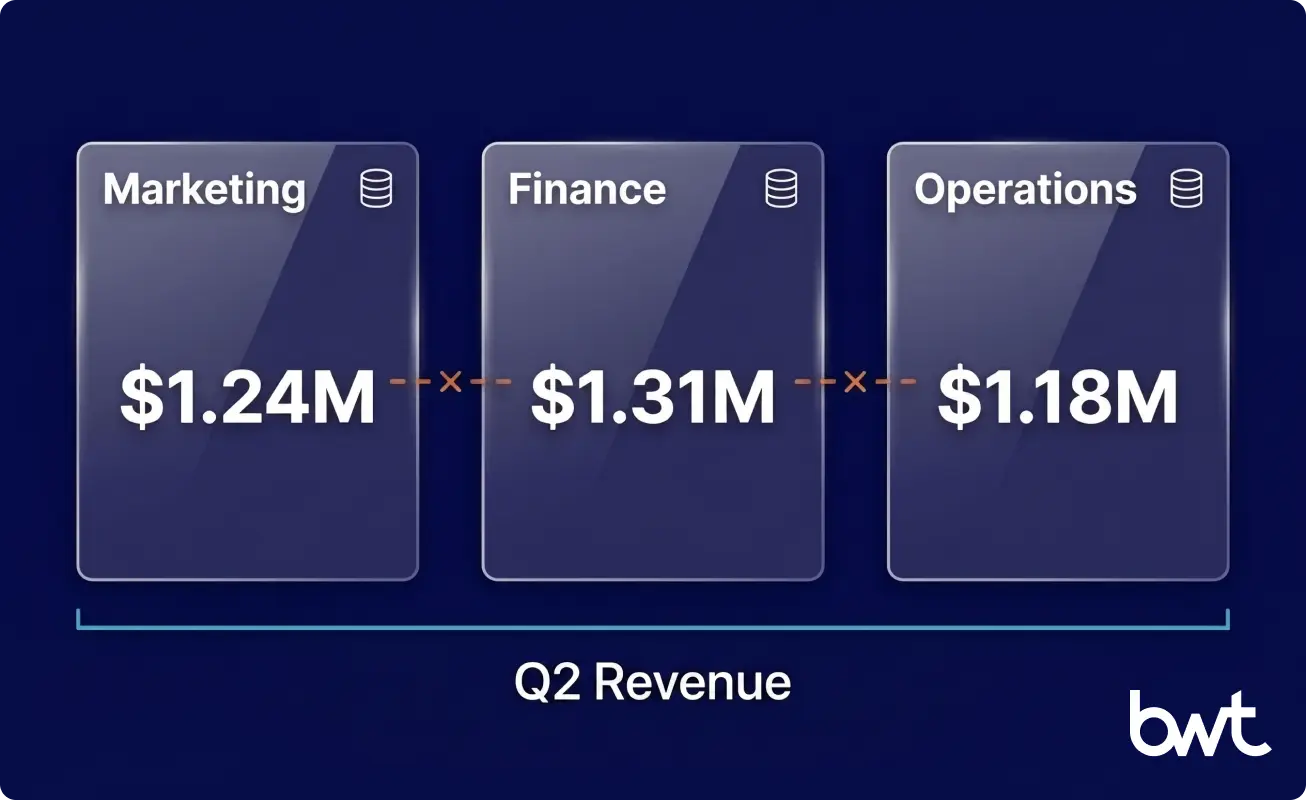
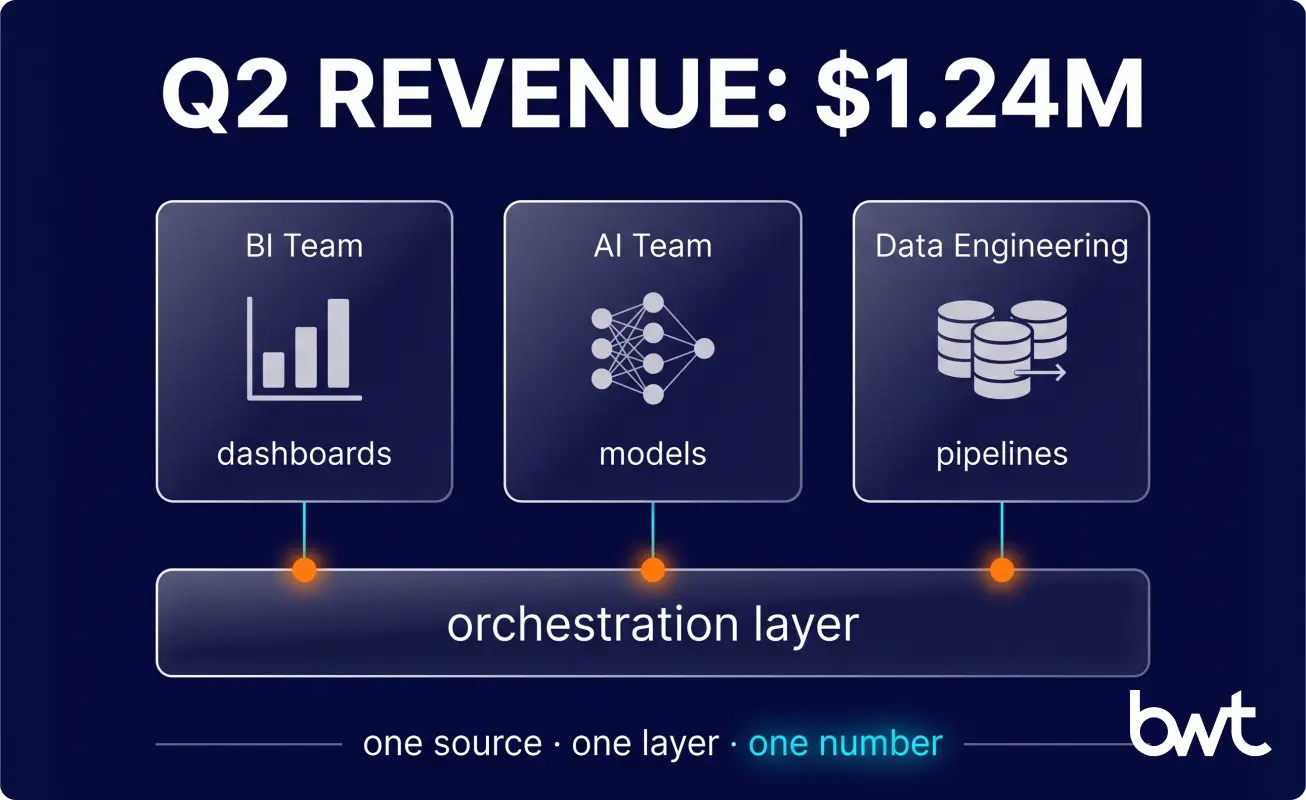
Marketing runs Fivetran. Over in product, everything goes through Segment. Finance is the odd one out: it owns a homegrown SQL extractor, maintained by the single analyst who is also the only person who knows the schema. Each function owns its slice. The seam where they meet belongs to no one. That seam is where dashboards diverge, and where the 9 AM Monday Slack thread starts explaining why two revenue numbers from the same warehouse disagree.
The Cost of Manual Workflow Management
Manual orchestration hides in the Tuesday backfill rerun, the analyst joining three CSVs by hand, and the meeting where four people argue about which funnel is correct.
Challenges of Scaling Data Operations In-House
Hiring a senior data engineer in 2026 takes four to six months. Pipelines do not wait. They break and accumulate technical debt while you recruit.
Why Orchestration Becomes Critical for AI and Analytics
A model retrained weekly on stale data is worse than no model. Peer-reviewed research is blunt: “the cost of model retraining is proportional to how frequently the model is retrained… retraining from scratch each time [is] impractical.” Without policy-driven retraining, you trade freshness for cost and lose both.

How Managed Data Orchestration Works
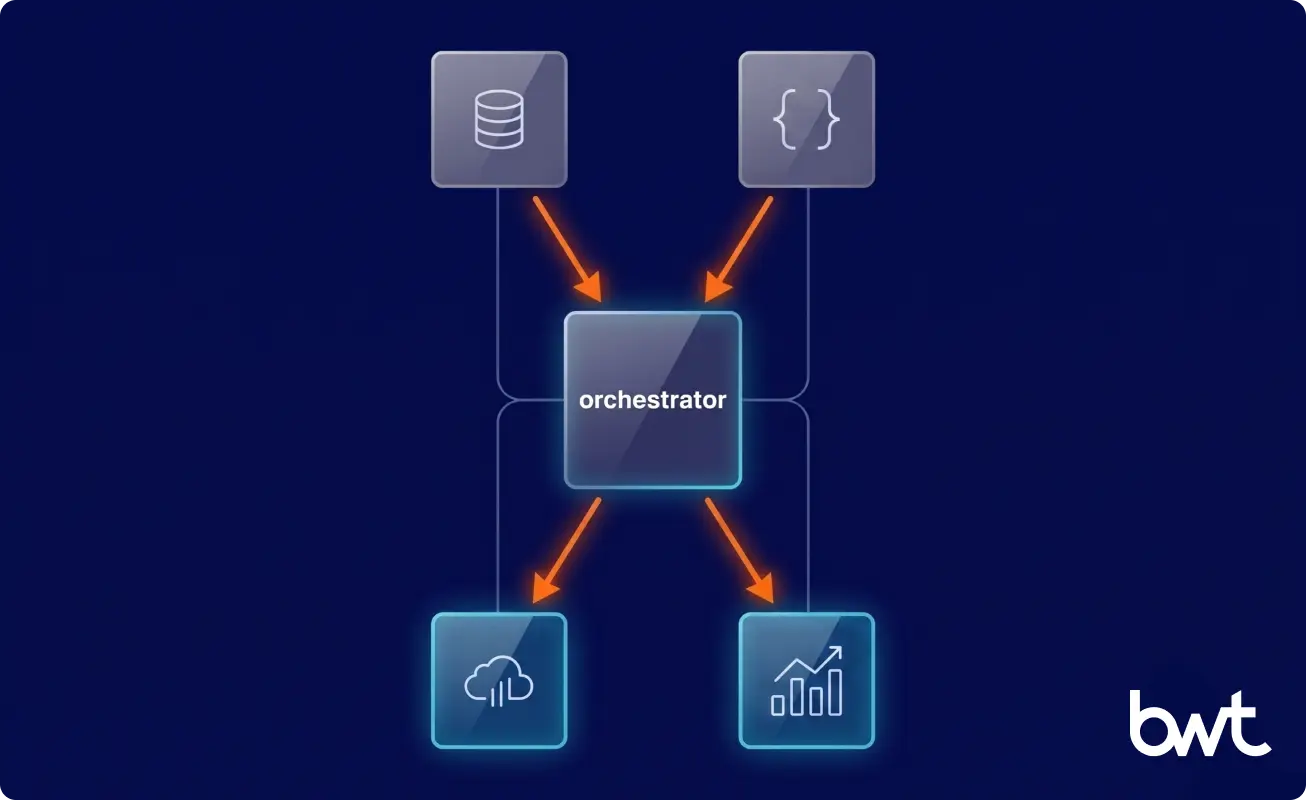
Pipelines rarely fail inside a tool. They fail in the seams between tools — where ingestion hands off to the warehouse, or the transformation layer hands off to the dashboard, and nobody owns the handoff. A managed partner takes that ownership and runs four things continuously.
Coordinating Data Ingestion, Transformation, and Delivery
The provider treats data flow as a directed graph rather than a script. Every node declares its contract before it runs. What data does it expect? What it produces. On what cadence? Which SLA it owes the node downstream. Anthropic recommends the same shape for “data transformation pipelines where each stage adds specific value that the next stage depends on.” One GroupBWT engagement for a North-American agricultural operator runs 20+ sources into a single medallion layer. The sources include agronomy APIs, SQL CDC feeds, IoT streams, ERP extracts, and a SharePoint of PDFs nobody will retire. That layer then feeds hundreds of Power BI reports.
The trap with self-built orchestration is that the first version always works. It breaks on the third source you add; by the seventh, nobody remembers the original assumptions. A managed service forces those assumptions to be explicit and versioned.
— Dmytro Naumenko, CTO, GroupBWT
Managing Dependencies Across Data Pipelines
Real pipelines lean on each other. The marketing dashboard cannot refresh until the funnel transform finishes. The funnel transform is blocked behind event ingestion. Event ingestion itself waits on a schema validator clearing the morning’s payload. When the validator fails at 3 AM, the orchestrator decides what halts and what keeps running, and who picks up the page. Tribal knowledge does not. A high-throughput e-commerce pipeline GroupBWT operates, splits live sessions and backlog into separate priority queues so the second never starves the first when daily volumes spike into the hundreds of thousands.
Monitoring Workflow Health and Failures
A pipeline that fails silently is the expensive kind. Managed orchestration plants monitors all the way through the path: row counts, schema drift, SLA-breach windows, pagination gaps, field-fill rates, anything that could mean the next number is bad. The alert reaches a human before any stakeholder reads it. For one HR-data client, five Metabase alerts in Slack replaced what used to be nightly manual checks.
Ensuring Reliable Data Movement Across Systems
Skip one of four mechanics,s and you will hear about it at 3 AM. The first is exponential-backoff retries, which keep a flaky upstream from looking like a real outage. The second is idempotent writes, so the same record never lands twice when a job is re-run. Transactional handoffs across system boundaries are the third; without them, a half-written transfer leaves two systems disagreeing about reality. The fourth is a dead-letter queue for messages that never parse, no matter how many times you replay them. Drop any of the four, and the data team spends mornings triaging the same broken record while the dashboard runs a day behind. In a retail-intelligence engagement, AWS Batch with SQS and DLQs catches malformed payloads after a single retry instead of looping forever. Duplicates get handled the same way. Rolling-window deduplication matches fingerprints, so the team stops reconciling by hand.
Also Read: Enterprise Data Warehouse Architecture Blueprint & Implementation
Core Components of a Managed Orchestration Service
Managed orchestration is not a single product. It is a stack of five working parts, and no single one is worth much without the other four.
Workflow Scheduling and Pipeline Automation
The scheduler runs jobs on time, by event, or by dependency. Apache Airflow 3.0 shipped in April 2025 and formalized event-driven execution alongside the classic cron model. The way AWS’s release note describes it: “Asset Watchers monitor external systems asynchronously and trigger workflow execution when specific events occur.”
Event-driven scheduling earns its keep when latency matters — operational dashboards, anti-fraud feeds, ad-bidding inputs. Where cost matters more than seconds, batch is still the cheaper choice: financial close, reconciliation, model retraining. Most production stacks run both. In one micromobility engagement, Temporal snapshots hundreds of cities across multiple time zones and delivers daily inside a contract-grade SLA.
Data Transformation and Task Dependencies
Transformation logic (dbt, Spark, Python) runs as orchestrated tasks with declared dependencies. The orchestrator decides what runs in parallel, what blocks, and what reruns when upstream input changes. State checkpoints and watermark tables keep reruns idempotent, so a failed task resumes from its last good checkpoint, and a 3 AM retry never inflates the morning dashboard.
A small DAG fragment makes the contract concrete:
ingest_events >> validate_schema >> [build_funnel, build_attribution] >> refresh_marts >> trigger_ml_retrain
build_funnel and build_attribution run in parallel after validate_schema; trigger_ml_retrain fires only once refresh_marts lands. A failure in validate_schema halts everything downstream, and pages on call before dashboards see stale data.
Monitoring, Alerting, and Recovery Logic
Recovery has to distinguish a transient API timeout (retry with backoff) from a structural failure (page oncall, halt downstream). A dedicated data-quality verification layer on the same retail-intelligence stack filters bad sessions before they reach the warehouse, not after.
Metadata, Logging, and Auditability
Every run leaves a trail. Inputs and outputs get hashed at the boundary. Schemas are captured at the moment they run. Lineage is rendered so anyone can ask “where did this number come from” and get an answer instead of a Slack thread. Open standards like OpenLineage and OCDS v1.1 keep that lineage queryable across tools rather than trapped inside one orchestrator. One public-sector engagement uses them to track every value back to its source portal. Catalogs such as Databricks Unity Catalog or DataHub close the loop. They attach access policies and ownership to every dataset the pipeline writes.
Governance and Access Controls
Role-based access. Secrets management. Dataset-level policies. A clear separation between who can read, who can run, and who can change.
Managed Orchestration vs Traditional Pipeline Management
Most teams arrive at data orchestration as a service after trying two cheaper options. In-house orchestration looks affordable on a slide. Two engineers, an Airflow instance, and a quarter of someone writing DAGs. With real DataOps discipline behind it, the in-house model holds indefinitely. That means documented runbooks, schema contracts, an on-call rotation, and an internal platform team that treats pipelines as a product. Companies that have built that muscle do not need a managed service, and pretending otherwise is dishonest. Without that discipline, the math holds for about eighteen months. Then the team that built it leaves, the DAGs are undocumented, and the next senior hire spends a quarter reverse-engineering the previous owner’s assumptions. Managed orchestration is one way out of the second scenario. Standing up an internal platform team is the other.
Off-the-shelf ETL tools solve a narrower problem: move data from A to B. The coordination job stays open. Seven systems still need to be sequenced, cross-pipeline dependencies still need to be tracked, and finance still wants to know where a number came from. Workflow automation platforms (Zapier and friends) live one tier higher, at the integration layer; fine for low-volume business-user automation, not for production data engineering at warehouse scale. A managed service wins when complexity outgrows what the in-house team can hold in scope, and internal time is worth more on analysis than on infrastructure.
| Dimension | In-House Build | Off-the-Shelf Tool | Managed Service |
| Time to first reliable pipeline | 3–6 months | 2–4 weeks | 1–2 weeks |
| Cost model | Salaries + tooling | Per-connector / per-row | Engagement-based |
| Coverage of complex dependencies | Full, if built | Limited | Full |
| Operational ownership | Internal team | Internal team | Provider |
| Scaling cost curve | Linear with hires | Linear with volume | Sub-linear |
Key Benefits of the Managed Model
The benefits of data orchestration as a service arrive on different clocks. A few land inside the first month; others take a full quarter before anyone feels them.
Faster Deployment of Data Pipelines
A managed provider brings reusable templates and a team that has shipped this exact shape of pipeline a hundred times. For one global beauty group, a templated pattern carried more than a dozen production pipelines under a single engagement, and the cost of standing up a new source dropped from roughly 25 engineering hours to 5 or 6. The team stopped rebuilding the basics every time.
Higher Reliability and Fewer Pipeline Failures
The SLA moves from the customer’s team to the provider’s. A public-sector tender platform has run on this model for over three years against an early-morning UK daily SLA, which is exactly the continuity in-house teams typically lose through staff turnover.
Reduced Operational Overhead for Internal Teams
Internal engineers stop running pipelines and start designing them. GroupBWT runs a daily job-listing aggregator at tens of thousands of records per day for one HR-data client across nearly two years of continuous delivery; analysts pull a fresh feed every morning, and nobody is debugging at 2 AM.
Better Data Quality, Visibility, and Governance
Quality gates run on every stage. Run history stays queryable months later, and every access is audited. Analysts stop running the “let me double-check that number” query before every meeting, because the lineage answer is now one click away.
One thing orchestration does not do, and no managed service will quietly fix for you: it does not clean the source. If sales reps enter customer records sloppily in the CRM, the orchestrator flags the failing rows. It can halt the load before bad data reaches the warehouse. The cure for entry-quality lives somewhere else, though. It lives in the business and in the people who own the source system. Managed orchestration is the alarm and the quarantine. The data-stewardship work upstream of it stays yours.
Scalable Foundation for BI, Analytics, and AI
The orchestration layer behind your BI dashboards is the same one that feeds feature stores, training datasets, and model inference. When BI and AI read from one layer, teams stop fighting over conflicting versions of the same data.
Who Uses Managed Orchestration, and Why
BI and Analytics Pipeline Automation
Daily and intraday refresh of executive dashboards, with quality checks that block bad data from reaching the boardroom.
Multi-Source Data Aggregation and Delivery
Marketing, product, transaction, and external market data merge into one warehouse view. A GroupBWT public-sector engagement consolidates dozens of UK and EEA tender portals into a single open-contracting record set. Hundreds of normalized releases land each day. Every value carries its source and original-format provenance.
Real-Time and Batch Data Workflow Management
Streaming for operational dashboards. Batch for financial reconciliation. The orchestrator decides which path each dataset takes.
AI and Machine Learning Data Pipelines
Training-data refresh, feature engineering, retraining triggers, evaluation, and inference each have their own cadence and failure mode. GroupBWT’s data engineering pipeline for an AI travel platform separates near-term and longer-horizon refresh schedules on fixed delivery windows. AI products stay synchronized with shifting markets, and the team avoids manual triage.
Cross-System Reporting and Data Synchronization
Keeping CRM, ERP, finance, and analytics aligned to the same view of customer, revenue, and inventory.
AI projects fail at the data layer twice as often as at the model layer. Teams blame the model. The pipeline broke a week earlier, and nobody noticed because nothing alerted. Orchestration is the difference between a model that improves and a model that quietly rots.
— Alex Yudin, Head of Data Engineering, GroupBWT
Managed Data Orchestration for AI, BI, and Data Engineering Teams
Each team uses orchestration differently. The BI side gets query-ready data on whatever cadence the business actually needs, not whatever the warehouse happens to refresh on. For data engineering, the job changes shape. Engineers stop owning the plumbing and start owning the contracts (schemas, SLAs, lineage). And on the leadership side, something quieter happens. Marketing, product, finance, and data science finally read from the same numbers on the same refresh cadence, defensible against one shared system of record.
AI workloads are the loudest demand driver in 2026 and the most expensive to fail. A managed orchestration layer for AI carries four jobs; the rest of the stack doesn’t. Training-data refresh has to ship with declared versioning, so a Tuesday model can be reproduced six months later by replaying the same inputs. Feature pipelines need idempotent semantics; a rerun should never double-write a row. Retraining triggers belong on drift signals and freshness thresholds, not on a calendar that fires whether the data moved or not. And inference inputs have to match the schema that the model was trained on. Drift between train and serve is the most common reason a model “rots” in production.
An AI-pricing engagement runs all four. Hundreds of millions of records a month flow at high-nineties upstream success. When any layer breaks, the orchestrator quarantines that day’s data and serves the last good version. The model never trains on bad input.
Challenges the Managed Model Solves
The day-30 state inverts every failure mode in Why Businesses Need Managed Data Orchestration above. Dependency graphs become the single source of truth. The question “why is this number wrong?” gets a lineage answer in minutes, not a Slack thread that lasts a week. Per-market pipelines turn into parameterized templates, not one-off rebuilds. Governance, access controls, and audit trails ship on day one rather than arriving as bolt-ons two quarters later. That holds in regulated work too. A long-running healthcare engagement runs event-level logs with sensitive patient data handled at ingestion. The result is the kind of evidence the in-house stack could not assemble on demand.
When to Choose a Managed Orchestration Service
Teams rarely move to data orchestration as a service on a hunch. The signals are usually quantitative:
- Pipeline failure rate above 3–5% per week, with the team firefighting more than building.
- Time-to-insight is measured in days while the business asks for hours.
- Senior data engineering hiring has stalled while pipeline complexity grows.
- Governance reviews are blocked because access controls and dataset history are tribal knowledge.
Signs Your Team Has Outgrown Manual Pipeline Management
When “who knows how this works” answers with one person’s name, manual management is already broken.
When Internal Data Engineering Resources Are Limited
Two engineers cannot run a 30-pipeline production stack and ship new work. The math does not change because everyone is talented.
When Data Reliability Starts Affecting Business Decisions
The loud signal is two execs presenting different numbers from the same dashboard in the same meeting. The quiet one is the executive who stops opening the dashboard.
How to Evaluate the Right Service Partner
Three questions are enough. Have them show you a production pipeline they built that resembles yours. Walk through how they handle a 2 AM Tuesday failure end-to-end. Last one: What does the lineage tooling and runbook look like after handoff? Vendors who dodge any of the three are selling slides, not systems.
There’s a fourth question worth asking out loud, even though most providers prefer it to stay implicit. What happens the day you leave? Handing the runbook to a third party also hands them the expertise. Two years into the engagement, if the decision shifts back to in-house, your team will need more than read access to the DAGs. They need the on-call playbook, the failure history, and the schema decisions that never made it into code. A partner who can’t hand back that institutional memory is a vendor lock-in by another name. Ask the offboarding question on the way in; the answer tells you whether the relationship is a partnership or a dependency.
Best Practices for Implementing Managed Orchestration
Implementation order matters more than depth.
- Start with one critical business workflow (finance or executive BI) and prove the model before scaling.
- Standardize schemas, naming, and pipeline conventions early. The cost of fixing inconsistency triples every six months, and the rework lands on whichever engineer was unlucky enough to inherit the original DAGs.
- Build for monitoring, recovery, and traceability from the start. Retrofitting observability is a multi-quarter project; building it in is a sprint.
- Align orchestration SLAs to business SLAs. A 2 AM batch is fine if reports run at 9 AM; a 7 AM batch is a problem.
We document this pattern in our guide to data pipeline architecture and apply it in the data pipeline AI playbook.
The Business Value of Managed Data Orchestration
ROI here is rarely framed correctly. The honest part has to come first: a managed engagement usually costs more than the salaries of the in-house team it replaces. That is, once you net out tooling, recruiting, on-call hours, and turnover risk. The “we’ll save you headcount” pitch collapses on close inspection. That is why this article does not lead with it. The argument that land is decision velocity. How fast does the business read a trustworthy number and act on it? And how much has delayed analytics been quietly costing the P&L every quarter nobody measured?
Reducing Time-to-Insight
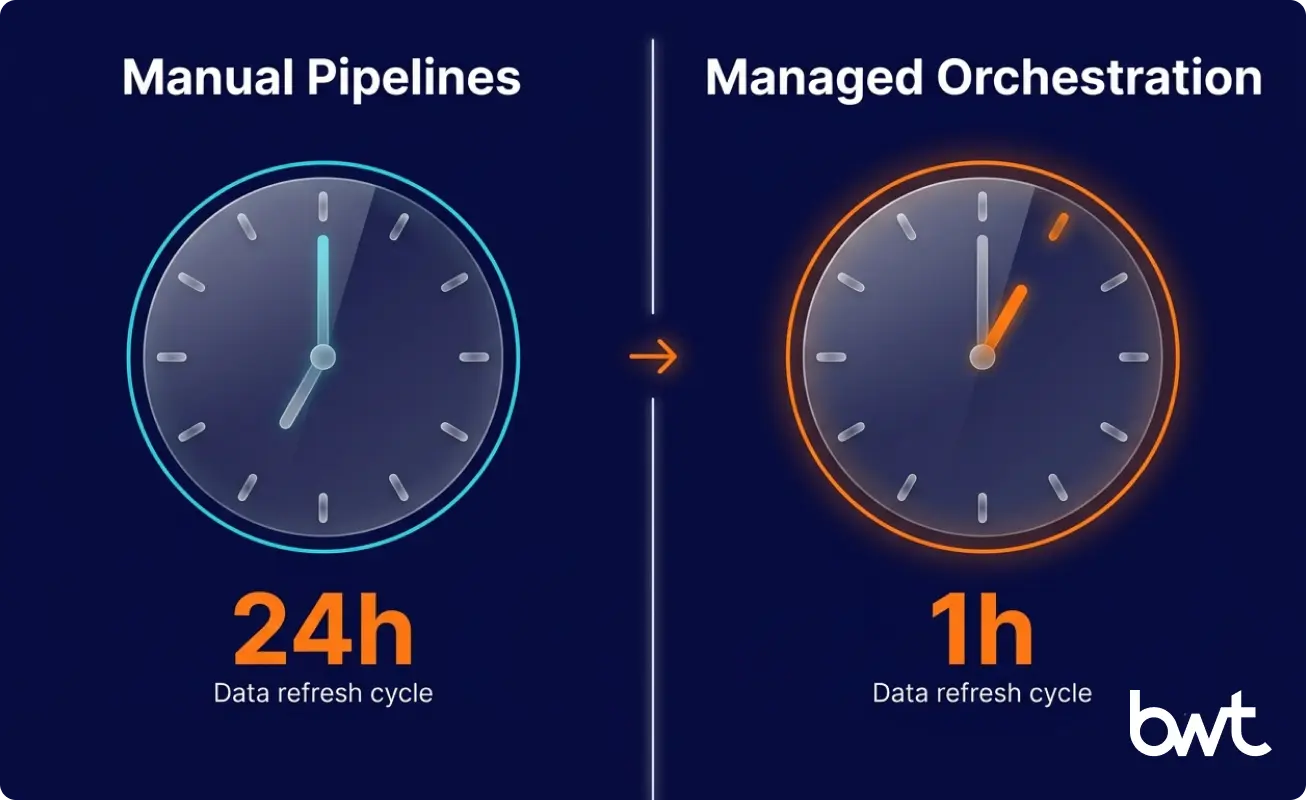
One orchestrated graph for ingestion, transformation, and delivery shortens dashboard refresh cycles from overnight to intra-day. In one e-commerce engagement, the same pattern compressed a 24-hour batch into a near-real-time sync. Finance reads numbers from the current hour, not from yesterday.
Lowering Data Operations Costs
Operations cost drops when senior engineers stop babysitting pipelines; infrastructure cost drops when retries are smart instead of brute-force. On a brand-protection engagement, snapshot/restore controls let the team pause and resume infrastructure across the client’s seasonal lull. Capacity right-sizes to demand. When traffic returns, there is no continuity loss.
Improving Trust in Dashboards and Analytics
Trust shows up as behavior, not as a number. Executives stop bringing two laptops to the same meeting, and analysts who spent half their week reconciling numbers spend it on questions the dashboard cannot answer yet.
Supporting Faster, Smarter Business Decisions
Decisions move at the speed of the slowest reliable data. On a travel-tech AI-pricing engagement, the pipeline keeps dynamic-pricing models on fresh inputs across near-term and longer-horizon windows. Pricing teams adjust positions the same day the market moves, not the day after.
The reason enterprises move to managed data orchestration as a service is not cost. It is that their internal teams have already paid the cost in turnover, in deferred analytics, in dashboards nobody trusts. A managed service is the recovery, not the bargain.
— Oleg Boyko, CCO, GroupBWT
How GroupBWT Delivers Managed Data Orchestration
Managed Orchestration for Complex Data Environments
GroupBWT’s data engineering solutions handle multi-source, multi-region, multi-cadence pipelines as one managed system. The portfolio numbers: 140+ data systems shipped across 16 years. That includes a public-sector tender platform that has run continuously for over three years against an early-morning UK daily SLA. Multi-year continuity is the real number that the build/buy decision is comparing against.
Typical day-one deliverables. A dependency map of every pipeline and SLA with breakpoints flagged. A reference pattern (fetch → validate → raw vault → business vault → mart → BI/AI consumer). Per-node monitoring with alerts to Slack or PagerDuty, plus a retry/DLQ policy per source. Lineage and access policy through Unity Catalog, DataHub, or OpenLineage. And a runbook that the client’s team can operate without renegotiating support every time it breaks.
Pipeline Design, Automation, and Monitoring
Recovery logic is built before go-live, not after the first failure.
The reference stack varies by client, but the lineup is fairly stable. Scheduling runs on Airflow or Temporal, with Kafka or RabbitMQ moving messages between stages. Transformation happens in DBT or Spark; the warehouse underneath is Snowflake, BigQuery, or Databricks, and BI lands in Power BI or Tableau. Observability sits in Grafana and Sentry, while GitOps ships changes through ArgoCD and Helm.
Integration with BI, Warehouses, and AI Systems
The orchestration layer plugs into whichever warehouse, BI tool, or AI platform the client already runs. Our position on warehouse-grade reporting sits in the guide to data warehousing and ETL. Enterprise delivery is documented in our pharmaceutical data-warehouse build, where the orchestrator feeds both the regulated reporting layer and the downstream analytics workspace.
Scalable Support for Enterprise Data Operations
Onboarding a new market, source, or destination is a parameter change, not a project. Days, not sprints, regardless of how many regions or carriers sit on the other side.
Engagement Models
Three shapes, chosen by where the client’s bottleneck actually is:
- Fixed-scope build — bounded scope (warehouse migration, defined pipelines, fixed go-live). Priced by milestone.
- Managed service retainer — ongoing operations of a live data platform. Priced by month, scoped by SLA and capacity.
- Embedded data team — senior engineering capacity inside the client’s own delivery process. Priced by allocated FTE under a master services agreement.
A client with a clear roadmap and no operations gap does not need a retainer; a client whose internal team is consumed by incident response does not need another fixed-scope build.
A managed offering. A third-party provider designs the pipelines that move and transform your data, runs them in production, and steps in to recover them when they break. The provider owns scheduling and dependency management, monitoring, retry logic, and lineage; your team owns the business outcomes. The difference from a tool is that the engagement includes the operations team running the tool.
ETL is a single job: extract, transform, load. Orchestration runs above it. It sequences many ETL jobs and manages their dependencies. It retries failures, blocks downstream steps when a quality check fails, and exposes lineage across the whole graph. Modern stacks use ETL inside orchestration, not as an alternative.
When complexity outgrows in-house capacity, reliability incidents start affecting business decisions, and senior data engineering hires have stalled. Any single signal can usually be fixed internally; all three at once is when in-house orchestration becomes the slowest path to recovery.
The open-source leaders are Apache Airflow, Prefect, and Dagster. Each cloud has its managed equivalent — Amazon MWAA on AWS, Workflows and Cloud Composer on Google Cloud, Fabric Data Factory on Microsoft. dbt remains the dominant transformation-layer sequencer. But the tool is only one element; the service wraps it with hosting, monitoring, recovery, and an operations team.
Yes. AI workloads benefit most. Orchestration keeps training data fresh. It sequences the inference steps and gates new models behind quality checks. A model retrained on Tuesday’s data gets evaluated and gated, then serves by Wednesday morning without a human deciding whether the data was clean enough. Event-driven orchestrators handle streaming alongside batch on the same dependency graph with different SLAs.
Read summarized version with
Data Engineering: From Raw Web to Data Product
We develop and manage custom data solutions, powered by proven experts, to ensure the fastest delivery of structured data from sources of any size and complexity.
We offer:
- Custom Web Scraping & Development
- 15+ Years of Engineering Expertise
- AI-Driven Data Processing & Enrichment