Read summarized version with


Introduction
Most shortlists start the same way. A VP of Data has a board deadline, a warehouse nobody left on the team fully understands, and four browser tabs, each ranking itself number one. That is the flaw in most rankings: the author keeps winning its own contest. This guide handles the 2026 vendor field the other way around. Scorecard first, then each of the top 10 data engineering companies in the same flat voice, with GroupBWT placed only where delivered work earns the slot.
Choosing a model is the easy part now. The harder job sits upstream: dirty tables, missing owners, and numbers scattered across tools. McKinsey’s 2025 global survey The State of AI keeps inaccuracy on the risk list. The cause is usually duller: stale tables, duplicate records, and orphaned fields nobody wants to own. A wrong number rarely stays a data problem. It becomes a pricing call made Friday off Wednesday’s figures. If you read one section, make it the criteria.
Build the Data FoundationYour AI Models Need
We develop and manage custom data solutions, powered by proven experts, to ensure the fastest delivery of structured data from sources of any size and complexity.
We offer:
- Custom Web Scraping & Development
- 15+ Years of Engineering Expertise
- AI-Driven Data Processing & Enrichment
Key Takeaways: How to Choose the Right Data Engineering Company
No single firm wins every data problem; anyone claiming that is selling the list, not helping you buy. Start with the failure in front of you — a legacy migration, a sub-minute feed, a standardized cloud build, or an AI program stalled by bad inputs. The shortlist below names the strongest fit by use case, while the full comparison covers 10 data engineering companies.
- Enterprise platforms — Accenture. Once a program spans dozens of business units and legacy ERPs, you are paying for the muscle of its Data & AI practice, a delivery organization tens of thousands strong inside a firm of nearly 800,000. EPAM Systems is the close alternative when software rigor matters most.
- Custom or non-standard data, real-time and external feeds — GroupBWT. Reach for it when standard connectors cannot get to the data, when a pricing feed has to move off a 24-hour SLA to near-instant, and you want the same team running the platform for years. GroupBWT’s record here is a daily competitor-and-supply feed across 200+ cities, delivered through warehouse sharing. Skip it if you just need five clean SaaS tables moved into BigQuery.
- Databricks builds — Lovelytics. The firm works only in Databricks, so the narrow focus works in your favor on a by-the-book lakehouse build.
- Snowflake consolidation — phData. One of the deepest Snowflake partners in the market, with migration accelerators for teams standardizing on one stack.
- AI-first infrastructure — ML6. The Ghent-based specialist has worked in machine learning since 2013 and partners closely with Google Cloud. Addepto is a strong alternative.
How We Selected the Top Data Engineering Companies
We did not rank by revenue or ad spend. The top data engineering services companies earn a place on production evidence, not brochure language. Five criteria did the sorting, and each doubles as a question you can put to any vendor. The one that matters most is the run model: the best engagements are measured in years, not sprints.
“The first deliverable from an honest data engineering vendor is a true inventory, not a roadmap. Clients underestimate their source surface by an order of magnitude, and the architecture you design for fifty tables collapses when it turns out to be six thousand,” — Dmytro Naumenko, CTO at GroupBWT
Treat the table below as a scorecard. Take it into the call, and watch where the answers turn vague.
| Criterion | What to look for | Red flag |
| Production track record | Live pipelines at your scale, callable references | Slide decks and logo walls with no running system |
| Data quality and governance | Lineage, observability, validation gates, ownership | “We’ll add governance later” |
| Cloud and stack fit | Clear reasoning for Snowflake, Databricks, BigQuery, or on-prem | One stack pushed regardless of workload |
| AI and BI alignment | One governed data store serving analytics, BI, and AI | “AI-ready data” sold as a later upsell |
| Delivery and run model | Ability to operate the platform after launch | Build-and-leave delivery with no support model |
Comparison of the Best Data Engineering Companies
A flat list tells you who exists. This table tells you who fits. Use the “Best for” column as the shortcut; the profiles matter only after you know your bucket.
| Company | Focus and core stack | Best for | Typical engagement |
| Accenture (Data & AI) | Multi-cloud data programs inside a global SI | Legacy sprawl, change management, and many business units at once | Enterprise transformation |
| GroupBWT | Python pipelines, Databricks/Snowflake builds, external and operational data | Messy source access, custom ingestion, and a partner that keeps operating it | Start small; keep the run team |
| EPAM Systems | Cloud data platforms with tests, CI/CD, and maintainable code | Enterprises where pipeline quality must survive handoff | Managed delivery team |
| Wavicle Data Solutions | ETL, BI migration, cloud data, and AI from a US team | Mid-market or enterprise modernization | Project, then managed services |
| phData | Snowflake-heavy delivery, Databricks work, and migration tooling | A company standardizing on one cloud data platform | Project, then managed services |
| Lovelytics | Databricks-native lakehouse and AI | Databricks-first organizations | Project plus managed services |
| Datatonic | Cloud data and AI on Google Cloud | Google Cloud-first data and GenAI builds | Project plus managed services |
| Addepto | Model-led pipelines, lakehouses, and ML data preparation | AI teams whose data has to be shaped before modeling | Project or advisory |
| Thoughtworks | Data platforms built with product-engineering habits | Data products where governance and engineering process matter | Advisory plus delivery |
| ML6 | European AI engineering for CV, NLP, and GenAI | Frontier AI work needing feature and model pipelines | Project or advisory work |
Top Data Engineering Companies to Consider in 2026
The profiles below describe each firm fairly, ours included. Where a competitor is the better call, we say so.
1. Accenture (Data & AI). HQ: Dublin. Global SI. Works at a scale most boutiques never touch: transformations across many business units, consolidating legacy sprawl, change management for tens of thousands of users. Best when the engagement is as much organizational as technical.
2. GroupBWT — best for custom data engineering, AI-ready data, and complex platforms. HQ: Kyiv, with offices in London and California. Founded 2009. Team ~80. The firm builds the data systems standard tools cannot reach: operational data off-the-shelf connectors never expose, then the governed warehouse and AI-ready layer on top. For a US agricultural cooperative across 12 farms in 8 states, that Databricks lakehouse pulled 6,000-plus legacy tables into one governed place. If the brief is a by-the-book Snowflake migration or “more dashboards, please,” choose a stack specialist instead. Core strengths: custom pipelines, external-data ingestion, lakehouse and Data Vault warehouses, and long-term support.
3. EPAM Systems. HQ: Newtown, Pennsylvania. Brings software-engineering discipline to data work, which shows in testing, CI/CD for pipelines, and builds that hold up under maintenance. Strong on cloud depth and large managed-delivery teams for Fortune-class clients.
4. Wavicle Data Solutions. HQ: Chicago. A US data, cloud, and AI consultancy with its own accelerators for ETL and BI migration. Good fit for platform modernization across mid-market and enterprise clients.
5. phData. HQ: Minneapolis. Founded 2014. Deep Snowflake bench, Databricks work, migration accelerators, and managed services for teams standardizing on one stack.
6. Lovelytics. HQ: Arlington. Founded 2017. A Databricks-native firm covering Delta Lake, Unity Catalog, and the analytics and AI layer above. Best for organizations already committed to Databricks.
7. Datatonic. HQ: London. Founded 2013. The Google Cloud lane is the point here: BigQuery warehouses, Looker analytics, and GenAI builds under one delivery team. Use it when the data platform and ML layer both sit on Google Cloud.
8. Addepto. HQ: Wrocław. Founded 2016. Leads with AI and machine learning, designing lakehouses and pipelines around model needs. Best for AI-first problems.
9. Thoughtworks. HQ: Chicago. Founded 1993. Pairs a strong software-engineering culture with data-product thinking and helped popularize data mesh. Apax Partners took it private in November 2024.
10. ML6. HQ: Ghent. Founded 2013. Its work sits around computer vision, NLP, GenAI, and MLOps, often with Google Cloud in the stack. Best for frontier AI work and feature pipelines.
Core Services Offered by Data Engineering Companies
Most of these firms deliver roughly the same catalog. The separation shows up after launch: depth in the work, and whether the vendor stays to run it.
Consulting should leave behind the target architecture, the build-vs-buy call, and the reason each tool made the cut. If nobody builds the pipeline after that, it is still a deck. Pipeline development is where the daily mess lives: batch jobs, streams, retries, source changes, and rows that disappear under load. Warehouse and lakehouse work decides where the records land — Snowflake, Databricks, BigQuery, Redshift, or on-prem when the workload forces it. Good ETL and data warehouse work gives a team one report it can trust. Under a terabyte and five sources, a full lakehouse is usually more machinery than the job needs.
Migration and modernization gets old warehouses off the critical path without shutting reporting down. The fragile part is the knowledge sitting in a departing architect’s head. That is why knowledge capture belongs in scope months before handoff. Real-time engineering covers streams and change-data-capture for decisions that cannot wait for the nightly batch; the harder call is knowing when the nightly batch is enough. Quality and governance adds lineage, access control, and quality gates so the business can trust the numbers. AI data engineering builds feature pipelines and retrieval-ready stores for models, which is where buyers get oversold most often.
“AI-ready data is just well-engineered data with a new label. The governed warehouse we ran for a client’s BI for three years became the corpus for its retrieval chatbot with zero re-architecture. If a vendor sells AI-ready data as a separate product, that is usually a tell that the original engineering was not done right,” — Alex Yudin, Head of Data Engineering at GroupBWT
If you are scoping this work, our guide to building an AI-ready data pipeline breaks down the layers in plain terms.
Best Data Engineering Companies by Use Case
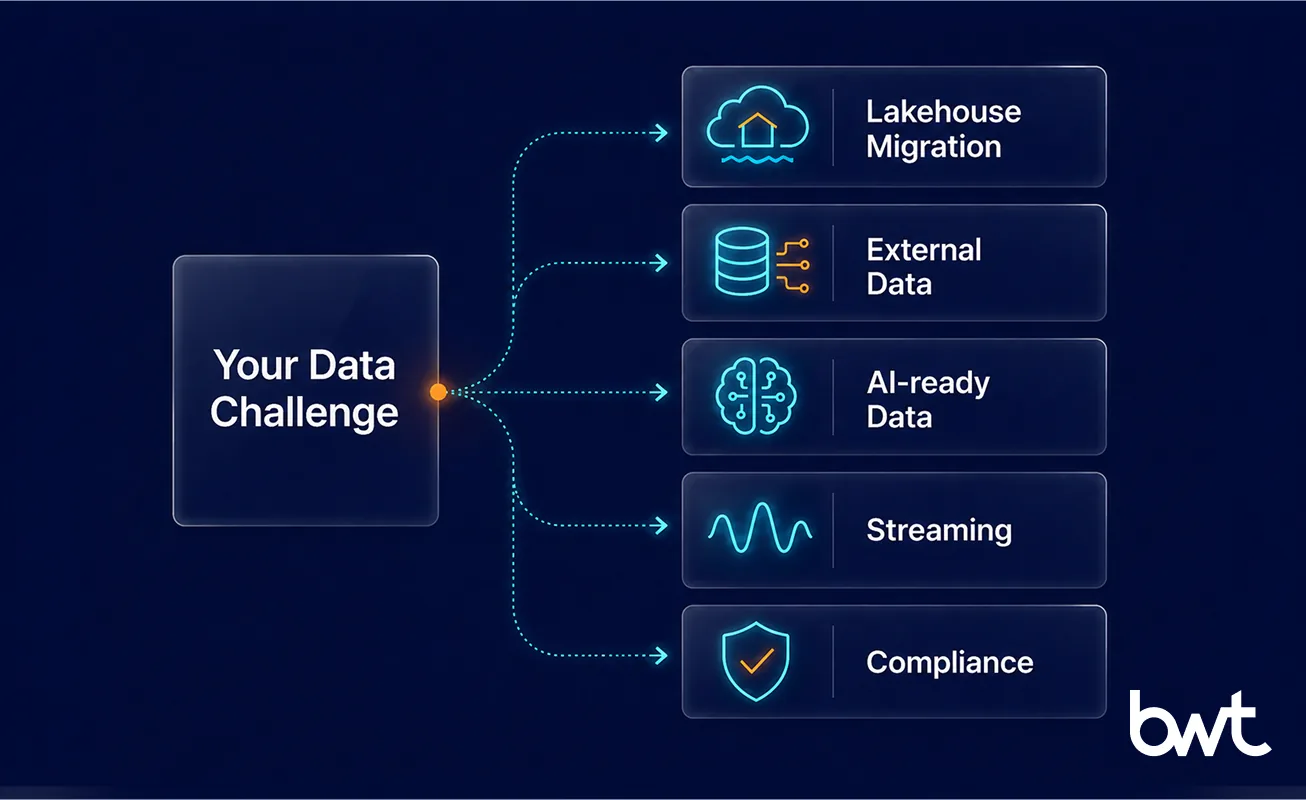
Picking by use case beats picking by reputation. Map your situation to the pattern, then to the firm:
- Enterprise lakehouse migration. A legacy estate moving to a governed cloud platform. Custom specialists and platform-elite partners like phData fit here; Accenture and EPAM fit when the program spans the whole organization.
- Production-scale ingestion of external data. Storefronts, marketplaces, and sources standard connectors do not reach. Firms with real scraping-to-warehouse pipelines win this.
- AI-ready warehouse and retrieval corpus. One store serving BI today and models tomorrow. Look for proof a single warehouse already served both.
- Real-time and streaming. Sub-minute feeds for event-driven decisions. Demand a live reference at your latency, not a diagram.
- Compliance and citation-grade data. Legal and audit work where every row needs a verifiable source and timestamp.
Not sure which pattern is yours, or whether your data is ready for the model you have in mind? A short data-readiness assessment is the cheapest way to find out before you commit a budget.
Also Read: Building Data Pipelines From 20+ Sources: Playbook
Best Data Engineering Companies by Industry
Demand differs by sector, and so does the right partner. Most top-rated data engineering companies cluster around retail and SaaS because that is where the volume sits. The harder, more defensible work lives in the regulated and physical industries below, and Manufacturing leads, because that is where the gap between the plant floor and the analytics team runs widest.
Manufacturing. Signals from plant-floor systems like PLC and SCADA are only useful if you capture them within seconds. Feed them into the same system as sales and finance, and an operator catches a problem during the shift, not in next week’s report. The recurring, underestimated scope item is reverse-engineering a departing DBA’s stored procedures. Our legacy warehouse migration to a Databricks lakehouse for a multi-site agricultural producer shows what this looks like, sensor floors included.
Retail and E-Commerce. Competitor pricing and assortment ingestion is the problem most brands underestimate, and the real deadline is rarely “real-time.” Buyers need the data before the merchandising meeting. Above five countries, locale-aware parsing for currency, language, and tax stops being optional.
Finance and Fintech. Reconciliation and middleware pipelines still dominate, and AI use cases sit on plumbing the bank has tolerated for a decade. Audit-ready lineage and tight access control decide the deal; treat them as less and the project stalls at compliance review.
Healthcare and Life Sciences. Here compliance is the whole deliverable, not fine print. Explicit status-code state machines beat retry loops for audit, because every silent failure has to be observable. In one such build, that approach caught two silent failures before a compliance deadline, across a dataset of more than 19,000 patient profiles.
Travel, Logistics, and Mobility. A daily snapshot delivered through a warehouse share is often the right primitive, and platform-native sharing removes the brittle file-handoff that breaks at the customer’s edge. Our case study on a data pipeline for an AI travel platform turned raw guest reviews from seven sources into structured city scores across 30-plus European cities, anonymized under NDA with the architecture on the public case page.
SaaS and Technology. When the pipeline is the product, an outage does not open an ops ticket. It shows up as churn on next month’s dashboard. Keep ingestion and delivery on separate tracks, and design the pipeline to slow down rather than crash when a source goes offline.
Where These Companies Operate
For US buyers, location is really three checks: time-zone overlap, data residency, and how much work happens onshore, nearshore, or offshore. EPAM, Wavicle, phData, Lovelytics, and Thoughtworks give North American teams easier overlap and a default path to US residency. ML6, Datatonic, and Addepto lead from Europe, a fit when GDPR-region residency matters. Accenture delivers anywhere through a global model, and custom specialists like ours run delivery from Ukraine with client-facing offices in London and California, priced below US-onshore rates. Whichever group you weight, confirm where your data is physically stored and put it in the contract.
How to Choose a Data Engineering Company
Start with the decision the data must support, well before the tool you read about last week. Run the same five scorecard criteria as questions: have they handled your exact source shape, at comparable complexity? Can they defend Databricks over Snowflake for your workload, and name the cases where on-prem still wins? Do lineage and quality gates come up before you raise them? Will one governed store serve both dashboards and models? And who operates the platform after go-live, and for how long? A vendor-neutral answer on the stack and a multi-year run commitment are the two strongest signals; vague governance answers are the weakest.
Red Flags When Hiring a Data Engineering Company
Some signals reliably predict a painful engagement:
- Tools over architecture. A pitch that is a stack of logos rather than a target design sells familiarity where you need judgment.
- Silence on data quality. If quality and lineage never surface in the first conversation, they will surface later as an invoice.
- No production-scale proof. A working demo will not survive a holiday traffic spike. Ask for live throughput numbers.
- No run model. Pipelines are living systems. A firm with no support model is planning to hand you a maintenance problem and walk away.
“Almost nobody hires their first data engineering vendor. They hire their second or third, after the first build quietly fell over. On one enterprise account we consolidated two prior vendors into a single pipeline. Ask any firm how many of its largest accounts are vendor-replacement work, and listen for an honest answer,” — Oleg Boyko, CCO at GroupBWT

How Much Do Data Engineering Companies Charge?
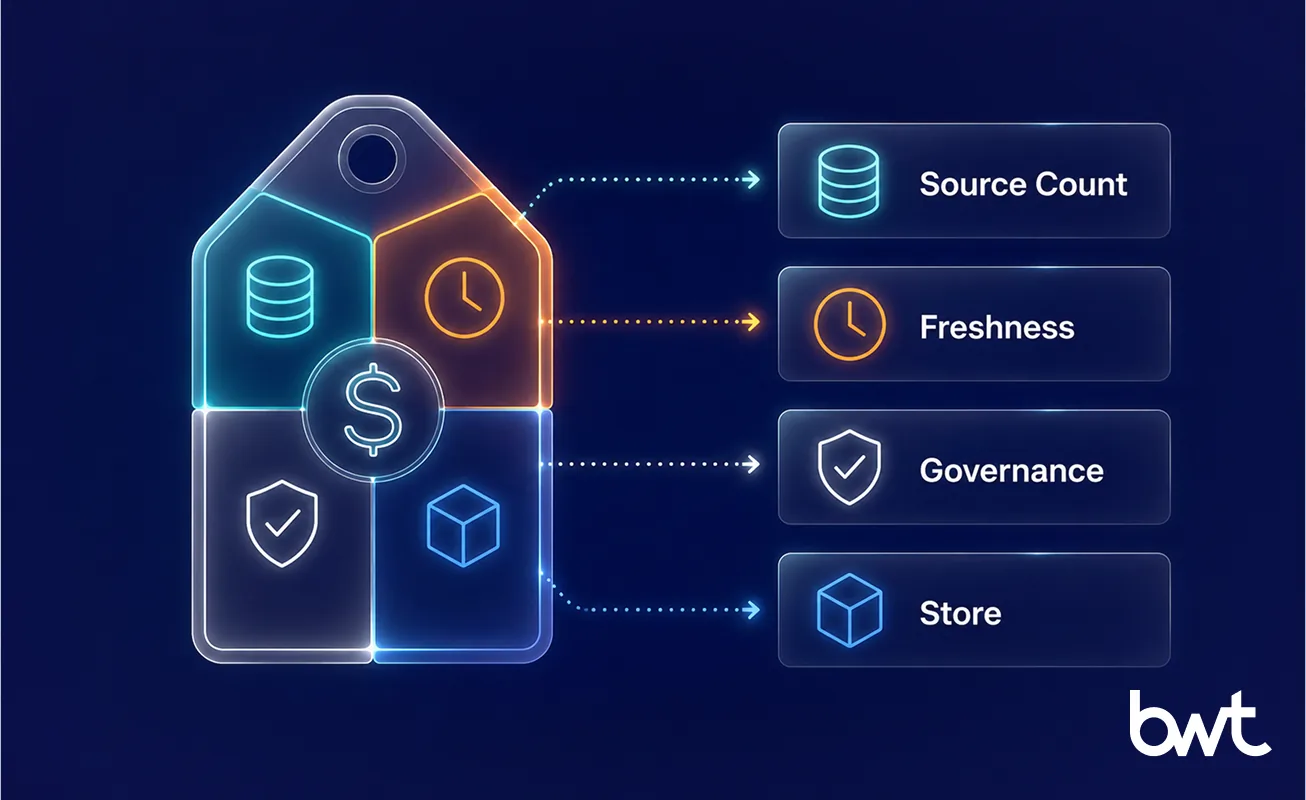
A vendor who gives a flat number before discovery is guessing. The price comes from four knobs: source count and volatility, freshness, governance, and whether ML workloads use the same store. One stable SaaS source on a daily refresh does not cost like twelve storefronts changing every minute, even if both briefs say “pipeline.”
Three engagement models cover most of the market. The ranges below are public-market ballparks for context, not quotes.
| Model | Best for | Ballpark range | What it covers |
| Fixed-scope project | MVP, 1–3 sources, 8–12 weeks | ~$15K–$60K one-time | Discovery, build, docs, handoff |
| Monthly run-and-support | Ongoing multi-source pipelines | ~$5K–$25K per month | Monitoring, fixes, new sources |
| Dedicated squad / platform build | Lakehouse builds and migrations, 6+ months | ~$150K–$1M+ total | Architecture, build, and the run that follows |
Read those as starting points. Put a stable SaaS source near the low end; regulated, multi-locale, sub-minute work pushes to the top or beyond it. If governance, observability, or run-cost is missing from the cheap quote, the money comes back out as downtime and rework. Cheap at build time can be expensive in year two.
Why GroupBWT Is a Strong Data Engineering Partner
With the field laid out fairly, here is the scoped case for one firm, held to where delivered work backs the claim. The recurring pattern is data that standard connectors do not reach: competitor pricing across thirteen retailer sources and thirty-plus locales, citation-grade marketplace evidence for a law firm’s litigation team, sensor streams from a plant floor. Building ingestion for those hard-to-reach sources turns inaccessible signal into a governed dataset the business can use. The portfolio covers the full stack a modern program needs: a Databricks lakehouse with Unity Catalog for a multi-site producer, a Data Vault 2.0 customer data platform that ran for years and then fed a retrieval chatbot, and streaming feeds delivered through warehouse sharing.
Several engagements have run for four and seven years, with the original team still operating the pipeline, so GroupBWT absorbs the maintenance burden most vendors hand back. Quality gets engineered in from the start: quality gates at the Bronze and Silver layers, classification accuracy measured and reported, governance held in Unity Catalog rather than in someone’s head. By wiring those checks into the ingestion path, one client’s competitor-pricing feed grew from 96 to 959,000 product price records a day, while refresh time dropped from 24 hours to under 60 seconds.
Final Thoughts
A crowned winner should make you suspicious. Sometimes the right answer is in-house hiring; sometimes it is staff augmentation; sometimes a connector tool covers enough because the sources are ordinary SaaS systems. A serious partner will say that out loud when custom build is the wrong buy.
A custom partner earns its place when standard tools cannot reach the data, when a wrong or late number hits revenue, and when you need someone to run the platform for years. Hiring will not rescue a stalled program quickly. The U.S. Bureau of Labor Statistics expects only single-digit growth for database administrators and architects this decade. Use the scorecard, match the pattern to your problem, and you will find the right data engineering partner for the data you actually have.
There isn’t one. The honest version of the question is “best for what.” A bank stuck on a tangled legacy stack wants someone who can land a governed lakehouse. A SaaS founder wants someone who runs a pipeline like a product and keeps it alive at 3 a.m. Different jobs. Different winners. So when you ask a peer to recommend top data engineering companies, lead with the shape of your data — how many sources, how messy, how fresh it has to be. This guide spans both ends, from integrators like Accenture and EPAM through to focused shops like phData and ML6. Filter on one thing first: can they point to a live system at your scale that a real client will pick up the phone about.
It builds the pipelines, stores, checks, and access rules analysts read from every day. One project is a warehouse. Another is a stream, a quality gate, or a model’s feature pipeline. Good firms treat the pieces as one production system, because they usually fail together. One tell of a good one: its first deliverable is a true inventory of your sources, since legacy estates routinely hold thousands of tables, not the few dozen you expect.
Start with the decision the data must support, then test four things. Do they have production references at your scale? Do they raise quality and governance before you ask? Will they tell you when not to build a lakehouse, and do they offer a long-term run model? Vague answers on governance and a reluctance to commit to run-and-support are the clearest warning signs.
Cost is driven by source complexity, freshness needs, governance scope, and whether you are building new or migrating, so credible vendors scope before they quote. An MVP on one to three sources is usually a fixed-scope engagement; a multi-source production pipeline is a monthly run-and-support contract; a full enterprise lakehouse migration is a multi-quarter squad. Be cautious of per-request pricing, which looks cheap in a pilot and becomes the cost finance cuts in year two.
Data engineering makes the data layer dependable. Data analytics uses that layer to answer business questions. Engineering owns the warehouse, pipelines, lineage, and governance. Analytics turns that base into dashboards or models. A dashboard can look polished and still be wrong.
A consulting firm chooses the strategy, vendors, and architecture; a data engineering company has to make those choices run. The top data engineering consulting companies do both, but it is a red flag when a self-described engineering vendor only ships slides and roadmaps with no live pipeline. Bundling the strategy phase and the build phase under one accountable partner avoids paying one firm to design and another to discover the design does not survive contact with the data.
Because a model fails fast when the data under it is late, inconsistent, or owned by nobody. Before the model work starts, the warehouse needs quality gates and lineage, and the pipelines need to feed features and retrieval corpora on schedule. The proof it pays off is reuse: a warehouse engineered correctly for BI becomes the corpus for an AI pilot with little or no rework. Skipping the data layer to reach the model faster is the most common way AI budgets are wasted.
Among US and US-serving firms, EPAM, Wavicle, phData, GroupBWT, Lovelytics, and Thoughtworks anchor delivery in North America, which suits buyers who need overlapping hours and US data-residency by default. Integrators like Accenture lead on sheer scale, while custom specialists lead when the work involves non-standard or external data and a long run commitment. Whichever you pick, weight live, callable systems over brochure case studies.
Read summarized version with
Build the Data FoundationYour AI Models Need
We develop and manage custom data solutions, powered by proven experts, to ensure the fastest delivery of structured data from sources of any size and complexity.
We offer:
- Custom Web Scraping & Development
- 15+ Years of Engineering Expertise
- AI-Driven Data Processing & Enrichment