
Data Aggregation
Data Aggregation for Ecommerce in 2026: Cut Decision Latency Without Risking Margin
Ecommerce data aggregation only pays off when it reduces the time between a market change and a margin-safe action. If...

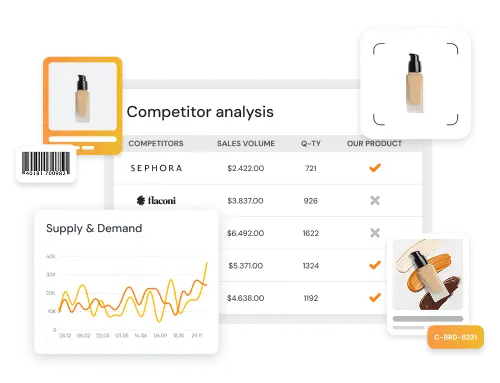
We build custom competitors monitoring services that track what your rivals are actually doing right now — not what last quarter’s report said they did. One of our systems processes 959,000 products per day inside a single e-commerce vertical.

software engineers
years industry experience
working with clients having
clients served





Pricing matters — but without assortment data, marketing activity, content shifts, and positioning signals, you’re looking at maybe 10% of the competitive story.
Every project we run starts the same way: we map which surfaces actually matter for the decision the client needs to make, then build collection logic for each one separately.
Product and Assortment Tracking
What are they selling right now? What dropped from the catalog? Which SKUs appeared this month? Stock status, attributes, categorization, new arrivals — the full assortment, not just the top sellers.
Marketing and Campaign Monitoring
Ad creatives from Meta Ad Library. Google Ads transparency reports. Brand bidding detection — which competitors are bidding on your brand terms, and what landing pages they're sending that traffic to.
Brand and Reputation Analysis
Review volume shifts. Sentiment changes. Social mention surges. PR coverage. If a competitor has a PR disaster, that's a window. Unusually positive press in a niche is also a signal worth acting on.
Website and Content Tracking
New blog posts. Pricing page updates. Product description rewrites. Feature page launches. SEO metadata shifts. Small edits on a pricing page often telegraph strategy months before it shows up anywhere else.
Price Band and Category Coverage Tracking
How does your assortment compare to the top three competitors by SKU count, price band, and category coverage? Benchmarking needs a consistent data structure underneath, which is exactly what custom pipelines are good at.
Share of Voice and Visibility
Who ranks for the keywords that matter? Whose product shows up first in the marketplace search? How does the share of shelf move week over week? These questions are answerable — but only if the raw data gets collected the same way every time.
Opportunity Detection
White space analysis. Categories nobody is defending. Geographies where a competitor is weak. Price bands are sitting empty. Monitoring data is what makes these gaps visible before someone else fills them.
Job Board and Hiring Monitoring
When a competitor starts mass-hiring in one engineering direction, that's a strategy signal — and it's an independently scraped data source. Our systems track job board postings and company career pages: which roles, which locations, at what volume, and when the hiring pattern changes.
The process is the same for every engagement. The specifics inside each step change completely depending on what you need to monitor.
Custom collectors pull raw data from the sources you actually care about — retailer product pages, competitor sites, review platforms, SERPs, and ad libraries. Each source gets its own proxy configuration and request cadence, because what works for Amazon will get blocked on Walmart inside ten minutes.
We handle the hard parts here: sites that block scrapers, pages that only render through JavaScript, APIs that change every two weeks without warning.
Raw HTML becomes structured records. Product, price, availability, category, review count, rating, timestamp. Every field gets validated against the schema before it moves downstream — bad records get flagged, not silently dropped.
This is where most cheap scraping projects fall apart. The data looks fine until you try to compare two competitors and realize the categories don’t line up.
Records from multiple sources get matched, deduplicated, and aligned so you can compare apples to apples across competitors and geographies. Then the analytics layer kicks in: price histories, assortment deltas, content change logs, sentiment trends.
This is the step where collection turns into intelligence — and where the schema decisions from week one start paying off.
Collection runs daily, hourly, or at whatever interval the decisions require. Delivery happens through dashboards, APIs, or scheduled exports — whichever fits the client’s existing workflow. Some of our systems have run for seven years without a single data delivery gap, and that’s the standard we hold every new project to.


Get Custom Competitor Monitoring Solutions in Just 2–4 Weeks
We build enterprise-grade data infrastructure tailored to your specific sources and schemas—delivering production-ready insights faster than you thought possible.

Multi-Source Data Collection
Retailer sites. Marketplaces. Ad libraries. Review platforms. Social feeds. SERP results. Press databases. Each source gets its own collection logic and its own anti-detection setup, because no two sites work the same way.

Data Aggregation and Structuring
Raw data is messy. We normalize it into queryable structures: unified product catalogs, deduplicated price histories, and categorized content events. The point is making the data comparable across sources, not just collecting more of it.

Automated Monitoring and Alerts
Define the triggers once — price shift above X%, new SKU in category Y, negative review surge — and the system watches around the clock. Your team gets a notification when something matters, not a daily digest nobody opens.

Custom Dashboards and Reporting
Tableau, Metabase, Power BI, and custom portals. Some clients want a single weekly PDF on Monday morning. Others want live dashboards refreshing every 30 minutes. Both are fine — the underlying data is the same.

API Integration with Internal Systems
Data should feed your BI, CRM, pricing engine, or content management system directly. We build the pipes, not just the reports. One client gets API updates every 30 minutes straight into their pricing model.

Quality Checks and Delivery Guarantees
Every collection cycle gets validated against historical baselines before delivery. If something looks off, we catch it before the data reaches the dashboard. That’s how one of our systems hit seven years of continuous operation without a delivery gap.
Price Monitoring:
Competitor Monitoring:
Stops at "what are they charging?"
Answers "what are they doing across pricing, product, marketing, and positioning?"
Retailer pricing pages only
Retailer pages, ad libraries, blogs, reviews, SERPs, social, SEC filings, and job boards
Price points, deltas, and history
Pricing, assortment, marketing, content, brand, and positioning signals
Fixed daily or hourly pulls
Hourly to weekly, tuned to each signal type
Feeds the pricing engine only
Supports strategic, marketing, product, and pricing decisions
Pricing manager
CMO, CSO, head of strategy, VP product
Core question
Price Monitoring
Stops at "what are they charging?"
Competitor Monitoring
Answers "what are they doing across pricing, product, marketing, and positioning?"
Data sources
Price Monitoring
Retailer pricing pages only
Competitor Monitoring
Retailer pages, ad libraries, blogs, reviews, SERPs, social, SEC filings, and job boards
Output
Price Monitoring
Price points, deltas, and history
Competitor Monitoring
Pricing, assortment, marketing, content, brand, and positioning signals
Cadence
Price Monitoring
Fixed daily or hourly pulls
Competitor Monitoring
Hourly to weekly, tuned to each signal type
Decision support
Price Monitoring
Feeds the pricing engine only
Competitor Monitoring
Supports strategic, marketing, product, and pricing decisions
Typical buyer
Price Monitoring
Pricing manager
Competitor Monitoring
CMO, CSO, head of strategy, VP product
01.
Lack of Visibility into Competitor
Most teams know what their three biggest competitors did last year. Very few know what those competitors shipped last week. Strategy decks get written on stale data. By the time a market research report lands on someone’s desk, two of the insights are already wrong — and nobody notices until the next quarterly review.
02.
Fragmented Market and Data Silos
Sales has anecdotes. The product has feature comparisons from six months ago. Marketing keeps a Google Doc of competitor taglines. None of these talks to the others. Without a central pipeline, competitive intelligence lives as scattered opinions instead of structured data that anyone can actually query.
03.
Missed Opportunities in Marketing
When a competitor discounts a SKU you also sell, you have maybe 48 hours before conversion rates drop across your catalog. When they ship a new feature, the window to claim a “we already had this” narrative closes fast. Slow detection means missed windows — and sometimes those windows don’t reopen.
04.
Need for Real-Time Data Intelligence
Weekly reports are a floor, not a ceiling. For pricing-sensitive verticals, we run hourly collection cycles. For category and content monitoring, daily checks with alert triggers. The right cadence isn’t a default setting — it’s a function of how fast the business decisions actually need to be made.
This is also where we differ from the average competitor monitoring services provider. Most ship dashboards. We ship data infrastructure with dashboards on top.
Better Strategic Decision-Making
When a €7 billion infrastructure decision hinged on competitor coverage data, systematic monitoring corrected a 60-point estimation error before construction started. That's not a marketing-deck number — it's the actual outcome on a real project. Good data changes outcomes.
Faster Reaction to Market Changes
Pricing teams get alerts the same day a competitor moves. Not next Monday. Not next quarter. The difference between a two-hour response and a two-week response is often the difference between keeping a customer and losing one to a discount you never saw coming.
Improved Competitive Positioning
Structured, historical competitor data turns arguments into evidence. Marketing, product, and sales teams stop debating what competitors are doing and start building around what those competitors actually do — week by week, not by gut feel.
Enhanced Product and Marketing Strategy
New product gaps get visible. Campaign calendars get informed by real competitor activity instead of guesses. Pricing decisions get made against real market context — and the next quarter's strategy deck has data behind it instead of placeholder slides.







What Our Clients Say

What do you like best?
Their deep understanding of our needs and how to craft a solution that provides more opportunities for managing our data. Their data solution, enhanced with AI features, allows us to easily manage diverse data sources and quickly get actionable insights from data.
What do you dislike?
It took some time to align the a multi-source data scraping platform functionality with our specific workflows. But we quickly adapted and the final result fully met our requirements.

What do you like best?
It was incredible how they could build precisely what we wanted. They were genuine experts in data scraping; project management was also great, and each phase of the project was on time, with quick feedback.
What do you dislike?
We have no comments on the work performed.

What do you like best?
GroupBWT is the preferred choice for competitive intelligence through complex data extraction. Their approach, technical skills, and customization options make them valuable partners. Nevertheless, be prepared to invest time in initial solution development.
What do you dislike?
GroupBWT provided us with a solution to collect real-time data on competitor micro-mobility services so we could monitor vehicle availability and locations. This data has given us a clear view of the market in specific areas, allowing us to refine our operational strategy and stay competitive.

What do you like best?
The company's dedication to understanding our needs for collecting competitor data was exemplary. Their methodology for extracting complex data sets was methodical and precise. What impressed me most was their adaptability and collaboration with our team, ensuring the data was relevant and actionable for our market analysis.
What do you dislike?
Finding a downside is challenging, as they consistently met our expectations and provided timely updates. If anything, I would have appreciated an even more detailed roadmap at the project's outset. However, this didn't hamper our overall experience.

What do you like best?
GroupBWT excels at providing tailored data scraping solutions perfectly suited to our specific needs for competitor analysis and market research. The flexibility of the platform they created allows us to track a wide range of data, from price changes to product modifications and customer reviews, making it a great fit for our needs. This high level of personalization delivers timely, valuable insights that enable us to stay competitive and make proactive decisions
What do you dislike?
Given the complexity and customization of our project, we later decided that we needed a few additional sources after the project had started.
What do you like best?
What we liked most was how GroupBWT created a flexible system that efficiently handles large amounts of data. Their innovative technology and expertise helped us quickly understand market trends and make smarter decisions
What do you dislike?
The entire process was easy and fast, so there were no downsides
What do you like best?
Their deep understanding of our needs and how to craft a solution that provides more opportunities for managing our data. Their data solution, enhanced with AI features, allows us to easily manage diverse data sources and quickly get actionable insights from data.
What do you dislike?
It took some time to align the a multi-source data scraping platform functionality with our specific workflows. But we quickly adapted and the final result fully met our requirements.
What do you like best?
It was incredible how they could build precisely what we wanted. They were genuine experts in data scraping; project management was also great, and each phase of the project was on time, with quick feedback.
What do you dislike?
We have no comments on the work performed.
What do you like best?
GroupBWT is the preferred choice for competitive intelligence through complex data extraction. Their approach, technical skills, and customization options make them valuable partners. Nevertheless, be prepared to invest time in initial solution development.
What do you dislike?
GroupBWT provided us with a solution to collect real-time data on competitor micro-mobility services so we could monitor vehicle availability and locations. This data has given us a clear view of the market in specific areas, allowing us to refine our operational strategy and stay competitive.
What do you like best?
The company's dedication to understanding our needs for collecting competitor data was exemplary. Their methodology for extracting complex data sets was methodical and precise. What impressed me most was their adaptability and collaboration with our team, ensuring the data was relevant and actionable for our market analysis.
What do you dislike?
Finding a downside is challenging, as they consistently met our expectations and provided timely updates. If anything, I would have appreciated an even more detailed roadmap at the project's outset. However, this didn't hamper our overall experience.
What do you like best?
GroupBWT excels at providing tailored data scraping solutions perfectly suited to our specific needs for competitor analysis and market research. The flexibility of the platform they created allows us to track a wide range of data, from price changes to product modifications and customer reviews, making it a great fit for our needs. This high level of personalization delivers timely, valuable insights that enable us to stay competitive and make proactive decisions
What do you dislike?
Given the complexity and customization of our project, we later decided that we needed a few additional sources after the project had started.
What do you like best?
What we liked most was how GroupBWT created a flexible system that efficiently handles large amounts of data. Their innovative technology and expertise helped us quickly understand market trends and make smarter decisions
What do you dislike?
The entire process was easy and fast, so there were no downsides

How quickly can we get the first data delivery after kickoff?
Most clients see the first usable dataset within 2–4 weeks of kickoff. The timeline depends on source complexity — a project tracking 5 competitor sites in one country moves faster than one covering 40 sites across three languages. Full production pipelines, with quality checks and delivery integrations in place, are typically live within a quarter.
Who owns the data and the infrastructure after the engagement ends?
You do. We build the collectors, pipelines, and schemas to your spec — they’re yours. Clients can run the infrastructure themselves, hand it to an internal team, or keep us on for maintenance. We don’t lock data or architecture behind a proprietary platform.
How does pricing scale as collection volume grows?
Infrastructure cost grows much more slowly than volume. One of our projects scaled from 100 products a day to 959,000 across 14 months without a pipeline rewrite. We price engagements around the scope of sources and the delivery cadence — not per-record fees that punish you for growing.
Can you integrate with our existing BI and analytics stack?
Yes. We’ve built delivery integrations into Tableau, Looker, Power BI, Snowflake, BigQuery, and custom data lakes — usually as part of the same engagement that builds the collectors. If your team already has a preferred tool, we design the output schema to match it from day one.
What sources can be tracked with competitor monitoring?
Practically any public web source. We’ve built collectors for Amazon, Walmart, Booking.com, Airbnb, Douglas, Sephora, regional marketplaces across Asia and Europe, the Meta Ad Library, Google SERPs, review platforms like Trustpilot, job boards, and competitor corporate sites. If the data lives on the open web, there’s a collection approach for it — sometimes through direct scraping, sometimes through APIs, sometimes through a mix of the two, depending on how the source is protected.
How often is competitor data updated?
That depends entirely on the use case. Pricing-sensitive verticals like e-commerce and hospitality often need hourly updates. Content and assortment tracking usually runs daily. Brand and reputation monitoring can be near-real-time for critical alerts and daily for trend analysis. The right cadence balances business urgency against infrastructure cost — running everything hourly is technically possible, but rarely the right call from a budget perspective.


How can we help you?

We’ll review your goals and suggest the right solution — technical, scalable, and tailored to you.
What do you need extracted, structured, or automated?