







background

Data Warehouse Services

Your CRM knows one part of the story and your ERP knows another. We bring both, and everything else you run, into one AI-ready warehouse. What do you get out of it? Automated forecasts, predictive insights, real-time reports. Enough to stay a step ahead of competitors.

Discuss your project
100+
software engineers
15+
years industry experience
$1B-$100B
client annual revenue range
Fortune 500
clients served

We are trusted by global market leaders

Logo PricewaterhouseCoopers
Logo Kimberly-Clark
Logo UnipolSai
Logo VORYS
Logo Cambridge University Press
Logo Columbia University in the City of New York
Logo Cosnova
Essence logo
Logo catrice
Logo Coupang

Data Warehousing Services We Provide

Some clients hand us the whole job, planning through support after go-live. Others already have engineers or a warehouse that mostly works, so full-scope data warehouse services would be more than they need. They bring us in for the one stage causing trouble: the plan, the data model, or the testing. Wherever we start, the silos go and you’re left with one source of truth, plus numbers built from raw transactions that your teams will actually act on.

Data Warehouse Consulting & Strategy

Our data warehouse advisory services begin by auditing the infrastructure you have now. No stack gets recommended before that. What gets built first? The audit tells us. Which technology stacks and cloud platforms are even worth comparing? The audit again. Where do you want to be in a few years? That decides the final pick. Before any budget is committed, we map how your sources, access rules, and reports depend on each other. Every risk we find, from cost overruns to queries that slow down after launch, gets a score and a named owner. If the plan is all you need, our data warehouse consulting services cover it as a standalone project.

Key Capabilities: Solution architecture design, platform evaluation, data governance planning, and ROI business case creation.

Data Warehouse Development & Implementation

Here our engineers build a custom warehouse from scratch. That covers the database schemas and the automated pipelines your enterprise analytics will lean on. And we size it for growth, because the data volume you have on launch day won’t stay that small. The data model follows the questions your teams actually ask. We work out where each source fits, even systems with no shared ID, so reports stay quick as volumes grow and a new department’s request does not mean starting over. This modeling work is also available on its own as data warehouse design services.

Key Capabilities: Data source mapping, dimensional modeling, automated ETL/ELT pipeline creation, and data mart setup.

Data Warehouse Migration & Cloud Modernization

Still running on a legacy on-premises platform or some other outdated system? We’ll get you onto a modern cloud data warehouse. Cutover happens after hours. Most of your staff will never know anything moved. Need more storage later? Add it when that day comes. And the upkeep bill shrinks. Your team can ship changes sooner, too.

Key Capabilities: On-premises to cloud migration, platform-to-platform migration (e.g., Teradata to Snowflake), cloud cluster cost optimization, and zero-downtime cutover planning.

Data Integration & Pipeline Engineering

Five systems, five customer counts. The CRM has one. The ERP has another. Ask e-commerce, the marketing platforms, and the financial software, and that’s three more. We wire them into one synchronized dataset. Two teams comparing numbers after that are finally comparing the same thing.

Key Capabilities: Multi-source data consolidation, native API integration, Change Data Capture (CDC), and automated data validation.

Real-Time Data Warehousing & Streaming Analytics

A daily report is too slow for some decisions. For those, there are our real-time data warehouse services. We process the data as it streams in. Did something shift in operations? Managers know right then. No waiting a day for the next report.

Key Capabilities: Streaming ingestion pipelines, event-driven processing, low-latency analytics, and real-time operational reporting.

Data Warehouse Support, QA & Optimization

We’re still around after launch, doing maintenance and testing. Testing covers every step between the source system and the dashboard, net revenue rules and other business logic included, so a renamed column or a changed date format is caught before it breaks a report leadership relies on. This validation is also available as a separate project through our data warehouse testing services. If a query starts dragging, we tune it. Your data quality bar stays where you set it. Then there’s cloud spend. Idle capacity still gets billed. That waste? Ours to find, ours to cut.

Key Capabilities: Query performance tuning, ETL/ELT quality assurance testing, cloud expense optimization, and regulatory security patching.

background

How It Works: Data Warehouse Architecture

Follow one record from the scattered tool it starts in to the report someone finally acts on. It makes four stops.

01

Collect

Raw data comes in from each separate app you use (sales, finance, CRM, web).

02

Clean & Format

Mistakes and duplicates get stripped out. Then everything is reshaped into one structure.

03

Store

Yesterday’s records and today’s go into one secure place. That’s your “single source of truth”.

04

Analyze

Clean data lands in dashboards and reports. Those are what people open when a decision can’t wait.

Data Warehouse Solutions by Industry

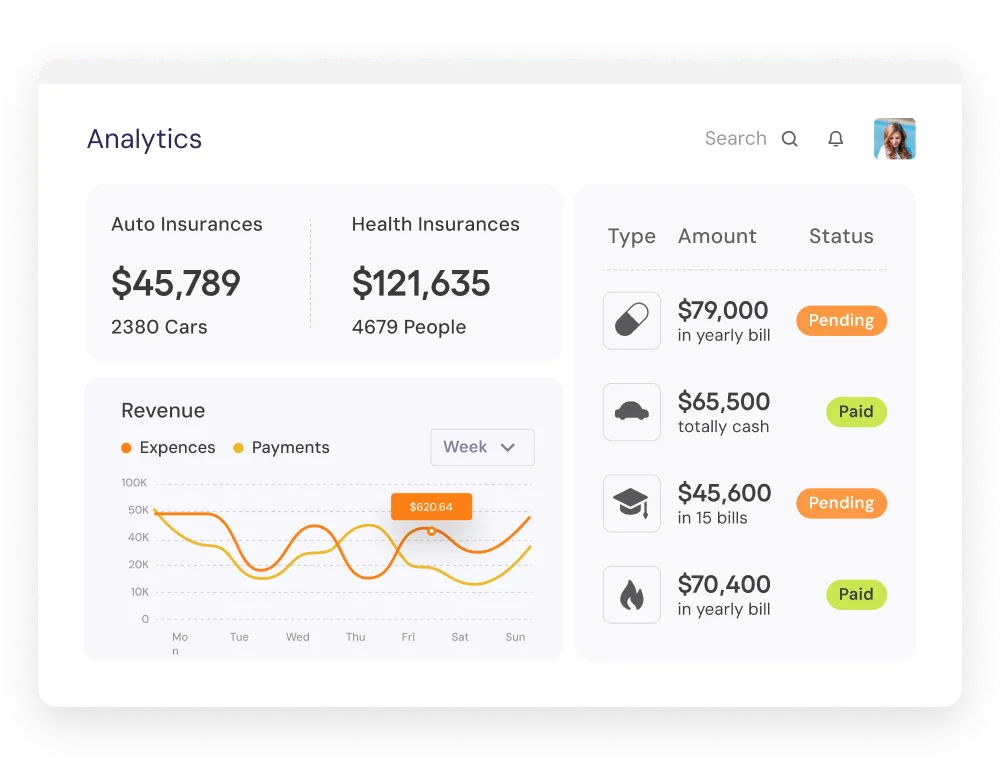
Insurance data consolidated in one data warehouse

Insurance

Data Consolidated: Policy details, claims histories, agent reports, payout records, and third-party property or telematics data.

Business Value: Every claim can be read next to the agent’s report and the payout record. Fraud patterns that used to hide between them come out earlier. Underwriting moves onto automated workflows. Claims get closed sooner, and there is less work in solvency reporting.

background

Can your data handle AI and automated reporting yet?

Start by telling us which tools you’re on. We’ll look at the setup and point out where data is getting trapped in silos between your CRM, ERP, and operational tools.

Talk to us:
Write to us:
Contact Us

Our Data Warehouse Implementation Process

We build a central warehouse in stages, turning data split across business tools into one reliable source of truth. Each of our data warehouse services follows the steps below, which keeps disruption to your daily operations low.

01/07

Business Goals & Data Audit

Our first questions have nothing to do with tables or schemas. What is the business trying to achieve? Which reports can't people live without? Does finance count revenue the same way sales does? Same question for every other KPI. After that comes the data itself, in your CRM, ERP, and marketing platforms. How much is there? How is it laid out? How messy is it?

Architecture & Platform Selection

Where should it all live? Depends on how you operate, what you can spend, and how fast you plan to grow. The cloud (such as Snowflake, Google BigQuery, or Azure Synapse)? On-premises? Somewhere in between? No answer is right by default. With that settled, we design secure storage around the way your teams report.

Pipelines & Validation Rules

Next come the pipelines. You pick the schedule. Each run grabs raw data from one business application. Cleanup and conversion to one standard format happen right there, in the pipeline. Validation rules sit inside every pipeline. If a record fails them, it doesn't get into the warehouse.

Data Cleanup & History Transfer

Old data is rarely tidy. Duplicates come out before launch, formats get standardized, and anything that doesn't line up gets fixed. Then the history moves over a secure connection into the new repository. We check it against the source systems, and we keep checking until the figures agree.

BI Tool Connection & Access Roles

Your team can stay on Power BI or Tableau. Your other BI and reporting tools stay too. We plug the data warehouse into them and set access controls and security policies role by role. A sales rep won't see what the CFO sees.

Load Testing & Data Accuracy

Before anything goes live, we run it under real working conditions. We time the queries, time the report loads, and check the data against its sources. If a figure is wrong, we'd rather catch it here than have leadership or operations find it on day one.

Rollout, Training & Support

After the tests pass, we deploy to production and train your users. They also get documentation to come back to later. Launch isn't the end of the data warehouse service either: monitoring, security maintenance, and performance tuning carry on as the business grows.
01/07

Data Warehousing Technology Stack

Operational Data Sources Layer

Where the raw data starts: the transactional apps your business runs on every day.

CRM and Support Platforms

Salesforce, HubSpot, Zendesk.

ERP and Commerce Systems

SAP, Oracle ERP, Microsoft Dynamics 365, Shopify.

Data Ingestion & Pipeline Layer (ETL / ELT)

This is where records leave their source systems. Pipelines pull them out automatically and fix errors and formats on the way, so what reaches central storage is already standardized.

Databricks

Delta Live Tables and Spark.

Integration Services

Azure Data Factory, AWS Glue, Fivetran, Talend, Informatica, Matillion.

fivetran_logo

Orchestration

Apache Airflow.

Centralized Storage Layer (Cloud Data Warehouse / Lakehouse)

Strip any data warehouse solution down and this layer is what’s left. It’s a single repository designed to keep huge volumes of business history and still return analytical queries quickly.

Databricks

Lakehouse and Databricks SQL.

Cloud Data Warehouses

Snowflake, Google BigQuery, Amazon Redshift, Microsoft Azure Synapse Analytics / Fabric.

aws-redshift-logo

Data Modeling & Semantic Layer

Raw tables? Hard to read unless you built them. This layer fixes that. It turns them into business entities such as sales or customers, and a metric gets defined here once. After that, every department counts it the same way.

Transformation Modeling

dbt (data build tool).

Dbt-Icon--Streamline-Logosvg

Semantic Models

Looker Semantic Layer, Cube, Microsoft Fabric Semantic Models.

Analytics & Business Intelligence (BI) Layer

Monday morning report? You’re looking at this layer. Interactive dashboards and trend reports sit here, for decision-makers and analysts. The other layers? They exist so these numbers are right.

Dashboard Platforms

Microsoft Power BI, Tableau, QlikView.

Logo Power BI
Logo Tableau

Cloud BI Services

Looker Studio, Amazon QuickSight.

Governance, Security & AI Layer

The last layer wraps around the rest. Access security, regulatory compliance, and data quality audits are handled here. It’s also where the predictive machine learning models run.

Databricks

Unity Catalog and Mosaic AI.

Access and Key Management

Azure Active Directory / Key Vault, AWS KMS.

Data Quality and ML Services

Acceldata, Amazon SageMaker, Azure AI Services.

Why Choose GroupBWT as Your Data Warehouse Provider

Plenty of teams can build a database. The harder part is turning scattered data into a business advantage you can measure. Why do leading enterprises trust GroupBWT as their strategic data engineering partner? A few reasons.

01/06

Your Business Goals Set the Agenda

A request for a new dashboard is usually about something bigger, like a process that’s too slow or a target the business keeps missing. So we ask about that first. Where does work get stuck? How many hours go into manual reporting, and what do they really cost you? The data solutions we design come out of those answers and are built to help the company grow faster.

First Results Within Weeks

Each data warehouse service we run is broken into phases, with the highest-ROI business use cases first in line. Leadership gets interactive analytics within weeks, not months. Early proof like that makes the rest of the budget much easier to defend.

Proven Expertise & Tier-1 Technology Alliances

AWS, Snowflake, and Databricks have all named GroupBWT an official partner, and clients give us strong scores on Clutch and G2. Your data will grow. What we build grows with it, on whatever stack you run today. Big enterprise-grade joins across CRM, ERP, or web data? It holds up.

AI-Ready Architecture from Day One

A warehouse that can only feed static dashboards is behind on the day it launches. The fix is mostly unglamorous work done early. We’re a data warehouse company, and clean, governed foundations are what we build first. Want machine learning models next? Predictive analytics, or autonomous AI agents? They come in whenever you decide. Nothing has to be rebuilt.

Reports Business Teams Can Run Themselves

Take a sales manager chasing last week’s numbers. Should that really mean an IT ticket and a wait? No. That manager can pull the answer alone. So can anyone else who isn’t technical, whether they’re following a KPI or setting up a custom view. Clear reports and self-service analytics are how we make that work.

Security & Compliance Planned Up Front

Any data warehouse services provider should keep corporate and customer information safe. That’s the bare minimum. Where teams differ is timing. Bolt security on at the end and you end up patching it again and again. Ours goes in on day one of the engineering lifecycle. Strict access controls. Encryption. Standards such as GDPR, ISO 27001, and SOC 2, met in full. When an auditor calls, the answers are ready.

01/06
background

Let’s Turn Your Scattered Data into an AI-Powered Growth Engine

What changes when everyone works from one secure source of truth? Decisions get faster and rest on data. And nobody fixes the same reporting mistake twice.

Blog articles background

FAQ

What's a data warehouse, and does our business need one?

In short, a cleaned and organized home for all your business data. Your CRM sends data there. So does your ERP, and so do billing software and your other operational tools. From then on, ask any department for a number and you get the same one. Nobody has to stitch spreadsheets or export files together by hand anymore. There’s also a less obvious benefit: heavy reporting runs on the warehouse instead of your transactional databases, so pulling a big report doesn’t slow down the systems your business runs on every day.

What signs show that a company needs data warehouse services?

It tends to happen once reports keep stalling because your systems don’t talk to each other. The usual signs:

  • Finance has one number for a KPI, sales has another, and marketing has a third.
  • Analysts lose days copying data between systems by hand just to answer a basic business question.
  • A data professional often loses around 38% of their time to cleaning and moving raw data, a cost no budget line ever shows.

What will we get back, in benefits and in ROI?

What changes first? The everyday stuff. Executives get reports without waiting, nobody rebuilds the same report by hand, and a few manual steps drop out of the workflow. Then there’s the money. Industry studies show companies on modern analytics platforms reaching a 209% ROI over three years and paying back the cost in under six months, and most of that comes from spending far less labor on data prep. For modern cloud data warehouses, reported returns run over 400%. Why that high? Leaner operations, mostly. Plus quicker answers when the market moves.

Cloud, our own servers, or both - where does the warehouse go?

Cloud Data Warehouses (such as Snowflake, Amazon Redshift, or Google BigQuery) run on someone else’s hardware, and you rent what you need. Busy month? Take more. Quiet one? Hand it back. That suits a business with seasonal peaks. No servers to buy, either. What you use is what you pay.

On-Premises Deployments flip that. The servers are yours, bought outright and kept in your building. Who goes this way? Mostly companies with strict data residency rules. Also anyone whose on-site systems can’t tolerate much latency.

Hybrid Deployments split the job. Sensitive data? Kept on your own servers. Analytics? Off to the cloud, where you add or drop capacity as needed.

How long do data warehouse services take, and what's the price tag?

Focused Projects (MVP): Picture one or two primary data sources with working dashboards on top. These usually wrap up in 6 to 12 weeks and cost $20,000 to $75,000.

Enterprise-Wide Systems: Lots of sources now. A legacy migration. Custom data pipelines and strict compliance controls on top. That kind of build typically needs 3 to 6 months. Expect $75,000 to $200,000+.

Maintenance: Each year, upkeep generally comes to 15% to 25% of the build cost. It covers system adjustments and pipeline changes.

What about our sensitive data?

Built right, a warehouse usually keeps it safer than scattered files do. Access is set role by role, right down to single fields. Data in transit? Encrypted. At rest? Also encrypted. No reason to see a sensitive value? Then you see it masked. Audit trails and lineage tracking, too, plus regulatory compliance (such as GDPR, HIPAA, or SOC 2). Much easier to enforce in one governed system.

What does a data warehouse have to do with AI?

BI dashboards are only part of it. Your AI tools lean on it just as hard. Think about where machine learning models and autonomous agents get their lessons. From your company’s own history. History that’s messy, ungoverned, or unstructured? They’ll learn from that too, and badly. Would you let the result touch your business workflows? We wouldn’t.

background