
Read summarized version with


Finance is closing revenue. Merchandising is checking sellable stock. Operations has WMS reservations. Marketing is explaining promo lift. A retail data warehouse works when each team can trace its number back to the same sale, return, stock snapshot, and price condition. If not, it is only a larger home for four versions of the truth. Retail data warehousing earns trust by preserving the right grain, whatever the vendor.
Don’t reach for the platform diagram first. Start with the number teams dispute, then identify the source events, history, conformed dimensions, and KPI rules needed to defend it. Source coverage, grain, ownership, and semantics must enter the model before a dashboard can earn trust. The practical question is which retail events become facts and which workloads need daily, intraday, or near-real-time delivery.
Build the Data FoundationYour AI Models Need
We build and manage custom data pipelines for sources that change shape, scale, and rules. The work is practical: collect, validate, enrich, and deliver structured data fast enough for reporting and AI use.
We offer:
- Custom Web Scraping & Development
- 15+ Years of Engineering Expertise
- AI-Driven Data Processing & Enrichment
Key Takeaways
If you skim nothing else, keep these working rules:
- Retail data warehousing starts with a signed business contract: metric owner, grain, accepted latency, source, and exclusion rules.
- Ingestion is only the entry point. The model also joins POS, e-commerce, WMS, OMS, ERP, CRM, and finance-ready reporting layers.
- Inventory and sales do not share one natural grain. A SKU-location-day snapshot answers a different question than a sale or return line.
- Net sales, sellable stock, promotion uplift, and margin need signed definitions. Without them, the same number turns into four private numbers that never agree.
- Conformed product, store, channel, calendar, and customer dimensions let departments compare the same period without rebuilding the metric in BI.
- Start with one decision domain, then turn that slice into a repeatable source and modeling template.
Why Retailers Need a Retail Data Warehouse
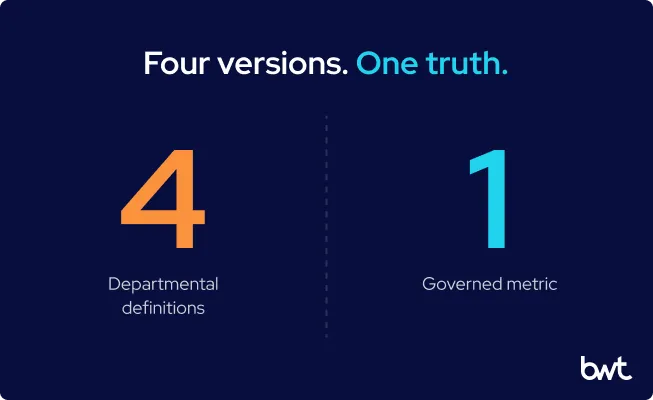
Storage is not the first fight. POS, e-commerce, inventory, finance, and pricing systems often describe the same event with different timing and names. The benefits of data warehousing in retailing appear when those definitions stop living in departmental spreadsheets and become shared rules, and a retail data warehousing practice succeeds or fails on that single move from local spreadsheets to a governed warehouse model.
| Source | Core entities | Typical issue | Warehouse response |
| POS | Sale, return, payment | Store definitions vary | Preserve sales and return grain |
| E-commerce | Order, cart, fulfillment | Order and delivery states split | Model the event lifecycle |
| Inventory and WMS | Stock, reservation, movement | Availability is not one state | Preserve distinct availability states at the grain the use case needs |
| ERP, OMS, and finance | Invoice, payment, ledger, shipment | Operational and finance timing differ | Reconcile event dates to reporting periods |
| CRM and loyalty | Customer, account, service | Duplicate identities | Store match rules and confidence |
A CTO may expect a coherent analytical layer shared across SAP, Oracle Retail, POS, WMS, Shopify, and finance. That is the right mental model. It may include several domain models or marts rather than one enterprise-wide model. The implementation risk is that each system uses a different product, store, channel, and timing definition before the warehouse ever sees the data.
The lifecycle needs its own contract. A sale line answers what was bought. A return line answers what reversed value. A cancellation answers what never became fulfilled demand. Payment captured looks like revenue recognition on the dashboard, but a partial capture, a settlement delay, or a refund can move the recognized number by the time books close. Collapse those events into one order status and reconciliation comes back after launch, when it is more expensive: disputed margin, slow close, stale replenishment, and promotion reports nobody wants to sign off.
| Lifecycle event | Warehouse grain | Decision it supports | Modeling caution |
| Order placed | Order line | Demand and conversion | Separate ordered from fulfilled |
| Payment captured | Payment event | Finance reconciliation | Track partial capture, settlement, and failure |
| Fulfillment started | Shipment or pick event | Operational backlog | Keep source timestamps |
| Delivery completed | Delivery event | Service performance | Link to customer promise date |
| Return, exchange, cancellation | Reversal event | Net sales and margin | Preserve original order link |
The shape of the warehouse follows the shape of those disagreements. That is where retail warehouse design differs from a general warehouse guide.
The Retail Warehouse Model Starts With Facts, Dimensions, and Grain
Grain is the level where a fact is true. One sales line. One SKU in one location on one day. One promotion during one period. One offer from one seller on one marketplace. In retail, that choice quietly decides cost, history, and trust.
| Grain choice | Best for | Trade-off | Required model element |
| Product x retailer x locale x week | Market comparison | Misses intra-week promo swings | Multi-source product dimension |
| SKU x location x day | Availability snapshots | Volume grows with every location | Inventory snapshot fact |
| Promotion x product x period | Campaign attribution | Needs campaign rules | Promotion fact and rule dimension |
| Order x line | Net sales, returns, margin | No stand-alone customer view | Reversal and fulfillment tracks |
A workable model separates sales, returns, inventory snapshots and movements, pricing, promotions, shipments, and fulfillment events. Its conformed product, location, customer, calendar, channel, seller, pricing-condition, and promotion dimensions let finance and merchandising compare the same SKU, date, and channel.
Product identity belongs in the model, but it should remain a warehouse concern rather than become a matching workflow. An enterprise retail data warehouse model needs a durable product key, source mappings, identifier history, and an exception flag for unresolved records. That is enough to preserve facts when a channel changes an identifier without teaching extraction or matching mechanics.
"Product keys arrive incomplete, reused, or simply wrong, and the model has to say so. We store the match confidence beside the key, because a merge nobody can question is how a product dimension quietly corrupts every fact hanging off it." — Dmytro Naumenko, CTO at GroupBWT
Inventory is not a single stock field. A WMS or ERP may record sellable, reserved, in-transit, and committed units at different times. Preserve the states at the grain required by the decision, whether as event facts, periodic snapshots, or both.
History matters because product hierarchy, pack size, store format, seller, channel, and calendar change while earlier facts must retain their original context. Choose slowly changing dimensions, transaction facts, and snapshots deliberately. Otherwise, moving a product into a new category can rewrite an earlier promotion result.
Retail calendars add another layer. A calendar dimension should capture trading week, fiscal period, campaign window, holiday shift, markdown period, and season. Model calendar periods as business definitions and avoid moving a cutover into peak season without business sign-off.
For the broader modeling methodology, see how to design a data warehouse. This article stays with retail grain, lifecycle, inventory, calendar, identity, pricing, and promotion choices.
Retail Warehouse Architecture Should Preserve Raw Facts Before Metrics
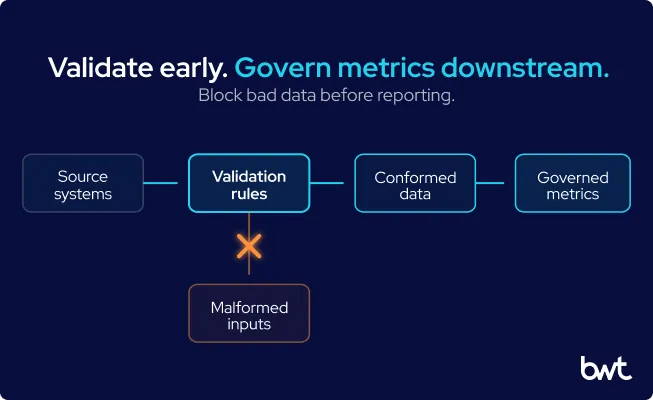
Use six conceptual responsibilities as a working map: source systems and external feeds, raw capture, validation, transformation, trusted business marts, and BI or AI consumption. The data warehouse architecture for retail sector work needs that separation because POS, WMS, OMS, ERP, and supplier data arrive on different clocks and fail in different ways.
A retail data warehouse architecture diagram should show responsibility rather than prescribe brands: sources enter raw capture, validation blocks malformed inputs, transformations conform retail entities, governed metrics feed marts, and consumption paths serve business teams and AI. Choose products only after defining latency, governance, workload isolation, portability, and operating cost.
POS / ERP / OMS / WMS / CRM / Marketplaces
                    ↓
               Raw Capture
                    ↓
       Validation & Data Contracts
                    ↓
       Conformed Facts & Dimensions
                    ↓
   Governed Metrics / Semantic Layer
                    ↓
Finance / Merchandising / Operations / Forecasting / AI

Ownership | Quality | Lineage | Access | Monitoring
For a system-level view of layers, governance, and consumption, see enterprise data warehouse architecture.
POS corrections can arrive late, a WMS reservation may clear after the daily snapshot, and finance may close a period while shipment events are still being corrected. Validation should stop bad inputs before they reach the trusted modeling layer.
A retail warehouse design should also preserve raw values when symbols carry meaning. A coupon suffix, clearance label, loyalty flag, pack-size marker, or supplier status code can change the business meaning of a record. Strip the symbol too early and the team cannot replay history when the metric definition changes.
"Every change to a metric definition is a rewrite of history, and you can only afford that rewrite if the raw layer is still there. Teams that drop raw records after transformation are not saving storage; they are giving up the right to ever redefine net sales again." — Alex Yudin, Head of Data Engineering at GroupBWT
Without a shared semantic layer, twelve dashboards can keep twelve definitions of margin. Net sales, sellable stock, promotion uplift, return rate, and margin need approved definitions tied to facts, dimensions, exclusions, and tests. This is where data warehouse solutions for retail businesses either earn their keep or stop at storage: a governed metrics tier lets finance, merchandising, operations, marketing, and AI consumers read the same definitions.
Validation belongs in the data warehouse testing guide – schema tests, row-count checks, and contract tests across raw, validated, and marts layers.
Also read: Enterprise Data Warehouse Architecture & Strategy
Retail Warehouse Use Cases and KPI Design
A warehouse earns its place when it supports recurring retail decisions, not merely when it stores approved definitions. Four use cases cover the core cross-functional workload:
- Sales and margin. Join sale, payment, fulfillment, return, freight, and cost events at their proper grain. Finance can then close net sales and margin while merchandising compares performance by product, store, channel, and period without rebuilding reversal logic.
- Inventory and replenishment. Preserve inventory snapshots alongside movements, reservations, commitments, and in-transit stock. Planners can distinguish low sellable stock from stock already allocated elsewhere, then feed replenishment and stockout decisions with the correct availability state and cadence.
- Promotion and pricing. Keep list, selling, loyalty, coupon, and card-linked prices with promotion windows and qualification rules. Marketing and merchandising can attribute uplift, markdown impact, and margin without treating every observed price as comparable.
- Omnichannel. Conform product, location, customer, channel, order, fulfillment, and return dimensions across stores, e-commerce, marketplaces, and service channels. Teams can follow the same sale through pickup, delivery, exchange, or return and compare channel performance without double-counting the customer or transaction.
Those use cases depend on metric contracts written before the dashboard exists. Each needs an owner, counting and reversal events, exclusions, and a valid grain. Otherwise, every team can reinterpret the number at quarter close.
Retail metric-contract framework
Metric → Owner → Grain → Events → Reversals → Exclusions → Latency → Test
If one of these elements is undefined, the KPI is not ready to enter the governed reporting layer.
| Metric contract | Definition question | Why it matters | Required model element |
| Net sales | Which events reverse revenue? | Finance and merchandising share one number | Order lifecycle logic |
| Sellable stock | Observed, reserved, in transit, or sellable? | Teams avoid false stockout claims | Inventory snapshot fact |
| Promotion price | List, selling, loyalty, coupon, or card-linked? | Campaign ROI stops mixing prices | Pricing and qualification rule |
| Margin | Which costs, returns, and freight are included? | Profit decisions depend on consistent cuts | Cost and return tracks |
KPI design turns the four workloads into governed decisions. Start with the number a team cannot defend, then map the facts, dimensions, exclusions, owner, and latency needed to reproduce it. A retail data warehouse design is judged on whether that number keeps the same meaning across periods and channels.
Pricing illustrates the rule. Store a price with its qualification rule and validity window so reports can distinguish list, loyalty, coupon, and card-linked conditions. Keep approved definitions, exclusions, lineage, and tests in the governed layer rather than one BI workbook. Retained history then lets the team recalculate a changed rule and explain the difference.
Forecasting draws from the same governed foundation. Demand history needs explicit missingness rules, return logic, promotion windows, calendar effects, product continuity, and inventory availability. With those conditions visible, planners can distinguish a genuine demand drop from a stockout, identifier change, or promotion gap before the forecast drives replenishment.
Together, these use cases show why retail data warehousing is more than KPI documentation: the model preserves the operational context behind sales, stock, prices, and channels.
Why Retail Warehouse Projects Fail
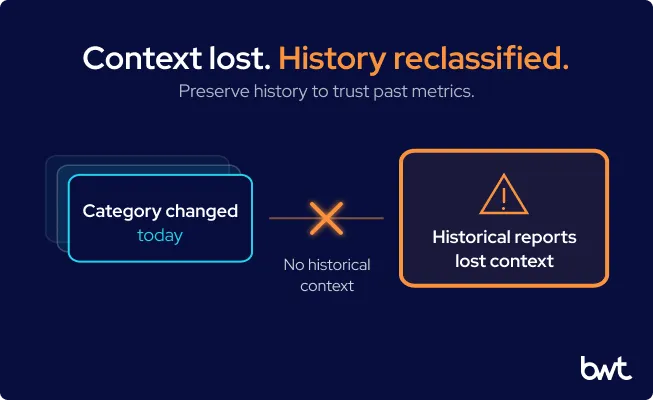
A common warehouse-program failure mode has little to do with storage capacity. The business rules remain too vague for the platform to enforce.
In the data programs GroupBWT has been brought into, these failure points are usually visible before build starts:
- No single grain for the first domain, so sales, returns, stock, and promotion facts mix line-level, order-level, and daily snapshot logic.
- Snapshot facts and event facts are blended, so teams compare a stock position with a transaction as if both described the same moment.
- KPI ownership is unclear, so finance, merchandising, and marketing each keep a private version of net sales, sellable stock, or promotion uplift.
- Product keys are treated as cleanup fields, so source mappings and unresolved records disappear from the governed dimension.
- Every workload is pushed toward real time, even when finance close, assortment planning, and planning reporting need different freshness.
- Historical changes are not modeled, so a product hierarchy or store format change rewrites the past instead of preserving context.
- Governance starts after dashboards launch, which means data quality issues become stakeholder disputes instead of failed tests.
The fix is not to design the whole enterprise warehouse at once. GroupBWT recommends starting with one decision domain, writing the source and KPI contracts, building the first production slice, testing adoption, and only then expanding by template.
How to Implement a Retail Data Warehouse
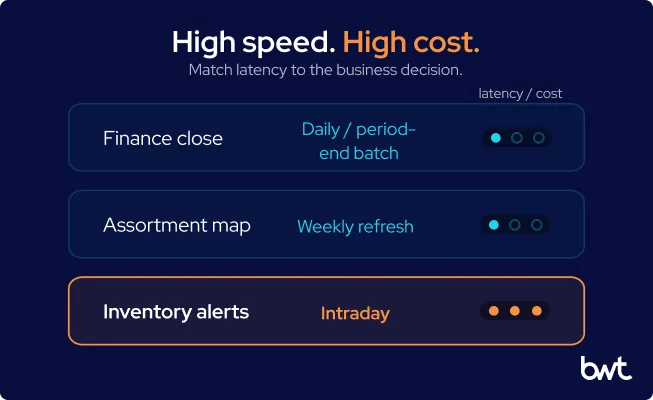
Start with latency, cost, and one decision domain. The first production slice should be narrow enough to reconcile but important enough to prove business value. Finance close, weekly assortment, intraday availability, and AI exploration do not need the same path. Data warehousing for retail gets expensive when every workload is treated as real time. Sometimes the useful answer is a slower, cheaper, better-tested refresh.
"Retail teams describe freshness in three classes, not one: what has to appear the moment it is saved, what can wait a few minutes, and what is historical. Move reporting into a warehouse without writing those classes down and you quietly lose the real-time behaviour some report already depended on." — Oleg Boyko, CCO at GroupBWT
| Workload | Reasonable freshness | Why | Design response |
| Finance close | Daily batch | Comparability beats speed | Stable reconciliation |
| Assortment map | Weekly to monthly | Reference data changes slower | Cheap history storage |
| Inventory and promo | Intraday where needed | Short windows lose value | Separate serving path |
Split the serving path instead of raising freshness everywhere. Operational signals that change a same-day decision – availability, promo state, fulfillment exceptions – can take a faster route into a serving layer, while the historical facts finance and merchandising compare against stay on the batch path. One refresh policy across every table is what makes a warehouse expensive without making it more trusted.
| Step | Deliverable | Why it matters |
| Pick the first decision domain | Use-case and KPI map | Prevents a warehouse-shaped data dump |
| Inventory sources and owners | Source-owner list | Shows which feeds are ready |
| Write metric contracts | Signed definitions and exclusions | Reduces finance-merchandising disputes |
| Model facts, dimensions, and grain | Retail event and dimension map | Stops table design from hiding business meaning |
| Build the first production slice | Validated mart and BI handoff | Proves adoption before regional rollout |
| Expand by template | Domain rollout roadmap | Scales the model, not one-off pipelines |
Platform choice follows the workload mix. Compare isolation, concurrency, governance, portability, operating cost, and migration effort after the design is clear. A search for the best data warehouse for retail companies 2026 may produce a vendor list, but it cannot decide those trade-offs without the retailer’s workload and constraints.
Before cutover, GroupBWT recommends running old and new pipelines side by side and comparing their outputs for the same period. Without that reconciliation, the migration remains unverified until a reporting dispute exposes the difference.
GroupBWT applied a template-first approach while building the data integration layer described in the cosmetics-maker data platform case. The client’s internal team owned its three-layer Data Vault 2.0 warehouse design, while the embedded engineering team built and scaled the pipelines feeding it. By normalizing retailer files from 24+ countries into a shared record structure for country, currency, product identifier, quantity, and revenue, the team expanded the platform from a three-pipeline proof of concept to 40+ production pipelines. The reusable template also cut new-source onboarding from about a week to roughly one development day. This retail-data integration case supports one specific principle: when sources multiply, standardize the source contract and ingestion pattern instead of creating a separate script for every retailer.
Start with one domain: one banner, market, category, or metric family. Its approved grain, contract, and reconciliation tests become the reference for the next source. Finance can close against traceable sales and return logic, while merchandising and promotion teams use the same product, period, availability, and exclusion rules.
What Determines Retail Data Warehouse Cost?
Cost follows scope and operating mechanisms, not a generic price band:
| Driver | What expands | Design response | Scope signal |
| Source count | Each feed adds connectors, owners, and tests | Audit and rank sources before slice | Documented source-owner list |
| Historical backfill | Storage and replay cost | Decide retention before cutover | Years of history per fact |
| Identity resolution | Source mappings and exception review | Build only for the first domain | Unresolved-record volume |
| Latency tier | Concurrency and serving paths | Split operational from analytical workloads | Workload-by-workload freshness target |
| Governance | Review and sign-off time | Assign owner before modeling | Defined owners and review cadence |
Retail teams often underestimate replacement risk. Stable source contracts turn a planned POS, ERP, or OMS change into a controlled connector cutover rather than a rewrite of KPI definitions and BI reports. By reusing approved contracts and tests, data warehouse solutions for retail businesses can make each subsequent connector cheaper to validate. The same logic keeps the data warehouse structure for retail sector work portable across banners.
Do not build yet when the audience is small, reports are simple, integrations are limited, or one broken dashboard is the real problem. Start with source cleanup or a smaller relational model if core systems cannot export reliable data or nobody owns metric definitions. A data warehouse architecture diagram for retail sector operations is not useful until those conditions change.
When grain, ownership, and delivery boundaries still need definition, data warehouse design solutions are the better entry point. If they are clear, implementation can move directly into pipelines, validation, and marts.

Store the facts teams need to reconcile: sales lines, returns, inventory snapshots and movements, payments, and fulfillment events. Add the dimensions and history required by the first decision domain, such as product hierarchy, location, customer identifiers, retail calendars, price conditions, and promotions. The practical retail data warehousing scope is set by those decisions. Across data warehousing in retail industry programs, source selection follows the questions a report must answer, not the tools available.
An operational database runs current transactions; the warehouse preserves checked history for analysis. Source systems remain authoritative for orders, stock movements, customer updates, and catalog changes. The warehouse models their history for sales trends, margin, stockouts, promotion ROI, forecasting, and repeatable decisions.
Typical facts cover sales, returns, inventory snapshots and movements, payments, fulfillment, pricing, and promotions. Dimensions cover product, location, customer, calendar, channel, seller, pricing condition, and promotion rule. Keep only what the decision requires: replenishment needs stock state, promotion analysis needs qualification rules, and finance close needs the order lifecycle.
Omnichannel analysis connects store, e-commerce, marketplace, fulfillment, service, and return events through governed customer, product, order, and location keys. Retained source mappings and explicit uncertainty flags let teams compare revenue, margin, fulfillment, and returns without double-counting a transaction or assuming every record identifies one confirmed customer in the data warehouse retail layer.
Yes, after the historical layer is stable enough to test. Forecasting needs product identity, missingness rules, returns, promotion windows, calendar effects, and clean demand history. Without governed history and metric contracts, an AI model has no stable target to learn from.
Only when latency changes the decision. Finance close can run daily, assortment analysis weekly, and availability or promotion signals intraday where a short window affects action. Faster refreshes add cost without value when nobody uses them.
Estimate cost and time from source count, SKU and location scale, identity complexity, backfill depth, latency tiers, governance, and reporting scope. A focused first slice and an enterprise rollout are different programs, so a universal budget or timeline is misleading. Price the deliverables, dependencies, and operating load of the chosen domain.
Choose after mapping the first workload. Finance emphasizes governance, cost control, and auditability; promotion or availability may need separate serving paths and higher concurrency. Compare isolation, latency, governance, portability, operating cost, and migration effort. See our comparison of top data warehouse vendors for a high-level platform assessment.
Read summarized version with
Build the Data FoundationYour AI Models Need
We build and manage custom data pipelines for sources that change shape, scale, and rules. The work is practical: collect, validate, enrich, and deliver structured data fast enough for reporting and AI use.
We offer:
- Custom Web Scraping & Development
- 15+ Years of Engineering Expertise
- AI-Driven Data Processing & Enrichment