
Read summarized version with


A finance lead opens Monday’s revenue dashboard and finds a number no one can defend. Every pipeline job completed, but that proves only that data moved. To prove the number, the team must show that all required records arrived, each transformation applied the approved business meaning, and the BI report preserved that meaning for the person making the decision. A reliable validation method follows that source-to-report chain.
"What separates a working warehouse from a fragile one is whether the team made the release contract explicit before the system ran." — Alex Yudin, Head of Data Engineering at GroupBWT
Validate Your Data Warehouse Before Release
We test the complete path from source records to the final BI report, so your team can release critical numbers with evidence.
We help you:
- Reconcile source and target data
- Validate transformation and metric rules
- Build automated release gates
Key Takeaways
A green pipeline is not evidence that a business number is correct. The shortest reliable proof has three parts: reconcile source and target records, validate the metric definition with its owner, and let analysts accept the rendered BI result. The broader test suite then checks structure, data quality, integration, incremental processing, regression, migration, performance, access, and production behaviour. Failed critical checks should block release until a named owner accepts or resolves the difference.
What Is Data Warehouse Testing?
Data warehouse testing asks whether a company can trace a business number back to complete source data and an approved definition. It extends beyond ETL checks because the proof continues through warehouse models, the semantic layer, and BI reports. It also continues after go-live as sources and transformation rules change.
The practical question is not only whether each component works. It is whether the complete path preserves the records, meaning, history, access rules, and presentation needed for a decision. That distinction shapes both the test plan and the release evidence.
Why It Pays Off at Release Time
The benefit becomes visible when a company can approve a release without another analyst-led reconciliation cycle. Our team defines the source inventory, metric rule, tolerance, and approver before release. The resulting evidence explains why systems differ and whether the difference affects a business decision.
It also changes defect timing. A missing source partition found before downstream work is cheaper to resolve than a disputed executive dashboard after go-live. The goal is not a large test count. It is enough relevant evidence to defend every critical number.
Three Proofs Behind a Trustworthy Warehouse Number
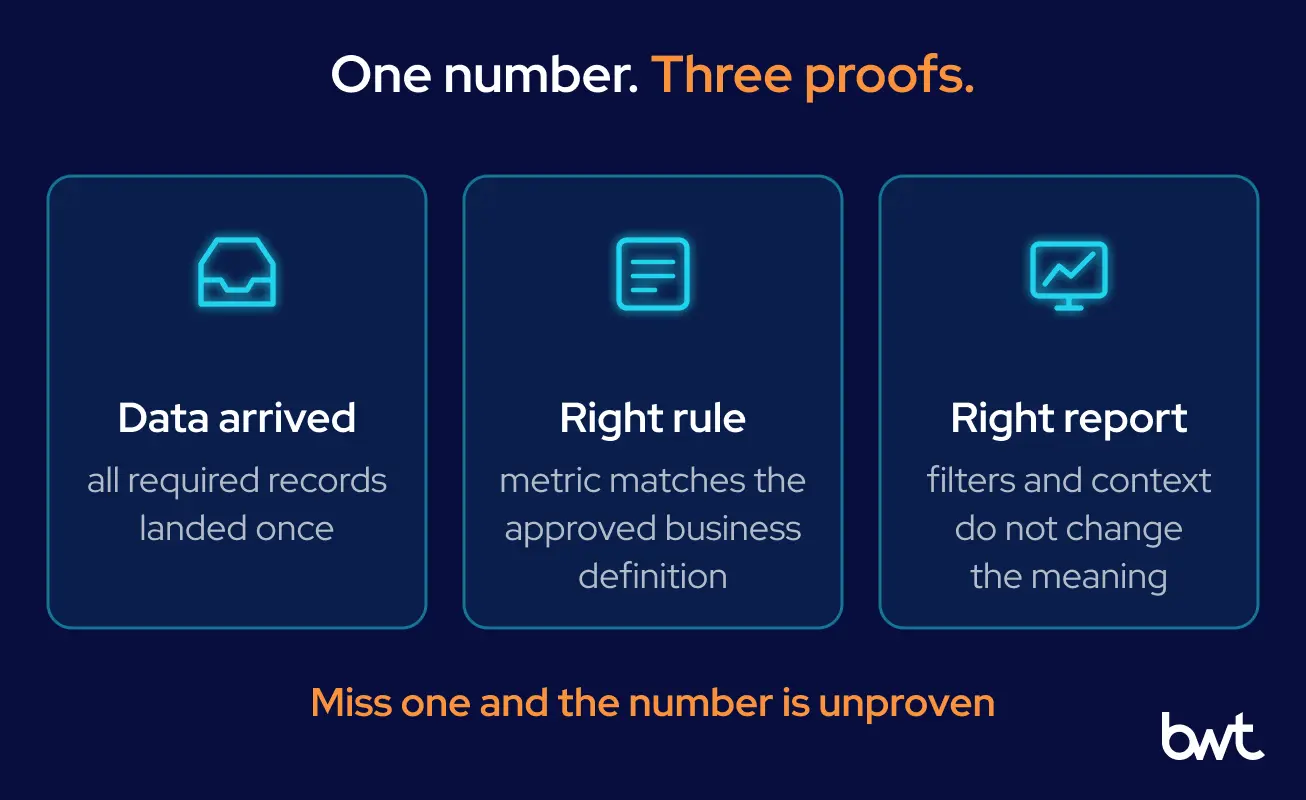
A comprehensive approach to data warehouse testing is easier to operate when the team treats correctness as three linked proofs rather than a catalogue of disconnected checks.
Proof 1: Did Every Required Record Arrive?
Start with source-to-target reconciliation. Expected source records should match what landed before downstream calculations run. Row counts help, but an equal total can still hide a missing file and a duplicated one. Compare business keys, file inventories, partitions, checksums, and freshness windows at the level the source contract supports.
A US home-care migration recorded no load error, yet GroupBWT’s inventory comparison exposed two missing archives totalling about 100 GB. A dashboard built on that target could have produced tidy but incomplete totals. The first gate is not "job completed." It is "expected source set equals landed source set," with every difference explained.
Proof 2: Does the Transformation Preserve the Approved Meaning?
Once the input reconciles, test the business rule. Schema and type checks catch malformed data; relationship checks catch broken joins. Neither can decide whether a valid field means what the business thinks it means. The DATA 2026 paper Data Quality Validation in Enterprise Master Data Management explains the same limit: predefined rules cannot detect a semantic error that no one encoded.
In an FTTH assessment, the parser returned valid records, but the coverage rule counted any technology instead of the target technology. By reviewing the field meaning and rewriting the rule, GroupBWT changed the reported coverage from 98 percent to 0.6 percent. The useful artifact was an approved definition linked to an input, expected output, and failure severity.
For historical models, this proof also covers grain and time. Date ranges should not overlap for one business key. The data warehouse design track covers the detailed model; the test asks whether it preserves the event being counted.
Proof 3: Does BI Render the Same Decision?
A correct warehouse table can still become a wrong business number through a dashboard filter, label, join, or default date range. The metric owner reviews the definition; analysts test whether BI presents it in the context where they use it.
GroupBWT used that sequence in a 2026 European cosmetics engagement: rule review first, Tableau UAT on Stage second. Engineering supplied lineage and record-level differences, but analysts accepted the rendered report. SQL alone cannot prove that the decision-maker sees the intended number.
Access rules can also alter a result by changing which rows or columns a user sees. Google Cloud’s Level Up Your Column-level Security: Using IAM Data Governance Tags in BigQuery describes tags that travel with columns. The release check still has to verify the client’s BI path.
Source for the three anonymized examples: GroupBWT internal delivery records; client identities withheld under NDA.
Types of Data Warehouse Testing
The three proofs above are a correctness model. Test types describe the checks a team runs at particular layers and change points. A release plan usually combines several of the following rather than selecting one.
Source-to-Target Testing
Compare the expected source inventory with landed records and business keys. Counts alone are insufficient when one omitted file can be offset by duplicates elsewhere. The pass condition is an empty difference or a documented exception approved by the data owner.
Schema and Structural Testing
Verify columns, types, nullability, relationships, keys, and model grain. These checks catch incompatible source changes and modelling defects before they distort downstream joins. Historical tables also need valid effective dates and current-row flags.
Transformation and Business Rule Testing
Give a transformation known inputs and compare its outputs with the owner-approved rule. This applies to SQL, dbt models, ETL or ELT jobs, calculated fields, and semantic-layer logic. A technically valid query still fails if it computes the wrong business meaning.
Data Quality Testing
Measure completeness, validity, consistency, uniqueness, and freshness against explicit expectations. Matching and deduplication accuracy belong here, not in performance validation. In a public food delivery pricing intelligence case, our team validated two million records per session and achieved a 98.6 percent match rate across more than 1,200 locations. That result proves matching quality at the stated scale; it does not prove query latency or throughput.
Data Warehouse Unit Testing
Test one transformation, function, or model in isolation with controlled fixtures. Unit checks are fast enough to run on each code change, but they cannot prove that handoffs between systems or the rendered BI result remain correct.
Integration Testing
Validate contracts between ingestion, storage, warehouse models, the semantic layer, and BI. Confirm that identifiers, timestamps, error states, and access context survive each handoff. An integration pass needs representative end-to-end data, not only mocked component inputs.
Incremental Load and CDC Testing
Exercise late-arriving records, replay, duplicates, deletes, updates, and out-of-order events. Rerunning the same change set should not duplicate business events. The team should also confirm that backfills update affected history without altering unrelated periods.
Regression Testing
Run stable reference inputs after code, source, or model changes and compare approved outputs. The reference set should cover critical business rules and known edge cases, not merely examples that are easy to pass. When an intended definition changes, version the expected output and its approval.
Migration Testing
Compare legacy and target systems under the same metric definitions before cutover. Use exact matching where the value must not change and metric-specific tolerances where rounding or platform behaviour creates an accepted difference. Inventory reconciliation comes before aggregate comparison.
Performance and Scalability Testing
Measure whether workloads complete within batch windows and interactive queries remain usable at representative volume and concurrency. Include peak conditions and scaling behaviour. A fast wrong answer still fails the correctness model.
BI and User Acceptance Testing
Ask analysts and report owners to verify filters, totals, labels, drill-downs, permissions, and decision flow. BI UAT is not a substitute for source or transformation checks. It proves that an approved number reaches the user in a usable form.
How to Test a Data Warehouse: A Twelve-Step Process
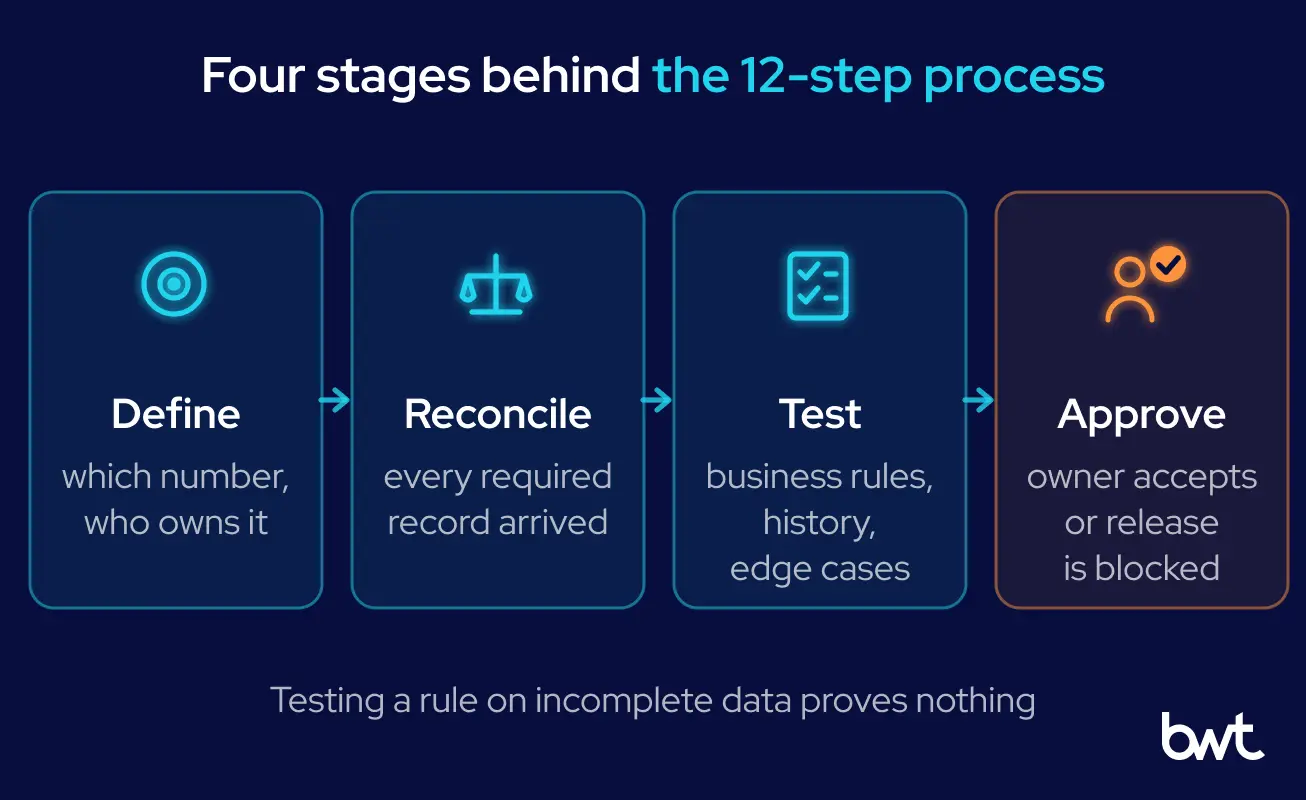
The validation process follows one critical report backward to its sources, then forward to the user’s screen. This is how to test a data warehouse without confusing completed jobs with correct numbers.
- Name the business-critical report and the decision it supports.
- Identify the metric owner and the analysts who use the result.
- Inventory the contributing sources, pipelines, models, semantic rules, and reports.
- Map lineage from the displayed number back to source records.
- Write the approved calculation, grain, time window, and exclusions.
- Define the acceptable difference and who may approve it.
- Reconcile the complete source inventory with the landed data.
- Test transformations, joins, history, duplicates, and null behaviour.
- Run representative unit checks on every relevant code change.
- Compare a stable regression reference set.
- Ask the metric owner to approve the rule, then ask analysts to complete BI UAT.
- Block release when a critical comparison fails or lacks an owner decision.
The order matters. Downstream checks can validate transformations over an incomplete source set. A release contract keeps completeness, meaning, and presentation as separate decisions instead of allowing one green result to stand in for the others.
How to Build a Data Warehouse Testing Strategy
A useful strategy starts with business risk, not a universal checklist. It decides which numbers require complete proof, how each can fail, who owns the decision, and what blocks release.
Prioritize Business-Critical Metrics
Start with the measures that finance, operations, regulators, or customers act on. Rank them by the consequence of a wrong value and by how quickly the error must be detected. A high-risk revenue figure warrants a source-to-report chain; a low-risk descriptive field may need only schema and freshness checks.
Map Failure Modes to Tests
For each metric, map likely breaks to the appropriate layer: omitted input, duplicate event, invalid relationship, wrong transformation, changed definition, stale data, hidden permission, or misleading BI presentation. One check should have one clear question and pass condition.
Define Tolerances and Severity
Set tolerances per rule rather than applying one percentage to every field. Exact business keys, financial aggregates, timestamps, and display rounding have different acceptance needs. Record why the tolerance is valid and which severity it carries when breached.
Assign Owners and Approvers
Engineering owns executable checks and evidence. The metric owner approves meaning and acceptable difference. Analysts or report owners accept the rendered output. Name these people before testing begins so an unexplained exception cannot drift through release by default.
Define Release Gates
Translate critical checks into go or no-go conditions. Record the source inventory, definition, expected result, tolerance, evidence, failure severity, and approver. A low-risk freshness warning may ship with an accepted exception; an unexplained difference in a critical metric should block release.
Performance, security, recovery, and observability remain part of release readiness. They complement, but do not replace, evidence that the number is correct.
Manual and Automated Checks Have Different Jobs
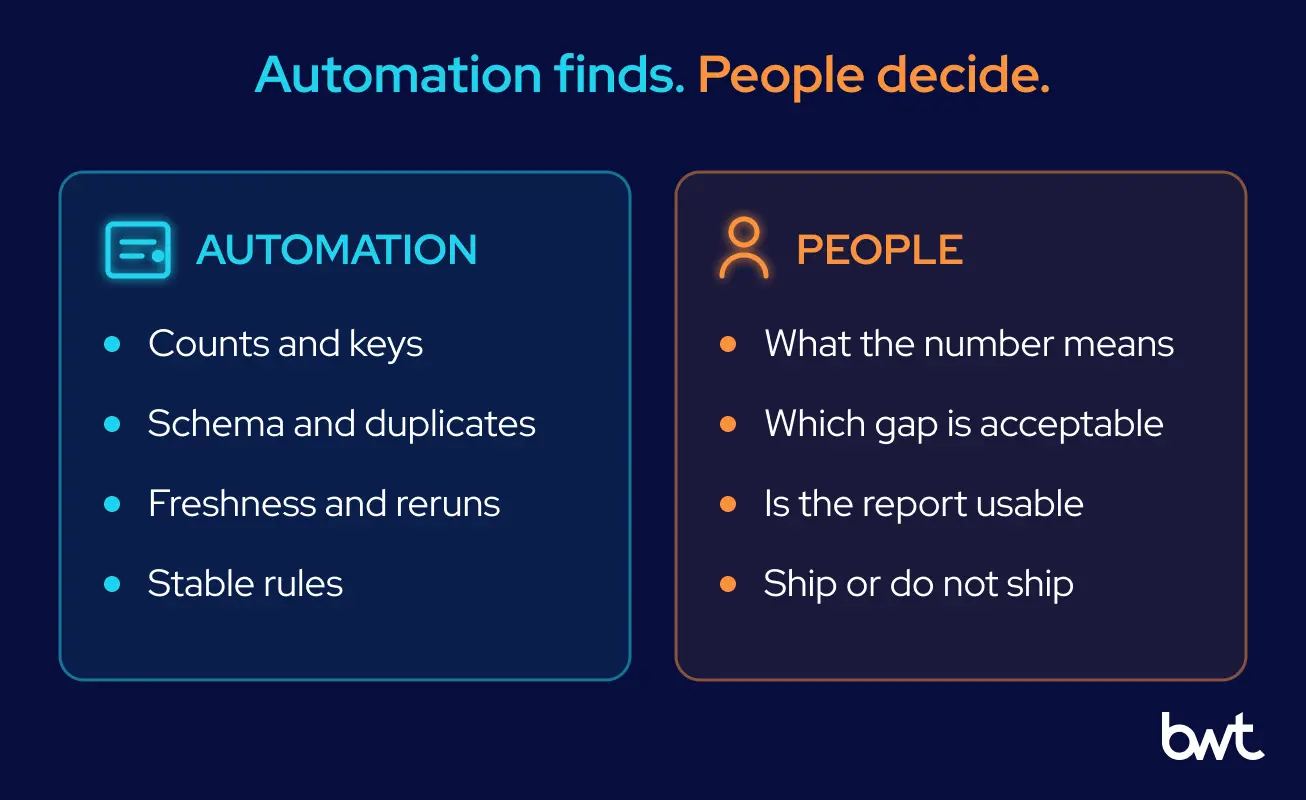
Automation determines that values differ. A business owner decides whether the difference is valid and whether it changes a decision. Keeping those jobs separate prevents an arbitrary threshold from becoming business truth.
| Check | Best owner | Release evidence |
| Source inventory and landed keys | Automated comparison, engineering review | Empty diff or explained exceptions |
| Transformation and relationship rules | Automated after owner defines the rule | Expected result and severity |
| Metric semantics | Metric owner | Approved definition and tolerance |
| BI acceptance | Analyst or report owner | Signed UAT on the rendered report |
Automating the original FTTH rule would only have reproduced the wrong interpretation faster. The check became useful only after a person clarified which technology the metric was meant to count.
What Should Be Automated?
Automate deterministic, repeatable evidence:
- row and business-key reconciliation;
- schema, null, duplicate, and referential-integrity checks;
- stable transformation rules and unit fixtures;
- freshness and batch-completion expectations;
- incremental loads, CDC replay, and idempotency;
- regression reference sets;
- CI/CD release gates for critical failures.
What Still Requires Human Review?
Keep judgement with the people who own or use the result:
- metric meaning and exclusions;
- tolerance and exception approval;
- BI usability and decision flow;
- business acceptance of known differences;
- changes to an approved definition;
- go or no-go decisions when evidence conflicts.
Also Read: Why Shift to Web Scraping Systems & Data Pipeline Architecture
How to Automate Data Warehouse Testing
Automation should preserve an evidence chain rather than produce a larger dashboard of pass counts. A practical delivery path is:
Code change -> unit and schema checks -> integration and reconciliation checks -> regression reference set -> Stage warehouse -> metric approval and BI UAT -> release gate -> production observability
Unit Tests for Transformations
Run small fixtures against changed functions, SQL models, and transformation rules. Include expected failures and edge conditions, then keep the tests close to the code so they execute on every relevant change.
Data Quality Tests
Apply explicit contracts for completeness, validity, consistency, uniqueness, and freshness. Quarantine or block critical failures rather than logging them after bad data has reached a report.
Source-to-Target Reconciliation
Compare expected files, partitions, keys, and aggregates with what landed. Store record-level differences so an engineer can diagnose the break without rerunning an opaque batch.
Regression Test Sets
Maintain approved reference inputs and outputs for critical rules. Version them when the business definition changes and retain the approval that explains why the new result is expected.
CI/CD Release Gates
Run fast unit and schema checks early, then integration, reconciliation, and regression checks in the appropriate environment. A critical failure should prevent promotion unless the named owner records an exception.
BI and Semantic Layer Validation
Test metric definitions, semantic models, permissions, and the final report in Stage. Automated comparisons can verify totals and configurations; analysts still need to accept labels, filters, drill-downs, and usability.
Production Monitoring After Release
Carry test expectations into production as freshness, volume, distribution, and failure alerts. Monitoring should route enough record-level context to a named owner. It detects drift after release but does not retroactively approve an undefined metric.
Migration Checks Need Metric-Specific Tolerances
A warehouse migration adds a second result set. Before cutover, run old and new outputs in parallel, compare them under the same business definition, and agree on tolerances per metric. A single percentage threshold across all fields is rarely useful: rounding may be acceptable for one aggregate while a missing legal entity is not.
Platform moves compare legacy and target outputs across a representative business period. Staged swaps compare each domain as it moves; vendor swaps compare feeds before traffic flips. The enterprise data warehouse architecture guide covers the wider design.
In one architecture assessment, the proposed financial check required the target sum to remain within an agreed plus or minus 0.5 percent of the legacy result. Because that engagement had not yet completed the migration, the figure is a designed acceptance rule, not a delivered outcome. It would be valid only after both platforms implement the same approved definition.
Rollback belongs in the release plan where needed. It does not prove numeric correctness or replace reconciliation and business acceptance.
Test Cases That Support the Proof
These data warehouse test cases are useful because each answers a specific question about a business number.
| Test | Pass condition | What a failure means |
| Source-to-target | Expected and landed business-key sets match | Input is incomplete or duplicated |
| Transformation logic | Known input produces the owner-approved output | Calculation or field meaning is wrong |
| SCD and history | Effective dates and current flags are valid | Historical reporting may be wrong |
| Duplicate and null | Counts and fill rates meet the contract | Aggregates may be inflated or incomplete |
| CDC and idempotency | Replay does not duplicate business events | Incremental processing is unsafe |
| Financial reconciliation | Difference stays within the metric’s agreed tolerance | Migration cannot be signed off |
| Access control | Each role sees only approved rows and columns | Security rules may change reported numbers |
| BI acceptance | Filters, labels, totals, and drill-downs match the rule | Correct data is rendered misleadingly |
These are techniques, not a quota. The test set should follow the ways a critical number can become wrong.
Data Warehouse Performance Testing
Performance proves timely delivery, not numeric correctness. Use production-like data distributions and representative volume, concurrency, query patterns, batch windows, and BI interactions. Test peak workloads and observe how the warehouse scales rather than extrapolating from a small clean sample.
In one delivered product-data engagement, GroupBWT ran a one-million-product load with a target of completing within 12 hours and serving 1,500-2,000 requests per minute within 60 seconds. The load run checked whether the system could meet its operating window. Separate precision, recall, and business-rule checks evaluated the result itself.
Source: internal delivery records; client identity withheld under NDA.
Common Challenges
The challenges in data warehouse testing usually begin where the team lacks a stable comparison or tests only the happy path.
- No complete source inventory. Without an oracle for expected records, a target count cannot prove completeness. Build or recover the inventory first.
- Hidden source logic. Encrypted or undocumented views require the team to reconstruct rules from input-output pairs before comparing platforms.
- Different KPI definitions. Old and new systems may both be internally consistent but calculate different things. Align the definition before applying a tolerance.
- Thresholds detached from real data. A gate that ignores structurally unavailable fields can block valid batches; a loose gate can hide genuine gaps. Profile production data, distinguish unavailable values from newly missing ones, and require the metric owner to approve the threshold before it controls release.
- Late-arriving facts and dimensions. An event may arrive before its reference record or after a reporting period closes. Test the correction path and the reports affected by restatement.
- Schema drift. Source columns, types, and meanings can change without a pipeline failure. Contract checks should expose the change before downstream models silently coerce it.
- Backfills and historical reprocessing. A repair can duplicate events, reopen closed periods, or alter unrelated history. Test replay boundaries and idempotency with realistic date ranges.
- Production-scale test data. A small clean sample can hide skew, history, access policies, concurrency, and rare joins. Use masked or synthetic data that preserves the relevant distributions and edge cases.
- No named approver. Engineering can explain a difference, but only the metric owner can accept its business meaning.
If the source cannot provide a trustworthy baseline, or two platforms use incompatible definitions, testing should stop the release. Repair the inventory or rule and rerun the proof. Shipping because the pipeline is green merely moves the disagreement into BI.
Metrics Worth Tracking
Track measures that tell the team whether critical numbers remain defensible and whether the release process can act on failures.
| Metric | What it tells you | Investigate when |
| Critical-metric coverage | Which decision-driving numbers have source-to-report checks | A key KPI has no complete proof |
| Reconciliation rate | Difference between expected and actual records or aggregates | The metric-specific tolerance is exceeded |
| Regression pass rate | Whether approved outputs survive a change | A critical fixture changes unexpectedly |
| Unresolved critical exceptions | How many release-blocking differences lack resolution | Any remains open at go or no-go |
| BI UAT completion | Whether report owners accepted the rendered output | A critical report has no sign-off |
| Critical metrics with named owners | Whether each decision has an accountable approver | Ownership is missing or ambiguous |
| Sources with automated reconciliation | How much input coverage is repeatable | A critical source depends on ad hoc comparison |
| Test execution duration | Whether the suite fits the release window | Evidence arrives too late to affect release |
| Defect leakage | Wrong-number defects first found after release | Business users discover issues before the tests |
| Detection and repair time | How long a disputed number remains unresolved | The delay exceeds the decision window |
| Freshness SLA | Age of data from the consumer’s view | The report is too old for its decision |
A raw pass rate can hide weak coverage. Ten thousand green schema checks do not compensate for one untested revenue transformation.
Testing and Observability Are Complementary
Testing checks a known expectation. Observability watches production for drift and failures no one encoded in advance. Release checks create the baseline; observability flags departures from it.
| Discipline | Question answered | Example |
| Warehouse testing | Does a predefined source-to-report expectation hold? | Source and target inventories reconcile |
| Blocking quality check | Does this batch violate a written rule? | A failed session is quarantined before Raw |
| Data observability | Has production behaviour drifted? | Batch volume or freshness moves outside its baseline |
| Business acceptance | Does the report support the decision? | Analysts approve the BI view |
Observability can warn that a coverage value changed sharply. It cannot decide whether "coverage" was defined correctly in the first place.
Practices That Keep Release Evidence Useful
- Start with the KPIs that finance, operations, regulators, or customers act on.
- Reconcile the full source inventory before testing downstream calculations.
- Give every metric one approved definition, grain, time window, and owner.
- Automate repeatable comparisons after the business rule is stable.
- Let analysts test the rendered BI output, not only warehouse tables.
- Set tolerances per rule and document who may accept an exception.
- Rerun the relevant source-to-report checks after every material change.
- Preserve record-level evidence for every blocked release.
A reusable framework is a starting point, not a replacement for the client’s runbook. The go-live checklist should name the actual metrics, systems, thresholds, evidence, and approvers for that environment.
Pre-Go-Live Test Checklist
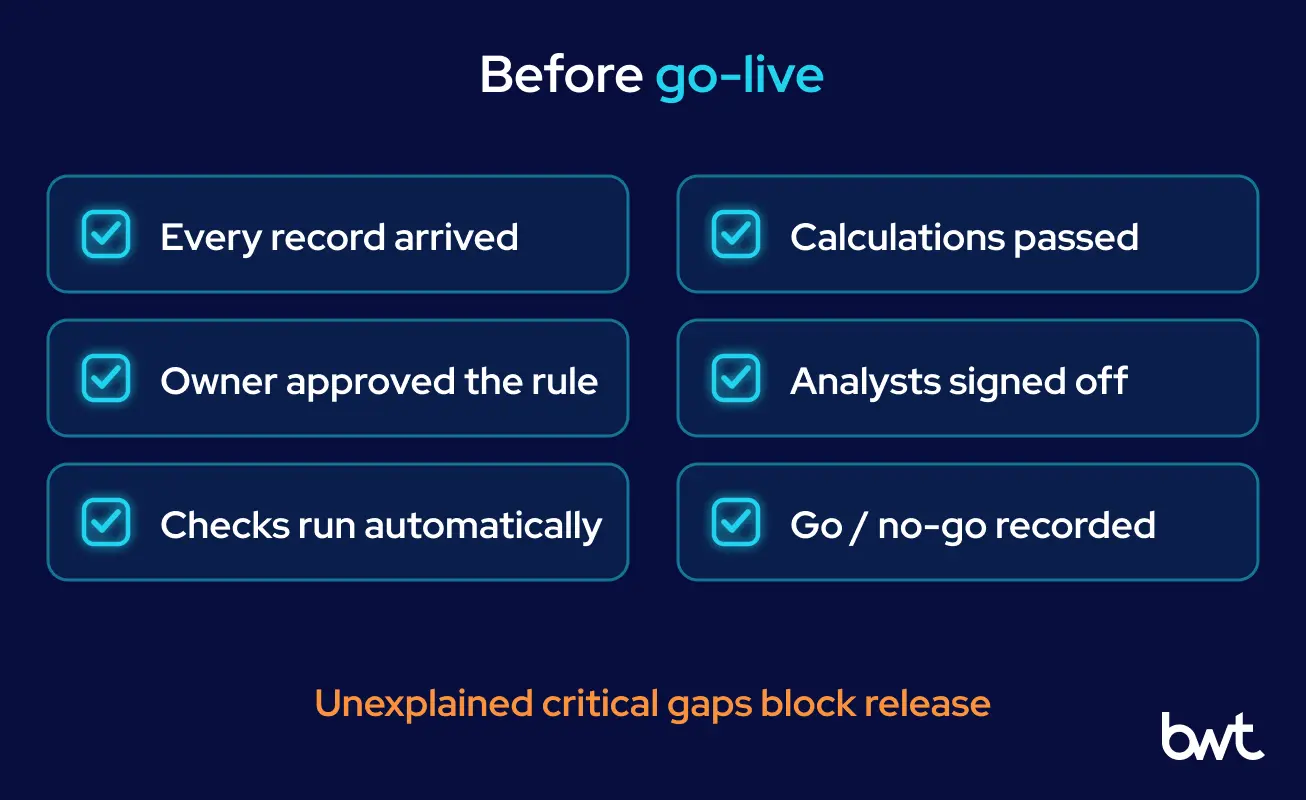
| Area | Required evidence |
| Source readiness | Expected and landed source sets reconcile |
| Transformation readiness | Every critical calculation passed against approved examples |
| Semantic readiness | Metric owner approved definition and tolerance |
| BI acceptance | Analysts signed off on the rendered report |
| Automation | Repeatable critical checks run in CI/CD or the release workflow |
| Performance and access | The result arrives on time and only to intended users |
| Operations | Alerts route to a named owner with record-level context |
| Go or no-go | Business and technical approvers recorded the decision |
This checklist keeps releases tied to measurable acceptance criteria. Security, recovery, and operational checks remain part of readiness, but they cannot compensate for missing numeric proof.
Final Thoughts
A trustworthy warehouse number needs complete source records, transformations that preserve the approved definition, and BI that presents the same decision. Test types and automation add coverage around that correctness model, while observability watches for new production behaviour after release.
The practical answer is to turn each critical number into traceable release evidence. If finance and BI disagree or a migration cannot be signed off, find the missing source, rule, tolerance, owner, or presentation check before shipping.
CTA: Validate Your Data Warehouse Before Bad Data Reaches Production – Request a Release-Readiness Assessment on our data warehouse services and solutions page. We map reconciliation, rules, BI acceptance, automation, and release gates into one evidence set.
For the broader ETL baseline – nulls, duplicates, referential integrity, and freshness – see our ETL and data warehousing playbook.

Trace one critical business number from the source inventory through transformations and its approved definition to the BI report. Reconcile what arrived, test the calculation with known inputs, and ask the metric owner and analysts to accept their respective parts of the proof. That is how to test a data warehouse end to end: verify every point where the number can become incomplete, change meaning, or render incorrectly.
ETL checks validate extraction, transformation, loading, and pipeline behaviour. Warehouse validation follows a wider proof path through models, metric definitions, permissions, and BI output. It asks not only whether data moved and transformations ran, but whether the resulting business number is complete, semantically correct, timely, and usable in the report where a decision is made.
Automate deterministic comparisons such as source inventories, business-key sets, counts, schema contracts, relationship integrity, stable transformation rules, freshness, incremental loads, and regression fixtures. Human owners should first define the business meaning and acceptable difference. Automation then reports the evidence and blocks critical failures; it should not decide that an unexplained difference is acceptable.
Run source and target platforms in parallel under the same metric definition. Compare complete inventories first, then business-critical calculations, and set a tolerance for each rule before cutover. Escalate any difference outside that tolerance to the named metric owner. If the platforms calculate different meanings, align the definitions before using a percentage difference for sign-off.
Confirm that source records reconcile, critical transformations pass, metric owners approve definitions, and analysts accept the BI reports. Then verify the performance, access, monitoring, recovery, and rollback controls required by the release plan. Record the go or no-go decision with its business and technical approvers. No green pipeline should override an unresolved difference in a critical number.
Read summarized version with
Validate Your Data Warehouse Before Release
We test the complete path from source records to the final BI report, so your team can release critical numbers with evidence.
We help you:
- Reconcile source and target data
- Validate transformation and metric rules
- Build automated release gates