Read summarized version with



The first useful questions in warehouse work are rarely about a platform. Which business decision must the warehouse support? Which system owns revenue? What does one sales row represent? How fresh must the answer be, and who can approve its definition?
Business needs define what the warehouse must deliver. Source realities show what is feasible. Security, retention, cost, and team skills shape the trade-offs. This guide turns those inputs into signed design deliverables, then carries them through a 12-step process to implementation handoff. Separate guides cover platform architecture and pipeline operations in depth.
Data Engineering: From Raw Web to
We develop and manage custom data solutions, powered by proven experts, to ensure the fastest delivery of structured data from sources of any size and complexity. We offer:
- Custom Web Scraping & Development
- 15+ Years of Engineering Expertise
- AI-Driven Data Processing & Enrichment
Key Takeaways
- Start with decisions, reports, and metrics rather than a vendor shortlist.
- Select the business process and declare grain before identifying facts or dimensions.
- Treat modeling methodology and processing layers as separate choices.
- Make mappings, metric definitions, quality rules, and ownership part of the contract.
- Use architecture to arrange approved choices, not to replace them.
- Prove one domain against signed acceptance criteria before expanding the pattern.
What Is Data Warehouse Design?
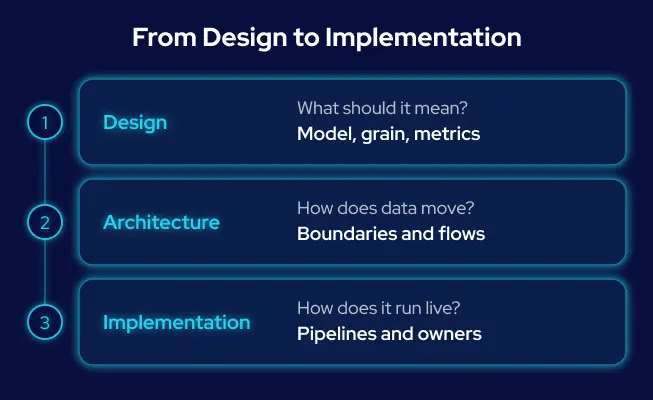
Data warehouse design turns reporting and analytics requirements into a buildable contract. It defines what the warehouse should mean: business processes, grain, facts, dimensions, history rules, metrics, mappings, quality criteria, owners, and constraints.
Design, architecture, and implementation answer different questions.
| Layer | Core question | Main deliverable |
| Design | What should the warehouse mean? | Model, grain, metrics, rules |
| Architecture | How should data move and be stored? | Architecture diagram and component boundaries |
| Implementation | How will it run in production? | Pipelines, CI/CD, monitoring, and operating ownership |
Design sets the decisions. Architecture arranges the components needed to execute them. Implementation builds, releases, and operates that approved design. Different owners therefore review different parts of the same contract: the business owner signs metrics, the architect signs boundaries, the engineering lead signs the handoff.
“Data truth isn’t a tool problem. Most platforms look identical on a slide; what separates a working warehouse from a documentation-only one is whether someone decided grain before they picked a primary key.”
— Alex Yudin, Head of Data Engineering, GroupBWT
Data Warehouse Design Requirements to Define First
Requirements should expose disagreements before tables harden around them. Record the business decisions and reports to support, the consumers who need them, and the metrics they must defend. Then assess the sources that can provide the required detail and history.
The first requirements workshop should settle these inputs:
- Business decisions and reports. Name the decision, KPI, current report, and reconciliation dispute that will prove value.
- Data consumers. Identify BI users, finance teams, operational applications, and AI or ML workloads, including their required level of detail.
- Source systems. Record the source of record, owner, schema, cadence, dependencies, change pattern, and known quality limits.
- Freshness and latency. Tie each SLA to a decision. A monthly board report and a pricing alert should not inherit the same cadence.
- Historical retention. Decide which changes must be reconstructed and for how long.
- Security and compliance. Define classification, residency, access, masking, audit, and deletion requirements before selecting components.
- Expected scale and cost. Size current and forecast volume, concurrency, compute windows, the cost ceiling for the most demanding workload, and the condition that would trigger a re-pricing review.
- Delivery constraints. Include team skills, procurement, network boundaries, and the production owner.
- AI and ML consumption. State the inference horizon, the data window, the cadence, and the access pattern that downstream models need, so the warehouse contract is built for them rather than retrofitted.
| Requirement area | Question to settle | Signed output |
| Business value | Which decisions and KPIs must improve? | Use-case and KPI map |
| Source reality | What can be trusted and integrated? | Source inventory and assessment |
| Constraints | What cannot be compromised? | Non-functional requirement register |
| Adoption | Who uses, approves, and operates it? | Ownership matrix |
Platform selection follows this assessment rather than preceding it. No platform is fully reversible: residency, integrations, skills, cost, and delivery timing all persist after the contract is signed. This is the practical starting point for teams deciding how to design data warehouse requirements before comparing products.
Core Data Warehouse Design Principles
William Inmon’s four canonical warehouse characteristics are subject-oriented, integrated, time-variant, and non-volatile. Governance and evolvability are modern design requirements that extend this foundation rather than historical members of the same list.
| Principle | Design implication |
| Subject-oriented | Organize data around business subjects and processes |
| Integrated | Standardize identifiers, types, and definitions across sources |
| Time-variant | Preserve the history needed to explain change |
| Non-volatile | Protect stable historical reporting after data is loaded |
| Governed | Assign ownership, access, lineage, and approval controls |
| Evolvable | Add sources and rules without destroying prior evidence |
Reversibility is a useful test for modern decisions. In an anonymized procurement platform, GroupBWT stored possible matches separately from the reporting threshold, so a threshold could be reviewed without deleting the underlying records or collecting the source again. This is internal GroupBWT project evidence; the client name is withheld under NDA.
Model the Business Process Before Choosing Architecture
Dimensional modeling starts with a business process, then grain. Grain states exactly what one fact-table row represents. Only after it is signed should the team identify dimensions and facts. This order follows Kimball’s four-step sequence and prevents architecture or source tables from defining the model by accident.
Data Warehouse Design Example: From Business Question to Star Schema
Consider a retailer asking: How much net revenue did each store generate by product category? That is not yet a model. The team must agree on the process, grain, measures, and reconciliation rule.
| Decision | Retail sales example |
| Business process | Product sales and returns |
| Grain | One row per sold order line; returns recorded as separate events linked to the sale where possible |
| Fact table | fact_sales |
| Acceptance test | Warehouse net sales reconcile with the finance-approved POS total within an agreed tolerance |
The measures are quantity, gross sales, discount, tax, return amount, net revenue, cost, and margin. Dimensions include dim_product, dim_customer, dim_store, dim_channel, dim_date, and dim_promotion.
The metric contract must remove ambiguity. For example:
Net Revenue = Gross Sales - Discounts - Returns
The contract also states whether tax is included, which date controls the reporting period, how cancelled lines behave, and who approves a change. Freshness may be 15 minutes for store operations, hourly for merchandising, and daily for finance – separate service levels over one certified definition, not three versions of revenue.
Slowly changing dimension Type 2 is appropriate when a historical attribute must remain true as of the event date. It creates a new version row with effective dates when an attribute changes. A source last_update timestamp may help detect that change, but the timestamp alone does not make the dimension Type 2.
Facts, Dimensions, and Real Queries
A fact is a measurable event at the declared grain. A dimension supplies the context used to group or filter it. Conformed dimensions keep shared concepts such as product, store, and date consistent across marts.
Validate the model with the queries people will run. Can finance reconcile net revenue? Can merchandising compare promotions without double-counting returns? Can an analyst join store history as it existed on the sale date? If any of those needs dashboard-specific repair logic, the design is not finished.
Star vs. Snowflake Schema
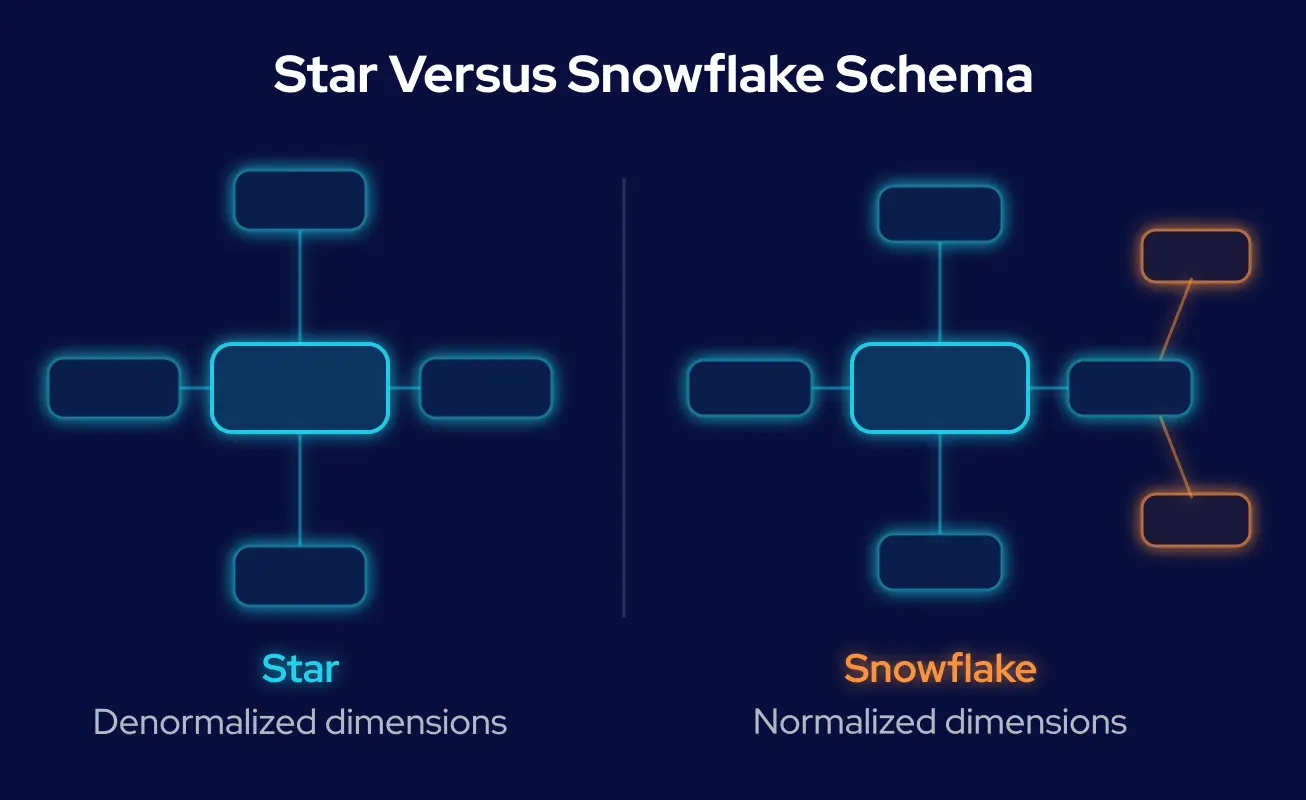
A star schema keeps dimensions denormalized around facts. It usually fits analyst-facing marts because the join path is short and understandable. A snowflake schema normalizes dimension hierarchies into related tables, which fits shared master structures or hierarchies needing centralized maintenance across several marts, at the cost of more joins.
A common compromise is a governed integration layer underneath readable star-schema marts. The right choice follows the required consumption model and ownership boundary, not a universal rule.
Also Read: Enterprise Data Warehouse Architecture Blueprint & Implementation
Choosing a Data Warehouse Design Methodology
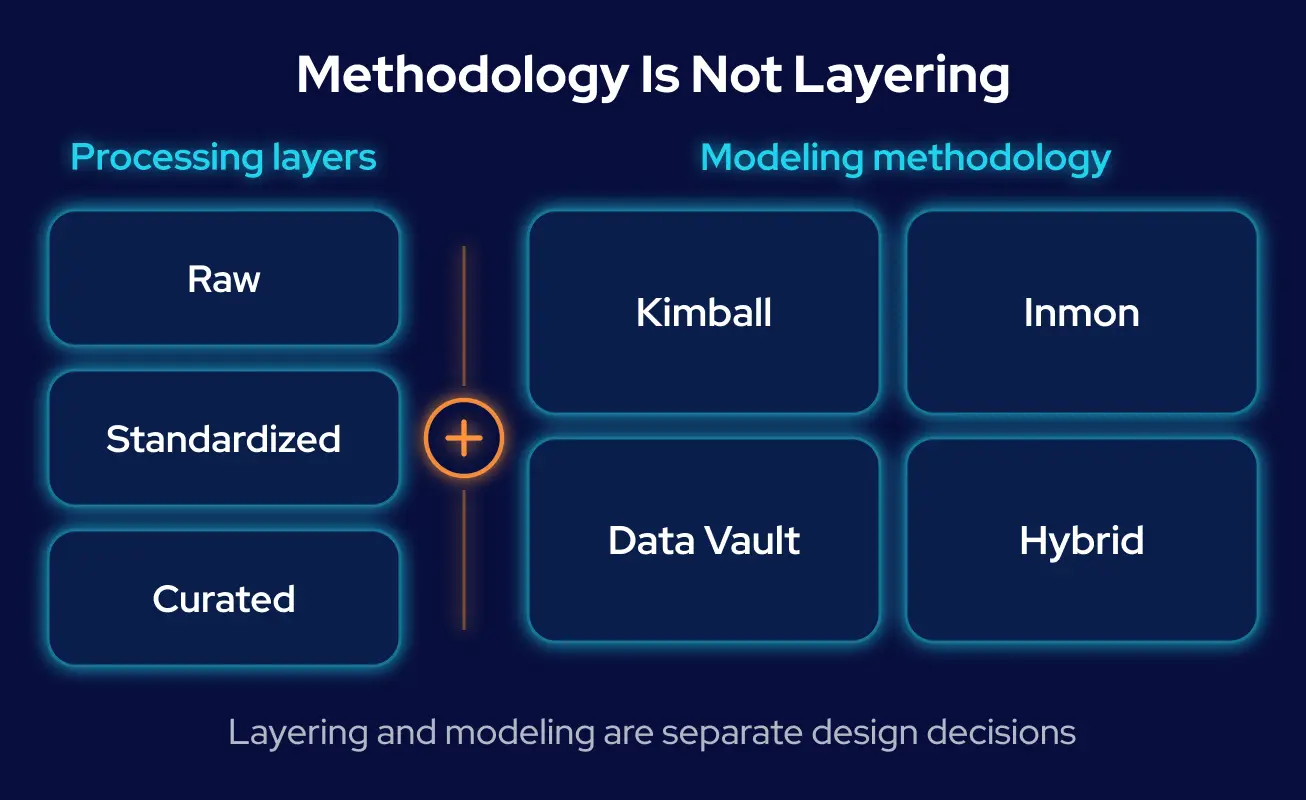
A data warehouse design methodology determines how teams organize the enterprise model and deliver domains. It does not determine the processing zones by itself.
| Method | Best fit | Trade-off | Typical consumption model |
| Kimball | Fast delivery around measurable business processes | Conformed dimensions need strong coordination | Star-schema marts read directly by BI |
| Inmon | Enterprise integration before downstream marts | Longer path to first domain value | Dimensional marts published from an enterprise core |
| Data Vault | Auditable integration across changing sources | Requires separate consumption models | Business vault rules feeding presentation marts |
| Hybrid | Programs with different needs by layer or domain | Boundaries and governance must be explicit | Auditable integration below, dimensional models above |
GroupBWT has direct delivery evidence for Data Vault and hybrid star-mart work. Kimball and Inmon are presented here as established design choices, not as claims that every approach appears in our portfolio.
Medallion belongs on a separate axis. Bronze, Silver, and Gold describe processing layers: raw, standardized, and consumption-ready. They can sit beside Kimball, Inmon, Data Vault, or a hybrid model. Mixing the two axes creates debates where one team is choosing a model and another is choosing pipeline zones.
How to Design a Data Warehouse Architecture
When designing a data warehouse architecture, arrange components only after requirements, source constraints, business processes, and grain are understood. This is how to design data warehouse architecture without letting a platform diagram dictate business meaning. The question here is narrow: Which architecture decisions must be made during warehouse design?
Operational Systems / SaaS / Files / Events
        ↓
Batch / CDC / Streaming Ingestion
        ↓
Raw and History-Preserving Layer
        ↓
Standardized Integration Layer
        ↓
Enterprise Model and Data Marts
        ↓
Semantic Layer
        ↓
BI / Analytics / AI Consumers
The architecture record assigns a responsibility to each boundary: where raw evidence is retained, where identifiers are standardized, where business rules run, where certified metrics live, and where access is enforced. Data warehouse architecture and design connect approved meaning to component responsibilities.
| Pattern | When it fits | Main design caution |
| Shared warehouse with conformed marts | Several domains need common KPIs | Define ownership and shared dimensions early |
| Domain-oriented marts | One bounded use case needs fast delivery | Prevent metric drift and duplicated dimensions |
| Warehouse plus lakehouse | Structured analytics, unstructured data, and ML share a governed base | Define storage and consumption boundaries explicitly |
Our enterprise data warehouse architecture guide covers platform structure, scalability, and operating trade-offs in depth. The design package needs only enough architecture to make its approved choices buildable.
How Integration Shapes the Warehouse Contract
Integration keeps a metric reconcilable when a source arrives late, repeats a record, or changes shape. The phrase data warehouse concepts design and data integration describes one contract: grain defines what a number means, mappings and controls preserve that meaning between systems.
Source-to-Target Mapping
A source-to-target map should include the source field, target field, data type, transformation rule, grain context, validation rule, exception disposition, owner, downstream consumer, freshness expectation, and schema-change policy. It is the document used to settle why a value moved, changed, or failed.
In one active phased engagement, GroupBWT specified roughly 30 fields per source with acceptance criteria. That scope is internal GroupBWT project evidence; the client name is withheld under NDA.
ETL, ELT, and Ingestion Cadence
ETL transforms data before warehouse loading. ELT lands data first and uses warehouse compute for transformation. The choice affects auditability, latency, cost, and security boundaries. Both still need mappings, tests, ownership, and retained evidence.
Batch, CDC, and streaming should follow the decision’s freshness requirement and the source’s capability. CDC, or change data capture, moves changed records after an initial load. Streaming may fit decisions measured in minutes; daily batch fits reports whose source closes once per day. The ETL and data warehousing integration guide owns run-time reliability details.
Data Contracts, History, and Quality
A contract states the expected schema, accepted values, ownership, freshness, validation, and response to change. Business rules should live in a governed transformation or semantic layer rather than being recreated in individual dashboards.
Data integrity means preserving values, keys, and relationships through movement and transformation. Data quality means fitness for the business decision. A pipeline can preserve every row and still deliver poor-quality revenue if the return rule is wrong.
Governance works across the path: schema and column controls, catalog metadata, contracts, identity and access policies, lineage, and audit records. cloud.google.com introduced global BigQuery data-governance tags for cross-region classification and access control in July 2026. As of August 18, 2026, that feature is still Preview, so confirm status and tenant eligibility before adoption. aws.amazon.com shows the same governance boundary spanning producer and consumer accounts.
Modern Data Warehouse Design Decisions
Modern data warehouse design should not become a second architecture guide. Three requirement groups materially affect the approved model.
Freshness, Scale, and Cost
Real-time is a cost, not a default virtue. Assign a cadence to each decision and document the volume, concurrency, and compute window behind it. Workloads with different latency or isolation needs may require different processing paths even when they share certified dimensions.
Governance and AI Readiness
AI readiness begins with trusted data and metadata. An AI consumer needs field-level provenance, traversable lineage, certified metrics, and access controls. A vector database may support semantic search, but it does not replace warehouse governance or a semantic contract.
“The mistake people make with AI-ready warehouses is treating it as a separate platform. In practice, the warehouse has to expose metadata, lineage, and certified metrics to the AI layer – and the way you expose them is by designing the schema to carry them, not by bolting on a vector store.”
— Dmytro Naumenko, CTO, GroupBWT
Cloud, On-Premises, and Hybrid Constraints
Cloud absorbs bursts without a hardware purchase. On-premises infrastructure can remain the better boundary for protected IP, fixed-latency operations, or strict residency requirements. Hybrid designs must state which data may cross the boundary, where transformation occurs, and who operates each side.
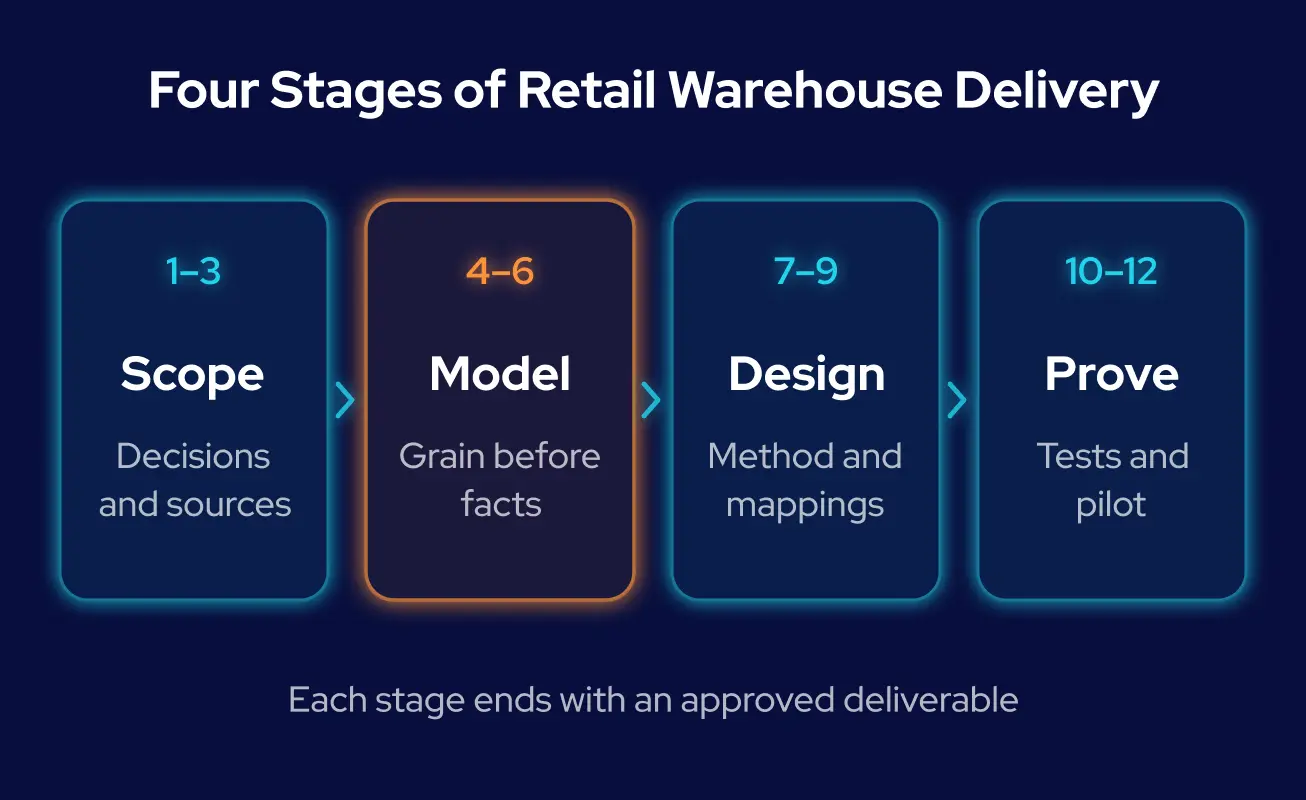
How to Design a Data Warehouse Step by Step
This data warehouse design process uses a signed output at each step. Business process and grain come before the final modeling and architecture decisions because they define what facts and dimensions must represent. Teams that want the sequence as a working document can request the design checklist as a worksheet and track each signature against it.
| Step | Signed deliverable |
| 1. Define business outcomes and analytics use cases | Use-case and KPI map |
| 2. Identify stakeholders and data consumers | Stakeholder and decision-owner map |
| 3. Inventory sources, dependencies, and constraints | Source inventory and scope classification |
| 4. Select business processes and declare grain | Grain statement per fact |
| 5. Set quality, history, freshness, compliance, and access requirements | Acceptance and non-functional criteria |
| 6. Model facts, dimensions, and metric definitions | Logical model and metric contracts |
| 7. Choose the modeling methodology | Methodology decision record |
| 8. Choose layering and architecture boundaries | Architecture decision record and diagram |
| 9. Write mappings and data contracts | Source-to-target map and contract set |
| 10. Define governance, lineage, semantic, and consumption outputs | Ownership, lineage, and certified KPI register |
| 11. Validate with real queries, sizing, and cost assumptions | Test results and cost model |
| 12. Create the pilot and rollout plan | Implementation handoff, phased roadmap, and ownership plan |
Step 1 is a scope cut: a source that supports no signed use case waits. Step 4 is pivotal – a grain statement such as “one row per sold order line” can be challenged before facts, dimensions, or ingestion choices harden around it. Steps 7 and 8 record two different decisions: methodology shapes the model, layering shapes processing boundaries.
Each step should have a signed deliverable and acceptance criteria. That turns the sequence into an implementation contract rather than a diagram engineering must reinterpret.
Data Warehouse Design and Implementation
The data warehouse implementation process starts with one pilot domain and the signed package above. Each phase produces a verifiable output engineering can defend. A first release typically runs one to two weeks to stand up environments, two to six weeks to build and reconcile the pilot mart, then a parallel-run window sized to the reporting cycle being replaced.
- Pilot scope. One business process, one source family, one mart. The pilot carries a written acceptance test: representative queries reconcile, source totals match within tolerance, access behaves as designed, and an owner signs the result.
- Environment and release. A dev, test, and prod environment exist before code merges. Releases go through version control, peer review, and a rollback path. Schema changes ship as code with a documented migration, so a column rename is reviewable rather than discovered by a broken report.
- Build and load. Engineering turns each mapping row into ingestion, transformation, and load logic at the declared grain. Late-arriving records, duplicates, and rejected rows get a defined disposition here, not an ad-hoc fix later.
- Reconciliation. Each load reconciles source counts, totals, and a small set of hash checks against the warehouse. Mismatches block promotion, not the BI layer. The finance-approved control total from the acceptance test is the reference, and a failed check is a release decision rather than a dashboard footnote.
- User validation. The people who argued about the number run their own reports against the pilot mart before cutover. Their sign-off, not a green pipeline, is what closes the acceptance test.
- Cutover and rollback. Cutover is sequenced, with a parallel-run window for the most material reports: the old and new report run side by side for at least one full reporting cycle, and the legacy path is retired only after they agree. Rollback is rehearsed, not improvised; recovery ownership is named in advance.
- Operating ownership. A named owner runs the warehouse in production. Monitoring covers freshness, lineage, and metric drift, not only infrastructure, and a change to a certified metric follows the same approval route as the original definition.
None of those phases should reopen grain or metric definitions unless validation exposes a genuine design error.
Expansion then follows a tested template rather than a platform-wide leap. By standardizing a reference-source template in a delivered cosmetics data program, GroupBWT reduced new-pipeline work from 25 hours to 5-6 hours. This is internal GroupBWT project evidence; the client name is withheld under NDA. The ETL and data warehousing integration covers CI/CD, monitoring, recovery execution, and runbooks.
Data Warehouse Design Best Practices
These practices belong in the first architecture workshop because each protects a measurable operational outcome. Requirements should trace to reports, reconciliation rules, freshness targets, or AI consumption needs.
The most useful data warehouse design tips are concrete controls: use conformed dimensions, assign each metric and pipeline an owner, retain lineage, define applicable row- and column-level access, and make schema evolution non-destructive.
Best practice data warehouse design also limits scope: pilot one domain, price demanding workloads early, and record the assumption that would reopen an architecture choice. A practice without an owner becomes documentation that drifts.
“The practices that survive contact with production are the boring ones. A conformed dimension with a named owner and a non-destructive schema change beats a clever model that only its author can explain six months later.”
— Oleg Boyko, CCO, GroupBWT
Common Data Warehouse Design Mistakes
| Mistake | Consequence |
| Buying tooling before validating requirements | A platform without an agreed business model |
| Modeling directly from source tables | Source quirks become permanent warehouse rules |
| Defining facts before grain | Inflated metrics and expensive model rework |
| Recreating logic in dashboards | Competing definitions that no owner can defend |
| Treating mappings and governance as later documentation | Changes arrive without impact analysis or accountability |
| Designing every domain at once | Late feedback and no proven template |
Data Warehouse Design Checklist
- Decisions, reports, KPI owners, and source constraints documented.
- Business process and grain signed before facts and dimensions.
- Methodology and layering recorded as separate decisions.
- Mappings, contracts, validation, and exception handling complete.
- Ownership, lineage, access, and semantic definitions assigned.
- Pilot acceptance, cutover, and recovery ownership agreed.
Final Thoughts: Make the Warehouse Prove Its Value
A warehouse succeeds when finance can reconcile a number, analysts can find its definition, and a source change does not erase the evidence needed to explain it. Grain, mappings, metric contracts, owners, and acceptance criteria are what make those outcomes testable.
Source note: Practice examples are anonymized and drawn from GroupBWT delivery and design engagements. Delivered work is described as implemented; discovery or design work is described as assessed, designed, or recommended. Client names are withheld under NDA.
Design a Data Warehouse That Can Scale With Your Business
GroupBWT turns a reporting problem, source inventory, or existing model into a reviewed architecture, methodology record, target model, mappings, acceptance criteria, and rollout plan. Our end-to-end data warehouse consulting services and data warehouse design solutions cover that scope, and the pharma data warehouse unification shows a related public delivery case.
Bring the disputed reports and available source list first. GroupBWT will identify whether the next useful action is a design engagement, a bounded pilot, or source and ownership work that must happen before either.

To design a data warehouse, define the decisions and metrics it must support, assess the sources, select the business process, and declare grain. Then model facts and dimensions, choose methodology and architecture boundaries, write mappings and contracts, and validate one pilot. Each step needs a signed deliverable and acceptance criteria.
The four canonical characteristics associated with Inmon are subject-oriented, integrated, time-variant, and non-volatile. Modern teams add governance and evolvability as design requirements. Together, these principles keep the warehouse organized around business subjects, consistent across sources, historically explainable, stable for reporting, controlled, and able to absorb change.
Design defines meaning and rules: grain, facts, dimensions, metrics, mappings, owners, quality, and constraints. Data warehouse architecture design arranges the components and flows that execute those choices. Our [enterprise data warehouse architecture](https://groupbwt.com/blog/enterprise-data-warehouse-architecture/) article covers the architecture side; this guide focuses on the decisions that must precede it.
Kimball starts with measurable business processes and dimensional marts. Inmon starts with an integrated normalized enterprise model and publishes downstream marts. Data Vault separates business keys, relationships, and attribute history to preserve auditability and absorb source change. Medallion is not a competing methodology; it describes processing layers that can accompany any of the three.
Use a star schema when analyst readability and simple joins are the priority. Use a snowflake schema when shared hierarchies or normalized master structures need centralized maintenance across marts. Many programs keep complexity in a governed integration layer and publish star schemas for consumption.
[image: 3]
Read summarized version with
Data Engineering: From Raw Web to
We develop and manage custom data solutions, powered by proven experts, to ensure the fastest delivery of structured data from sources of any size and complexity. We offer:
- Custom Web Scraping & Development
- 15+ Years of Engineering Expertise
- AI-Driven Data Processing & Enrichment