

Data Engineering
Enterprise Data Warehouse Architecture Blueprint & Implementation
Executives deploy an Enterprise Data Warehouse (EDW) to consolidate data and establish a single source of the company’s analytical truth....

When a dashboard shows the wrong number, the cost is a decision made on bad data — not a failed test case. GroupBWT’s data warehouse testing services validate every figure from source to dashboard, so finance, operations, and analytics act on one set of numbers. Most teams arrive with a situation, not a test type. So we test on two fronts: the layers the data passes through, and the production scenarios where it breaks.






We group the work into six checks, one per layer where trust tends to break.
We reconcile what left the source against what landed. Common examples? Row counts, checksums, and value matches that catch a dropped row or a value changed in transit.
Every join, aggregation, and business rule is tested against expected output, so “net revenue” means the same thing in the warehouse as in finance’s own definition.
Schema drift and silent type changes are caught at the load, before a renamed column or a changed date format quietly breaks a downstream report.
Every feed is held to its source. For one European cosmetics manufacturer, GroupBWT sustains a 99% match across 13 retailer feeds for 3+ years.
Keys, joins, and relationships are tested, so a broken reference never silently drops rows or double-counts them inside a report.
We test the semantic layer, filters, and aggregations against the governed query, so a measure can’t double-count after a join or read differently on two dashboards.
Most teams don’t test the warehouse until a wrong number reaches a board deck. By then, the cost isn’t a failed check — it’s a decision already made on bad data. Three pressures push the decision from “later” to “now.”
One unmatched join or silent truncation can move a revenue figure by millions. And once leadership catches a wrong number, they stop trusting the dashboard and fall back to spreadsheets nobody governs.
Every migration or model change can quietly break a downstream report, and without a baseline to test against, you find it in production — after the number is already in front of the business.
Spot-checking rows in SQL works for one table, not hundreds across a dozen sources, where manual checks miss the late-arriving record or the currency that changed format overnight.


Not sure which of your numbers you can trust?
Send us your platform and the one report you cannot afford to be wrong. A senior data engineer returns a written risk read within one business day.
Services That Pair With Data Warehouse Testing
The warehouse we test, designed and built for one governed source of truth.
The same discipline is applied where the data is too large to spot-check by hand.
When the warehouse moves, we test the cutover so each feed is validated before it carries a report.
Fixing the pipelines that feed the warehouse, so bad data never reaches a test.
Lineage, access, and quality policies that make the results of testing hold over time.
The dashboards and semantic layer whose numbers our testing keeps honest.
GroupBWT’s data warehouse testing solutions turn analytics from “probably right” into “verified before release.”
Without Testing:
With GroupBWT:
Leaders argue over whose number is right, then fall back to ungoverned spreadsheets.
Every figure is validated before it ships, so leadership acts on one trusted set of numbers.
Each warehouse change ships untested and breaks a report in production.
Regression and CI/CD checks gate every release, so changes ship without breaking live reporting.
Gaps, duplicates, and access errors surface only at audit time or after a wrong call.
Completeness, reconciliation, and access rules are validated continuously, not under audit pressure.
Teams rebuild reports and chase bad numbers after the fact.
Defects are caught before release, so rework and reporting-error costs fall.
Trust in analytics and dashboards
Without Testing
With GroupBWT
Release risk
Without Testing
With GroupBWT
Data quality and governance
Without Testing
With GroupBWT
Cost of rework
Without Testing
With GroupBWT
01
Pre-Migration Baseline
We capture the source-system numbers as the truth the new warehouse is tested against.
02
Parallel-Run Reconciliation
Old and new run side by side until every feed reconciles — proven on a 6,000+-table agricultural-producer cutover with no missed reporting day.
03
Post-Migration Regression
Every report is re-tested against the baseline before the old system is switched off.
04
Post-Change Regression
Each later schema, pipeline, or model change is regression-tested, so one fix never silently breaks another.
We run on your platform’s own engine: wherever the warehouse lives, the test reads the same engine your reports do — so a number that passes is the number on your dashboard, not an approximation from a side copy. Platform coverage: Databricks · Snowflake · BigQuery · AWS (Redshift, Aurora) — with Azure lake-and-warehouse validation on the same plan.
Where the checks above test each layer, the jobs below start with the scenario that triggers the call — a warehouse buckling under peak load, the wrong person able to read restricted data, a release that quietly breaks a live report, a feed that drifts for weeks before anyone notices — and end with the automation that keeps it from recurring.
When a warehouse slows under peak load, the failure shows up as a stale or half-loaded dashboard at the worst possible moment. A Tier-1 Asian e-commerce marketplace sustains 959,000+ products a day on a 60-second source-to-target SLA. Before each release ships, GroupBWT runs a load-and-latency gate against that SLA across two consolidated vendor streams: a release that would breach the SLA fails the build, not the dashboard — so a traffic spike never turns into a reporting outage in front of the business.
When a finance analyst can open another region’s restricted revenue or payroll detail, or a masked column quietly un-masks after a schema change, the gap surfaces at audit — or worse, in the wrong hands. We test row-level access, column masking, and role permissions against each role, so a permission that drifts open fails a test before it reaches production, and the access audit trail exists long before the auditor asks for it.
Tests run on every pull request and deploy, so a broken transformation fails the build instead of reaching production.
Assertions live next to the models, version-controlled with the code. We write them as dbt tests or native SQL, and where you already run a data-quality framework such as Great Expectations or Soda, we add tests into it rather than impose a separate tool.
Freshness, volume, and schema-drift checks keep running on live feeds and alert the moment one misbehaves, not when a user reports a blank chart. Where a fixed threshold misses a slow drift, AI-driven data warehouse testing services add a learned baseline — a model of each feed’s normal volume and timing that catches the anomaly a static rule lets through.
The same reconciliation tests keep running against production loads, so a feed that silently drifts is caught as a failed check, not weeks later in a board review.









What Our Clients Say

What do you like best?
Their deep understanding of our needs and how to craft a solution that provides more opportunities for managing our data. Their data solution, enhanced with AI features, allows us to easily manage diverse data sources and quickly get actionable insights from data.
What do you dislike?
It took some time to align the a multi-source data scraping platform functionality with our specific workflows. But we quickly adapted and the final result fully met our requirements.

What do you like best?
It was incredible how they could build precisely what we wanted. They were genuine experts in data scraping; project management was also great, and each phase of the project was on time, with quick feedback.
What do you dislike?
We have no comments on the work performed.

What do you like best?
GroupBWT is the preferred choice for competitive intelligence through complex data extraction. Their approach, technical skills, and customization options make them valuable partners. Nevertheless, be prepared to invest time in initial solution development.
What do you dislike?
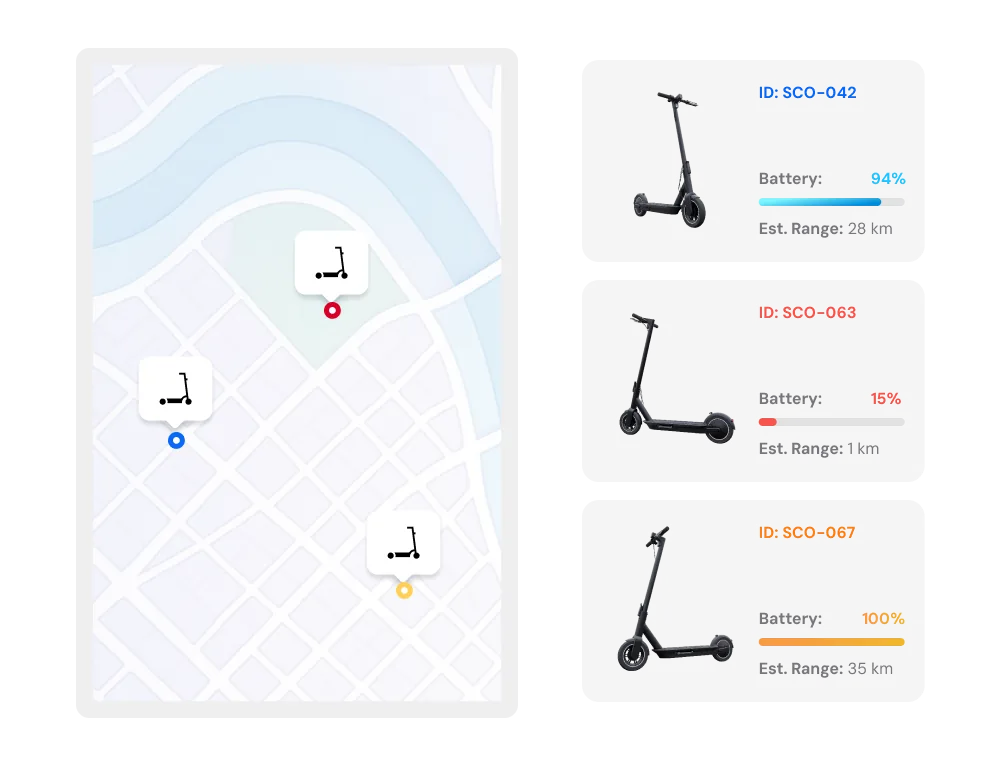
GroupBWT provided us with a solution to collect real-time data on competitor micro-mobility services so we could monitor vehicle availability and locations. This data has given us a clear view of the market in specific areas, allowing us to refine our operational strategy and stay competitive.

What do you like best?
The company's dedication to understanding our needs for collecting competitor data was exemplary. Their methodology for extracting complex data sets was methodical and precise. What impressed me most was their adaptability and collaboration with our team, ensuring the data was relevant and actionable for our market analysis.
What do you dislike?
Finding a downside is challenging, as they consistently met our expectations and provided timely updates. If anything, I would have appreciated an even more detailed roadmap at the project's outset. However, this didn't hamper our overall experience.

What do you like best?
GroupBWT excels at providing tailored data scraping solutions perfectly suited to our specific needs for competitor analysis and market research.
What do you dislike?
Given the complexity and customization of our project, we later decided that we needed a few additional sources after the project had started.
What do you like best?
What we liked most was how GroupBWT created a flexible system that efficiently handles large amounts of data. Their innovative technology and expertise helped us quickly understand market trends and make smarter decisions.
What do you dislike?
The entire process was easy and fast, so there were no downsides.
What do you like best?
Their deep understanding of our needs and how to craft a solution that provides more opportunities for managing our data. Their data solution, enhanced with AI features, allows us to easily manage diverse data sources and quickly get actionable insights from data.
What do you dislike?
It took some time to align the a multi-source data scraping platform functionality with our specific workflows. But we quickly adapted and the final result fully met our requirements.
What do you like best?
It was incredible how they could build precisely what we wanted. They were genuine experts in data scraping; project management was also great, and each phase of the project was on time, with quick feedback.
What do you dislike?
We have no comments on the work performed.
What do you like best?
GroupBWT is the preferred choice for competitive intelligence through complex data extraction. Their approach, technical skills, and customization options make them valuable partners. Nevertheless, be prepared to invest time in initial solution development.
What do you dislike?
GroupBWT provided us with a solution to collect real-time data on competitor micro-mobility services so we could monitor vehicle availability and locations. This data has given us a clear view of the market in specific areas, allowing us to refine our operational strategy and stay competitive.
What do you like best?
The company's dedication to understanding our needs for collecting competitor data was exemplary. Their methodology for extracting complex data sets was methodical and precise. What impressed me most was their adaptability and collaboration with our team, ensuring the data was relevant and actionable for our market analysis.
What do you dislike?
Finding a downside is challenging, as they consistently met our expectations and provided timely updates. If anything, I would have appreciated an even more detailed roadmap at the project's outset. However, this didn't hamper our overall experience.
What do you like best?
GroupBWT excels at providing tailored data scraping solutions perfectly suited to our specific needs for competitor analysis and market research.
What do you dislike?
Given the complexity and customization of our project, we later decided that we needed a few additional sources after the project had started.
What do you like best?
What we liked most was how GroupBWT created a flexible system that efficiently handles large amounts of data. Their innovative technology and expertise helped us quickly understand market trends and make smarter decisions.
What do you dislike?
The entire process was easy and fast, so there were no downsides.

Do you need our production data?
No copy leaves your environment. Our data warehouse testing services run on your platform’s own engine, against your data in place and under NDA — and where access is restricted, we test on masked or synthetic data instead.
How soon do tests start gating releases?
The free 1-day read returns a written risk assessment in one business day. First reconciliation tests usually run within the first weeks, and CI/CD gating switches on once the test plan is signed off — so the payback starts before the full suite is finished.
When a test fails, do you fix it or just flag it?
We triage every defect, trace it to the feed or transformation that caused it, and work it until it reconciles — not a list handed back at the end. The pipeline fix is yours or co-owned; the diagnosis and the per-feed reconciliation report are ours.
How is this different from the observability tools we already run?
Observability watches production and alerts after a number has already drifted; testing gates the change before it ships and verifies each figure against the data it came from. The best results come from doing both — so we add tests into the framework you already run (dbt, Great Expectations, Soda) instead of selling you another dashboard.
What does it cost, and how do we engage?
It depends on scope — sources, platform, how many reports are business-critical, whether a migration is in play — so we scope before we quote. Most engagements start with the free 1-day read, then pick a shape: a one-off migration cutover, a fixed-scope test build, or an ongoing release-gate retainer. You see the scope and the cost before any build begins.


How can we help you?

We’ll review your goals and suggest the right solution — technical, scalable, and tailored to you.
What do you need extracted, structured, or automated?