Read summarized version with


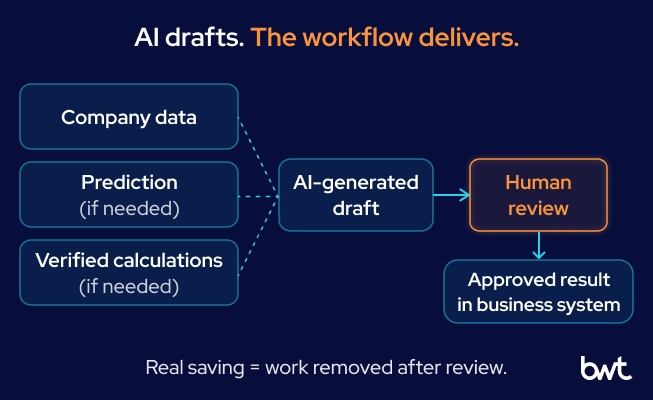
Most generative AI use cases start from records the company already holds. The model drafts a support reply from the account history, a visit note in the clinic’s template, or one table that compares supplier quotes. Only the time left after review and correction counts as a saving.
An application around the model first retrieves the records the task needs and extracts fields from incoming documents. It then passes exact calculations to ordinary software and writes the result into the system the employee already uses.
Build the Data FoundationYour AI Models Need
We develop and manage custom data solutions, powered by proven experts, to ensure the fastest delivery of structured data from sources of any size and complexity.
We offer:
- Custom Web Scraping & Development
- 15+ Years of Engineering Expertise
- AI-Driven Data Processing & Enrichment
At GroupBWT, we build knowledge assistants, document applications, and connected workflows as part of our generative AI development services. We map source records and access rules first, then connect the finished application to your business systems.
Executive summary
- Customer support, document preparation, knowledge search, and software assistance are practical first projects, because today’s output and handling effort are already known and give the pilot a baseline.
- Five of the 11 industries below draw on our published generative AI case studies: Insurance, Finance, Healthcare, Travel and Hospitality, and Automobile. The other six use third-party sources or common workflow patterns.
- Which mistake would hurt your industry most? Test retrieval, permissions, change tracking, and action controls against exactly that one before go-live.
- The budget owner measures return on investment per accepted result, its cost including corrections, review, integration, and operation, not per faster draft.
Generative AI as one step in a business process
The generative AI use cases below all work from an instruction and its context. For a disputed charge, the instruction asks for a draft reply, and the context covers the account history, the tariff, and the earlier messages in the thread.
A faster draft is not yet a saving for a budget owner comparing enterprise use cases for generative AI. The return on GenAI use cases rests on two figures. One is the work removed from the whole process after review and corrections. The other is the solution’s build cost plus its running cost.
Most deployments combine traditional automation, predictive machine learning, and a generative model that often runs inside retrieval-augmented generation (RAG) or an AI agent. One agent request may pull passages through RAG and an estimate from a predictive model, while ordinary software does the exact calculation.
Generative AI use cases: examples by business function
In sales, support, and finance, much of the week goes into looking up information, compiling documents, and explaining results. The generative AI use cases below are aimed at those three tasks.
Find the current answer in company knowledge
An engineer asks for the installation procedure of one equipment revision. The assistant returns only passages tagged with that revision, and the engineer confirms the match before work starts.
RAG development services connect company search with generation, so the answer and its sources appear together. When two manuals disagree, the assistant shows the conflict unless a documented source priority settles it.
Alex Yudin explains why the version matters: “A search result can be accurate and still be wrong for the job. The source needs the right revision, effective date, and authority before its wording becomes an instruction.” — Alex Yudin, Head of Data Engineering at GroupBWT
Help support staff answer and escalate
A support copilot grounds its draft reply in the applicable policy and account context. Escalated cases go to a specialist. The handover includes the conversation history, the cited document version, and the open issue.
Generative AI at Work is a 2025 field study from The Quarterly Journal of Economics. It tracked 5,172 customer-support agents at one company as they gained access to an AI assistant. With access, the average number of issues resolved per hour rose 15%. Less experienced agents gained the most.
Turn incoming documents into reviewable work
One supplier request may bundle a scanned certificate, a price table, and an email that moves the delivery date. Optical character recognition (OCR) reads the scan, parsing extracts the fields, and a person confirms each uncertain reading. Only confirmed fields reach the model, which lists every conflict or gap against the requirements for the procurement specialist to resolve.
Checking a counterparty’s revised contract is a use case that can be addressed by a generative AI assistant. The assistant marks every changed clause and drafts questions for counsel. Counsel decides what each change means.
Produce content from controlled facts
Verified attributes and approved claims can become localized descriptions, campaign text, scripts, or storyboards. Count accepted assets per editor hour rather than drafts produced, because one invented feature copied into twenty variants means twenty corrections. Generated images need a separate check for rights, consent, and product configurations that do not exist.
Draft proposals from approved sales material
A customer specification can combine delivery dates, compatibility questions and a request for an itemized price. The assistant fills the repeat items from approved descriptions and earlier proposals. Requirements without an approved answer go to a specialist, and the salesperson works on them. Every reused passage gets a final read before the offer goes out. An earlier customer’s price or delivery date can remain in the text.
Code generation with developer review
Developers use coding assistants to write functions and explain unfamiliar code, and they ask for tests drafted from a written requirement. Tests need the most care. If the code already contains a bug, a generated test can encode it and still pass, so reviewers check each assertion against the requirement, not the code. Review effort and escaped defects belong in the same count as coding time.
Explain calculated results without inventing causes
An analyst asks why margin changed by product group. The team first agrees on the margin definition and the comparison period. An assistant can then explain a validated breakdown beside the calculation and suggest what to check next. A breakdown locates where margin moved but cannot tell why. The analyst can link that movement to a promotion or a staffing decision only with evidence from other sources. Each statement in the assistant’s explanation is labeled fact, calculation, or hypothesis.
Put employee assistance inside existing tools
Some tasks require no custom development. Copilot, an off-the-shelf assistant, covers meeting minutes, document search, and draft evaluations at CRESCO. In a December 2025 customer story, Microsoft put the average saving per trial user at about ten hours a month.
When one workflow draws on several business systems, a connected AI application can bring that information into one context. We built one real life application of generative AI for our own use: an AI agent platform. It draws on six synced sources: Slack, Jira, Confluence, customer relationship management (CRM) records, project data, and meeting transcripts. Three role agents use that data. The outreach agent writes reply drafts from CRM and meeting context. The funnel agent answers pipeline questions. The meeting-prep agent prepares briefs. A member of our team reads each outreach draft before it is sent, and according to the published case, 95% of drafts are approved without edits.
Coordinate multi-system business operations
When a request depends on records in several systems, an agent can take a permitted next step, such as an authorized order lookup. Custom AI Agent Development Services cover tool integration, evaluation, and separate permissions for reading an order and changing it.
How generative AI use cases differ by industry
A wrong specification in a product description has to be corrected and can start a customer dispute. The same type of error in a clinical note can put the patient at risk. Since the cost of an error varies this widely, the risk in generative AI use cases depends on the industry. Sources, integration, and checks therefore have to fit each industry’s work. In Insurance, Finance, Healthcare, Travel and Hospitality, and Automobile, the examples below come from our published case studies; the other industries draw on published third-party examples or common workflow patterns.
The table below maps generative AI business use cases by industry to an output and a pilot metric.
| Industry | Application | Output | Metric to track |
| Insurance | Claims and policy assistance | Claim summary and clause-referenced answers | Time to a complete claim file; tickets handled without escalation |
| Finance | Exception underwriting | Reconciled evidence and credit memo | Review time per flagged application |
| Healthcare | Clinical documentation | Draft visit note for physician review | Documentation time per physician |
| Manufacturing | Maintenance planning | Draft work orders and repair windows from anomaly alerts | Time from alert to an approved work order |
| E-Commerce | Catalog content | Descriptions from verified attributes | Time to publish a new listing |
| Retail | In-store sales support | Product stories and stock answers for associates | Time to prepare a customer response |
| Beauty & Personal Care | Consumer-research synthesis | Product brief with source references | Research-summary preparation time |
| Travel and Hospitality | Guest messages and destination content | Pre-arrival messages and city content | Response preparation time; update time per city |
| Real Estate | Lease comparison | Referenced clause comparison | Time to prepare a review pack |
| Automobile | Supplier sourcing | Supplier outreach and structured quote comparison | Complete custom-part sourcing cycle |
| Telecommunications | Agent assistance and billing support | Sourced answers and account-specific bill explanations | Average handling time; repeat contacts per resolved issue |
Insurance: claims summaries and policy assistance
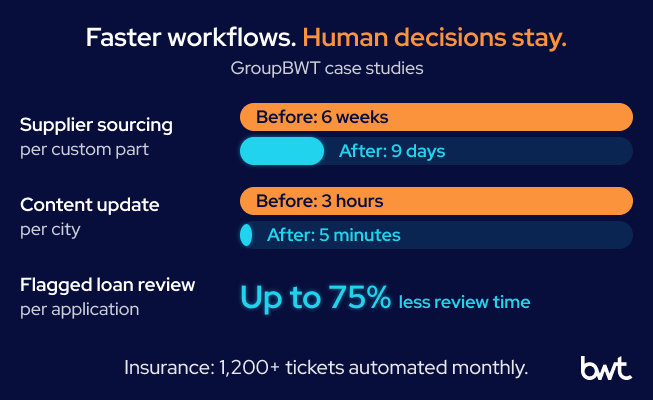
An adjuster opening a new claim can start from a timeline the assistant built from the reported events and a drafted request for missing evidence. For a regional insurance platform, we built a GPT-based insurance support chatbot on the platform’s policy clause library: each reply quotes the clause ID and document version, and escalated conversations reach a live agent with the chat log. GroupBWT automated clause lookups, policy checks, and eligibility queries. Through that automation, we removed over 1,200 repetitive tickets a month, more than half of the platform’s manual workload, according to the published case. No risk, coverage, or claim-payment decision bypasses the insurer’s approved process.
Finance: reconciling loan files before the credit decision
The financial statement in a loan file sometimes disagrees with the bank statement. An analyst may then need hours to reconcile the two before the lender sees the case.
In the financial-document and credit-agent case, five agents divide that work. The Document Processing agent reconciles the two statements, and four more agents cover financial analysis, risk assessment, credit policy, and the credit memo. Each exception file had taken an analyst one to three hours. According to the published results, GroupBWT’s automation of that preparation cut exception-application review time by up to 75% and let one analyst handle up to three times as many flagged applications. A credit analyst still made every lending decision.
Healthcare: visit notes prepared in the clinic’s template
Once the visit ends, a documentation assistant has the note ready in the clinic’s template, and any missing or unclear detail is marked for the physician to check.
In the clinical-documentation case, physicians at the network’s 45 clinics spent two to three hours finishing notes after their last appointment. GroupBWT integrated note-drafting agents into the network’s existing electronic medical record (EMR) system, and the published case reports that this cut documentation work by up to three hours per physician per day, with more than 70% of records needing only minor edits. Nothing went into the record without physician approval.
Manufacturing: engineering knowledge search and predictive maintenance
The revision-matched search above also lets an assistant draft work instructions for a specific component and variant, revision attached.
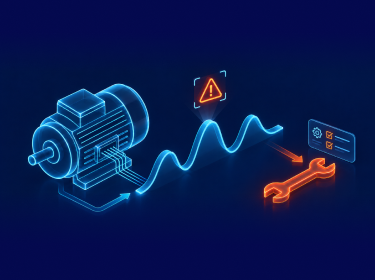
In predictive maintenance, when a condition-monitoring system detects unusual equipment behavior, the assistant drafts a work order with a proposed repair window from the alert, the maintenance history, and the equipment manual. The maintenance planner gets the draft together with the alert. The prediction itself comes from the monitoring model, not from generation. Engineers approve every work order and schedule change.
E-Commerce: product content from verified attributes
Catalog teams can write descriptions in one house style straight from the current product record (size, compatibility, variants), while availability stays with the inventory and checkout systems. If the record has no battery life, the description should leave it out rather than borrow a figure from a similar product.
For an online store, the benefit is new SKUs on sale sooner and fewer live descriptions needing fixes. In The Very Group’s product-content workflow, as AWS describes it, models analyze products and produce material that copywriters work from.
Retail: store associate support and weekly regional reports
Store associates need correct product and stock answers while the customer is still at the counter. A Microsoft profile of Chow Tai Fook, published in April 2026, describes associates using AI for product storytelling, inventory checks, and sales-conversation practice.
Store reporting is a second use in retail. For the regional manager, an assistant drafts a weekly summary from store, product-group, and period figures. Each change links back to the stores behind it, which shortens report preparation.
Beauty & Personal Care: product research briefs with sources
Product teams asking for a research brief can have an assistant gather consumer studies and market reports, references still attached. Microsoft’s Estée Lauder ConsumerIQ example describes answers drawn from internal research documents, charts and images among them, with citations that people can check. ConsumerIQ works from internal research, not from customer reviews collected independently. Before campaign copy built on the brief goes out, an editor should check it against approved claims and each market’s rules.
Travel and Hospitality: guest messages and destination content
Pre-arrival messages can be drafted in each guest’s language from approved property guidance, and prices, availability, and reservation details are taken only from the booking system.
Destination content at scale is about more than how much data the pipeline processes. Source quality, freshness, and processing costs also determine whether the workflow is useful. The pipeline we built for an AI travel platform MVP covered more than 30 European cities within 90 days. A lightweight model handles bulk language detection and sentiment, and a large language model (LLM) writes only the final editorial text. By keeping bulk processing away from the LLM, we kept AI costs 70% below an all-LLM design, as calculated in the published case. The same case puts the NLP processing costs of a full refresh cycle across those cities at about $49 and reports that content updates fell from three hours to five minutes per city.
Real Estate: lease review and listing content
For shortlisted premises, a lease assistant can line up renewal clauses and assemble a referenced review pack. On a JLL podcast on AI in real estate, Ankit Kapoor, Associate Partner in McKinsey’s Financial Services Lab, estimated that AI extraction of lease dates, break points, and price points could bring asset and portfolio managers potential time savings of up to 20%. The speakers also stress checking each abstraction and leaving interpretation to the responsible professional. Listing copy can be checked against the property record, and virtually staged images need a clear label.
Automobile: automating custom-part RFQs
With a custom-part request for quotation (RFQ), emails, specification checks, and quote comparisons can take weeks before a supplier is chosen. We built an AI-assisted sourcing pipeline into the client’s existing enterprise resource planning (ERP) system. With it, we cut custom-part sourcing from six weeks to nine days, according to the published RFQ sourcing automation case. The pipeline’s screening of each supplier reply for qualification documents such as IATF 16949 certification cut dead-end evaluations by roughly 60%. The pipeline also compares quotes like for like, saving buyers about 18 hours per custom RFQ. A buyer approves every supplier message and makes the final supplier choice.
Telecommunications: agent assistance and billing support
At Verizon, customer service representatives find answers to customer queries through an on-screen assistant built on a version of Google’s Gemini model and nearly 15,000 internal documents. In a Reuters report from April 2025, Verizon credited the assistant with shorter calls; according to Sampath Sowmyanarayan, CEO of Verizon’s consumer group, sales through the 28,000-person service team had risen nearly 40% since the July 2024 rollout. A bill explanation from the assistant should rest on the tariff in that customer’s agreement, and a refund should be offered only after the billing system confirms it.
Which generative AI use cases suit a first pilot
Figure 4.3.1 of the Stanford AI Index 2026 records that 79% of respondents’ organizations regularly used generative AI in at least one business function in 2025. For many businesses, the open decision is which applications to expand and fund. Some use cases of generative AI pass technical tests and still cost more to build than they return. For a first project, the best generative AI use cases usually combine a frequent task and reachable data with a measurable result and errors the team would notice. Costly mistakes can still exclude a repetitive task from pilot selection.
Rank the candidates that pass this filter by expected financial value, implementation cost, and operational risk. Then run existing tools and a custom option on identical examples. Does a ready-made assistant already connect to your sources, permissions, and applications? Start there. If a ready-made tool cannot securely reach your data, respect per-document permissions, apply your business rules, meet your evaluation requirements, fit the workflow’s interface, or trigger the business actions the process needs, custom development is justified. What you pay for is the working application and its integration, not exclusive access to a language model.
The $15,000-$40,000 Level 2 proof of value in our published AI implementation budget reference covers a defined validation scope with one or two connected business systems. The $50,000-$150,000 proof-of-concept band in our guide to AI consulting costs pools many vendors and scopes from public market guides, so it shows market direction only.
Oleg Boyko describes what the pilot has to settle: “A pilot should leave you able to decide what to fund, what to change, and what to stop. A demonstration that cannot produce a no-go decision has not tested the investment.” — Oleg Boyko, CCO at GroupBWT

How GroupBWT turns a GenAI use case into a working application
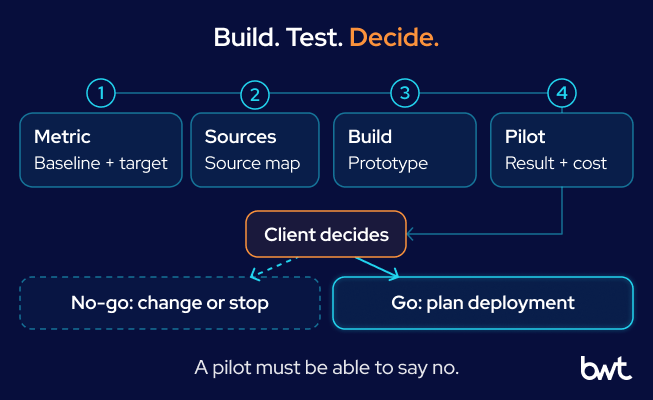
We agree on the scope first, and it sets which of the following stages and deliverables an engagement includes.
- Choose the business problem and metric. We define the needed output and measure today’s handling effort, corrections included, which produces the use-case scope, baseline KPI, and acceptance criteria.
- Assess sources and integration. Source access and data quality often determine how quickly a pilot can progress. We therefore identify the records, access rules, and system connections first, and Data Engineering Services address source pipelines and consistent records. This stage ends with a source map, the access requirements, and a list of integration risks.
- Design and build the application. The workflow determines the design: RAG, plain generation, or an agent. Your team then tests a working application or a prototype.
- Pilot against the business metric. The pilot runs complete workflows on representative requests and on independent acceptance examples. The evaluation results and costs then reach your budget owner with our go or no-go recommendation.
- Deploy and support when the pilot meets its acceptance criteria. We release the application into the agreed workflows. We also configure its monitoring and recovery procedures. Your team and ours then agree who owns ongoing support. The handover includes the agreed application deliverables, the monitoring setup, and support documentation. The project agreement sets ownership and licensing.
Also Read: Enterprise-Ready Generative AI Solutions: How to Move From PoC to Production
Production readiness checks
Production requests are usually more varied than a pilot sample. The go-live decision should therefore rest on records of how review, retrieval, permissions, and actions performed in real work.
Why reviewers need a defined role
With a defined review role, the reviewer sees the original facts beside the generated result and has time to catch omissions. A Microsoft Research survey published in 2025 found that the more confidence knowledge workers reported in GenAI, the less critical thinking they reported. Both measures are self-reported, and the survey does not show that confidence caused the reduction.
What implementation checks mean for your team
Answers based on the correct sources. A policy question should return the current document version and the right cited passage, with each clause retrieved together with its conditions and exclusions so that no restriction is dropped.
Access controlled by business permissions. Role and access rights are checked before retrieval, because retrieved content is already on its way to the model. Logs need access and retention controls too.
Reliable performance after changes. Every evaluated result needs a record of the model, prompt, retrieval configuration, and source document versions behind it. Together with monitoring and evaluation logs, these records let your team track quality, latency, errors, and operating costs and trace a drop in results to the change that caused it.
Controlled actions and recovery. An action runs only after it clears permission checks and any required approval, and instructions hidden in retrieved documents or emails (prompt injection) never count as authorization. Each kind of failed action needs an agreed fallback, such as keeping an unsent message as a draft.
Dmytro Naumenko highlights a separate acceptance test for action-taking systems: “Two individually valid requests can still produce a wrong result when they run together. Test retries and concurrent requests against the business record, not just the success message returned by each tool.” — Dmytro Naumenko, CTO at GroupBWT
Calculating generative AI ROI from realized benefit instead of freed hours
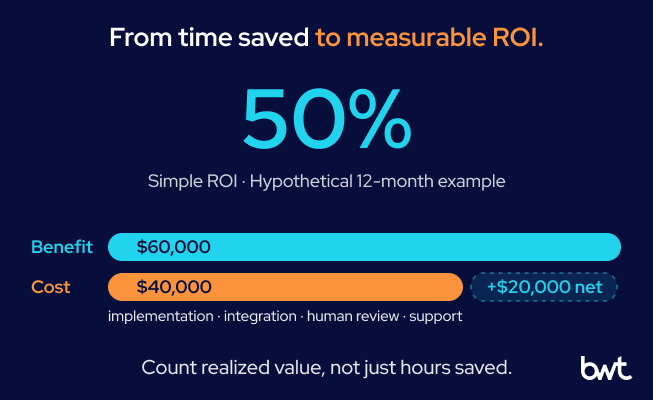
Hours released by the application become savings only when paid hours go down, and become revenue only when the team has additional demand to serve. Record how the released capacity was used before counting any realized benefit.
ROI = (realized financial benefit – total program cost) / total program cost × 100%.
Realized benefit includes operating costs the company stops paying and overtime that is no longer worked. For extra work the same team takes on, the contribution profit counts, not the full revenue. An hour freed counts once, as a labor saving or as new-revenue capacity, never both.
For a 12-month example with $60,000 of documented financial benefit and $40,000 of implementation and running costs, the net gain is $20,000 and the simple ROI is 50%. Longer projects record costs and benefits separately in each year they occur.
The total program cost starts with implementation and adds source preparation, integration, model usage, human review, maintenance and support. When a staffing or process change contributed to the same result, the application is credited with only its own share.
The budget owner also tracks cost per approved output next to overall ROI, dividing the period’s full relevant cost by the number of results that met the agreed criteria.
Start with one workflow and its systems
For the first conversation, describe the workflow, its systems, and the step that costs your team the most hours. GroupBWT works through the technical and business questions with you, including whether a tool you already license would be enough. The data assessment, scope, timeline, and estimate come later, in discovery. To compare several candidate use cases by value and data readiness, see our AI Readiness Assessment Services.
Widespread generative AI enterprise use cases include customer support, knowledge search, and document summarization. Product content, proposal preparation, and software development assistance are also frequent choices. Where to start depends on the data a company can reach and on what a mistake costs in that workflow.
An output that changes a record or goes to a customer directly carries the most risk. Four failures need separate tests before go-live, starting with an answer from a wrong or outdated source. Another is protected information reaching a user without access rights. The others are an action that skips a required check and a generated image published without rights or consent.
Price calculation, routing, and threshold checks run on stable rules. Conventional automation often runs such tasks more simply, with easier audits and lower running costs. Generative AI belongs in work that needs flexible interpretation, content generation, or contextual interaction that predefined rules cannot handle well.
RAG supplies relevant retrieved information with each request, while fine-tuning changes model parameters. A company knowledge assistant often benefits from RAG when it answers from current internal documents. Where a model performs a task poorly or inconsistently, fine-tuning may improve results but cannot substitute for access-controlled retrieval. Many production assistants run without fine-tuning. A search tool that only returns existing documents may not need RAG.
Our published AI implementation pricing puts a Level 2 proof of value with one or two connected business systems at $15,000-$40,000 and typically 2-4 weeks, depending on data availability, system access, integration complexity, and compliance requirements. The proof of value covers a defined validation scope. Production deployment requires a separate estimate after the results and next steps have been reviewed. Each proposal states which recurring costs, such as model usage, hosting, and support, it includes, and indicative ranges for AI agent projects are on our AI agent development page.
Read summarized version with
Build the Data FoundationYour AI Models Need
We develop and manage custom data solutions, powered by proven experts, to ensure the fastest delivery of structured data from sources of any size and complexity.
We offer:
- Custom Web Scraping & Development
- 15+ Years of Engineering Expertise
- AI-Driven Data Processing & Enrichment