
CLIENT STORY
A fast-growing digital fintech lender that specializes in financing for small and medium-sized businesses across the US had already automated the front half of its underwriting process: a loan origination system to collect applications, OCR-based extraction on incoming documents, and a baseline credit-scoring model. What still ran on analyst judgment was the last stretch — the applications that model and rules didn’t confidently resolve. As loan volume grew, leadership wanted to clear that backlog faster without growing the credit team or loosening its risk standards, while keeping a human analyst as the final decision-maker on every loan.
| Service: | AI Agent Development |
|---|---|
| Industry: | Finance |
| Year: | 2026 |
| Region: | USA |
Read summarized version with


As application volume grew, manual review became the bottleneck. We needed to process more loans without simply adding analysts, but we weren’t willing to trade speed for weaker credit controls. - VP of Credit
The biggest change is how much work happens before an application reaches an analyst. The team gets a structured view of the financials, risk factors, and policy issues upfront, so they can spend their time on the cases that actually require judgment. - Credit Operations Manager
The Challenge: A Credit Team Outpaced by Growth
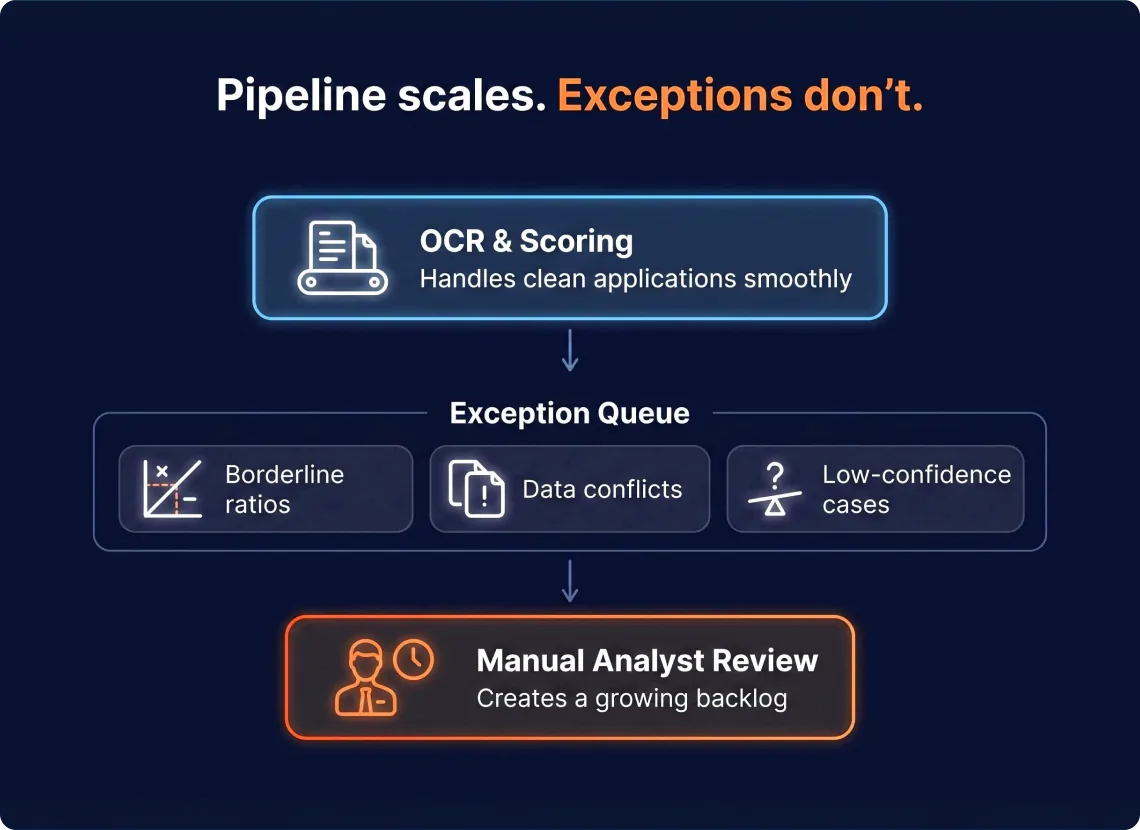
The lender’s OCR pipeline and baseline scoring model handled clean, straightforward applications well. What they routed around was everything else: borderline financial ratios, inconsistent or conflicting document data, and applicants whose risk profile didn’t fit the model’s confident range. Those exceptions still landed on an analyst’s desk for manual review — building the credit memo, weighing the judgment calls the model couldn’t make, and checking the file against underwriting policy by hand.
The existing scoring model had been tuned for the lender’s historical portfolio, and as the company expanded into new borrower segments, more applications required manual assessment despite passing through the automated pipeline. That approach held up when a few hundred exceptions a week reached the credit team. As weekly application volume climbed toward 2,500, so did the exception queue, and each of those files still took an analyst one to three hours to work through. Even with shared underwriting policies in place, two analysts reviewing similar borderline cases could still reach different risk conclusions.
SLAs started slipping, the backlog of unresolved applications grew faster than the team could clear it, and the lender was hiring more analysts just to hold response times steady. Applicants who used to hear back within days were now waiting long enough to start applying with competing lenders instead, and management needed to close that gap without adding more headcount or handing the final credit decision to a machine.
Five Connected AI Agents Running the Credit Scoring Pipeline
GroupBWT built a system of five specialized AI agents on top of the lender’s existing loan origination system and OCR pipeline, picking up exactly where the baseline automation left off — the exception queue — and routing every output back to a human credit analyst before a decision is made.
Document Processing Agent. For applications the existing OCR pipeline flagged as inconsistent or incomplete — conflicting figures across a financial statement and bank statement, non-standard tax filing formats, partially scanned documents — this agent re-extracted and cross-checked the structured data instead of an analyst reconciling the discrepancy by hand.
Financial Analysis Agent. Recalculated the core financial ratios from the reconciled data and assessed liquidity, profitability, debt load, and cash flow for each flagged applicant, replacing the manual spreadsheet work an analyst used to repeat for every exception file.
Risk Scoring, Policy Checks, and the Analyst Summary
Risk Assessment Agent. For applicants the baseline scoring model couldn’t confidently resolve, this agent reviewed credit history alongside the reconciled financial analysis and produced a refined risk score using the lender’s existing underwriting framework, with the reasoning behind it laid out for the analyst — a recommendation for review, not a final rating.
Credit Policy Agent. Validated each flagged application against the lender’s internal credit policies and surfaced missing documents or inconsistencies before the file reached an analyst, catching gaps that used to surface only once an analyst was already deep into manual review.
Credit Summary Agent. Assembled the credit memo for the analyst — the key risk factors behind the score, the policy check results, and a recommended approval, decline, or further review — turning four agents’ output into one document an analyst could act on directly instead of building that memo by hand.
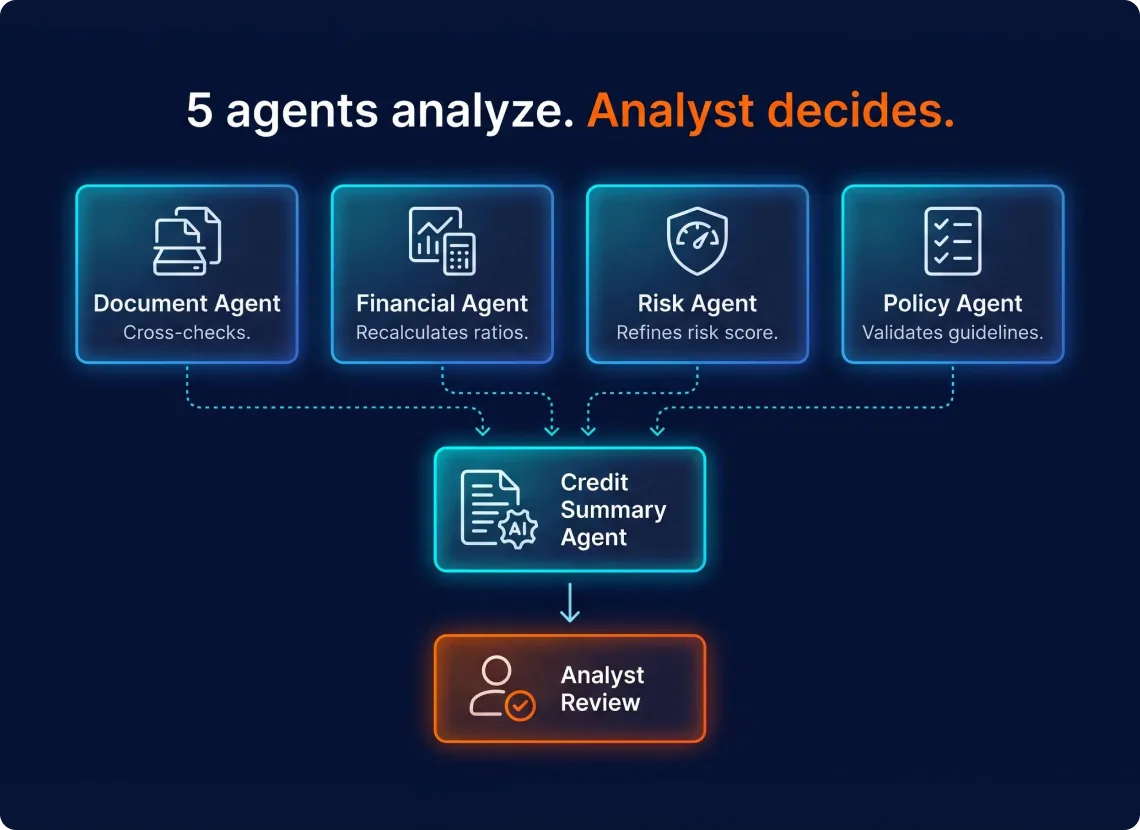
We deliberately kept the final credit decision outside the agent workflow. The agents extract data, run financial analysis, surface risk factors, and check credit policies, but the analyst sees the reasoning and makes the final call.

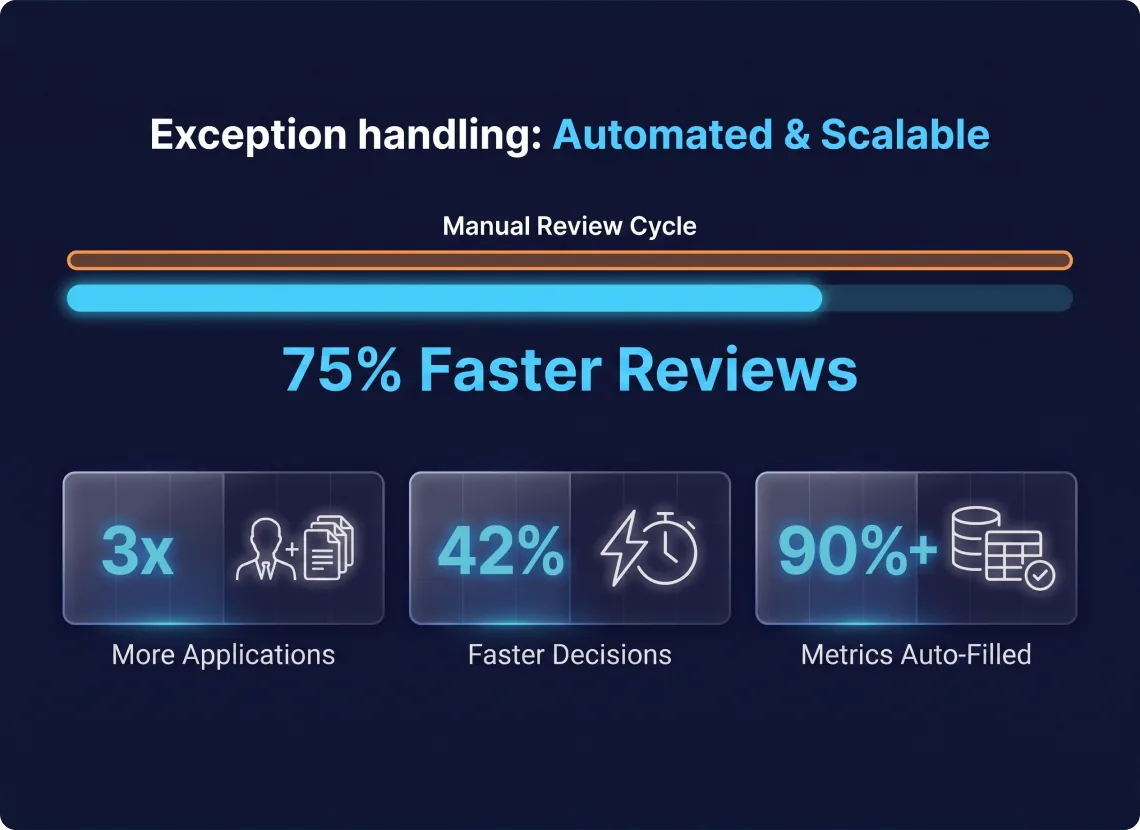
Up to 75% Faster Loan Application Review
- By reconciling flagged documents and recalculating financial ratios automatically, GroupBWT cut review time on exception applications by up to 75%.
- With agents handling document reconciliation and refined risk scoring on the exception queue, one analyst could work through up to 3x as many flagged applications as before.
- By generating the credit memo the same day instead of after a manual review cycle, GroupBWT helped clients receive preliminary decisions 42% faster.
- The Financial Analysis Agent auto-populated more than 90% of financial metrics on flagged applications directly from reconciled data, cutting manual data entry.
- Standardizing exception handling and policy checks across every flagged application cut inconsistent calculations, missing fields, and document mismatches that used to slip through manual review.
Looking to Cut Loan Application Review Time Like This?
We build AI agents that read financial documents and score credit risk inside your existing workflow, so analysts approve more qualified borrowers without losing final say.



You have an idea?
We handle all the rest.
How can we help you?