CLIENT STORY
GroupBWT is a data engineering company with a classic services structure — sales, delivery, project management, marketing, HR, recruiting. Every team had the information it needed, but it was fragmented across systems and people, each working in isolation. GroupBWT connected that information into one shared context layer, then built role-specific AI agents on top and ran them across its own daily operations before offering the same path to clients.
| Service: | AI Implementation |
|---|---|
| Industry: | Professional Services |
| Region: | EU, USA |
Read summarized version with


“In Slack you go back and forth, in Jira you open a ticket, and there's also the CRM — but we never had one system that pulled all these threads into one place.” — Delivery Team Member, GroupBWT
“Even the most expensive expert wouldn't carry that much campaign context in their head. A person simply can't hold that much.” — Sales Team Member, GroupBWT
The Challenge: Data Everywhere, No Shared Context
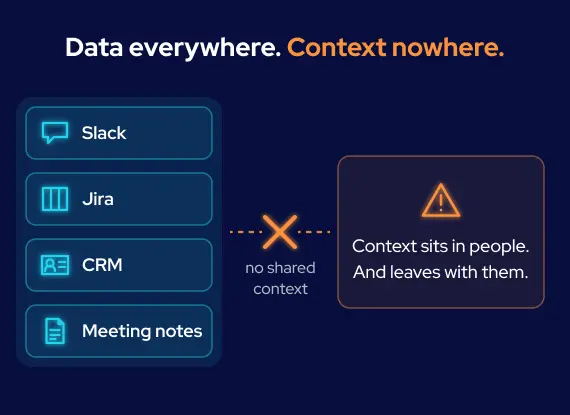
GroupBWT’s teams already worked across Slack, Jira, Confluence, a CRM, financial records, and meeting transcripts — but none of them talked to each other. Across outreach, pipeline reviews, and meeting preparation, staff kept hitting the same wall. The context they needed sat with different people and in different systems; no expert could keep all of it in their head. Matching senior-level work therefore required either a costly technical specialist, a senior salesperson, or enough time for a new hire to learn the same context.
A general chatbot could not solve this. Longer conversations dropped earlier details, while generic assistants returned polished answers without reliably pulling the project context held across GroupBWT’s systems. Expertise varied from person to person, with no shared memory. More than once, confidential information also reached outside AI tools through ad hoc use that GroupBWT could neither control nor see centrally. When someone left, whatever they knew about a project left with them.
A Shared Context Layer With Role-Specific Agents on Top
GroupBWT built a shared context layer and role-specific AI agents on its own data, using its daily operations as the proving ground for clients. Externally, GroupBWT delivers that same approach as an AI implementation: connecting the required company context, building purpose-specific agents, and integrating them into the workflows they support. Depending on readiness, the engagement may begin with an assessment or proof of concept.
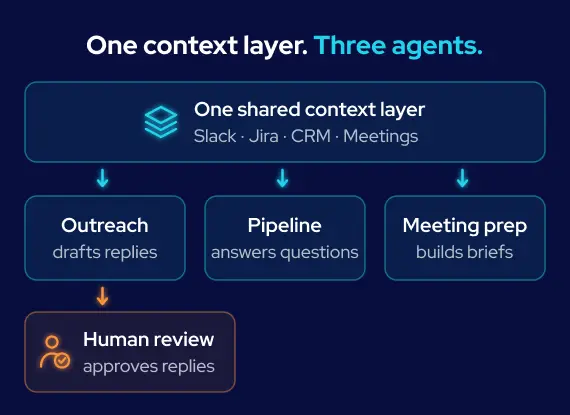
Data layer. GroupBWT synced Slack, Jira, Confluence, CRM, project data, and meeting transcripts into one context store powering its AI Agent Platform. Staff now query that data through the platform’s agents instead of copying it into consumer AI tools on their own — the uncontrolled use that had put data at risk.
Agents, not one chat. GroupBWT split the work across three role-specific agents. One drafts outreach replies from CRM and meeting context; another answers funnel questions on request; the third builds meeting briefs from account and project history.
Scoped context. The task sets the boundary. An agent may draw on one message, a full thread, project history, portfolio-wide information, or live campaign data.
The platform is still evolving: contracts and some PM workflows aren’t yet connected and remain manual. Outreach replies still go through a person. Letting the platform send them automatically is planned, but not live.
Slack, Jira, Confluence, CRM
The value of an AI system isn't the model — it's the context it holds. So instead of one universal assistant, we built specialized agents per role: narrower scope means fewer chances to get something wrong.

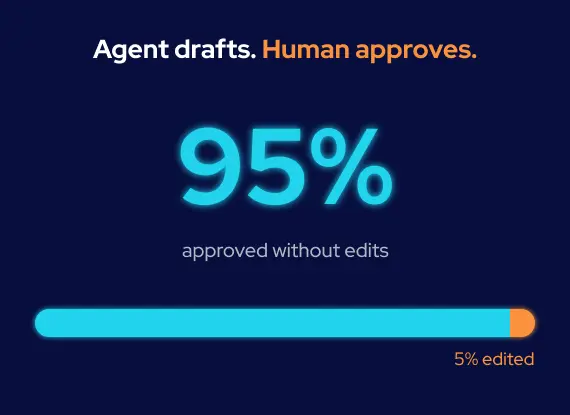
95% of AI-Drafted Outreach Replies Are Approved Without Edits
- GroupBWT’s outreach agent drafts every campaign reply for a person to review before send; the team accepts 95% of those drafts without an edit.
- By giving the outreach agent full campaign context, GroupBWT got a new outreach hire — three months into an IT career — running campaigns at a pace the team rates on par with its top salesperson.
- GroupBWT replaced its mandatory weekly funnel review meeting with on-demand Q&A once the funnel agent could answer the same pipeline questions on request.
- GroupBWT’s meeting-prep agent replaced manual research with a brief assembled automatically from account, project, and conversation history.
Ready to Put AI Agents to Work on Company Data?
We used this same implementation approach on our own operations first. If your team runs on disconnected systems, we can assess where you stand and scope a pilot.



You have an idea?
We handle all the rest.
How can we help you?