Read summarized version with


The demo usually looks cleaner than the future system. A team points a language model at five friendly documents. Three safe questions come back with polished answers, and the room relaxes. Then a real user asks about a stale policy. Someone else has a permission level the index forgot. A security reviewer wants to know which source produced the answer. The pilot stops looking like a product and starts looking like an unmanaged data surface.
That gap — polished pilot on one side, governed daily system on the other — is the actual work.
Build the Data Foundation
We develop and manage custom data solutions, powered by proven experts, to ensure the fastest delivery of structured data from sources of any size and complexity.
An enterprise-ready GenAI solution is not a model on its own. Think of it as a stack with five working parts: the model, retrieval over company knowledge, orchestration for multi-step work, integration into business systems, and governance that proves every answer. If one layer is missing, the demo may still answer. The production system will not survive traffic, audits, or angry edge cases. GroupBWT usually spends the heaviest part of GenAI delivery below the model, where the source systems, permissions, integrations, and controls live. That is where most pilots quietly lose momentum.
Read this as a production map. Start with the failure modes. Then check the stack, the data layer, the security controls, the operating model, the build-versus-buy decision, and the provider questions that matter before a pilot turns into another demo.
Key Takeaways
- Enterprise-ready generative AI solutions are systems, not standalone models.
- Data quality, permissions, integration, and governance usually decide whether a PoC reaches production.
- Production architecture needs model, retrieval, orchestration, integration, and governance layers.
- RAG needs governed sources, metadata, lineage, access controls, and retrieval testing.
- Most enterprises should buy the foundation model, then customize the data, retrieval, integration, and governance layers.
- A production pilot needs measurable business value, human escalation, monitoring, and an accountable owner.
What Are Enterprise-Ready Generative AI Solutions?
An enterprise-ready generative AI solution has to answer a blunt question: can this run every day in front of customers, regulators, and staff without someone babysitting the output? A consumer chatbot can be charming and wrong. A bank, a hospital, or a global manufacturer gets a shorter leash.
How Enterprise GenAI Differs From Basic AI Tools
Basic tools answer prompts. Enterprise systems answer while carrying constraints: who may see the data, which record the answer came from, what happens when confidence drops, and whether the workflow still holds when usage jumps from a pilot group to a full department.
Why “Enterprise-Ready” Means More Than Model Accuracy
Test-set accuracy covers the questions the pilot team imagined. Production finds the ones nobody wrote down: a misread contract, a stale retrieval index, a permission gap that leaks salary data into a sales answer. “Right more often” is not enough. The system has to stay safe when it is wrong.
Core Components of Production-Ready Generative AI
GroupBWT treats the five layers as one delivery surface: model access, retrieval over company knowledge, orchestration for multi-step work, integration into CRM, ERP, BI, and helpdesk, and governance for permissions, audit logs, and human review. Miss one and the demo can still impress the room. Production will not hold, and enterprise ready generative AI solutions stay out of reach. The plumbing starts with our AI-ready data solutions company work. Once the layers are tied together, the system can serve customers, auditors, and ten thousand employees without relying on a human to catch every bad answer.
Why Many Generative AI PoCs Fail Before Production
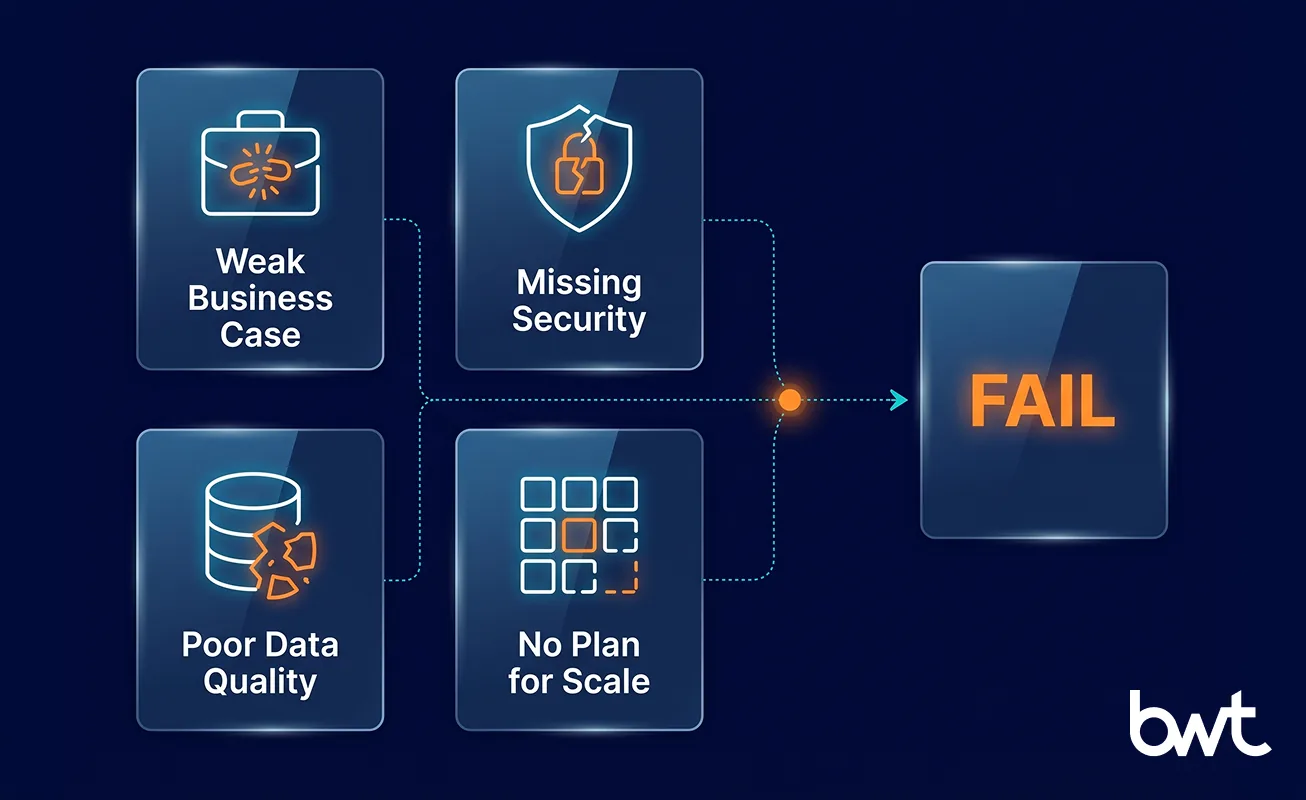
Weak models rarely kill a pilot. A missing organization around the model does. Four failure modes cover most stalled enterprise GenAI projects.
A weak business case comes first: a pilot that shows what’s possible but names no number to move can’t justify a budget.
Poor data quality and fragmented knowledge sources are the most common causes. When knowledge lives in PDFs, an ERP, and three people’s heads, the model answers confidently and wrong — in a regulated setting, worse than no answer at all.
Missing security and access controls is third: without role-based permissions the first security review stops the project.
No plan for scale, monitoring, or updates is the fourth — even a good pilot decays within six to twelve months.
Also read: How to Build an AI Knowledge Assistant for Internal Q&A
The Enterprise GenAI Architecture Behind Reliable AI Solutions
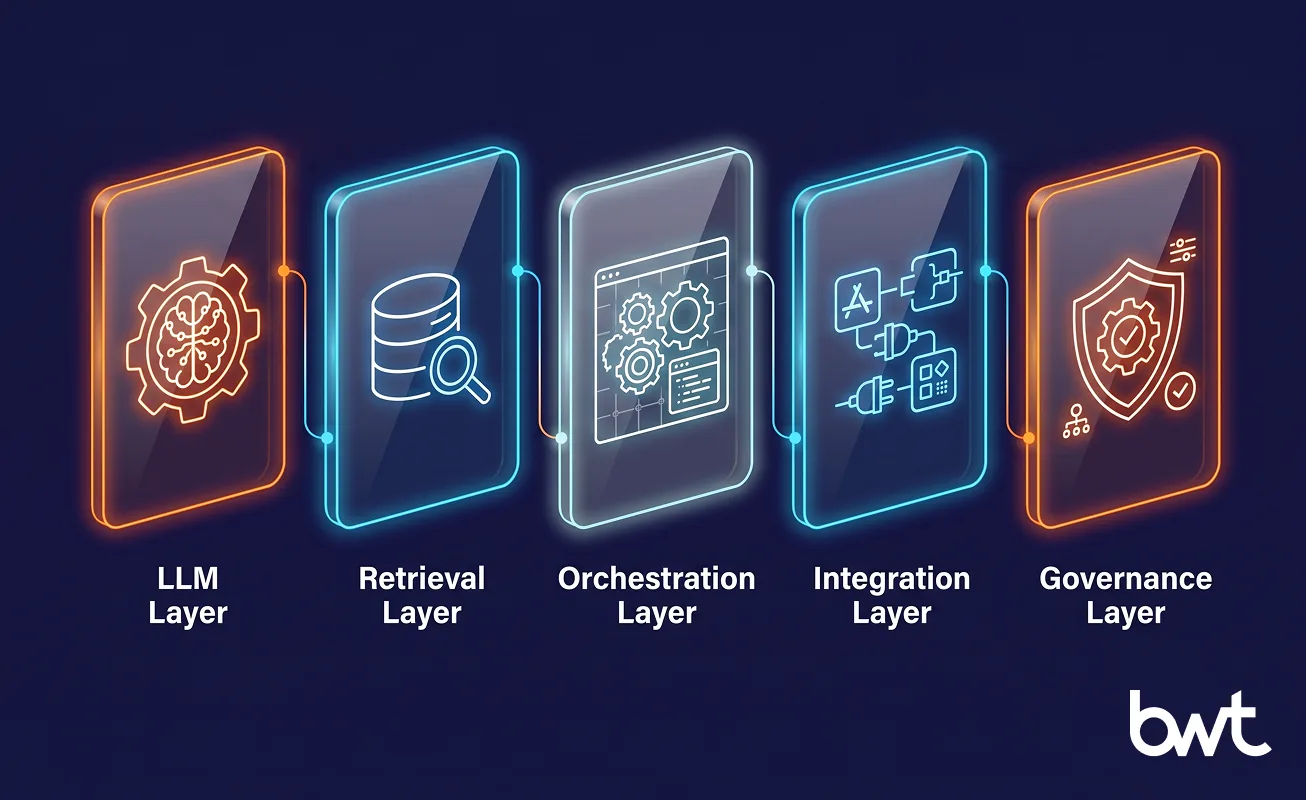
Architecture earns the word only if the team can draw the failure paths, not just the happy path. In GenAI enterprise solutions, five layers carry most of that load.
PoC vs Production-Ready Generative AI
| Area | GenAI PoC | Production-ready GenAI |
| Data | Small curated dataset | Governed enterprise sources |
| Retrieval | Basic vector search | Versioned, permission-aware retrieval |
| Users | Internal test group | Employees, customers, partners |
| Security | Basic API controls | RBAC, audit logs, privacy controls |
| Evaluation | Handpicked questions | Continuous evals on real traffic |
| Integration | Read-only demo | Safe reads and writes into core systems |
| Failure handling | Error reaches user | Fallback, escalation, human review |
| Monitoring | Limited | Quality, latency, cost, drift, incidents |
| Ownership | Pilot team | Named product, policy, and technical owners |
That is the board-level cut. Engineering still needs the layer map underneath it.
| Layer | What it does | Production requirement |
| LLM | Generates and reasons over content | Model gateway, fallback, version control |
| Retrieval | Grounds answers in enterprise knowledge | Versioned index, citations, access-aware retrieval |
| Orchestration | Runs workflows, tools, and agents | Approval steps, retries, state management |
| Integration | Reads from and writes to business systems | Authorization, idempotency, rollback |
| Governance | Controls and documents system behavior | RBAC, audit logs, escalation, human review |
LLM Layer: Public, Private, and Fine-Tuned Models
Model choice should follow the use case. Public models work for low-risk productivity. Private or fine-tuned models make sense when domain language, data residency, or policy pressure changes the risk. Fine-tuning can teach tone, format, and vocabulary, but it does not replace retrieval. It cannot keep answers current as policies change, and it cannot enforce access control. RAG plus permissions still does the work of showing where an answer came from and who was allowed to see it. A multi-model gateway does not remove vendor risk; it gives the team a managed fallback when one provider slows down, changes pricing, or goes offline.
Retrieval Layer: RAG, Vector Databases, and Knowledge Bases
Every chunk in the index needs a source document, version, owner, date, and access label. Weak retrieval produces confident guesses. Strong retrieval cites itself and refuses sources the user cannot open.
Orchestration Layer: Workflows, Agents, and Tool Calling
Orchestration is where the assistant stops answering and starts acting. A safe workflow has approval points, retries, state, and a record of every tool call. Without those controls, an agent can create duplicate tickets, trigger the wrong workflow, or keep retrying a bad action until it becomes an incident.
Integration Layer: CRM, ERP, BI, Helpdesk, and Internal Systems
Every write needs three guarantees: authorization, idempotency, and rollback. Authorization checks whether the user can make the change. Idempotency makes a repeated action safe, so the same request creates one ticket, not two. Rollback gives the team a way to undo a bad write. That is what lets an assistant update a CRM or open a helpdesk ticket without leaving a mess behind. GroupBWT treats this as integration engineering, not prompt engineering, because the model API is rarely the hard part.
Governance Layer: Permissions, Audit Logs, and Policy Controls
Governance needs simple mechanics before it needs a policy deck: role-based permissions, audit logs that tie each output to a user and decision, and status codes that route failed or uncertain answers to people.
"The fastest way to tell a GenAI pilot from a production system is to ask what happens when the model is wrong. In a pilot, the bad answer just goes out. In the systems we ship, every output is a labeled state with an audit log behind it, so a wrong or low-confidence answer routes to a person instead of a customer. We stopped hiding errors in code years ago; you cannot govern a failure the system quietly swallowed." — Dmytro Naumenko, CTO at GroupBWT
Put simply: the system tags each answer as good, uncertain, or failed. Only the good ones reach a customer on their own.
Production Requirements Enterprise GenAI Teams Often Miss
Security and governance will not save a system that times out, burns budget, or has no fallback when a model vendor is down. These requirements belong beside the feature backlog, not in a later operations document:
- Latency and throughput. Set a response-time target and peak request volume for each workflow. A claims-review assistant and an internal search box do not need the same service level.
- Cost per request and usage controls. Track token, API, retrieval, and orchestration cost per task. Put caps on loops, retries, and expensive prompts before a user can trigger them at scale.
- Availability and multi-model fallback. Decide what happens during a model outage, vendor rate limit, or slow retrieval. Fallback reduces incident impact, but the team still needs a service-level objective.
- Model, retrieval, and workflow observability. Log prompt version, model version, retrieved sources, latency, cost, acceptance, escalation, and failure reason. If the answer changes, the team should know which layer changed first.
- Incident response and disaster recovery. Name who triages bad outputs, data exposure, retrieval drift, and failed writes. Keep rollback and recovery runbooks close to the system, not buried in a shared drive.
- Versioning and change management. Treat models, prompts, indexes, policies, and integrations as release artifacts. Run evals before rollout, and keep the old version available until the new one clears real questions.
Data Foundations for Enterprise-Ready Generative AI
If one idea survives this article: the model is not the bottleneck, the data layer is. That is why our data engineering work, not model selection, is where an enterprise build usually stands or falls.
Why AI-Ready Data Matters More Than the Model
A brilliant model on ungoverned data gives fast, confident, unverifiable answers people believe. For a US agricultural cooperative, we couldn’t deploy any GenAI use case until that layer existed. So we built it first: 6,000-plus legacy tables migrated from plant databases and SAP into a governed lakehouse, plus a departing architect’s knowledge captured before it walked out the door. Only then could the GenAI queries the cooperative wanted actually run. The full list of what that foundation has to look like is in our data observability for AI readiness post.
"’AI-ready data’ isn’t a slogan, it’s a checklist you can fail: modeled schema, lineage from source to the retrieval index, metadata, access policies. When a GenAI project stalls, it’s almost never the model. It’s that nobody can say where an answer came from or who was allowed to see it. We spend roughly four-fifths of an engagement on that before the model earns its keep." — Alex Yudin, Head of Data Engineering at GroupBWT
How to Prepare Enterprise Knowledge for RAG Systems
Retrieval-augmented generation (RAG) lets a model answer from your documents instead of its training data. You don’t dump files at it — you prepare them in order:
- Inventory sources and decide which is authoritative when two disagree.
- Clean and chunk documents so a query returns a coherent passage rather than half a table.
- Tag every chunk with owner, date, access level, and locale.
- Build the vector index with lineage back to the original file.
- Test retrieval on a real question set before any user sees it.
Data Quality, Metadata, and Lineage for GenAI
Lineage turns a chatbot answer into a defensible one: name the document, version, and date, and a compliance officer can sign off; without it, every answer is a liability. It is the same discipline behind a sound enterprise data warehouse architectures approach; GenAI just raises the stakes.
Handling Structured, Unstructured, and Sensitive Data
Structured and unstructured data want different handling; sensitive data wants a wall. Split knowledge into access-scoped stores, and check permissions before retrieval runs — never after.
Security and Compliance Requirements for Enterprise GenAI Solutions
Security is where enterprise GenAI meets the people who can veto it. Four controls are non-negotiable.
Role-based access control comes first: the model inherits the asker’s permissions, so it never returns a document they couldn’t open.
Data privacy keeps sensitive records in gated stores with every access logged by user, record, and decision.
Prompt injection and data leakage are not hypothetical. A user can bury instructions inside a document to hijack the model — and the OWASP Top 10 for Large Language Model Applications ranks prompt injection the number-one LLM risk. Production needs input and output filtering built for exactly that.
Audit trails tie it together. For a major US healthcare provider under strict data-compliance rules, we replaced hidden errors with a system that turns every failure into an explicit, logged state instead of silently swallowing it. That change caught two silent failures before the deadline and shipped the full patient-profile dataset on time. The same discipline runs under the governed NLP system that cut fraud-review time by 61% for a banking client. The model ranks. The log proves. The human signs.
Generative AI Governance: How Enterprises Control Risk at Scale
Evals are not governance. A passing test suite proves behavior on the test set and nothing past it; governance is the loop around the model. Teams that confuse the two ship a pilot that passes, then watch it surprise everyone in production.
AI usage policies and approval workflows set who can deploy a use case and what review it clears.
Human-in-the-loop review handles high-risk outputs. For a UK public-sector procurement programme and a US legal IP-enforcement firm, we scoped the GenAI to rank and cite candidate matches, never to decide. That scaled review volume without ever putting legal judgement on a model.
Model evaluation runs on real traffic, with a named owner for evals and policy, not a side project.
Responsible-AI principles carry further when auditors already recognize the words. The NIST AI Risk Management Framework gives them four: Govern, Map, Measure, and Manage.
Enterprise Generative AI Use Cases That Are Ready for Production
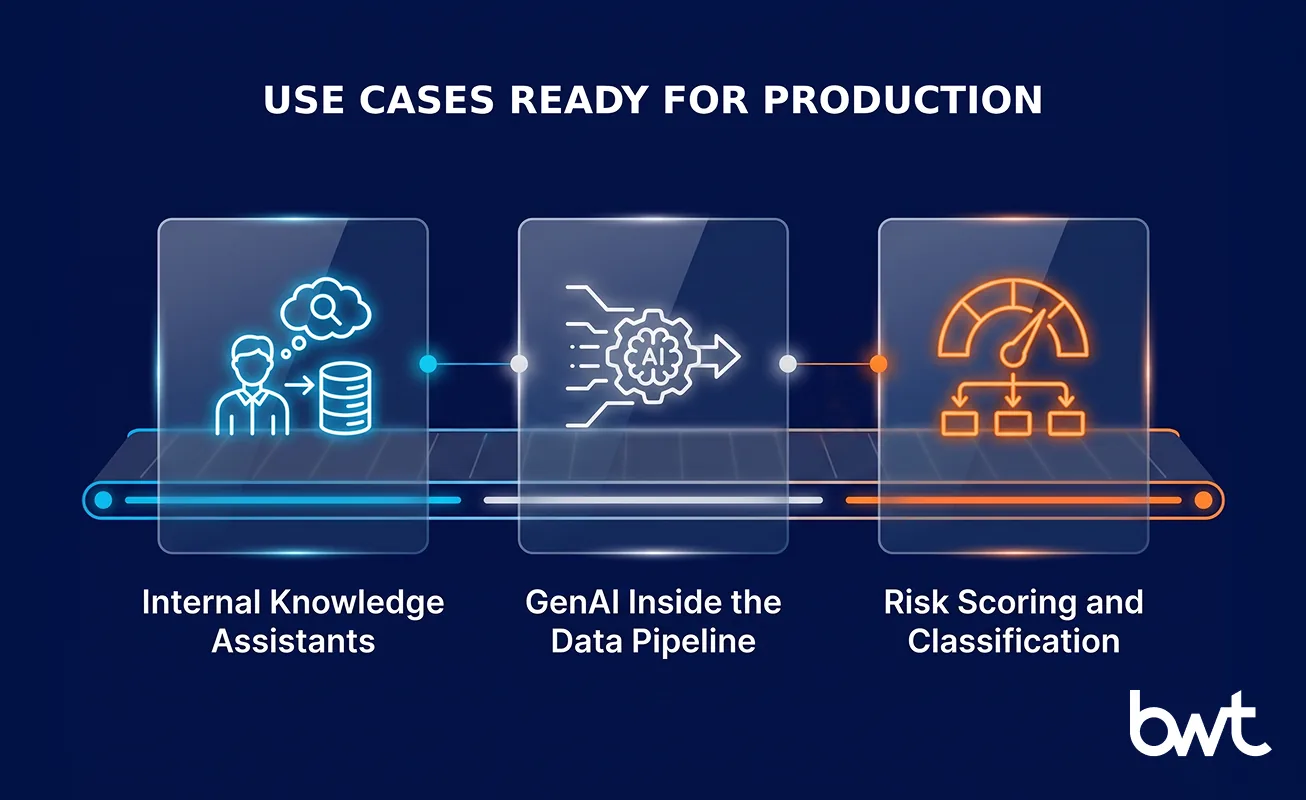
Not every GenAI idea is production-ready. These three are, because the failure mode is contained and the value is measurable.
Internal knowledge assistants. A model answers staff questions from governed documents, with citations and access control. Take a large European beauty and personal-care manufacturer whose product and regulatory knowledge was scattered across PDFs, an ERP, and supplier docs — staff wasted hours chasing the current version of a spec, and sometimes acted on an outdated one. We built a RAG document assistant that answers from the approved source and cites it, validated as an internal pilot first to prove answer quality before anyone customer-facing saw it.
GenAI inside the data pipeline. Sometimes the model is one narrow component, not the product. For a Tier-1 Asian e-commerce platform, we embedded a small model only where rule-based logic kept failing: classifying products and recovering blocked requests. By our delivery numbers, that scaled the pipeline into the high hundreds of thousands of products a day over 14 months, holding a sub-60-second target. The lesson is placement, not the raw count. Use a small model only where the rules break, and let deterministic code handle the rest.
Risk scoring and classification. A cybersecurity identity-verification platform needed faster, broader risk decisions than rule-only review allowed: rules caught the obvious cases, missed the novel ones, and every threshold change meant another engineering cycle. GroupBWT built classification and scoring with a continuous evaluation harness and a threshold gateway, so the model reached production with measurable error bounds, and the team could move the threshold without a rewrite.
Not sure which use case is ready for your data? A GenAI production-readiness assessment is a short, fixed-scope engagement: we map your knowledge sources, access constraints, and integration points, then hand back a written readiness map — which use cases to ship first, which to wait on, which to skip, and what your data layer is missing before any of them can run. It is where our artificial intelligence (AI) consulting services work usually starts.
Enterprise GenAI Production Readiness Checklist
Use this checklist before expanding a pilot beyond the first controlled audience:
- The use case has a measurable business KPI.
- Authoritative knowledge sources are identified.
- Data ownership and access rules are documented.
- Retrieval returns sources and versions.
- Sensitive data is separated and protected.
- High-risk actions require approval.
- Every write operation supports authorization and rollback.
- Evaluation uses real user questions.
- Low-confidence outputs have a fallback route.
- Quality, latency, cost, and incidents are monitored.
- A named owner is responsible after launch.
Custom vs Off-the-Shelf Generative AI Solutions
This is the decision most enterprises get wrong both ways: building what they could buy, and buying what they needed to build.
| Dimension | Off-the-shelf | Custom | Hybrid |
| Time to value | Fastest | Slowest | Fast for commodity components |
| Data control | Limited to platform controls | Full | Full where customization matters |
| Workflow fit | Standardized | Exact | Custom for critical workflows |
| Best for | Generic productivity | Regulated or integration-heavy use cases | Most enterprise implementations |
When Enterprise Teams Should Use Existing GenAI Platforms
For generic productivity, under ten thousand users, no regulated data, and no custom retrieval, an off-the-shelf platform wins on cost. Building your own there is wasted spend, and we’ll say so before you sign anything.
When Custom Generative AI Development Makes Sense
Custom earns its keep when answers must come from your governed knowledge, when regulated data can’t leave your control, or when it writes back into core systems. That is where custom generative AI development services pay for themselves.
Build vs Buy: Cost, Control, Security, and Scalability
In GroupBWT’s experience, custom development is harder to justify for a small, single-team productivity use case unless integration, security, control, or expected scale materially changes the economics. The more your answers depend on governed data, regulated constraints, and write-back into core systems, the stronger the custom case becomes. Where your own line sits moves with integration depth and regulatory load, so we scope it per project rather than quote a universal number.
"Clients call us to pick a model. We almost always find the real problem one layer down: the knowledge is scattered across PDFs and an ERP nobody has mapped in years. The model is the cheap, interchangeable part. If your data layer isn’t governed, buying a bigger model just makes wrong answers faster." — Oleg Boyko, CCO at GroupBWT
How Hybrid GenAI Solutions Combine Speed and Flexibility
Most enterprises land on hybrid: buy the commodity model, then build the retrieval, integration, and governance specific to you.
How to Build Enterprise-Ready GenAI Solutions Step by Step
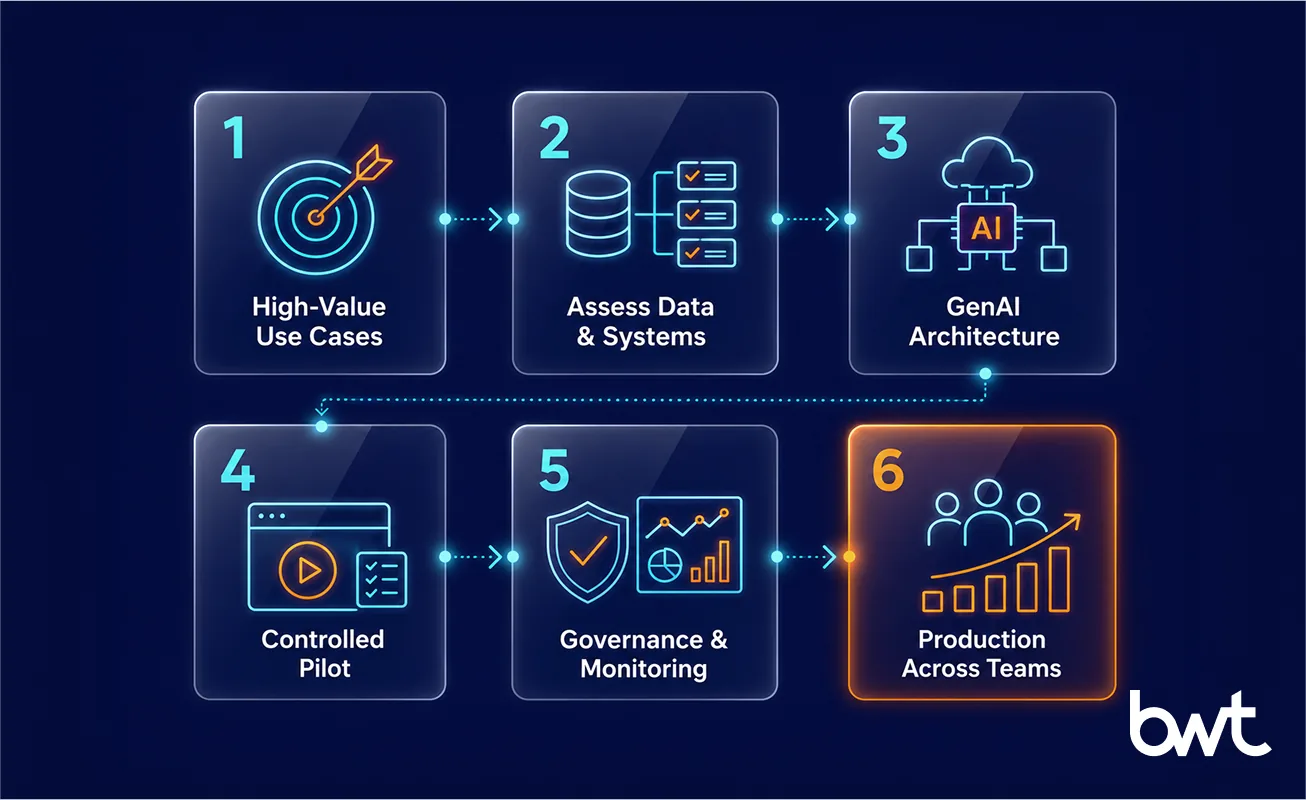
The route from PoC to production isn’t glamorous, but it repeats. The six steps below are the order we run them in.
Step 1 — Identify High-Value Business Use Cases
Start where a wrong or slow answer already costs money. One or two use cases — not ten.
Step 2 — Assess Data, Systems, and Security Constraints
Map the knowledge sources, integration points, and access rules before choosing a model. This step decides the timeline.
Step 3 — Design the GenAI Architecture and Integration Model
Lay out the five layers and decide build versus buy for each. Spell out every system you will read from and write to.
Step 4 — Build a Controlled Pilot With Clear Success Metrics
Ship to a small, real audience with a number to move. Start internal where you can; it bounds the risk.
Step 5 — Add Governance, Monitoring, and Evals
Wire in permissions, audit logs, human review, and quality measurement on real traffic before you widen access.
Step 6 — Scale to Production Across Teams and Workflows
Roll out by workflow, keep an owner and an eval set per use case, and treat re-tuning as routine.
How to Measure the ROI of Enterprise Generative AI Solutions
Generative AI solutions for enterprises earn their budget on a few measurable lines, and the first return is almost always internal. Productivity is the clearest: an internal assistant that gives knowledge workers their minutes back pays for itself in 6 to 12 months. The honest metric is the no-edit rate — the share of the system’s drafts that reach a colleague, customer, or file without a human rewrite. On GroupBWT’s own internal multi-agent operating system, our usage analytics put that rate at roughly 95% after 30 months of iteration. Beyond that: deflected tickets, faster resolution, and risk reduction that is real money in regulated settings.
| Use case | Primary KPI | Supporting KPI |
| Knowledge assistant | Time saved per query | Answer acceptance or no-edit rate |
| Customer support | Ticket deflection | Resolution time, CSAT |
| Document generation | Cycle-time reduction | Human edit rate |
| Risk classification | Review time | False-positive and false-negative rates |
| AI agent | Completed workflow rate | Escalation and failure rate |
| Internal search | Successful retrieval rate | Citation accuracy |
How to Choose an Enterprise Generative AI Solution Provider
When you evaluate GenAI solutions for enterprises, set the model demo aside for a moment. Ask who owns the data-engineering work, because delivery risk usually hides there. Ask whether the provider can write safely into CRM, ERP, BI, and helpdesk systems, not just read from them. Ask how governance changes by industry. Ask who carries the system after the PoC. A provider that has kept production workflows running past year one — the way we carried that e-commerce pipeline under a single SLA — tells you more than a polished pilot. The warning sign is simple: they talk only about models and never about your data.
Turn those checks around and you get the mistakes that sink most enterprise programs:
- Building around a model instead of a workflow. The workflow is the product; the model is the swappable part.
- Ignoring data ownership and access permissions. Skip it and the security review ends the project for you.
- Launching without monitoring and evaluation. What you can’t measure, you can’t trust, and quality drifts silently.
- Over-automating work that still needs human review. For smaller teams and simple workflows, agentic orchestration can add more operational complexity than value. Start with deterministic automation and introduce agents only where multi-step reasoning is necessary.
- Treating GenAI as a one-time project. Without a re-training and monitoring cadence, programs quietly decay.

The Future of Enterprise-Ready Generative AI Solutions
Two shifts are worth budgeting for now. Assistants that only answer are giving way to agents that act, and an agent that takes actions needs tighter permissions, approval, and audit than one that only talks. In regulated settings, private domain-tuned models keep gaining ground, trading API spend for ops headcount. The deeper shift is cultural. Continuous evaluation on live traffic turns into a standing engineering practice rather than a launch-day test — and the teams that make that switch are the ones still running working systems a year later.
Final Thoughts: Architecture, Data, and Governance Decide Enterprise GenAI Success
What turns a demo into a system you can run is the unglamorous work underneath it — a governed data foundation, an architecture that holds under load, integrations that write safely, governance that proves every answer. Get those right, and swapping the model is a routine change rather than a rebuild.
Have a pilot that impressed the room and then stalled? Pick the one use case where a wrong or late answer costs the most, and start there with a GenAI production-readiness assessment. That is the fastest honest way to find what’s actually blocking you.
It stays safe when it is wrong, not just accurate when it is right. That takes grounded retrieval with citations, role-based access so it only surfaces data the user can see, monitoring and evaluation on real traffic, and a route that sends low-confidence or high-risk outputs to a human. Test-set accuracy is table stakes — production breaks on the questions the test never asked.
AI-ready data. That means a modeled schema, lineage from each source to the retrieval index, metadata such as owner and access level, and clear access policies. Organized that way, the system can prove where an answer came from and confirm the user was allowed to see it. In most stalled projects the model was fine — the data layer simply didn’t exist yet.
Start with role-based access control, so the model inherits the asking user’s permissions and never returns a document that user couldn’t open. Add audit logging by user, record, and decision, plus defenses against prompt injection and data leakage, which OWASP ranks as the top LLM risk. Sensitive data stays in gated stores, and high-risk outputs go to a person before they reach a customer.
Buy for generic productivity, smaller user counts, and non-regulated data, where an off-the-shelf platform wins on cost. Build when answers must come from your governed knowledge, when regulated data can’t leave your control, or when the system writes back into core systems; most enterprises end up hybrid. On timeline, a controlled pilot on existing data takes roughly 8 to 16 weeks, and a governed production rollout is a 6-to-12-month program, driven mostly by the state of your data layer. Anyone promising a four-week enterprise rollout is selling a demo.
Three kinds of providers do: model vendors and platforms, general system integrators, and data-engineering-led firms that treat the model as one layer among five. Data-engineering-led providers may be the strongest fit when the project depends on regulated data, custom retrieval, or complex integration with enterprise systems. That is where GroupBWT sits, with 15+ years on enterprise data and engineering across manufacturing, agriculture, regulated healthcare, beauty and CPG, e-commerce, government, and legal.
Read summarized version with
Build the Data Foundation
We develop and manage custom data solutions, powered by proven experts, to ensure the fastest delivery of structured data from sources of any size and complexity.