Read summarized version with


Search for the top data warehouse vendors 2026 and most results open with the same feature grid. We are writing this differently. Here, cloud warehouses, lakehouses, unified suites, enterprise ecosystems, and real-time OLAP engines get separate treatment. Each class earns its shortlist place on different terms.
The first enterprise screen usually leaves ten names on the board: Databricks, Snowflake, Google BigQuery, Amazon Redshift, Microsoft Fabric, Oracle Autonomous Data Warehouse, Teradata VantageCloud, ClickHouse Cloud, SAP Datasphere, and IBM Db2 Warehouse. No product wins by default. Workload shape, the cloud and applications already in place, governance pressure, and year three of the bill decide the useful shortlist.
Discussions of the top data warehouse vendors 2026/2027 routinely mix unlike categories. So we separate the categories before making comparisons.
Build a vendor shortlist around a real PoC
Before platform selection, we map the workloads, governance rules, migration dependencies, and cost drivers that the PoC must test.
Key Takeaways
- Put Databricks on the list when one foundation must carry data engineering, BI, machine learning, and AI.
- Snowflake suits cross-cloud analytics where governed sharing is a buying requirement. Workload design still determines whether credit use stays under control.
- BigQuery is the natural pick for Google Cloud teams; Redshift plays the same role for AWS estates.
- Fabric makes sense when Power BI and the Microsoft ecosystem already shape how the business consumes data.
- ClickHouse Cloud specializes in low-latency workloads. It does not automatically replace a finance or multidomain warehouse.
- An existing estate can keep SAP, Oracle, IBM, or Teradata in contention, especially when hybrid constraints or specialist skills carry more weight than cloud novelty.
- A proof of concept has to reproduce real workloads, concurrency, controls, and cost behavior — not isolated query speed.
What This Data Warehouse Vendor Comparison Includes
This guide covers enterprise platforms built to run warehouse-class analytical workloads. Data warehouse consulting firms, implementation partners, ETL vendors, and BI tools are outside that platform ranking.
GroupBWT sits separately as the implementation partner behind the evaluation method, not as an eleventh software vendor. Product descriptions rely on official documentation and public product material. Our practical lens comes from delivered data engineering and warehouse work, plus architecture and discovery engagements in which platform fit, dependencies, governance, and migration risk had to be made explicit before implementation.
We rarely treat implementation partners as interchangeable with the ten platforms above. Vendors ship engines; partners help an enterprise run a defensible selection, design governance, and execute migration without losing business measures along the way. We act as that partner, which is why this comparison is built around workload and governance rather than a vendor score.
Disclosure: GroupBWT holds partner relationships with Databricks and Snowflake. Those relationships do not decide the order or recommendations on this page.
Vendor Snapshot at a Glance
The table is a buying map, not a league table. Order does not imply rank.
| Platform | Core fit | Deployment and commercial model | Watch first |
| Databricks | Shared lakehouse for data engineering, BI, and AI | Multi-cloud; usage and compute based | Wider scope increases the governance load |
| Snowflake | Governed analytics and sharing across clouds | Multi-cloud SaaS; consumption credits | Query and compute controls shape the bill |
| Google BigQuery | Serverless analytics in Google Cloud | GCP; on-demand or capacity | Most direct fit inside the GCP ecosystem |
| Amazon Redshift | AWS-native data warehousing | AWS; provisioned or serverless | More architecture choices to manage |
| Microsoft Fabric | Power BI-centered unified analytics | Azure SaaS; capacity based | Shared capacity requires careful planning |
| Oracle Autonomous Data Warehouse | Analytics within Oracle cloud estates | Oracle Cloud; consumption or subscription | Wider hybrid options belong to the broader Oracle stack |
| Teradata VantageCloud | Large regulated enterprise estates | Cloud or hybrid; enterprise agreements | Specialist skills and commercial complexity |
| ClickHouse Cloud | Low-latency event and product analytics | Managed cloud service | A full EDW may need added governance components |
| SAP Datasphere / SAP Business Data Cloud | SAP-centric business data | SAP cloud; capacity based | Less direct fit when SAP has little influence on the data model |
| IBM Db2 Warehouse | IBM-centered or hybrid analytics estates | Cloud, software, or appliance options | Smaller modern cloud mindshare |
Workload shape changes which products qualify as the best data warehouse vendors for scalability. A finance warehouse, a customer-facing event product, and an AI retrieval layer may share SQL and columnar storage. Their latency, concurrency, access, and support demands do not match. That distinction matters in any cloud data warehouse comparison.
How We Selected and Compared the Vendors
The selection method favors decision usefulness over a synthetic score. We included platforms with enterprise market relevance and a credible role in warehouse-class analytics, then compared architecture, deployment, workload fit, data engineering, BI and AI support, governance, ecosystem fit, migration effort, and cost model.
Evidence and Sources
Product capabilities come from official vendor documentation and public product pages. Our delivery material is used only where it demonstrates a relevant implementation constraint. Architecture and discovery work is described as such, never promoted into a completed migration or platform deployment.
Editorial Disclosure
Partner status does not add points, alter order, or soften limitations. Vendor profiles use the same editorial test: where the product is a credible candidate, and which condition could remove it from the shortlist.
Limitations
Do not read this guide as an independent benchmark, a price quote, or a procurement recommendation. We verified product information in August 2026. Capabilities and commercial terms can still change. Before selecting a platform, confirm its edition, region, contract, support, and roadmap details with the vendor.
Data Warehouse Vendor Evaluation Criteria
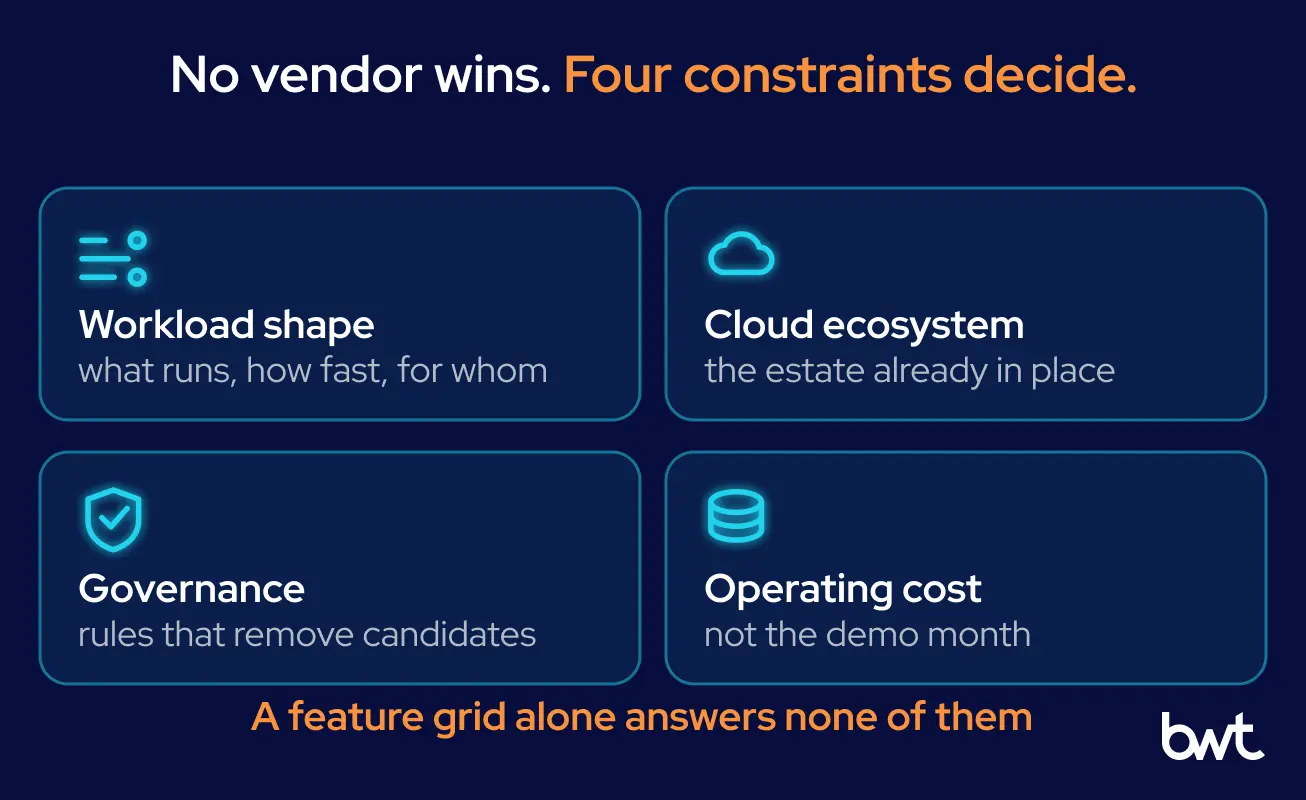
A defensible data warehouse vendor selection starts with operating constraints. An enterprise data warehouse platform must fit the surrounding estate as well as the queries run during a proof of concept.
Architecture and Deployment
Compare storage-compute separation, serverless or provisioned operation, cloud and hybrid options, lakehouse fit, and open table formats. The warehouse vs lakehouse decision tests whether engineering, BI, and AI workloads genuinely need one operating foundation. Serverless products reduce cluster administration, not workload design. A lakehouse may cut handoffs across engineering, BI, and AI. It also gives owners a wider governance surface.
Performance and Workload Behavior
One fast query tells you almost nothing. Do not benchmark these conditions separately. Build one test that forces the hard conditions to meet: concurrent users, workload isolation, autoscaling, batch jobs, interactive queries, large joins, and refresh peaks. In the PoC, let dashboards compete with pipelines, notebooks, and models. Production will. Watch who carries the tuning responsibility at the same time.
Ecosystem and Migration
The engine is only one part of the decision. The surrounding work comes from cloud services, ETL/ELT tools, APIs, BI products, catalogs, identity, and data-sharing patterns. A low engine rate means little if the migration also requires rebuilt integrations, rewritten SQL, staff training, and two systems running through cutover.
BI, Data Engineering, and AI
SQL reporting is only one workload. Buyers often need notebooks, machine-learning preparation, model training, vector search, event analytics, or governed semantic models. Give AI and machine learning analytics a separate workload class. They need their own access rules, latency budgets, serving paths, and controls.
Security, Governance, and Portability
Set the security gate before anyone starts the pilot. Cover access controls, masking, audit logs, lineage, residency, encryption, private networking, and compliance evidence. Governance alone can knock candidates out of the running before any performance test. Open storage formats may loosen the bytes; proprietary SQL, orchestration, identity, and commercial terms still decide how hard it is to leave.
Platform and Consumption Models Compared
Four data warehouse platform shapes compete for the same budget while solving different problems. A category mismatch leaves you paying for unused capabilities.
| Shape | Distinctive strength | Workload that benefits | Products |
| Cloud warehouse | Governed SQL at enterprise scale | Shared reporting across business teams | Snowflake, BigQuery, Redshift |
| Lakehouse | One data layer across engineering, BI, and AI | Analytics spanning tables, files, and model inputs | Databricks |
| Unified analytics suite | Connected tools from ingestion through BI | Enterprises committed to one vendor ecosystem | Microsoft Fabric |
| Real-time OLAP | Fast analysis of incoming events | Product usage, telemetry, and event workloads | ClickHouse Cloud |
| Enterprise ecosystem | Existing application and hybrid estates | SAP-, Oracle-, IBM-, or Teradata-heavy environments | SAP, Oracle, IBM, Teradata |
The consumption question is separate from the shape question. A serverless data warehouse removes idle clusters but can magnify inefficient scans. Provisioned capacity makes resource boundaries visible while charging for underuse. Consumption-based pricing has to be modeled across a realistic operating period, not one demo month. Pilot the candidate on a real workload before the contract conversation starts.
Three consumption shapes recur in the field:
| Model | Works well when | Main risk | Pilot check |
| Serverless | Teams want less infrastructure work | Spend can hide in query behavior | Query mix, budgets, and guardrails |
| Provisioned | Teams need explicit resource control | Tuning and idle capacity remain internal | Queues, peaks, and idle cost |
| Managed capacity | Central IT funds a shared envelope | Workloads compete for purchased capacity | Burst behavior and allocation |
Also Read: Enterprise Data Warehouse Architecture & Strategy
Vendor Profiles
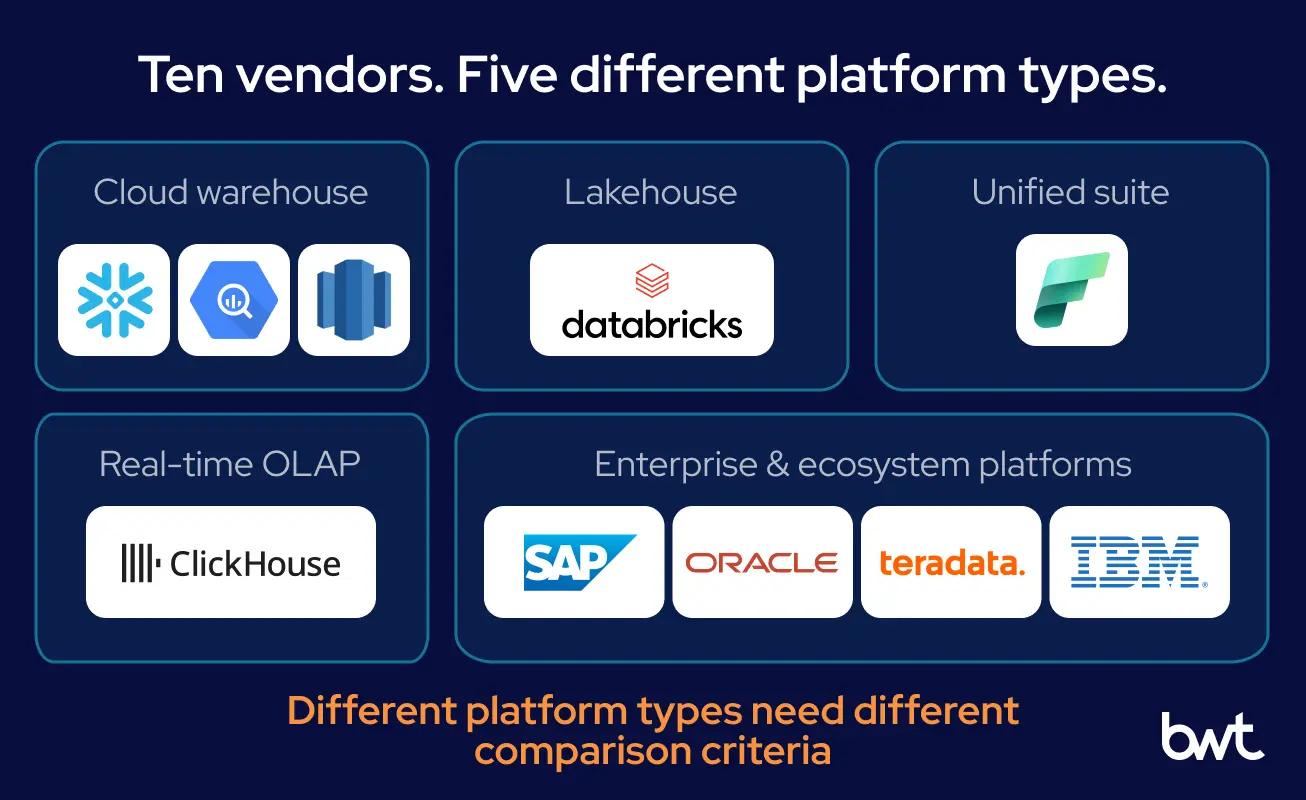
The ten platform profiles below follow the same decision fields. Pricing describes the commercial mechanism to test, not a quote; contract terms, editions, regions, and committed-use discounts still need vendor confirmation.
Databricks
Best fit: Teams that need data engineering, SQL analytics, machine learning, and AI on one operating foundation.
Pricing: Usage-based compute and platform consumption; model job clusters, SQL Warehouses, serverless services, storage, and data transfer separately.
Strengths: Delta Lake provides transactional tables, Unity Catalog centralizes permissions and lineage, SQL Warehouses serve BI, and Mosaic AI supports model and generative AI workflows.
Limitations: The breadth creates more ownership work across workspace design, catalogs, cluster policies, identity, cost controls, and serving boundaries.
When to consider an alternative: Choose a narrower warehouse when governed SQL reporting is the main workload and the organization would not use the engineering or AI surface. In a buyer-side discovery for a legacy relational analytics environment, we recommended Databricks because future document and AI workloads mattered alongside BI, but the engagement produced an architecture and migration blueprint rather than a completed implementation.
Snowflake
Best fit: Governed analytics, isolated workloads, controlled data sharing, and multi-cloud estates.
Pricing: Consumption credits for compute and services, plus storage and transfer; test ingestion, transformation, development, recovery, dashboard peaks, and ad hoc analysis as separate cost drivers.
Strengths: Virtual warehouses isolate compute workloads, controlled sharing supports cross-organization data use, and Snowpark extends work beyond SQL reporting.
Limitations: Credits make usage visible, not automatically controlled. Cost depends on who can create compute, how quickly it suspends, and which queries scan more data than expected.
When to consider an alternative: Prefer a cloud-native warehouse when most data and operations already sit in one hyperscaler and cross-cloud sharing does not justify another commercial and operating layer.
Google BigQuery
Best fit: Serverless analytics for teams whose identity, storage, data engineering, and machine-learning stack already runs on Google Cloud.
Pricing: On-demand query processing or committed capacity, with storage and data transfer modeled separately.
Strengths: Teams avoid cluster administration and can place streaming services and Vertex AI close to the warehouse.
Limitations: Repeated scans, dashboard concurrency, reservation design, and data transfer can make a simple-looking setup expensive.
When to consider an alternative: Compare other platforms when workloads sit across clouds, capacity planning needs tighter resource boundaries, or the surrounding estate has little dependence on GCP.
Amazon Redshift
Best fit: AWS-centered estates that already rely on S3, Glue, IAM, and related operating practices.
Pricing: Provisioned RA3 capacity or Redshift Serverless consumption, plus managed storage and data transfer.
Strengths: RA3 separates managed storage from compute, serverless adds another operating model, and supported Zero-ETL integrations can reduce custom extraction work.
Limitations: Teams still choose between provisioned and serverless patterns, manage workload queues, and model concurrency and lake access.
When to consider an alternative: Look beyond Redshift when AWS proximity does not reduce enough integration work or when multi-cloud sharing, mixed AI workloads, or second-level event analysis drives the decision. In one delivered assessment, we retained Redshift because moving the surrounding AWS estate would have added migration work without a clear workload benefit.
Microsoft Fabric
Best fit: Microsoft-centered organizations where Power BI already shapes reporting and fewer service boundaries would simplify ownership.
Pricing: Capacity-based billing shared across Fabric workloads; model pipelines, notebooks, warehouses, semantic models, and report refreshes within the purchased envelope.
Strengths: Fabric combines integration, engineering, warehousing, data science, real-time analytics, and Power BI over OneLake. Direct Lake lets Power BI semantic models read OneLake data without a separate imported copy.
Limitations: Shared capacity can turn unrelated workloads into competitors during peaks.
When to consider an alternative: Separate services may fit better when workloads need hard isolation. The same applies when Power BI and Azure have little influence on the estate.
Oracle Autonomous Data Warehouse
Best fit: Oracle Cloud becomes the practical boundary when the applications, databases, committed spend, and available skills already sit there.
Pricing: Consumption or subscription options in Oracle Cloud; verify the selected service, licensing, storage, network, and support terms.
Strengths: Automated tuning, scaling, patching, and security reduce routine database administration.
Limitations: Autonomous Data Warehouse is an Oracle Cloud service; broader hybrid choices sit elsewhere in Oracle’s portfolio.
When to consider an alternative: Compare other platforms when Oracle has little influence on the application estate or when hybrid deployment, cross-cloud operation, and non-Oracle skills outweigh the automation benefit.
Teradata VantageCloud
Best fit: Large, regulated analytical estates with mature Teradata SQL, workload management, specialist skills, or hybrid constraints.
Pricing: Enterprise agreements shaped by deployment, capacity, services, and support; commercial assumptions require direct validation.
Strengths: Mature SQL and workload controls support large mixed workloads, while cloud and hybrid options can preserve existing operating boundaries.
Limitations: Specialist skills can narrow hiring and support choices, and migration may touch extensive SQL, schedulers, BI, security, and governance dependencies.
When to consider an alternative: Compare cloud-native platforms when the installed Teradata estate no longer offsets the commercial complexity, skills constraint, and migration work.
ClickHouse Cloud
Best fit: Low-latency analysis over events, logs, telemetry, and product behavior.
Pricing: Managed consumption based on compute, storage, and data transfer; distinguish cloud-service economics from open-source or self-hosted operation.
Strengths: Its columnar engine supports high-ingest applications and interactive event queries.
Limitations: Broad business definitions, lineage, cross-domain governance, and access patterns may require additional components.
When to consider an alternative: Use a governed warehouse for finance or multidomain reporting when second-level event latency adds no business value, or run ClickHouse beside that warehouse instead of replacing it.
SAP Datasphere / SAP Business Data Cloud
Best fit: SAP context matters most when business definitions and application data already run through S/4HANA, BW, and related systems.
Pricing: Capacity-based SAP cloud consumption; validate packaging and commercial overlap with SAP products already licensed.
Strengths: Datasphere preserves SAP business context while connecting external sources and analytics tools within the wider SAP Business Data Cloud portfolio.
Limitations: The platform loses differentiation when SAP has little influence on the data model. Non-SAP ingestion, transformation flexibility, and BI integration still need testing.
When to consider an alternative: If most workloads originate outside SAP, preserving SAP semantics may not justify the platform. A general-purpose warehouse or lakehouse then deserves the PoC slot.
IBM Db2 Warehouse
Best fit: Db2 skills, IBM infrastructure, or a firm hybrid boundary can make continuity more valuable than a platform reset.
Pricing: Cloud, software, or appliance options; validate capacity, licensing, infrastructure, and support together.
Strengths: Columnar processing and multiple deployment options can align with established IBM estates.
Limitations: Cloud-first teams may find a smaller skills and partner market than for Snowflake, BigQuery, Redshift, Databricks, or Fabric.
When to consider an alternative: Compare platforms with broader cloud adoption when IBM continuity does not reduce migration risk or operating work.
Implementation Partner: GroupBWT
Best fit: Enterprises that need an independent platform assessment, migration design, or implementation plan before committing to one of the ten products.
Engagement model: Scoped consulting and engineering work rather than software consumption; the commercial scope depends on workloads, dependencies, governance requirements, proof-of-concept design, and migration depth.
Strengths: GroupBWT separates observed test results, vendor documentation, commercial assumptions, and unresolved risks. The assessment can connect platform choice to data modeling, reconciliation, security, cutover, and operating ownership.
Limitations: An implementation partner does not replace vendor product support, licensing advice, or the client’s procurement decision. Partner relationships with Databricks and Snowflake are disclosed above and do not change the comparison order.
When to consider an alternative: A partner-led assessment adds little when the team already has a tested workload model, platform-specific migration experience, governance ownership, and an auditable three-year cost case.
Vendor Starting States by Use Case
Where each buyer starts matters more than the vendor scoreboard. Use cases turn the top data warehouse vendors into a first-pass shortlist rather than a winner’s podium. Several cloud data warehouse vendors repeat across these scenes because companies rarely run a single product.
- Manufacturing: Fabric can fit when Microsoft and Power BI dominate. Databricks becomes more relevant when predictive workloads drive the program. SAP Datasphere deserves attention when SAP business context is the central constraint.
- E-Commerce: Snowflake can support governed sharing across clouds, while BigQuery and Redshift reduce integration distance in GCP- and AWS-centered estates. Product-event analytics may justify ClickHouse beside the reporting warehouse.
- Retail: Dashboard peaks, finance-close concurrency, supplier feeds, and promotion logic need to be tested together. The cloud already used for commerce and analytics often narrows the field first.
- Beauty & Personal Care: A mixed brand and retail estate may value Snowflake’s sharing model or a native cloud platform that reduces integration work across partners and regions.
- Travel: Reservation peaks, pricing feeds, and event volumes can split the architecture between a governed warehouse and a lower-latency specialist engine.
- Real Estate: Fabric is a natural candidate where Power BI already carries portfolio reporting; other platforms can win when data science or cross-cloud sharing drives the program.
- Automobile: SAP- and manufacturing-heavy estates may favor ecosystem continuity, while telemetry analysis can justify a separate real-time engine.
- Telecom: Large regulated estates may keep Teradata, Oracle, or IBM when migration cost and installed controls outweigh cloud standardization benefits.
Our team uses these starting states to define the pilot workload; industry labels alone do not select the platform.
Data Warehouse Vendor Comparison by Decision Factor
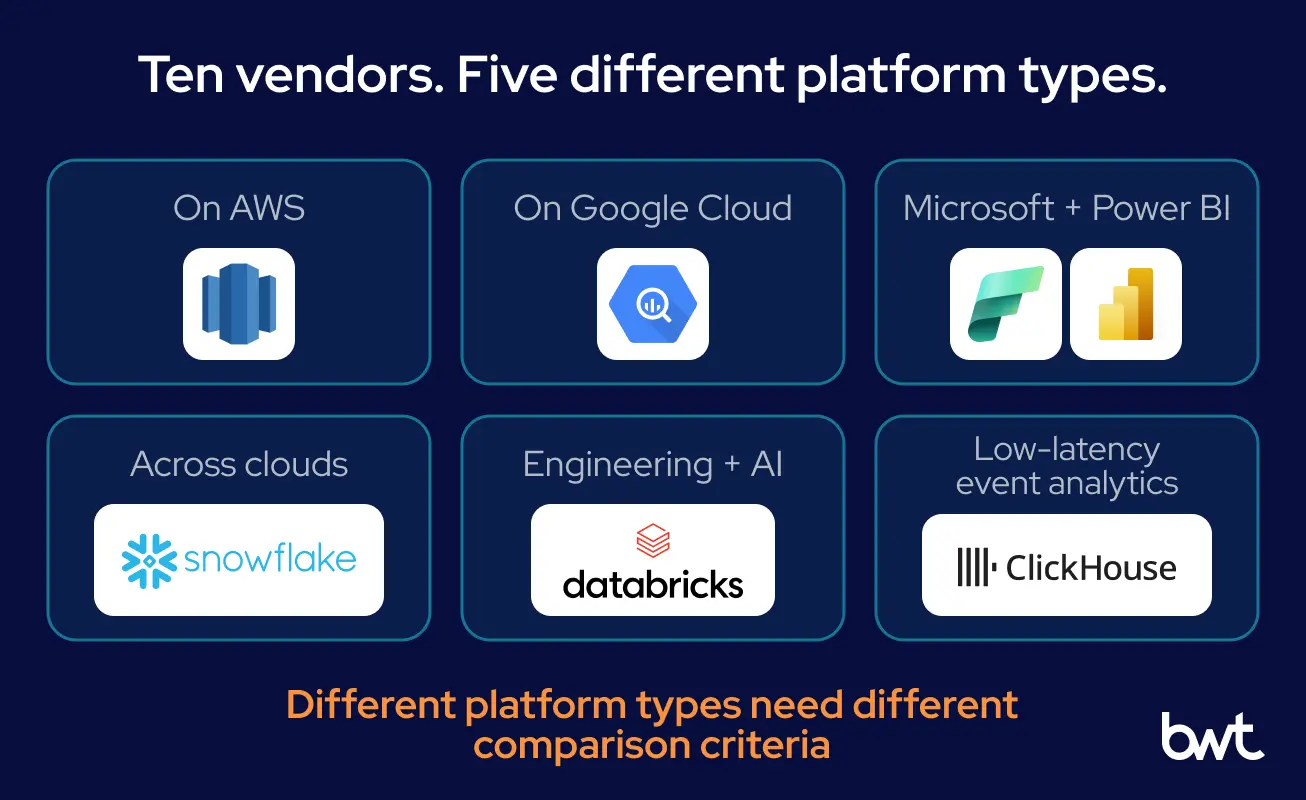
This top data warehouse vendor comparison is a routing aid. It names candidates worth investigating, not winners selected without a pilot.
| Decision factor | Strong candidates | Reason to investigate |
| AWS-native estate | Amazon Redshift | Closest fit with S3, Glue, IAM, and AWS operations |
| GCP-native estate | Google BigQuery | Serverless analytics beside Google Cloud data and ML services |
| Microsoft and Power BI | Microsoft Fabric | OneLake, Fabric workloads, and Power BI in one capacity model |
| Multi-cloud governed analytics | Snowflake | Cross-cloud service, workload separation, and controlled sharing |
| Unified engineering and AI | Databricks | Lakehouse foundation across pipelines, BI, ML, and AI |
| Real-time event analytics | ClickHouse Cloud | High-ingest, low-latency analytical applications |
| SAP-heavy estate | SAP Datasphere | Preserves SAP business context and application relationships |
| Oracle-heavy estate | Oracle Autonomous Data Warehouse | Operational fit with Oracle applications and databases |
| Large regulated legacy estate | Teradata VantageCloud | Mature SQL, workload management, and hybrid options |
| IBM or hybrid estate | IBM Db2 Warehouse | Alignment with Db2 skills and IBM infrastructure |
| Independent platform assessment | GroupBWT | Implementation-partner support that separates workload tests, migration dependencies, governance, and TCO assumptions from vendor claims |
How to Validate Cost and Migration Risk
Apply mandatory gates first: residency, encryption, private networking, audit logs, required regions, and critical BI compatibility. Test each surviving candidate with the same data, dashboards, concurrency, and operating assumptions. Record whether each result was observed, documented, vendor-asserted, or unknown.
A credible total cost of ownership includes storage, compute, transfer, support, migration, administration, training, committed spend, and exit work. Model low, expected, and high use. The aim is not to predict an invoice to the dollar. It is to expose which assumptions can move the decision.
Migration extends beyond SQL conversion. Procedures, schedulers, ETL/ELT logic, BI models, access rules, reconciliation, parallel running, cutover, and rollback often dominate the work. Before cutover, reconcile business measures rather than row counts alone; our data warehouse testing guide explains the difference.
We used that discipline while consolidating four warehouse and data mart environments into a 25-table enterprise model. By defining the model, transformation rules, and reconciliation checks together, we created one reporting baseline instead of moving conflicting definitions into a new engine. The data warehouse design guide documents the modeling choices behind that work.
Platform Evaluation Checklist
Before approving a pilot, write down the answer and evidence owner for each item:
- residency, encryption, private networking, data governance, and compliance evidence;
- identity, roles, masking, audit, lineage, and data ownership;
- BI compatibility, dashboard concurrency, refresh peaks, and semantic models;
- batch, streaming, notebook, ML, AI, and event workloads;
- SQL, procedure, pipeline, scheduler, and source-system migration scope;
- team skills, operating ownership, vendor support, and partner availability;
- three-year TCO under low, expected, and high consumption;
- export, contract, data-format, and operational exit paths.
When a New Data Warehouse Platform Is Not the Best Answer
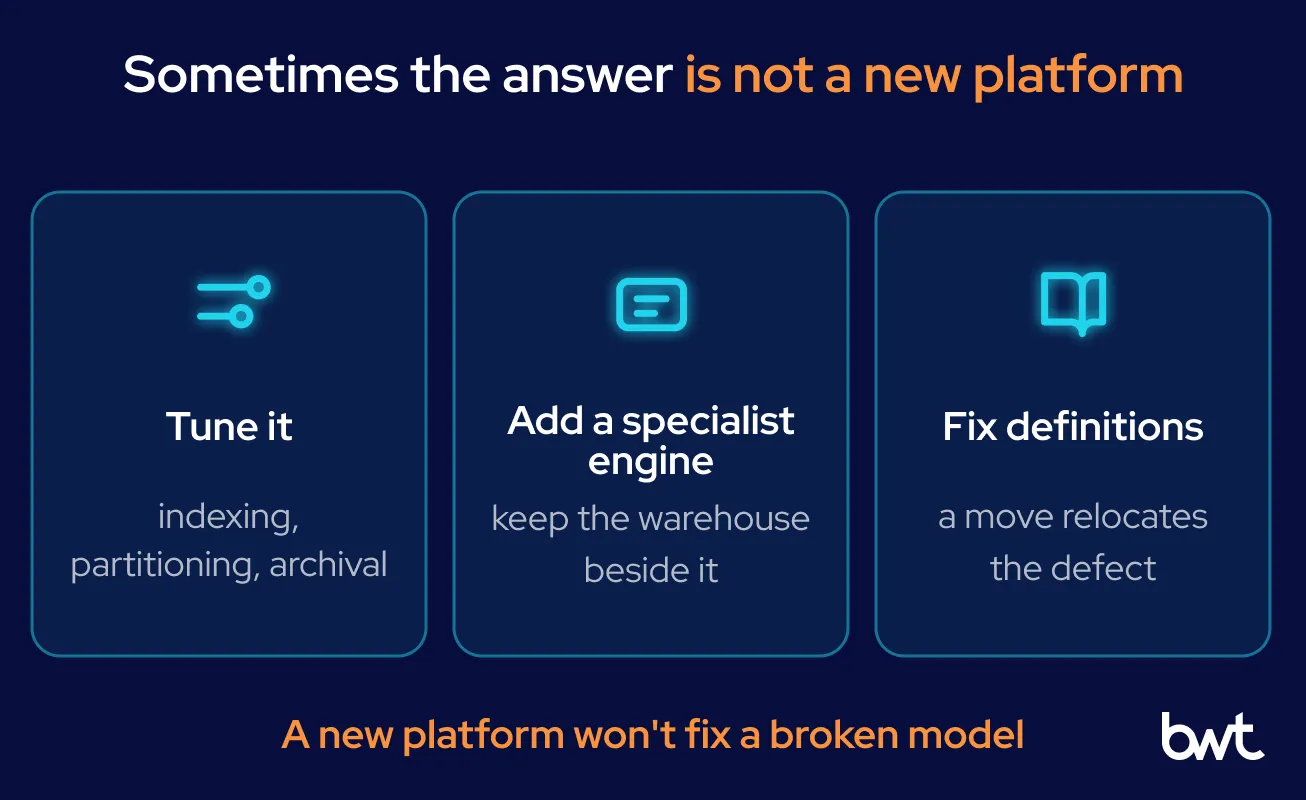
A new warehouse is not always the right purchase. Stable workloads and narrow reporting may need an index, partitioning change, repaired model, or archival policy rather than a migration.
A specialist engine beside the warehouse can also be cleaner than replacement. If only low-latency events are failing, ClickHouse may serve that application while the warehouse remains the governed reporting layer. If inconsistent definitions or weak testing are the real fault, a platform move simply relocates the defect.
"The cleanest platform decision is the one a team can operate six months later. If a vendor removes three moving parts but adds a residency gap, the trade-off is still unfinished." — Dmytro Naumenko, CTO at GroupBWT
Which Data Warehouse Vendor Fits Which Buyer?
Start with the workload carrying the most business risk. Narrow the field by ecosystem, deployment limits, governance, available skills, and the cost of three years in operation. Databricks is a strong candidate when engineering and AI share a foundation. Snowflake earns attention when governed analytics span clouds. BigQuery, Redshift, and Fabric become easier to justify as one cloud ecosystem gains influence. Oracle, Teradata, SAP, and IBM stay in play where enterprise applications, hybrid constraints, or installed skills decide the estate.
The decisive proof is whether a candidate can run critical workloads, preserve business measures, and expose migration and contract risks before commitment. We can turn an initial shortlist into a workload-based platform assessment covering migration dependencies, TCO assumptions, governance requirements, and unresolved technical risks. Findings remain labeled as observed, documented, vendor-asserted, or unknown, so the recommendation stays auditable. We treat each shortlisted platform as one option in a defensible evaluation, not as the default answer.

Our discovery and architecture work tends to leave the same ten names after the first enterprise screen: Databricks, Snowflake, Google BigQuery, Amazon Redshift, Microsoft Fabric, Oracle Autonomous Data Warehouse, Teradata VantageCloud, ClickHouse Cloud, SAP Datasphere, and IBM Db2 Warehouse. Of those ten, only ClickHouse Cloud is a real-time OLAP engine. The other nine fall into the warehouse, lakehouse, or ecosystem-suite groups. Start with all ten, then remove candidates that fail your governance, cloud, or skills constraints. See Vendor Snapshot at a Glance for the full buying map.
Existing cloud boundaries narrow this choice fast. Snowflake supports controlled sharing across clouds; BigQuery suits Google Cloud teams that want serverless operation; Redshift offers the shorter path inside a substantial AWS estate. The honest tiebreaker comes from each platform’s cost behavior on your own query mix and concurrency profile, not from a feature table. Cost reasoning is in How to Validate Cost and Migration Risk.
It includes a warehouse, but the product boundary is wider. SQL Warehouses handle reporting inside a lakehouse that also covers transactional tables, data engineering, BI, machine learning, and AI. That breadth pays off when those workloads actually share the same data. Pick Databricks only for SQL reporting and you inherit platform surface you never use. The architecture comparison sits in the Vendor Profiles and How We Selected sections.
Event, log, telemetry, and product workloads often put ClickHouse Cloud on the list. BigQuery, Databricks, Redshift, Snowflake, and Fabric can also take streaming or near-real-time work, each through a different design. First, establish the latency the business can use. If second-level updates change no decision, batch or micro-batch processing costs less and is easier to operate. The trade-off lives in the Vendor Profiles under ClickHouse Cloud.
Compute and storage cover only a slice of the bill. Data transfer, support contracts, migration effort, administration, training, data growth, and committed capacity all sit on the same line item. Build a low, expected, and high usage model before signing, and keep the assumptions attached to every number you quote internally. The full cost reasoning, including the Platform Evaluation Checklist, sits in How to Validate Cost and Migration Risk.
Lock security and residency down first. Run one identical representative workload across every surviving candidate, with concurrency and cost controls in the same test. Keep observed results, vendor documentation, and unresolved questions on separate lines instead of averaging them into a single score. Method, criteria, and limits are spelled out in How We Selected and Compared the Vendors.
Yes, under specific conditions. One platform runs governed business reporting while another handles events, AI, or a regional requirement. The arrangement holds only when each critical measure has an authoritative definition and every dataset has a clear system of record or ownership boundary. Skip that discipline and you pay twice for the same logic while reading two different numbers in the same dashboard. The boundary test sits in the Vendor Profiles and When a New Data Warehouse Platform Is Not the Best Answer.
Read summarized version with
Build a vendor shortlist around a real PoC
Before platform selection, we map the workloads, governance rules, migration dependencies, and cost drivers that the PoC must test.