Read summarized version with


The prototype answers correctly in a demo. Then someone connects it to a customer record, lets it update a ticket, and asks who can stop it when the workflow takes an unexpected branch. Model quality is no longer the whole product question.
The AI agent development lifecycle takes a tool-using workflow from initial framing through controlled release and operation. GroupBWT uses a seven-stage ADLC framework for this guide: Workflow Framing, Architecture, Risk Validation, Production Build, Release Evaluation, Controlled Deployment, and Production Operation. Each stage ends in an evidence-based decision to proceed, narrow the scope, redesign, restrict, or stop.
Define Your AgentRelease Gate
Bring one workflow, the systems it touches, and its highest-risk action. We turn them into a production plan with named controls, evaluation evidence, and recovery ownership.
We define:
- Workflow & Autonomy Boundaries
- Evaluation & Release Evidence
- Monitoring, Rollback & Incident Ownership
We can enter where the work is stuck: prototype rescue, production architecture, evaluation setup, data and tool integration, hardening, or full implementation. A complete engagement produces a workflow baseline, authority map, production integrations, release evidence, controlled rollout, and monitoring and recovery setup. Our enterprise AI consulting services help teams identify the first unresolved gap rather than repeat work already supported by evidence.
Key Takeaways
- Treat every stage as work and every gate as a decision based on named evidence.
- Bind approval to the exact action, target, and parameters the production tool will execute.
- Keep development cases separate from held-out acceptance cases so tuning does not invalidate release evidence.
- Test ambiguous timeouts and partial failures before granting write authority.
- Expand production exposure only while quality, latency, cost, escalation, and incident evidence stay within defined limits.
- Keep operation active after deployment: detect failures, contain them, diagnose causes, and add regression coverage.
What Is the AI Agent Development Lifecycle?
The lifecycle covers how a team designs, builds, releases, and operates software that can interpret a goal, choose among permitted actions, use tools, maintain workflow state when needed, and escalate when its authority ends. Major agent-platform providers including IBM, Microsoft, and LangChain use the term for this build-to-operation process.
Some sources use “agentic development lifecycle” for the same work, but the phrase can also describe software engineering performed with coding agents. This guide uses ADLC for building and operating the agent itself. Our separate article explains the benefits of AI in software development, where agents help people write requirements, code, and tests.
A chatbot produces text. A production agent may query governed data, prepare a refund, or update a record. Every action class therefore needs a defined permission path, failure path, and accountable owner.
GroupBWT Seven-Stage ADLC Framework
Workflow Framing → Architecture → Risk Validation → Production Build → Release Evaluation → Controlled Deployment → Production Operation
Across all stages: Security | Governance | Evaluation | Observability | Ownership
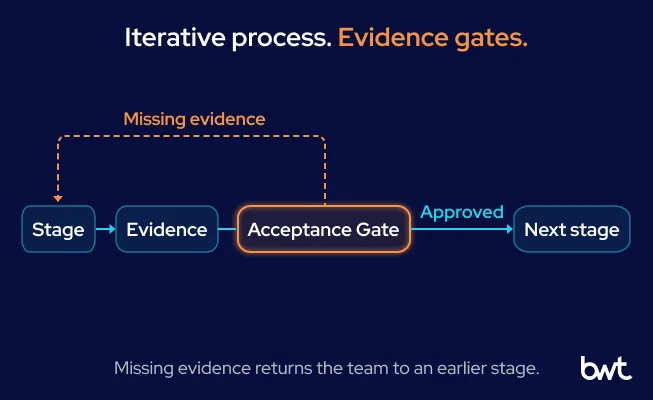
The sequence is iterative rather than a one-way conveyor belt. Missing evidence or a production failure returns the team to the relevant earlier stage.
| Stage | Main question |
| Workflow Framing | Is the workflow worth solving? |
| Architecture | Can we control data, tools, authority, and recovery? |
| Risk Validation | Are the critical assumptions valid? |
| Production Build | Does it work with production-shaped systems? |
| Release Evaluation | Is the complete workflow acceptable? |
| Controlled Deployment | Can exposure grow safely? |
| Production Operation | Can failures be detected, contained, and corrected? |
AI Agents Need Lifecycle Gates Because They Can Choose and Act
Deterministic automation keeps permitted transitions explicit, even when runtime data selects a branch or an external system fails. An agent can let a model choose among permitted tools at runtime, so similar requests may take different routes through data and actions. That variability changes what “tested” means.
Behavior can change with a prompt, model, retrieval rule, tool description, permission, or external dependency. A passing unit test cannot prove that the complete run will select the right tool, respect approval, and recover after partial failure. Production deployment therefore starts measured operation rather than ending development.
Dmytro Naumenko frames release readiness through recovery: “Before launch, force a tool call to time out after the external system has accepted it. If the team cannot prove whether the action happened and resume without repeating it, the workflow is not ready for write access.” — Dmytro Naumenko, CTO at GroupBWT
Seven Agent Development Stages End in Acceptance Gates
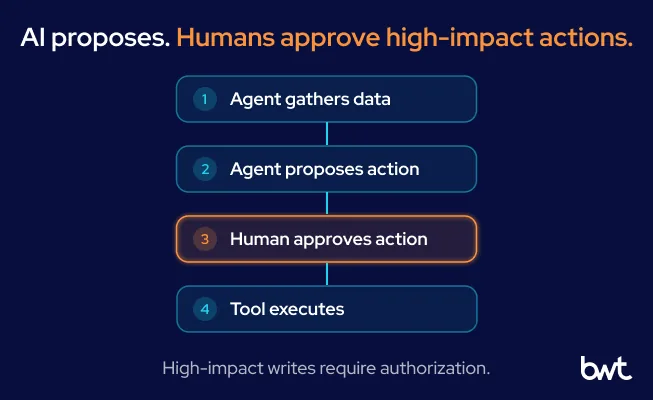
The GroupBWT Seven-Stage ADLC Framework applies one clear contract to every stage: required output, named approvers, and a condition that blocks progression. Consider a refund agent that reads an order, payment status, delivery evidence, and policy, then prepares a recommendation. A support specialist approves the action, target, and amount before a separately permissioned tool can issue the refund. The lifecycle gate decides whether the system is ready to receive that capability; transaction approval decides whether one refund may proceed.
| Stage | Required evidence | Exit decision |
| Workflow Framing | Baseline, workflow and exception owners, action boundary | Proceed only with a measurable outcome and accountable owners |
| Architecture | Data, tool, policy, approval, state, and recovery map | Proceed only when protected actions have authorization and recovery paths |
| Risk Validation | Representative cases, review criteria, test evidence | Proceed, narrow, redesign, or stop |
| Production Build | Realistic identities, integrations, timeouts, duplicate-safe writes | Proceed only when state and side effects survive realistic failures |
| Release Evaluation | Behavior, action, refusal, latency, cost, and recovery results | Approve only when bounded action meets agreed thresholds |
| Controlled Deployment | Limited cohort, scoped permissions, alerts, disable path, rehearsed rollback | Expand, hold, or reduce exposure |
| Production Operation | Monitoring, evaluation, incidents, regression cases, named ownership | Continue, correct, restrict, suspend, or retire |
Stage 1 – Workflow Framing: Define the Baseline
Start with the work, not the model. Name the event that starts it, the systems it reads, the decision or action it produces, and the person accountable for the result. Record the current baseline in a unit the business already uses: review time, backlog age, completion rate, rework, or missed service level.
Map human and agent roles next. Which judgment stays with a person? Which read can policy authorize automatically? Which write requires approval? For the refund workflow, the outcome may be shorter review time and correctly prepared recommendations, while execution remains a separate approved action.
Stage 2 – Architecture: Map Authority and Evaluation
The architecture maps the route from request to recorded outcome. It may include agents, retrieval, workflow state, tools, identity controls, approval, and trace storage. The control path should be explicit: proposed tool request → policy and access check → approval when required → approved execution → action and recovery record. Approval must bind the action, target, and relevant parameters actually executed.
Evaluation belongs in the design because architecture and instrumentation determine what runtime evidence can be captured. Record the final answer, tool choice, arguments, state transitions, policy decisions, latency, cost, and escalation. If a trace cannot reveal the failed step, the team will tune by anecdote after launch.
A direct case shows why data and routing belong together. GroupBWT connected 14 operational sources into a validated semantic layer, then built an analytical AI agent that routed factual questions to SQL and analytical questions to a versioned statistical check. By defining that route and refusing out-of-scope questions, the team enabled the client to investigate new questions in minutes instead of assembling data by hand first.
Stage 3 – Risk Validation: Test the Blocking Assumptions
A prototype should attack uncertainty, not imitate the final interface. Test the weakest link first: access to the system of record, ambiguous policy language, document quality, risky tool behavior, or whether reviewers can establish a stable correctness standard.
Build representative cases from ordinary work, known failures, edge conditions, and requests that should be refused. Keep development cases separate from a held-out acceptance set. This reduces the risk that repeated tuning overfits the system to cases used during development. Anthropic’s Demystifying evals for AI agents recommends starting with 20-50 simple tasks drawn from real failures and reading transcripts to verify that graders measure the intended behavior (Anthropic, 2026).
Stage 3 passes when evidence supports proceeding and the main uncertainties are bounded. Stop or redesign when required data or system access is unavailable, reviewers cannot establish an agreed standard, or a critical control cannot be tested.
Stage 4 – Production Build: Integrate Real Systems
A prototype can appear reliable because its test account has broad access and its inputs were cleaned by hand. Production construction removes those shortcuts. The system must not lose required workflow state, repeat a side effect, or access data outside its permitted scope when an integration is slow or partially fails.
Build retry and recovery around tool calls, with duplicate protection around state-changing actions. Use an idempotency key where the downstream API supports one. Where it does not, use a stable transaction reference and reconcile the system of record before deciding whether a retry is safe.
This is where data engineering solutions become part of reliability. Prompt changes cannot replace consistent identities, current source data, or authorization controls that preserve user, agent, and task scope across connected systems. Teams needing production agent logic and integrations can also use our generative AI software development services.
Stage 5 – Release Evaluation: Test the Complete Workflow
AI agent production readiness depends on complete-workflow evidence. In the refund example, a successful run must read permitted records, identify a duplicate charge, request the correct amount, and stop at the approval check. A fluent explanation with the wrong amount is a failed answer. A correct explanation followed by an unauthorized refund is a failed action.
Run nondeterministic cases more than once. Score the outcome and the parts that explain it: factual answer, selected tool, arguments, policy decision, final state, and escalation. Keep tuning cases separate from held-out acceptance cases. Also measure end-to-end latency, cost per completed workflow, rate limits, and human review load under realistic volume.
Alex Yudin keeps the release test tied to observable evidence: “A release score is a snapshot. Preserve the failed step, its inputs, and the resulting state so the next change can prove it fixed the defect without reopening an older one.” — Alex Yudin, Head of Data Engineering at GroupBWT
Stage 6 – Controlled Deployment: Limit Exposure
A release that passes evaluation can still overwhelm reviewers or expose too much authority. Limit who can use the agent, which records it can reach, what actions it can request, and how much work can be in flight. Scope write authority by action and resource rather than relying on one broad permission.
Monitoring should be live before exposure grows. Alerts need to distinguish model-quality shifts from tool errors, permission denials, stale context, rising cost, and slow dependencies. Operations also need a separate disable path and a rehearsed deployment rollback. Reverting a model does not undo an external action already completed, so that action needs reconciliation or recovery.
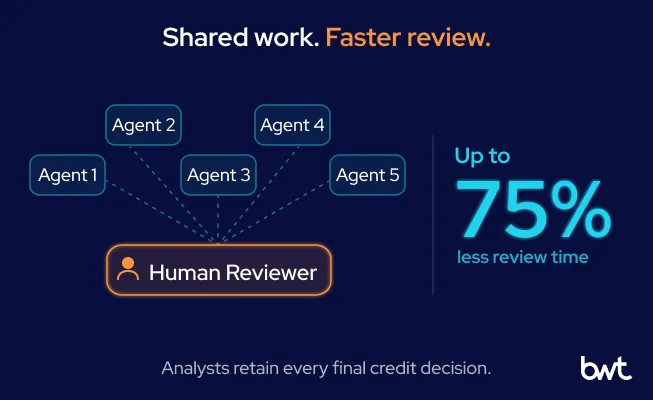
GroupBWT built five connected AI credit analyst agents while retaining every final credit decision with a human analyst. By automating document reconciliation and ratio calculation before review, the team cut exception-application review time by up to 75% (published case, 2026).
Stage 7 – Production Operation: Monitor and Correct
Production use reveals combinations pre-release tests missed. Monitor completed-workflow quality, business outcomes, latency, cost, escalations, and user corrections. When an incident occurs, contain the affected action, preserve the run, route pending work to people, and diagnose the failed step before changing a prompt. Recurring failures need a diagnosis and owner, regression coverage where appropriate, and explicit risk acceptance only when the issue is consciously accepted rather than fixed.
Preserve only the execution evidence needed for diagnosis: relevant inputs, model and prompt versions, relevant tool, policy, and configuration versions, proposed actions, control decisions, results, state changes, and final outcome. Remove credentials and raw secrets, mask sensitive fields where appropriate, encrypt the trace, restrict access, and apply the retention policy. The PROV-AGENT paper supports treating traceability as an operating concern rather than only a debugging aid (IEEE e-Science, 2025).
Microsoft Research’s AgentRx framework normalizes heterogeneous trajectories, checks constraints derived from tool schemas and policies, evaluates individual steps, and localizes the critical failure category (Microsoft Research, 2026). Make the smallest controlled, versioned correction possible, test it, and route it through the relevant release and deployment gates. Keep held-out cases outside tuning; refresh them when optimization exposure or changed production conditions make them unrepresentative.
Governance and Operational Ownership Cross Every Stage
Security, governance, evaluation, observability, and ownership are not additional AI agent development stages. They are cross-cutting controls in the GroupBWT framework. Effective AI agent lifecycle management keeps identity and authorization active across architecture, deployment, and operation. Approval belongs before consequential execution. Privacy affects context, logs, and retention. Versioning covers prompts, models, tools, policies, and evaluation cases.
NIST’s AI Agent Standards Initiative focuses on identity and authorization, interoperable protocols, and security evaluations (NIST, 2026). That scope supports a practical rule: lifecycle governance includes evidence that a known agent, acting for a known principal, requested and executed an allowed action.
The AI agent development process still uses SDLC for software, MLOps where teams train or directly manage ML models, and LLMOps for model-facing operations. The AI agent production lifecycle makes model-selected routes, tool authority, workflow state, external actions, escalation, and recovery explicit control concerns. Multi-agent designs do not represent a later maturity stage; they add interfaces, handoffs, and more ways for state to fall out of sync.
The lender case illustrates this point. Five specialist agents shared one exception-review workflow, but a human retained the final decision. The architecture added specialist handoffs without replacing the authority boundary.
Google Cloud’s Vertex AI multi-agent overview covers development, runtime, enterprise connections, evaluation, identity-based permissions, and tracing (Google Cloud, 2025). In this framework, test each specialist, every handoff, the coordinator and shared state where present, partial failures, and the complete workflow.

When Explicit Rules Should Own the Decision
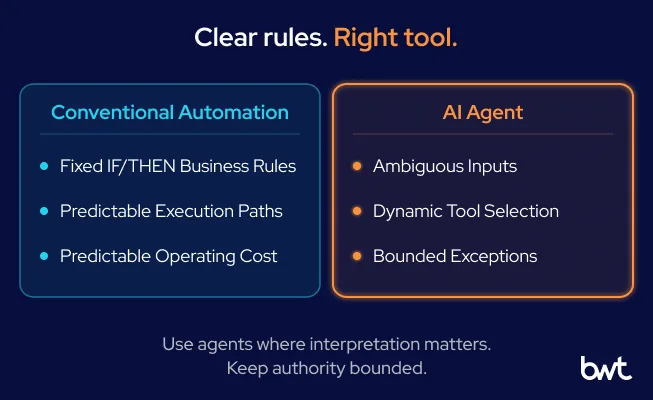
Choose conventional automation when the decision rules can be written and executed reliably. Do not build an agent when no stable owner can define acceptable outcomes or when correctness cannot be evaluated. That is different from a workflow where an agent can help but autonomous action carries unacceptable risk: keep the agent advisory and place the consequential action under deterministic controls or human approval.
Oleg Boyko puts the boundary plainly: “Ask whether the rule that leads to an action can be written down and tested. If it can, a workflow engine is usually the stronger product. An agent earns its operating cost when interpretation is real and the exceptions can still be bounded.” — Oleg Boyko, CCO at GroupBWT
Before an ADLC review, bring the workflow, business baseline, connected systems, highest-risk action, outcome and exception owners, and existing release evidence. Our AI implementation services can turn those inputs into an authority map, evaluation suite, production integration, or controlled rollout. We validate existing evidence first, then begin at the first unresolved gap.
Also Read: RAG Data Pipeline: How to Build an End-to-End RAG Pipeline
The agentic development lifecycle works only when its controls survive contact with real systems. The objective is not to remove uncertainty. It is to make authority bounded, evidence reviewable, failures containable, and ownership explicit for as long as the agent remains live.
ADLC means Agent Development Lifecycle in this guide: the process for building and operating an AI agent. Some sources use “agentic development lifecycle” for the same process, while others apply it to software engineering with coding agents. Naming the system being built keeps the intents separate.
The seven stages in this GroupBWT framework are Workflow Framing, Architecture, Risk Validation, Production Build, Release Evaluation, Controlled Deployment, and Production Operation. Each stage produces evidence for an acceptance decision, while security, governance, evaluation, observability, and ownership apply across all seven.
Production-ready AI agents have complete-workflow evidence, bounded permissions, approval checks, traceability, containment, recovery, realistic latency and cost measurements, and named incident ownership. A successful demo or an average answer score does not establish those properties.
The stages remain the same in this framework, but the evidence surface expands. Teams must test each specialist, every handoff, shared state and coordination where present, partial failures, and the end-to-end outcome.
Avoid an agent when rules can execute the workflow reliably, no stable owner can define acceptable outcomes, or correctness cannot be evaluated. If the agent is useful but autonomous action would be too risky, keep it advisory and require deterministic controls or human approval for the consequential step.
Read summarized version with
Related Services
Define Your AgentRelease Gate
Bring one workflow, the systems it touches, and its highest-risk action. We turn them into a production plan with named controls, evaluation evidence, and recovery ownership.
We define:
- Workflow & Autonomy Boundaries
- Evaluation & Release Evidence
- Monitoring, Rollback & Incident Ownership