Read summarized version with


A RAG data pipeline decides which company knowledge an AI assistant can use, cite, and defend. It turns policies, SOPs, tickets, contracts, audit logs, catalogs, and research folders into governed LLM context. In an end-to-end RAG pipeline, freshness and access checks sit in the data path.
That matters when a prototype leaves five clean PDFs. The assistant may answer from an old policy, a missing export, or a folder with the wrong permissions. The model is visible; the pipeline is where production failures usually start.
Build the Data Foundation Your AI Models Need
We develop and manage custom data solutions, powered by proven experts, to ensure the fastest delivery of structured data from sources of any size and complexity.
We offer:
- Custom Web Scraping & Development
- 15+ Years of Engineering Expertise
- AI-Driven Data Processing & Enrichment
Since 2009, GroupBWT has shipped production data pipelines across compliance, market intelligence, regulated document access, and AI-ready systems. This guide separates offline indexing from online retrieval in an end to end rag pipeline before the chat interface takes credit.
Key Takeaways
- RAG works when retrieval, permissions, refresh, and evaluation are designed as data-pipeline controls.
- Restricted chunks must be stopped before prompt assembly. Post-generation filtering is too late.
- Launch only after parser, recall, refresh, monitoring, and rollback checks pass.
What Is a RAG Data Pipeline?
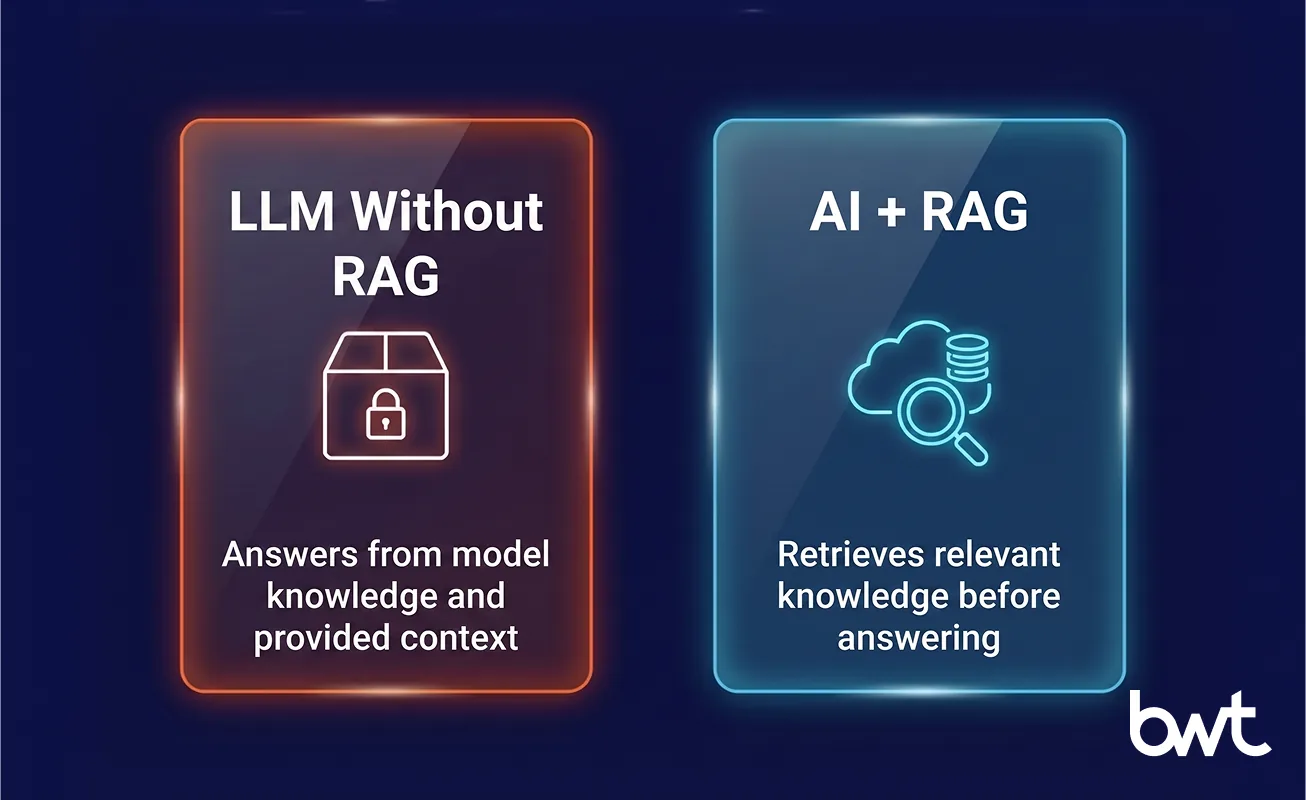
The retrieval-augmented generation pipeline route is simple to describe and hard to operate. It pulls sources in, parses them, chunks them, attaches metadata and access rules, builds an index, then sends the LLM only the passages it may use.
A plain LLM workflow can work when the input is small, fixed, and fully available in the prompt. RAG fits changing knowledge bases that need evidence before an answer.
| Requirement | RAG | Plain LLM |
| Changing knowledge base | Strong fit | Weak fit |
| Source citations | Supported | Limited |
| User-specific permissions | Possible through retrieval | Difficult |
| Small fixed input | Often unnecessary | Strong fit |
| Retrieval infrastructure | Required | Not required |
How the Online and Offline Lanes Connect
How a RAG pipeline works end-to-end depends on what happens before and after the question arrives. The offline lane handles inventory, ingestion, parsing, chunking, metadata, permissions, embeddings, and indexing. The online lane handles query transformation, filtering, retrieval, reranking, context assembly, generation, citations, and evaluation.
The split keeps the assistant fast and governable. Finish the slow work before the user asks, with status checks and rollback paths.
Pipeline Architecture Diagram: Data, Model, and Governance Layers
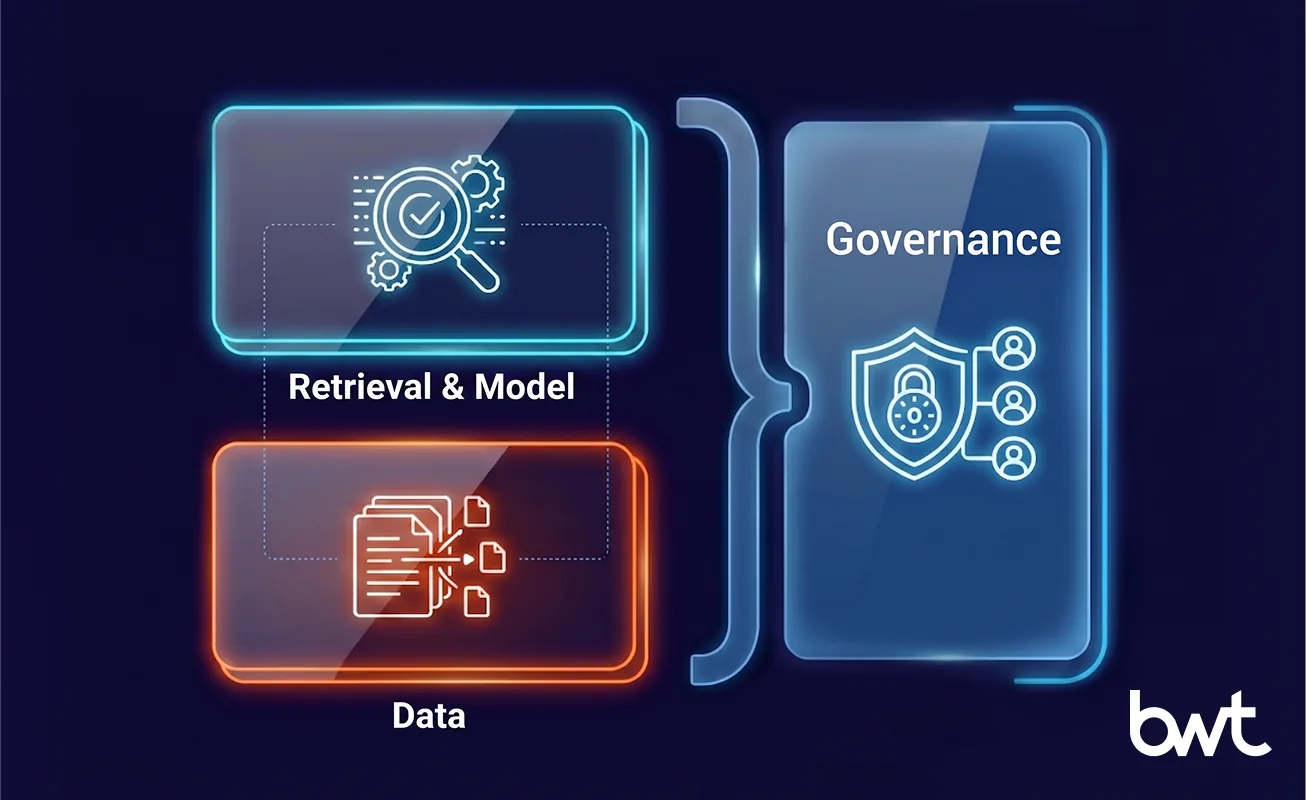
A useful rag pipeline diagram shows three layers, not just a vector database between a source and a model.
The data layer covers sources, ingestion, parsers, chunking, metadata, lineage, and refresh jobs. The model layer covers embeddings, indexes, retrieval, reranking, context assembly, generation, and citations. The governance layer crosses both: identity, permissions, audit logs, monitoring, evaluation, and owner alerts.
The Nine Core Components
Google Cloud’s Vertex AI RAG Engine post presents parsing, retrieval, vector storage, and generation as core managed stages. In vendor-neutral enterprise architecture, RAG pipeline components also need source governance, permissions, lineage, refresh ownership, and monitoring.
| Component | Core decision | Why it matters |
| Source inventory | Authoritative repositories | Prevents missing or duplicate corpora |
| Ingestion | Batch, near-real-time, or event-driven | Controls what enters search |
| Parsing | Parser per document type | Preserves clauses, tables, and fields |
| Chunking | Size, overlap, hierarchy, metadata | Changes recall and precision |
| Metadata | Source, owner, date, version, sensitivity | Enables filters and audit trails |
| Permissions | Identity and policy before indexing | Blocks restricted context |
| Retrieval | Vector, keyword, hybrid, reranker | Controls candidate quality |
| Evaluation | Retrieval and generation measured separately | Finds the failed layer |
| Monitoring | Freshness, drift, owners, recovery | Catches silent degradation |
In one production marketplace pipeline, GroupBWT found that source coverage had fallen below the client’s target because identity and session flows blocked part of the corpus. Redesigning collection and validation restored a sustained daily flow that met the client’s coverage and accuracy acceptance criteria. In RAG terms, the answer layer cannot recover evidence the corpus never receives.
“When documents never reach the corpus, the model is not the bottleneck. Parsing, normalization, deduplication, and source access decide whether retrieval has anything truthful to work with.”
— Alex Yudin, Head of Data Engineering
Business Outcomes of a Well-Built Pipeline
A CTO funds retrieval because people need faster, safer answers from company knowledge. Better metadata gives precise filters. A tested refresh cadence keeps current policies in the index. Pre-prompt access checks keep restricted records out of the prompt. The result is cited answers users trust, faster time-to-answer, fewer stale-content escalations, and audit trails that explain why a source appeared. In a travel-platform AI delivery, the same audit trail discipline showed up in a real data engineering pipeline build for an AI travel platform, where every chunk had to be traceable back to a regulated source.
How to Build a RAG Pipeline, Step by Step
Anyone searching how to build a rag pipeline gets more out of a build plan than a diagram. For engineering depth, see How to Build an AI-Ready Data Pipeline. Teams often ask for the rag data pipeline architecture components steps in one artifact; the useful artifact is the RAG pipeline steps list below.
- Define the use case and success metrics. Name the questions, allowed users, and unacceptable failure.
- Inventory enterprise data sources. Record owner, update frequency, format, permission model, and criticality.
- Design the rag pipeline architecture. Separate offline indexing from online retrieval, with governance across both.
- Build ingestion. A RAG data ingestion pipeline should detect missing files, schema changes, blocked sessions, and partial exports.
- Parse, clean, and chunk documents. Policies, invoices, drawings, and tickets need different boundaries.
- Add metadata, permissions, and lineage. Metadata controls filters; permissions control retrieval.
- Generate embeddings and build the index. Pick the model and vector store after privacy, language, length, and refresh constraints are known.
- Implement retrieval and reranking. AWS’s Amazon Q Business article is useful for agentic retrieval. Test summaries separately from fact lookups.
- Connect retrieval to the LLM. Preserve citations, mark uncertainty, and stop unsupported answers.
- Add evaluation and monitoring. Test retrieval and generation separately.
- Test real user questions. Support, compliance, engineering, sales, and operations phrasing exposes what synthetic questions hide.
- Deploy and maintain. Assign owners for refresh jobs, parser failures, access changes, drift, and backfills.
Is Your Enterprise Data Ready for RAG?
Before writing code, ask whether your sources can support retrieval at all: named owners, current versions, access rules, parsable formats, and refresh paths. GroupBWT can assess these constraints before a production build. In one agribusiness readiness assessment, the team mapped undocumented data flows and integrity risks before architecture decisions were locked.
How to Build a RAG Pipeline for Sensitive Data
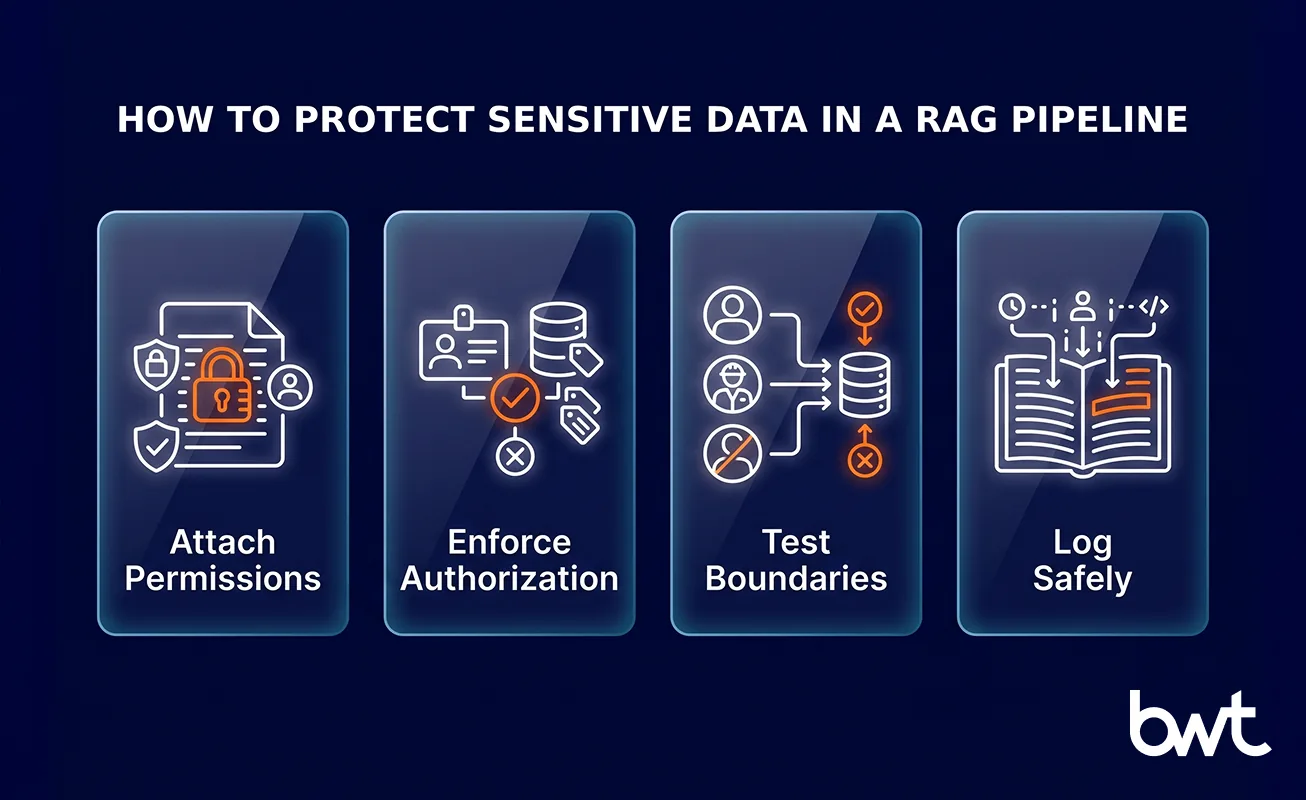
The safe rule is narrower than “filter before retrieval”: restricted chunks must not enter model context.
Attach Permissions Before Indexing
Represent permission as data on sources, chunks, index entries, retrieval calls, and audit logs. If access rules live only in the UI, the retriever can still select forbidden context.
Enforce Authorization Before Context Assembly
Use separate indexes, tenant isolation, ACL metadata, security trimming, an authorization-aware retriever, or a final filter before context assembly. The goal is the same: no restricted chunk enters the prompt for the wrong user.
Test Permission Boundaries Directly
Microsoft’s Foundry Build 2026 update discusses identity, permissions, and policy across managed AI systems. For enterprise RAG, test allowed, blocked, and mixed-permission queries.
Log Retrieval Without Exposing Sensitive Content
Audit logs should show source ID, chunk ID, permission decision, retrieval score, and response trace without copying sensitive text into the log store. GroupBWT engineering note (Dmytro Naumenko, CTO): If identity is checked after generation, the damage is already done; permissions have to travel with the document and into the audit trail.
Evaluation Metrics That Separate Retrieval Problems From LLM Problems
A good evaluation plan tells you which layer failed. NIST’s TREC RAG Track overview compares retrieval-augmented systems on relevance, completeness, and attribution. The 2025 RAG evaluation survey reaches the same lesson: measure retrieval and generation separately.
| Metric | What it measures | Failure it catches | Signal you watch |
| Retrieval recall | Relevant chunks retrieved | Missing documents or filters | Target set coverage |
| Context precision | Retrieved chunks are useful | Noisy top-k results | Useful chunks in top results |
| Faithfulness | Claims grounded in context | Hallucinated statements | Claim-to-source match |
| Citation accuracy | Sources support claims | Wrong or stale citations | Citation audit pass rate |
| Abstention rate | Refusal on no-evidence queries | Overconfident answers | No-evidence test set |
Data Pipeline Analogue: Restoring Source Coverage Before Retrieval
This was not a production RAG system, so it should not be sold as one. It is a data pipeline analogue. The lesson transfers because retrieval cannot cite a product, policy, or record that collection missed. For a Korean e-commerce marketplace, the team fixed identity, session, and pagination gaps before records entered the pipeline.
Also Read: How to Build an AI-Ready Data Pipeline: C-Level Guide
Monitoring and Observability for RAG Pipelines
End-to-end RAG pipelines age every day. Sources change layouts, owners rename fields, SaaS exports hit limits, permission groups change, and parsers keep running while dropping tables.
Source and Ingestion Health
Watch expected versus actual files, record counts, parser errors, session failures, and schema changes. GroupBWT separates source-arrival checks from record-quality checks in production pipelines.
Retrieval Quality
Track recall on a fixed question set, context precision, stale-source rate, empty-result rate, and reranker impact. A reranker that only reshuffles chunks adds cost without trust.
Generation and Citation Quality
Review whether answers stay grounded in retrieved context, whether citations support the claim, and whether the assistant abstains when evidence is missing. Fluent text is not a success metric.
Business and User Metrics
Watch accepted answers, escalations, correction requests, unsupported questions, and repeated searches after an answer. These signals show whether the system is reducing work or moving it to reviewers.
Keeping the Knowledge Base Current
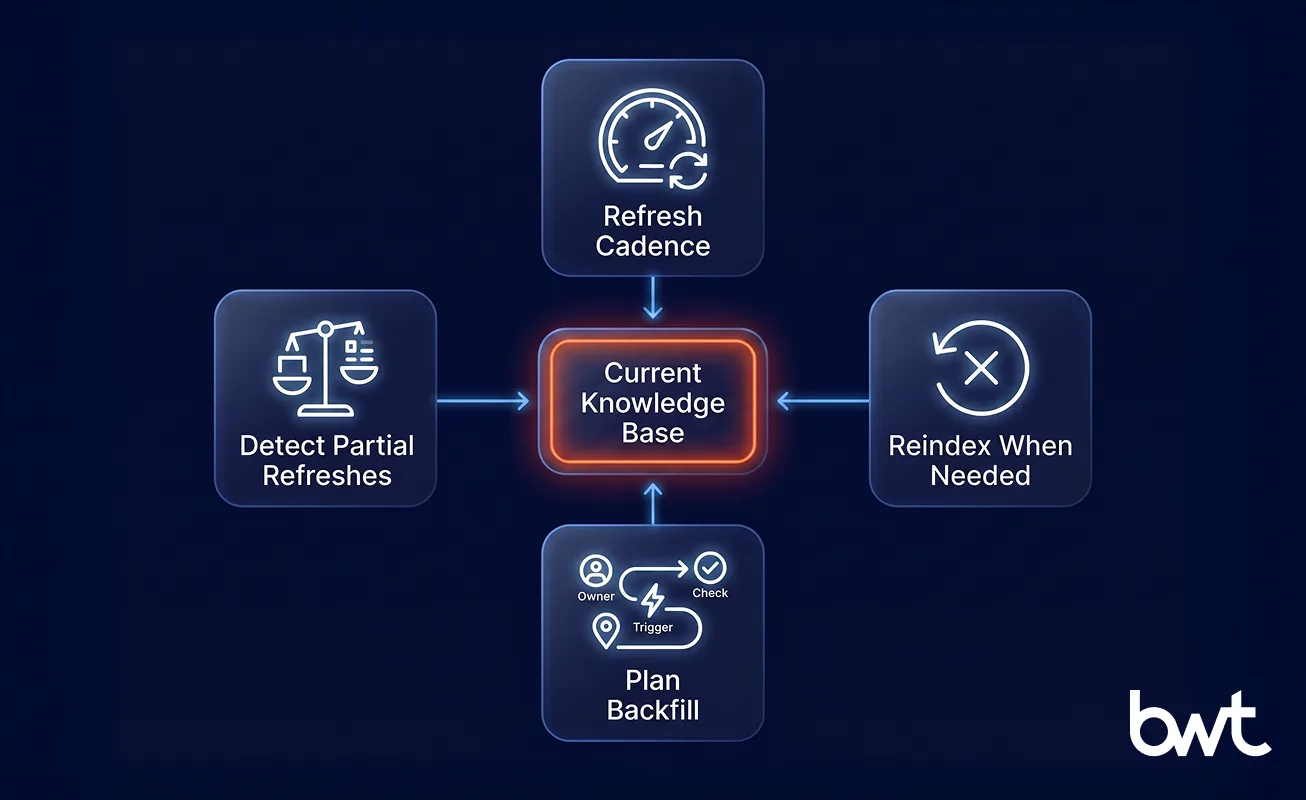
A stale knowledge base is not a content problem. It is a retrieval problem: the retriever may find the best chunk in the index, but the index no longer matches the business.
Define Refresh Cadence by Source Risk
Daily refresh may fit market intelligence and support tickets. Near-real-time updates may fit promotions, incident playbooks, or inventory. Monthly refresh may fit stable policies.
Detect Failed and Partial Refreshes
Even well-built RAG pipelines fail when refresh slips quietly. Reconcile expected files against actual destinations, check parser counts, and alert the owner when only part of a source arrived.
Version Indexes and Embeddings
A parser change, metadata migration, or embedding-model change may require a full rebuild. Keep index versions so the team can compare retrieval quality and roll back a bad release.
Plan Backfill and Re-Indexing
“A feed that was right six months ago is a snapshot, not a system. Owner, cadence, and recovery path matter as much as the first successful run.”
— Oleg Boyko, COO
Batch vs Real-Time Indexing: When Each Makes Sense
Not every corpus deserves real-time indexing. Faster refresh raises cost, complexity, and operational risk; choose it only when stale answers harm the business quickly.
| Dimension | Batch indexing | Real-time indexing |
| Best fit | Stable policies, reports, archived knowledge | Promotions, incidents, inventory, fast-changing tickets |
| Retrieval impact | Slightly older corpus, lower operational load | Fresher answers, more failure surfaces |
| Risk | Stale answers between runs | Partial updates, race conditions, harder rollback |
Vector Search vs Hybrid Search
| Pattern | Best fit | Main limitation |
| Vector search | Semantic similarity | Can miss exact identifiers |
| Keyword search | Exact terminology and codes | Weak semantic matching |
| Hybrid search | Enterprise mixed queries | More tuning and infrastructure |
| Reranked hybrid | High-value production use | Higher latency and cost |
Vector search helps with paraphrased questions. Keyword search protects exact IDs, product codes, clauses, and error names. Enterprise teams often need both.
Transferable Enterprise Data Patterns for RAG Systems
The examples below are not three shipped RAG products. They map one scoped architecture and two operational analogues into reusable choices.
Scoped Manufacturing RAG Architecture
Manufacturing leads because technical-document search is the clearest enterprise fit: large corpora, mixed formats, confidential drawings, and engineers who need evidence fast. In one scoped architecture, SAP stayed the source of truth, Databricks held metadata, about 600 R&D folders formed the corpus, and hybrid retrieval with reranking was proposed. It was not shipped.
Compliance Pattern From Financial Data Systems
A remittance compliance workflow shows the governance transfer. Daily watchlist rescreening, regulated customer records, and data residency in eu-west-1 shaped the architecture. The RAG lesson is that residency and audit evidence must be designed before generated answers appear.
Access and Retention Pattern From Healthcare Data Systems
A delivered healthcare data-compliance platform used sensitive-field stripping before the audit log, storage segmentation, and traceable retention. For RAG, the parallel is context logging: keep the audit trace without copying sensitive content where it does not belong.
What Production-Ready Means for the System
Production-ready means owners and recovery paths exist for boring failures in an end-to-end RAG pipeline. Can the owning team backfill a missed export? Can the operator pause a bad parser release? Can support explain why a source was retrieved? Can governance remove a document after a permission change? Can evaluation prove a reranker improved answer quality?
Whether teams call it a RAG LLM pipeline or an LLM RAG pipeline, the production question is the same: reliability, access boundaries, residency, monitoring, cost, escalation, and recovery must have owners.
Where RAG Pipelines Break – and Why
Competitor guides often stop at the happy path: ingest, chunk, embed, store, retrieve, generate. Production breaks in smaller ways.
| Symptom | Cause | Consequence | Fix |
| The answer misses a known document | Source UI or export changed | Corpus is incomplete | Parser tests and backfill path |
| Fresh documents never appear | Identity or session flow blocks ingestion | The LLM cites stale context | Session monitoring |
| Indexing stops halfway | Queue or worker failure | Some chunks are old | Checkpoint-resume tracking |
| Whole archives are absent | Silent upload failure | Search cannot find evidence | Reconcile expected files |
| Filters fail on sensitive records | Metadata is not mapped | Context may leak | Test field contracts |
In one production pipeline, the team detected whole archives missing from the destination even though the upstream process had not raised a visible error. They reconciled expected records against the destination API, then reloaded the missing archives. In RAG, the same silent gap becomes an assistant that cannot answer from documents everyone assumes were indexed.
How to Choose the Right Partner
Choose a partner by the questions they ask before they mention a model. Do they ask who owns the sources, how permissions are represented, which questions should force abstention, and what happens when a parser drops a table? Ask to see a completed RAG project, demo, or scoped architecture artifact with clear limits.
A credible partner should leave you with a source inventory, access-control map, refresh plan, evaluation set, launch checklist, monitoring design, and backlog of data fixes. GroupBWT is a fit when the hard part is source integration, refresh, governance, and model strategy.

Production Launch Checklist
Before users depend on the assistant, run this checklist against real data and real questions.
- Source inventory approved. Every source has an owner, update cadence, access path, and authority level.
- Parser regression tests pass. PDFs, tables, spreadsheets, tickets, and exports keep answer-bearing structure.
- Chunking tests pass. Policy clauses, table rows, specs, and ticket histories are retrievable as complete evidence.
- Metadata and ACL filters pass. Users retrieve only allowed chunks, and audit logs show why.
- Retrieval baseline is measured. Recall and context precision are tested before launch.
- Refresh cadence is documented. Owners know when to rebuild, backfill, or pause a source.
- Monitoring has responders. Alerts cover ingestion misses, parser failures, stale sources, drift, latency, cost, and low acceptance.
- Rollback and backfill are tested. A bad parser release or partial upload can be reversed.
- Abstention rules are accepted. The system may say it does not have enough evidence.
This checklist turns a RAG pipeline for LLMs into a defensible service.
What Determines the Cost?
No useful estimate starts with model pricing alone. Cost follows the sources, controls, and operating model.
Number and Complexity of Data Sources
A few clean exports cost less than portals, databases, tickets, scans, and SaaS systems that refresh differently.
Document Formats and Parsing Requirements
Tables, drawings, invoices, policies, and scans need different parsers and tests. Parsing complexity often drives timeline.
Permissions and Tenant Isolation
Per-user access, tenant separation, residency, and audit trails add design and test work before indexing.
Refresh Frequency
Batch jobs cost less to run and recover. Near-real-time updates add queues, events, race checks, and more monitoring.
Retrieval and Reranking Infrastructure
Hybrid search, rerankers, larger indexes, and lower latency targets raise cost. Use them where they improve answer-bearing context.
Evaluation Requirements
A launch-grade system needs question sets, relevance labels, citation checks, no-evidence tests, and acceptance review.
Monitoring and Production Support
Alerts, owners, rollback paths, and backfill procedures decide long-term budget. Stale answers make cheap prototypes expensive.
When You Should Not Build One
RAG is not the default answer to every LLM workflow.
The Entire Input Fits Into the Prompt
If the request already contains all required context, retrieval adds moving parts without improving evidence.
The Knowledge Base Is Small and Static
A fixed handbook or short policy set may work with a simpler long-context workflow.
Exact Database Queries Are More Reliable
For balances, inventory counts, prices, and statuses, deterministic queries may be safer than retrieval over text.
The Workflow Requires Deterministic Logic
Approval rules, calculations, compliance checks, and routing often belong in tested software logic, not generated answers.
No One Owns the Source Data
If the company cannot name source owners, refresh cadence, or permission rules, build data ownership first.
The Use Case Does Not Need Citations
If users only need formatting, summarization of provided text, or one transformation, retrieval may not pay for itself.
Build the Data Pipeline Before You Optimize the Model
A data pipeline for RAG and LLM applications deserves a sharper decision rule than "use RAG for everything." Use RAG when the corpus changes, users ask ad hoc questions, answers need citations, or access rules vary by user. Use a simpler LLM workflow when the input is already known, small, and fully available at request time.
Most RAG pipelines only earn trust once the offline lane follows the same governance rules as the online one. The model matters, but it cannot compensate for missing documents, stale indexes, weak metadata, or restricted context that should never have been retrieved. The production gap closes under the model: ingestion, parsing, chunking, metadata, access control, refresh, evaluation, and ownership.
Talk to a data engineer when the real question is not "which model should we pick?" but "can we trust the context this model will receive?"
Book a RAG Data Readiness Review
If your prototype works on five clean PDFs but fails on real policies, tickets, portals, or permissions, start with the pipeline. GroupBWT reviews sources, access rules, refresh cadence, and evaluation plan, then maps the first architecture draft in two weeks. The output is a source inventory, permission model, architecture, retrieval evaluation plan, refresh strategy, and prioritized backlog. No procurement, no model commitment.
RAG retrieves external knowledge before generation. A plain LLM pipeline transforms a known input without searching a changing knowledge base. RAG is stronger when answers need current sources, citations, or user-specific permissions.
It collects documents and records from source systems before parsing and indexing. Its job is to make missing, partial, blocked, or stale data visible before retrieval depends on it.
Attach permissions and sensitivity metadata before indexing, then enforce authorization before any retrieved chunk reaches the prompt. That can use separate indexes, ACL filters, security trimming, or a final context-assembly check.
Measure retrieval and generation separately. Use retrieval recall, context precision, citation accuracy, faithfulness, abstention behavior, latency, cost, and human acceptance.
Cost moves with source count, formats, access rules, refresh cadence, evaluation depth, retrieval infrastructure, and production support. Do the source inventory first; model pricing alone will mislead the estimate.
Read summarized version with
Build the Data Foundation Your AI Models Need
We develop and manage custom data solutions, powered by proven experts, to ensure the fastest delivery of structured data from sources of any size and complexity.
We offer:
- Custom Web Scraping & Development
- 15+ Years of Engineering Expertise
- AI-Driven Data Processing & Enrichment