
Read summarized version with


An AI agent in finance earns its place when a flagged loan file has conflicting figures, missing supporting evidence, and a risk score that requires review. It reconciles evidence, checks policy, and prepares a recommendation without making the final decision.
Agentic AI in financial services fits workflows where evidence varies between cases and changes the next permitted step. Stable calculations belong in deterministic software, standard reporting in analytics, and retrieval without action in search or RAG.
Key Takeaways
- Use an agent only when evidence changes the next permitted action.
- Keep stable finance rules in deterministic automation.
- Define autonomy by action authority, not by how sophisticated the agent appears.
- Keep accountable human authority over high-impact decisions.
- Require permission, evidence, an audit trail, and a recovery path for every write.
- Start ROI analysis with the current workflow baseline, not an automation-rate target.
- Demonstrate production readiness through failure, security, cost, and operating tests.
Finance Agents Advance a Workflow, Not Just a Prompt
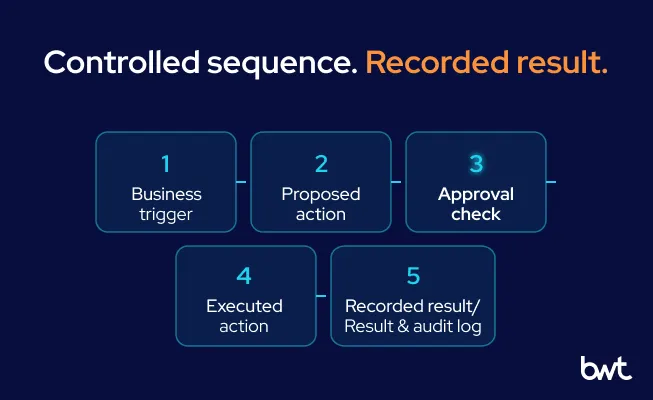
In practice, AI agents in finance evaluate the current task state, choose a permitted next step, use approved tools, and record their work. Traditional automation follows predefined rules; a copilot assists a person; an AI agent for finance can move a task forward.
A typical run moves from business trigger to permitted records, a proposed tool request, policy and approval checks, execution, and a recorded result. A named owner monitors exceptions and incidents.
“A finance agent should never receive broad tool access just because its answers look accurate. Give it the smallest action scope the workflow needs, record every attempt, and design recovery before the first write reaches a financial system.”
— Dmytro Naumenko, CTO at GroupBWT
The Right Finance Agent Starts With the Right Workflow
Use an agent when variable inputs change the next step but actions and outcomes remain verifiable. Stable rules are cheaper and safer to automate conventionally.
| Workflow signal | Better fit | Decision reason |
| Stable rules and predictable inputs | Deterministic automation | The behavior can be specified and tested without model judgment |
| Questions over approved documents, no action | Retrieval or RAG | The user needs a sourced answer, not execution |
| Prediction from structured features | Machine learning model | The task is scoring, not multi-step control |
| Variable evidence and bounded next steps | AI agent | Context changes, while actions and review criteria remain definable |
| High-impact, irreversible, or legally constrained decision | Human-led process with AI support is often the appropriate default | The system prepares evidence; accountable authority and controls reflect the institution, jurisdiction, and risk |
AP exceptions justify an agent when evidence varies
Trigger: An invoice fails three-way matching. Evidence: Invoice, purchase order, receipt, vendor master, and policy. Permitted action: Classify the mismatch, request a record, or prepare corrected coding. Reviewer: An AP specialist approves posting changes. Measure: Exception age, reviewer minutes, correction rate, and reopened cases.
Exact matches still belong in deterministic automation. An agent can handle exceptions where documents disagree and the cause determines the next step.
Build the Data FoundationYour AI Models Need
We develop and manage custom data solutions, powered by proven experts, to ensure the fastest delivery of structured data from sources of any size and complexity.
We offer:
- Custom Web Scraping & Development
- 15+ Years of Engineering Expertise
- AI-Driven Data Processing & Enrichment
A standard scheduled report does not need an agent
Trigger: Produce the same monthly report from governed tables. Evidence: Versioned measures and a fixed reporting calendar. Action: Refresh calculations and distribute the report. A BI schedule or deterministic pipeline is the better fit because neither the path nor output requires contextual choice.
Credit review can justify an agent-human split when evidence and next steps vary
Trigger: A file falls outside automatic decision thresholds or requires exception review. Evidence: Financial statements and supporting records, credit history, policy rules, and missing-document checks. Permitted action: Prepare analysis and a recommendation. Reviewer: A credit analyst makes the lending decision. Measure: Review time, applications per analyst, policy exceptions found, and override rate.
An AI consulting partner can map the task, evidence, systems, permissions, and review burden before development, then determine whether the right intervention is an agent, a smaller automation, or foundational data work.
GroupBWT’s Five Production Gates for Finance Agents
Before one candidate workflow goes live, define these five production gates:
- Action map: what the agent reads, recommends, prepares, or executes.
- Evidence contract: source-of-truth rules, business definitions, freshness, and conflict handling.
- Tool and permission design: available actions, required permissions, and approval conditions.
- Acceptance plan: task success, tool-action correctness, escalation correctness, attacks, failure scenarios, cost, and latency.
- Production ownership and recovery: monitoring, incident ownership, retries, corrective actions, and escalation.
Our AI agent development services cover workflow design, development, system integration, evaluation, production release, and post-launch support. The published AI prototyping for finance case shows a different boundary: synthetic data and evidence-grounded outputs can support a stakeholder demo without presenting it as a production agent. That case demonstrates prototyping and grounding, not connected-agent delivery.
Finance Agent Applications Span Two Common Operating Contexts
Corporate finance covers planning, accounting, treasury, and reporting. Financial services includes lending, insurance, investment operations, fraud and financial-crime review, and customer operations, where customer impact can raise the approval threshold.
| Operating context | Representative use case | Permitted agent output | Accountable review |
| Corporate finance | Close exception or treasury investigation | Evidence package, proposed coding, or flagged discrepancy | Finance process owner approves material changes |
| Financial services | Lending, fraud, or underwriting review | Case summary, policy check, or recommendation | Authorized analyst or risk owner makes the high-impact decision |
Corporate finance agents prepare work and surface exceptions
AI agents in corporate finance can collect planning assumptions, compare scenarios, and explain material variances. AI agents for FP&A are credible when assumptions and outputs trace back to source records. They become agentic AI use cases in finance when the system can choose among permitted next steps based on case context and advance the workflow; generated narrative alone is not enough.
During close, AI agents in finance and accounting may investigate mismatches and prepare journal support. In treasury, they may investigate payment exceptions, gather supporting records, and prepare them for review. AI agents for finance teams are useful when they remove evidence gathering without hiding judgment.
AI agents for financial services support high-volume review
They can prepare fraud cases, assemble AML/KYC evidence, analyze lending exceptions, and summarize underwriting files. The most useful finance-agent examples name the trigger, evidence, permitted action, reviewer, and measurable outcome.
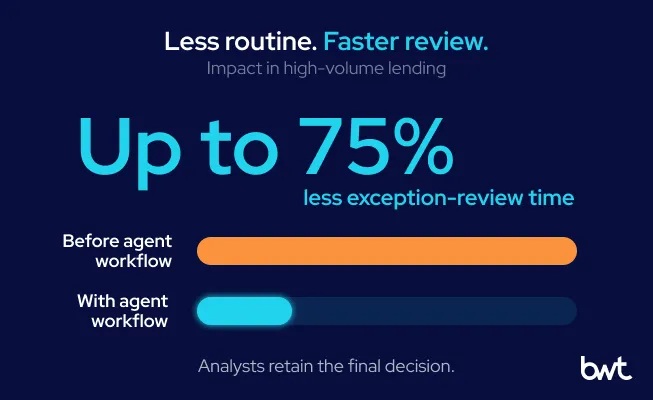
For a US fintech lender processing more than 2,500 SMB applications each week, our team built a five-agent credit-underwriting workflow. Connected to the lender’s loan-origination and OCR systems, the agents reconciled documents, recalculated ratios, assessed risk, checked policy, and assembled a credit memo. A human analyst made every final lending decision.
By reconciling flagged documents and recalculating financial ratios automatically in that single engagement, GroupBWT cut exception review time by up to 75%. The case demonstrates connected analysis, cross-agent handoff, policy checking, recommendation preparation, and human review – not autonomous approval or open-ended planning.
“When two financial records disagree, a second model does not create truth. The workflow needs a source-of-record rule, a visible reconciliation trail, and a clear reason for the analyst to accept or reject the recommendation.”
— Alex Yudin, Head of Data Engineering at GroupBWT
Finance Agent Architecture Enforces Permissions, Preserves Evidence, and Supports Recovery
After a run, the organization should be able to reconstruct what happened and correct it when necessary.
ERP, accounting, warehouse, documents, market feeds
Current task state, permitted next steps, transition rules
Requested read, preparation step, or restricted write
Proceed, request approval, or stop
The authorized tool performs the permitted action
Tool use, result, reconciliation, audit trail
Policy, access, and approval checks decide whether a proposed action may run. Our guide to big data analytics in financial industry explains the governed data beneath this flow.
When approved external records belong in that evidence layer, web scraping services can collect them under defined source and freshness rules. A data engineering services company can then connect those records to governed internal systems without giving the agent direct authority over ingestion.
| Action | What is recorded | Approval | If something goes wrong |
| Read | Source, timestamp, access scope | Usually policy-based | If access was improper: contain exposure, revoke or narrow access, review logs, and follow incident procedures |
| Recommend | Rationale, cited evidence, policy checks, tool log | Reviewer accepts or rejects | Discard the recommendation; retain the review log |
| Prepare a change | Proposed change, target system, expected effect | Approval before write | Cancel the pending change |
| Execute a reversible action | Approved request and access limited to the required action | Risk-based gate | Reconcile the result; run a corrective or offsetting action |
| Irreversible action | Required evidence, decision record, and accountable owner | Authority set for the institution, jurisdiction, and risk | No rollback; remediation or a corrective process may be required |
This record distinguishes a rejected recommendation, a blocked action, and a partial write, so each event follows the right handling and recovery path.
Also Read: Big Data Analytics in Finance: Use Cases, Technologies, and Real-World Applications
Threats must map to operational controls
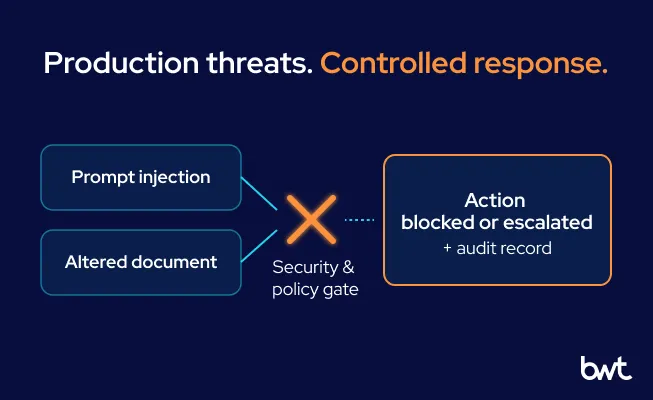
Prompt injection can arrive in an email, PDF, web page, or policy. Treat retrieved text as data, not authority. Keep its instructions separate from the agent’s rules, limit where tools can act, and validate each request. This reduces the risk that retrieved content can influence tool authority or change what the finance system is permitted to do.
Stale documents need freshness and version checks. Altered or untrusted documents need source and integrity verification. Sensitive fields need access controls, redaction, retention limits, and careful logs. Reading account data never grants permission to modify it.
After a successful write, a later failure must not create a duplicate. Give each logical action a retry-safe key that the receiving system recognizes, then verify the recorded result before retrying. This keeps one failed workflow from posting the same payment or journal change twice.
Google Cloud’s guidance on agent delegation supports verifiable sub-goals and minimum permissions for each assignment. Our gen AI development services connect the agent to approved evidence and tools, record its actions, and define what happens when a step fails. This gives the operating team a workflow it can inspect, stop, and recover.
Action Authority Determines Controls for Agentic AI in Finance
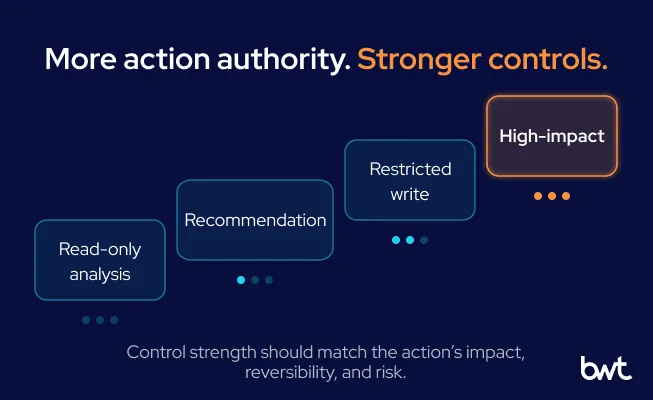
Classify finance agents by action authority, not maturity. A read-only agent can analyze evidence but not change systems. A recommendation agent proposes the next step; a human-approved agent waits before a change; limited autonomy covers narrowly defined actions under explicit policy, preferably reversible or recoverable ones.
Control strength depends on materiality, reversibility, customer impact, regulatory classification, monetary value, data sensitivity, permission scope, scale, and evidence quality. A correctable categorization may run automatically. A material journal entry may require approval and reconciliation. Credit approval, payment release, and account restriction need accountable authority suited to the institution, jurisdiction, and risk. Do not assume an agent can authorize itself.
Anthropic’s 2026 multiagent research found coordination failures outside finance: agents sometimes converged on incomplete information or acted destructively under incompatible goals. The transferable lesson is to design finance systems with conflict rules, independent checks where appropriate, and escalation rather than assume a multi-agent system will correct itself.
For agentic AI in finance, “human in the loop” is not a control specification. Name the reviewer’s evidence, authority, rejection path, and recovery responsibility.

Agent ROI Starts With a Finance Workflow Baseline
The ROI of implementing AI agents in finance starts with baseline volume, cycle time, review effort, correction rate, backlog, and the financial cost of delay.
Use two calculations for different questions:
- Net benefit = monetized workflow benefit – total program cost over the measurement period. This is the absolute value created during that period.
- ROI = (monetized workflow benefit – total program cost over the measurement period) / total program cost over the measurement period x 100%. This compares net benefit with the investment required.
Faster review or higher throughput becomes a financial benefit only when tied to avoided hiring, reduced backlog, or additional demand processed. Total program cost includes implementation, integration, model use, evaluation, human review, monitoring, incidents, and support.
The benefits of AI agents in the finance industry need paired measures: cycle time with reopen rate, throughput with exceptions, backlog with SLA age, and automation with evidence completeness.
The 2025 arXiv survey When AIs Judge AIs suggests evaluator agents with calculators for numerical consistency and arithmetic checks. This could catch a correct-looking memo whose totals do not add up. It is a research direction, not measured finance performance.
How to Evaluate an AI Agent Before Production in Finance
Production readiness is demonstrated through controls and operating evidence. For AI agents in financial services, a demo covers only the tested paths. Pre-release acceptance tests cases, permissions, attacks, failures, cost, and latency. Sustained evidence comes from pilot and production monitoring, where teams can observe exception quality and operating stability over time.
Before release, teams should:
- test representative cases withheld from workflow tuning, including expected outputs, tool choices, permission decisions, escalation paths, and failure recovery;
- run prompt-injection, altered-document, improper-access, duplicate-action, and partial-tool-failure cases;
- confirm escalation paths with the actual reviewers;
- reconcile system state after partial or failed writes;
- measure latency and cost at representative volume;
- name the team that owns monitoring, incidents, and changes.
The Federal Reserve’s SR 26-2 introducing the agencies’ 2026 Revised Guidance on Model Risk Management states that model risk management should fit an institution’s risk profile, size, and complexity. Its more-than-$30-billion threshold describes the expected relevance of this Federal Reserve letter, not a universal threshold for finance organizations.
Microsoft Research’s Orchard framework supports testing agents in the deployment environment rather than a simplified stand-in. For finance, the transferable engineering lesson is to test the same orchestration, tools, permissions, and failure conditions the agent will face in production.
“A production owner does not need to inspect every successful run. They need to know when the workflow left its expected path, who can stop it, and whether the safest response is to retry, reverse, or hand the case to a person.”
— Oleg Boyko, CCO at GroupBWT
Start With the Smallest Safe Action Boundary
Start with one measurable workflow when implementing a finance agent. Expand authority only when the additional action is justified and its controls pass production acceptance.
A finance AI agent can choose and carry out a permitted next step when the case changes. A copilot assists the person; deterministic automation follows predefined rules.
Exception-heavy reconciliation, credit-file preparation, close investigation, and evidence assembly may fit when the baseline is measurable. Stable calculations, scheduled reporting, and pure prediction usually do not.
Match autonomy to the action’s customer, financial, regulatory, and recovery impact. Record who holds accountable authority.
They need current source records, consistent definitions, historical exceptions, and clear ownership. More data does not fix contradictory definitions.
Often, yes. Deterministic automation is easier to test when rules and inputs are stable. An agent earns its complexity when context varies and its permitted actions remain verifiable and constrained.
The strongest use cases combine variable evidence, repeatable review criteria, and bounded next steps. Examples include reconciliation exceptions, credit-file preparation, payment investigations, close support, and evidence assembly for fraud or underwriting review.
A finance copilot analyzes, explains, or drafts while a person advances the task. An AI agent can choose and perform a permitted workflow step through approved tools, subject to its evidence, permission, and approval rules.
Measure the workflow before implementation, then compare monetized gains from cycle time, capacity, backlog, or error reduction with implementation and operating costs over the same period. Pair every speed or volume measure with a quality or control measure.
They need least-privilege access, source and evidence rules, action-specific approvals, complete tool and decision logs, escalation routes, duplicate-action protection, monitoring, and a tested recovery path.
Read summarized version with
Build the Data FoundationYour AI Models Need
We develop and manage custom data solutions, powered by proven experts, to ensure the fastest delivery of structured data from sources of any size and complexity.
We offer:
- Custom Web Scraping & Development
- 15+ Years of Engineering Expertise
- AI-Driven Data Processing & Enrichment