
Read summarized version with


A production manager sees one downtime figure in the morning meeting. Finance sees another in the monthly report. The maintenance team has the work-order history, but its asset IDs do not match the equipment names in the plant historian. Everyone has data. Nobody has a number they can defend from source to decision.
Data governance in manufacturing gives that disagreement an owner and a set of controls teams can actually enforce. For each product, asset, batch, supplier, or quality record, it states who owns the definition, which standard applies, who can use it, and what proves the rule worked. The point is practical: teams should be able to act on production, quality, traceability, and investment data without rebuilding the answer by hand. Other tables can enter the scope later, once the critical decision path is stable.
Make One CriticalData Path Accountable
We map ownership, definitions, controls, and evidence around the manufacturing decision that matters first.
The engagement can cover:
- Data ownership & stewardship
- Quality, lineage & access controls
- Control implementation in data pipelines
A manufacturer can run reliable pipelines and still argue over which downtime figure is valid. Moving and storing the records is data management. Governance answers the questions the pipeline cannot: who approves the definition, which source wins, who may change it, and where an exception goes. When those decisions stay implicit, accountability disappears inside the architecture.
Key Takeaways
- Govern the data behind important manufacturing decisions first.
- Name who approves each definition and who handles its exceptions.
- Keep governance controls out of safety-critical OT control loops.
- Require operational evidence for data quality, lineage, access, and identity controls.
- Measure governance reliability separately from plant performance.
- Scale only after the first governed scope works in daily operations.
What Manufacturing Data Should Be Governed First?
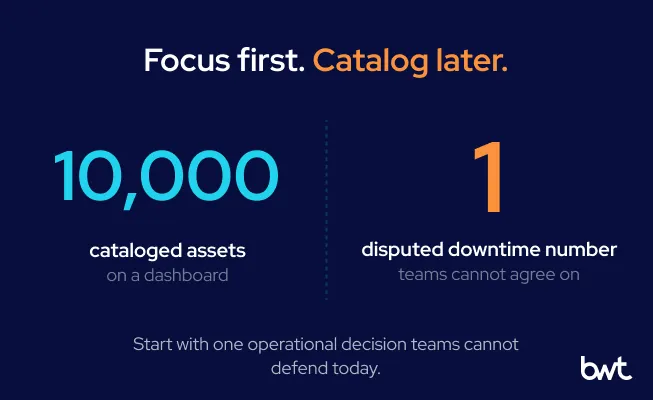
Govern the manufacturing data that can change a decision. Start with records that can stop a line, release a batch, alter a production plan, change a supplier decision, or invalidate a report. Prioritize these records before expanding governance to the wider enterprise catalog. Those records usually cross systems and teams, which is why their definitions drift first.
The inventory starts with the records people use: bills of materials (BOMs), specifications, drawings, engineering changes, production orders, shift events, equipment identities, sensor readings, inspections, batch genealogy, supplier records, materials, and the master data that connects them.
Environmental or compliance records enter the governed set when they influence a named obligation or operating decision. The same test applies to spreadsheets and operator notes. Their format does not make them low priority. A spreadsheet that determines batch release deserves more control than a well-cataloged table nobody uses.
Choose the first scope by asking what decision fails when a record is wrong, how many teams reuse it, and who can approve a change to its definition. Start where getting the data wrong has a real operational consequence. Cataloging ten thousand assets can produce a busy dashboard while the plant still debates which downtime number is valid.
Who Owns Manufacturing Data Governance?
Manufacturing governance needs owners and controls. A working operating model combines human authority with controls enforced in the relevant systems and workflows. An owner approves the rule. The system checks it, and a named person handles the exception. Otherwise, governance meetings and automated alerts accumulate while the disputed data stays disputed.
Owners decide; stewards keep the decision usable
A domain owner approves the meaning of a critical field or key performance indicator (KPI). A steward maintains its definition, allowed values, and exception process. Engineering teams implement the relevant technical controls across data platforms, OT systems, applications, security, and identity services. Operations, quality, maintenance, or manufacturing engineering retains authority over the operational risk.
There is no universal assignment. Equipment data can belong to operations, maintenance, or manufacturing engineering. The deciding factor is who owns the asset lifecycle. Start with the table, then change it to match that accountability.
| Data domain | Possible accountable owner | Operational steward | Control responsibility |
| Product and BOM | Product or engineering leader | PLM specialist | Version, change approval, canonical product ID |
| Equipment and telemetry | Operations, maintenance, or engineering leader | Plant OT engineer | Asset mapping, timestamp, signal quality |
| Quality and genealogy | Quality leader | Plant quality analyst | Batch links, release status, evidence retention |
| Supplier and material | Supply-chain leader | Procurement data steward | Supplier ID, material definition, exception review |
Product lifecycle management (PLM) teams often maintain engineering definitions. Accountability still sits with the business function that carries the risk of a wrong revision.
Four control families turn ownership into evidence
Decision controls define who may approve a field or KPI. Quality and identity controls check required fields, timestamps, units, duplicates, and links to canonical IDs. Access and lifecycle controls govern sensitive formulas, quality records, commercial terms, and retention. Traceability and monitoring controls connect a reported figure to its source and show whether freshness and access rules continue to hold.
Central teams can own global identifiers, minimum security rules, and definitions used in consolidated reporting. Plant teams should own local context and valid operational exceptions. Teams often bypass a global standard when it cannot represent a legitimate plant exception. Record each approved local exception, or plants will gradually apply incompatible definitions.
The plant-level test is blunt. At 2 a.m., a quality alert leaves no room for an ownership debate. The on-call person needs to know who can approve the correction, who gets notified, and whether to block or label the record. A policy deck sitting elsewhere will not answer the alert.
Govern Operational Data Without Slowing the Control Loop
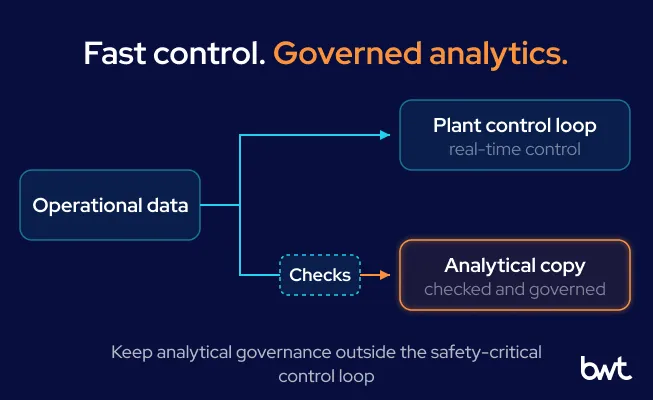
Governance should follow a record from its source to the person or system acting on it. A separate portal may document that route, but the relevant systems and workflows still have to enforce ownership, certification, and stewardship decisions. This keeps enterprise governance software out of a safety-critical runtime while operational data remains governed.
Operational sources still need governance
Operational technology (OT) is the machinery-facing control environment. Machine state comes from programmable logic controllers (PLCs), supervisory control and data acquisition (SCADA), sensors, and historians. Orders, batches, inspections, product versions, and costs come from manufacturing execution systems (MES), quality management systems (QMS), PLM platforms, and enterprise resource planning (ERP) systems.
At this source level, governance covers asset identities, timestamp standards, calibration records and metadata, configuration changes, access, retention, and audit evidence. Those controls belong in the systems and processes approved for plant operations. A changed controller configuration, a stale calibration record, or an untraceable asset ID can corrupt every analytical copy downstream even when the pipeline itself runs perfectly.
Analytical enforcement belongs outside the control loop
A latency- or safety-critical control decision cannot wait for an analytics-governance network call. NIST SP 800-82 Rev. 3 treats performance, reliability, and safety as distinct OT requirements, so critical control logic remains in the approved OT control environment. The analytical copy can carry the heavier controls: validation, business context, lineage, and certification for cross-plant reporting, analysis, or model training. Plant control keeps running while downstream teams gain a record they can inspect.
| Data-path layer | Governance control | Evidence that the control worked |
| Operational source | Asset identity, calibration metadata, configuration, access | Approved change and calibration records |
| Ingestion | Schema, unit, timestamp, and identity checks | Rejected-record log with owner and resolution |
| Storage and transformation | Versioned rules, lineage, and access policy | Transformation history and access decision log |
| Published data product | Certified definition, freshness target, owner | Certification record and freshness history |
NIST’s Advanced Manufacturing Data Infrastructure and Analytics Program identifies trusted and reproducible information workflows, interoperability, and supply-chain traceability as manufacturing infrastructure goals. That is the architecture test: a governed flow should be reproducible, not merely visible on a diagram.
Each Use Case Must Link Data, Control, and Outcome
If the team cannot name the decision, the data behind it, the control that makes that data trustworthy, and the signal that proves improvement, the use case is not ready for the governance roadmap. “Better data quality” says too little. Measure a shorter investigation or fewer disputed KPI definitions instead.
| Manufacturing decision | Required data | Governance control | Outcome to measure |
| Compare line performance | MES events, shift calendar, asset hierarchy | Shared Overall Equipment Effectiveness (OEE) definition and asset IDs | Fewer cross-plant KPI disputes |
| Release a batch | Test results, batch genealogy, product version | Approval status, retained evidence, source lineage | Time to assemble release evidence |
| Investigate supplier quality | Supplier lot, inspection, material, defect record | Canonical supplier and lot IDs | Time from defect to affected lots |
| Find and verify current engineering data | Drawing, specification, change record | Version ownership and source traceability | Time to find and verify current file |
The engineering-data example is direct. A European electric-motor manufacturer had drawings, winding data sheets, spreadsheets, SAP records, and Microsoft 365 files spread across six systems. Engineers spent up to an hour finding and checking a document. By designing one governed search layer that kept SAP as the system of record, linked every answer to the original file, and routed low-confidence drawing values to an engineer, GroupBWT helped reduce document lookup from up to an hour to seconds across more than 3,600 motor variants, as documented in the published engineering data management case.
That result came from a chain of controls. Source authority stayed explicit, extraction confidence triggered human review, and every surfaced value cited the original drawing. An engineer can verify which source document informed the answer. The case proves engineering-data governance; the plant-floor example below carries the telemetry evidence.
Predictive maintenance needs stable asset identities, maintenance outcomes tied to the correct machines, and sensor history that separates normal operating modes from faults. Governance cannot promise less downtime by itself. It can show whether the inputs are complete, current, and attached to the right asset before a maintenance model reads them.
At a European industrial pump manufacturer, GroupBWT connected telemetry, repair history, and production constraints from SAP ERP, Siemens Opcenter MES, SCADA, PLC, and IoT systems across three plants and 14 production lines. Each maintenance case retained the original alert, the agents’ proposed work and repair window, the engineer’s approval, and the system change that followed. By combining that governed record with condition-based maintenance and two planning agents, GroupBWT helped cut unplanned downtime hours by 31% across the monitored lines over six months, according to the published predictive-maintenance case. The 31% result belongs to the full predictive-maintenance system, not to governance alone.
Digital twins and AI consumers add another boundary. Their outputs need traceable, approved inputs and permissions that match the action. The dedicated guide to AI-Ready Data for Manufacturing covers model preparation in depth; this article keeps the focus on ownership and control evidence.
How to Implement Data Governance in Manufacturing
Implement controls around one disputed decision. Begin where a business decision already hurts. A disputed cross-plant quality figure, an engineering-document search, or batch-release evidence assembled by hand gives the program a concrete finish line. Starting with a platform purchase or an enterprise catalog makes progress harder to judge.
Map the current decision and its evidence
Name the decision, its accountable owner, and the delay or error the work should reduce. Follow the record from source through files, integrations, transformations, reports, and manual corrections. Agree on the product, asset, batch, supplier, location, unit, status, and KPI definitions needed for that decision.
Build controls, then automate repeatable exceptions
Assign approval, stewardship, implementation, monitoring, and exception handling. Put structure, identity, unit, timestamp, access, and freshness checks where failures enter. Store lineage, approvals, failed checks, access decisions, and issue resolution with the pipeline run or data product.
Manual review is acceptable during the first release. It shows which exceptions recur and who can resolve them. Automate those repeatable decisions after the team agrees on the rule; an undefined quality check only creates confusion faster.
Manufacturing Data Governance Best Practices
Use these principles to keep the first scope practical:
- Govern decisions first, not every available dataset.
- Assign accountable owners for definitions and exceptions.
- Maintain canonical identities across systems.
- Preserve lineage from the source to the decision.
- Keep analytical controls outside critical OT control loops.
- Route exceptions to a named person.
- Automate only rules the team already understands.
A single plant with stable ownership and a handful of critical definitions may be able to do this internally. Expand only after the first scope survives daily operation.
What the first governed scope produces
The first scope should leave the team with a decision-to-data map, named owners and stewards, agreed critical definitions, a control matrix, automated checks where they are practical, source-to-output lineage, an exception workflow, and success criteria for the next review. GroupBWT uses these working artifacts to move the next operating review away from another maturity score or policy inventory.
GroupBWT’s governance work becomes useful when governance crosses plants, OT and IT teams, platforms, reporting layers, or audit boundaries that no single owner can resolve. These are common manufacturers data governance challenges when several teams must approve the same definition or exception.

How to Measure Manufacturing Data Governance Success
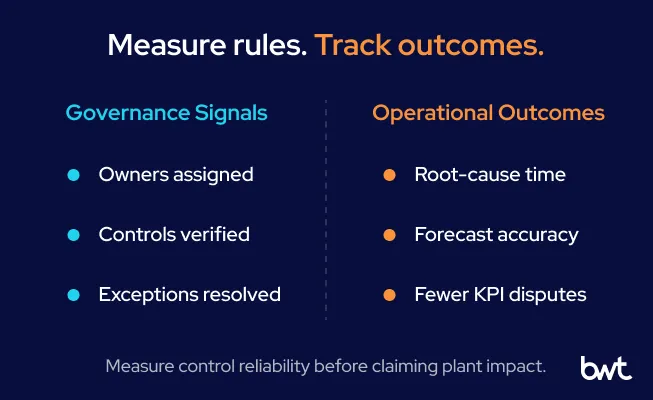
Measure control reliability before claiming plant impact. Governance metrics should show whether controls operate. Manufacturing metrics should show whether the business decision improved. Keep the two sets separate until the causal link has been tested.
Leading signals show whether the controls run
Track the share of critical data products with named owners, lineage coverage for business-critical KPIs, quality-rule pass rates, freshness compliance, access exceptions, and time to resolve an issue. These measures tell the team whether ownership and controls work as designed.
| Governance signal | How to measure it | Next decision |
| Critical-domain ownership | Approved owner and steward per priority domain | Escalate unowned domains before adding tools |
| End-to-end lineage coverage | Share of business-critical KPIs traceable to source | Fix gaps in the highest-consequence KPI |
| Quality-control reliability | Pass, block, and exception rates by rule | Retire noisy rules or correct the source |
| Issue-resolution time | Alert to verified closure by severity | Change ownership or automate recurring fixes |
Operational outcomes need separate attribution
Reporting consistency, root-cause time, defect investigation time, downtime, forecast accuracy, and audit preparation effort show whether the business changed. Governance may influence them, but maintenance practice, equipment condition, process changes, and staffing also move the number. Report which control changed, which decision it affected, and what else changed during the same period.
One practical way to read maturity is through observable behavior, not a score. A fragmented program cannot name owners. A defined program has standards but relies on manual evidence. A governed program runs checks and records exceptions. An automated program routes repeat failures and tracks closure. An AI-ready program extends the same ownership, lineage, access, and quality discipline to model inputs and actions.
Use those signals to choose the next investment. If definitions are unstable, observability will produce precise alerts about inconsistent data. If owners are clear but evidence is manual, automate lineage and control logs. If both hold, GroupBWT can help extend the controls to the next plant or consumer.
The Fastest Programs Know What Not to Govern Yet
Trying to govern every asset at once is one failure mode. Treating governance as an IT project while operations and quality join after the rules are built is another. Buying a catalog before deciding who owns the definitions leaves the hardest decision untouched.
Controls can also hurt operations. A validation rule that blocks a production-critical feed with no fallback can turn a quality problem into an outage. Match the response to the consequence: block a dangerous record, quarantine one that needs review, or warn an owner while a low-risk feed continues.
Policy counts, catalog coverage, and meeting attendance show activity. A plant trusts the number only when a critical KPI has one definition, its lineage remains intact, exceptions reach an owner, and the correction survives the next load.
Also Read: Manufacturing Data Management: Framework, Architecture, and Best Practices
Put Governed Manufacturing Data Into Operation
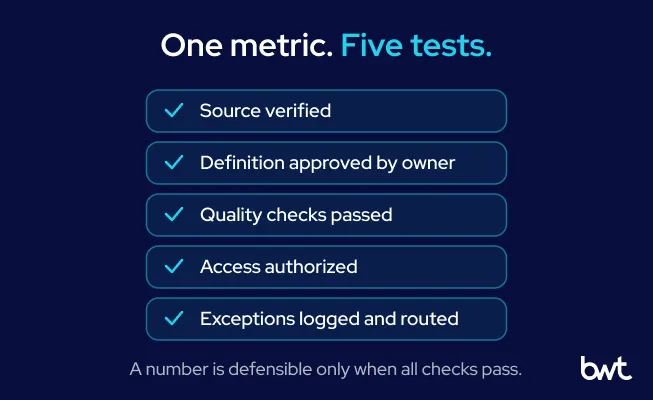
Data governance for manufacturing begins with a decision that teams cannot defend today. Trace its data, name its owner, agree on the critical definitions, put controls where errors enter, and retain evidence of exceptions. Then use the evidence to decide where the approach belongs next.
The guide to manufacturing data analytics explains how governed plant data becomes KPIs, forecasts, and root-cause analysis. Governance makes those outputs defensible while the analytics layer still does the forecasting and root-cause work.
A plant should be able to explain where a number came from, who owns its meaning, which rule checked it, who may use it, and what happened when the rule failed. GroupBWT treats those answers as the test that governance has moved from policy into production.
Governance for manufacturing data is the system of decision rights and controls applied to product, production, equipment, quality, supplier, and master data. It assigns ownership, defines standards, controls access, records lineage, and routes exceptions. Data management performs the daily movement and use of data under those rules.
Start with data behind a high-consequence, frequently repeated decision. Common candidates include batch release, cross-plant reporting, product changes, defect traceability, and maintenance planning. Prioritize records that cross several systems and lack one accountable owner.
Enterprise domain owners approve shared identities, definitions, and minimum controls. Plant-level stewards supply local context, manage valid exceptions, and respond when a rule fires. Engineering teams implement the relevant controls across data platforms, OT systems, applications, security, and identity services, while operations, quality, maintenance, and security retain authority over their respective risks.
Connected manufacturing needs reliable context around every signal. Governance ties machine readings to assets, batches, products, owners, permissions, calibration, and source history so digital twins, analytics, and AI consume data the plant can trace. It keeps analytical enforcement outside latency-sensitive production control.
Measure whether critical domains have owners, whether business-critical KPIs trace to source, whether quality and freshness rules run reliably, and how quickly exceptions reach verified closure. Track operational outcomes separately until the team can show how a specific control changed a specific decision.
Read summarized version with
Make One CriticalData Path Accountable
We map ownership, definitions, controls, and evidence around the manufacturing decision that matters first.
The engagement can cover:
- Data ownership & stewardship
- Quality, lineage & access controls
- Control implementation in data pipelines