Read summarized version with


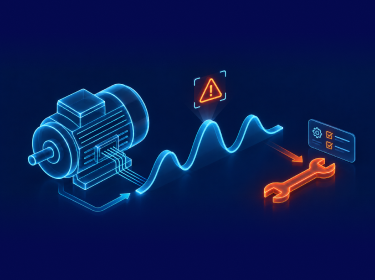
A maintenance model flags a spindle that may fail. The warning is useful, but it does not check whether the part is in stock, find a repair window, prepare the work order, or show a production engineer which customer orders the repair could delay. Those steps still sit across separate systems and separate people.
AI agents for manufacturing can coordinate that work. An agent receives a goal or signal, gathers approved context, chooses the next permitted step, and, when needed, uses connected tools to prepare or execute an action. The useful distinction is not whether the interface feels intelligent. It is whether the system can move a real workflow forward while permissions are enforced and evidence, approvals, and recovery remain traceable.
Related AI & Data Services
Put One ManufacturingWorkflow Under Control
GroupBWT designs bounded AI-agent workflows that connect approved plant systems without handing critical decisions to a black box.
The engagement can cover:
- Workflow and permission design
- ERP, MES & CMMS integration
- Evaluation, audit & recovery controls
That makes agentic AI in manufacturing a workflow design decision before it becomes a model decision. Permission before autonomy is the governing thesis: a plant should first define which operational decision or workflow step the agent is meant to change, which systems supply the evidence, what the agent may read, propose, or execute, and who can approve or stop the action. GroupBWT starts with one bounded process, then tests whether the orchestration produces an accepted business result rather than merely completing a chain of tool calls.
Key Takeaways
- Use an agent when the next permitted step requires contextual interpretation that predefined rules cannot capture reliably. Keep deterministic automation where rules cover the relevant conditions and exceptions.
- Put policy and access checks before every protected read or write. Human approval is an action control, not a substitute for identity and permissions.
- Separate prediction from orchestration. A model detects an anomaly or estimates risk; an agent can gather context and prepare the operational response.
- Define an accepted output before the pilot begins. A completed tool sequence can still arrive late, miss a constraint, or leave the owner with unusable output.
- Begin with a low-risk workflow whose actions can remain in draft, be reversed, or be safely recovered. Name the result owner and test the recovery or escalation path for tool failures. Multi-agent scope is an architecture choice, not a maturity badge.
- Measure exceptions and rejected actions as carefully as successful runs. They show where the workflow encounters missing context, policy boundaries, unresolved exceptions, or judgment the system should not carry.
Where manufacturing agents remove operational delay
The early value is not “more AI.” It is less coordination work between a signal and an accountable response.
| Business problem | What the agent changes | Useful measure |
| A maintenance warning requires several people to assemble a response | Collects repair context and prepares an approval-ready plan | Alert-to-plan time and planner handling time |
| A material or line exception breaks the production schedule | Evaluates current constraints and prepares a revised schedule proposal | Exception-resolution time and proposal acceptance rate |
| A quality investigation spans several systems | Assembles the product, inspection, and process evidence into one case | Investigation handling time and missing-evidence rate |
| A parts request requires stock, supplier, and policy checks | Validates the request and prepares a requisition for the authorized owner | Review time and share accepted without material correction |
These measures need a baseline from the existing workflow. Record when the case starts, how much active handling it requires, when an accountable owner receives a complete proposal, and whether that person accepts it without a material correction – a change to the recommendation, constraints, source data, action, or timing rather than a wording or formatting edit. A shorter elapsed time means little if the agent shifted missing checks to the reviewer. The better result is a proposal that arrives sooner because the workflow assembled the right evidence, tested the known constraints, and made the remaining judgment visible.
This value framing also keeps the technical design honest. Identity, authorization, tool constraints, audit logs, and recovery paths are part of the production design, not governance added after the business case. They allow the plant to reduce coordination without losing control of who may act, on what evidence, and what happens when execution fails. Controls required for security, compliance, or source-system integrity remain baseline requirements. Beyond those, each additional control should address a credible workflow risk rather than be added by default.
When Should Manufacturing Use an AI Agent?
Agentic AI in manufacturing is most useful when a process cannot be reduced reliably to one prediction or a predefined sequence. The system interprets context, chooses a permitted next step, and may use approved tools, inspect the result, and continue or escalate. That is a narrower job than the broad AI in manufacturing landscape, which includes forecasting, computer vision, optimization, and predictive models.
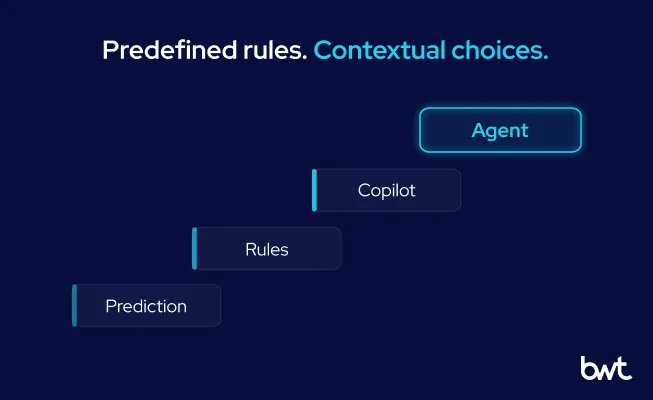
The first design question is whether the next step can be expressed reliably as a predefined rule or requires contextual interpretation to choose the next permitted action.
| System type | What it does | Best fit | Main boundary |
| Predictive model | Estimates a class, value, anomaly, or future event | Failure risk, demand, defect probability | By itself, does not coordinate the operational response |
| Robotic process automation (RPA) or rules engine | Executes predefined rules, including branches and fallbacks | Stable forms, transfers, validations, and known exceptions | Needs explicit rule coverage or escalation when relevant context falls outside the predefined logic |
| Copilot | Assists a person with retrieval, analysis, drafting, or recommended actions | Search, summaries, instructions | A person normally remains the primary workflow operator |
| AI agent | Selects permitted steps and may call approved tools toward a goal | Workflows that require contextual choice | Needs permissions, evaluation, recovery, and audit |
A production-order transfer with fixed fields and known exceptions may need RPA, not an agent. A technician asking for the current service manual may need a retrieval assistant. A model that spots bearing drift is still a predictive model. The agent becomes useful when the next action depends on live parts availability, production commitments, maintenance capacity, safety rules, and the result of prior tool calls.
This test also protects the plant from unnecessary complexity. Agentic AI systems for manufacturing introduce another runtime, another identity, another evaluation surface, and a new way for a bad instruction to travel across systems. If a deterministic process can handle the work, use it. The agent earns its cost when adaptive decisions materially reduce coordination work, delay, or error without obscuring who remains accountable.
For agentic AI in manufacturing, the production implication is practical: action capability and control need to advance together.
One practical warning deserves emphasis. Do not label every AI-assisted workflow an agent. A browser script, an extraction pipeline, or a natural language processing (NLP) classifier does not become agentic because a model appears inside it. What makes the workflow agentic is that a model participates in deciding how to pursue a goal across steps, using available context and, when needed, permitted tools rather than following only a fully predefined path. Production implementations may still use deterministic orchestration, policy checks, and explicit exception handling around that model-directed decision-making.
How Does an AI Agent Work in Manufacturing?
AI Agent Architecture for Manufacturing
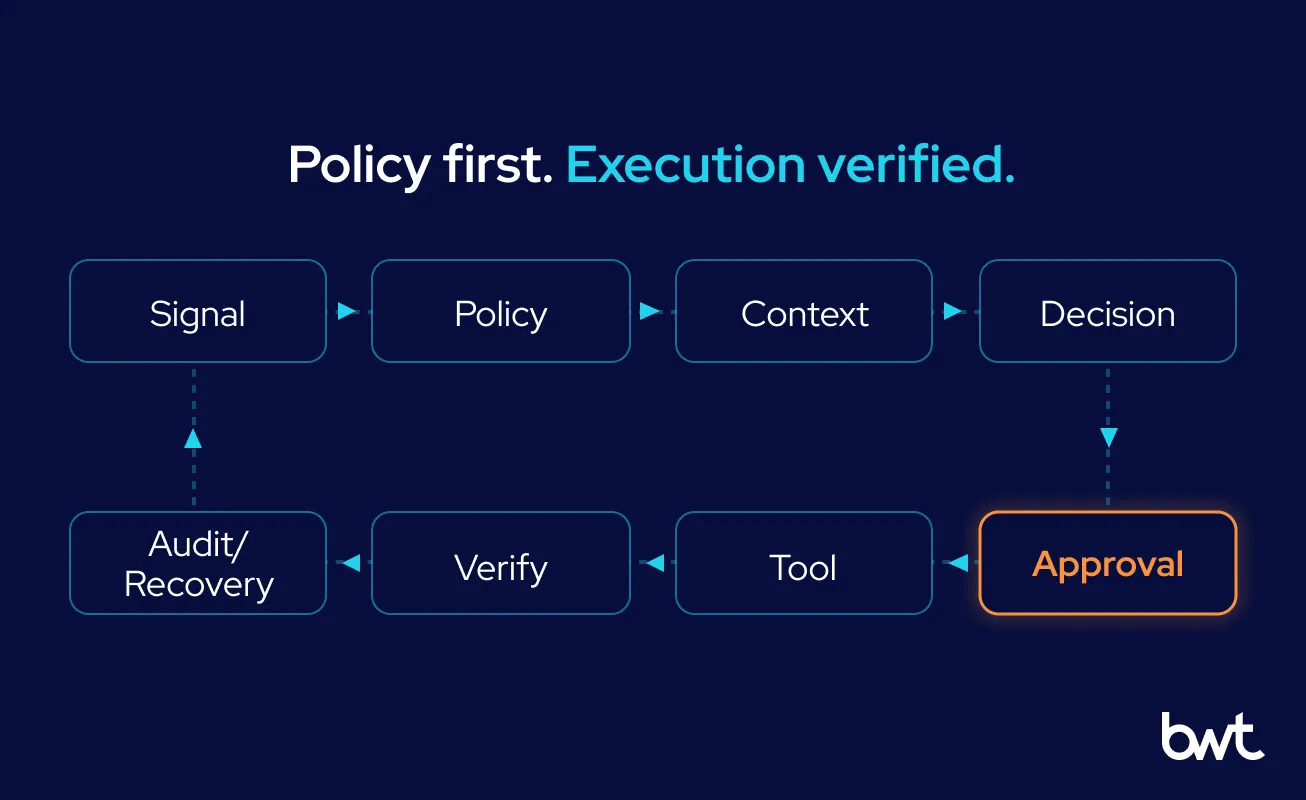
A controlled manufacturing agent follows this path: signal or authorized request -> identity and policy checks -> approved context -> agent reasoning and orchestration -> action gate -> approved tool -> verification -> audit and recovery. The gate applies before the governed action, while the final record preserves the evidence, decision, execution result, and recovery state.
A safe manufacturing agent begins with bounded authority, not broad access. The workflow checks policy and identity first, retrieves only the permitted context, evaluates the next step, and places any high-impact change behind the required approval. Execution follows the gate. Verification closes the operational loop, and the audit record preserves what happened.
A useful sequence looks like this:
- A validated signal or authorized user request opens a case.
- Policy checks outside the model determine which data and tools this agent identity may use.
- The agent uses approved read paths to gather the minimum context needed for the decision.
- It evaluates that context and proposes the next permitted action or plan.
- Policy rules test the proposed write or operational action.
- A named person approves high-impact actions that can materially affect safety, production commitments, customer commitments, or spend.
- An approved tool executes the change and records the result.
- The workflow verifies the result, closes the case, or escalates with its evidence intact.
Order matters. If the agent reads protected maintenance records before access is checked, a later approval cannot repair the exposure. If it posts a work order before the production owner sees the affected schedule, the approval has become documentation after the fact.
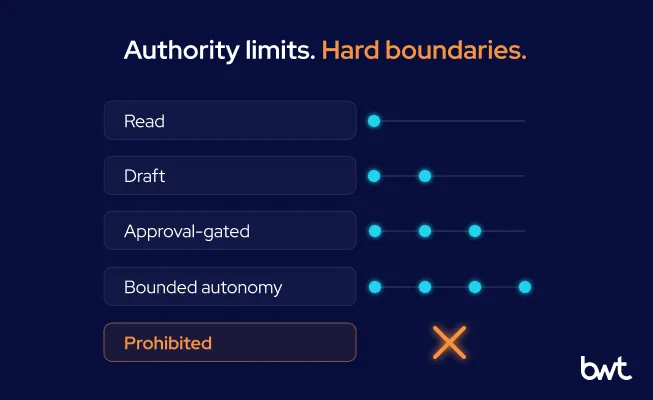
The controls are easier to reason about as a permission ladder, followed by a hard boundary. The ladder describes increasing action authority, not data sensitivity; protected reads still require their own access controls.
| Permission level | Typical action | Required control | Example |
| Read | Retrieve approved context | Role and source-level access policy | Read an existing work order |
| Draft | Prepare an uncommitted artifact | Evidence links and schema validation | Draft a maintenance task |
| Approval-gated action | Change a system after review | Named approver and recorded decision | Release the work order |
| Bounded autonomous action | Execute a low-risk action within a predefined operating boundary | Predefined policy, limits, verification, and recovery or compensating action | Route a completed maintenance case to the next approved workflow state |
Actions outside the workflow’s defined authority are prohibited. In this architecture, the agent does not directly control safety-critical equipment or bypass safety interlocks.
Human approval belongs at the risky action, not at every routine, already-authorized read. Force a person to approve routine retrieval and the queue soon becomes a rubber stamp. Nor does a person in the loop make the underlying data access safe. Authorization should be enforced outside the model, at the identity, policy, tool, or integration layer. Authentication, least privilege, logging, and source-system rules still govern the agent before anyone sees a recommendation.
The hardest design choice is often what the agent may not do. Dmytro Naumenko describes the line this way: “Autonomy is not the number of steps an agent completes alone. It is the precision of the boundary around the next action. If the system cannot show what evidence supported a write, who could stop it, and how the workflow would recover or compensate if it went wrong, the workflow is not ready for production.” — Dmytro Naumenko, CTO at GroupBWT
One agent or several?
A single agent can manage a narrow manufacturing process when its tools, context, and decision policy fit one bounded responsibility. Split the design when independent responsibilities need different permissions, evidence, or owners. A maintenance-planning agent may read repair history and prepare a work order, while a scheduling agent reads production commitments and proposes the least disruptive window. Neither necessarily needs the other’s write permissions.
A 2025 Journal of Manufacturing Systems review distinguishes LLM-based agents, multimodal LLM-based agents, and Agentic AI, while noting that their definitions, capability boundaries, and practical applications in manufacturing remain unclear. Define responsibilities from the work itself; “multi-agent” is an architecture choice, not a higher maturity badge.
Siemens offers a current industrial-software example. A 2026 Google Cloud account of Siemens’ modernization workflow describes five agents with separate jobs: search, user stories, architecture impact, task breakdown, and coding. A graph-based knowledge layer preserves structural relationships across the codebase that flat text retrieval can lose. This is an industrial software example, not evidence of autonomous plant control, but it shows why a complex industrial workflow may benefit from separate agents when responsibilities, context, and outputs differ.
Agentic AI Use Cases in Manufacturing Start With the Action
Generic lists blur the difference between AI and agents. Predictive maintenance, defect detection, and demand forecasting can all produce valuable signals without any agent. Agentic AI becomes especially useful in manufacturing when a variable workflow must interpret context, choose the next permitted action, coordinate relevant systems or people, and preserve the decision record.
Maintenance coordination after a validated warning
Trigger: An anomaly-detection or predictive-maintenance layer produces a validated equipment warning.
Agent action: The agent collects parts, open work orders, instructions, technician availability, production deadlines, and available production capacity. It drafts a repair plan and routes high-impact choices to the appropriate engineer or operations owner.
Result: The predictive layer remains measurable by warning quality and lead time. The agent is assessed by evidence completeness, correct routing, accepted work orders, decision time, and correct escalation and recovery behavior.
Production exceptions that cross planning and operations
Trigger: A late material, unavailable line, or changed order priority invalidates the morning schedule.
Agent action: The agent gathers current constraints, tests permitted scheduling options, and prepares a revised plan without silently rewriting production commitments.
Decision owner: The production owner sees which orders would move, which constraints drove the recommendation, and the relevant alternatives considered before approving a commitment change.
Quality cases that require investigation, not just detection
Trigger: A computer vision system detects a defect.
Agent action: The agent opens the associated case, retrieves the product revision and inspection criteria, adds recent process readings, and routes the evidence to quality engineering.
Decision owner: An authorized quality owner decides the disposition unless an approved rule already covers that class of low-risk case.
Procurement and inventory workflows
Trigger: A maintenance parts request requires checks across several approved sources.
Agent action: The agent compares the request with approved suppliers, current inventory, lead times, and purchasing policy before preparing a requisition.
Result: The goal is to reduce repetitive collection and checking while preserving the approval path. Useful measures include handling time, missing-data exceptions, and the share of requisitions accepted without material correction.
Do not start with the longest use-case list. Start with the handoff that already consumes attention and has a measurable consequence. A manufacturing AI agent that materially shortens one repeated coordination handoff is easier to defend than a broad assistant searching for a purpose.
The cost to build a custom agent for a manufacturing workflow follows the same logic. Integration count alone does not determine implementation effort. Scope also grows with the number of permission domains, exception classes, evidence requirements, evaluation cases, and recovery paths. A read-only assistant over one curated source is a different engagement from an action-taking workflow spanning enterprise resource planning (ERP), manufacturing execution systems (MES), and computerized maintenance management systems (CMMS).
Also Read: Generative AI in Manufacturing: Use Cases, ROI, Architecture, and a Working Pilot Path
ERP, MES, SCADA, and CMMS Integration Must Preserve System Authority
Plant systems usually divide responsibility. ERP commonly owns enterprise planning, purchasing, inventory, and financial transactions. MES manages production execution. Supervisory control and data acquisition (SCADA) systems supervise operating processes and expose operational data. CMMS manages maintenance assets, tasks, and work orders. An agent should not flatten those boundaries into one undifferentiated pool.
Integration starts with a source-of-truth map. Each decision-critical data element needs an authoritative source, freshness expectation, and permitted use. An agent may read an MES schedule while preparing a maintenance recommendation, but where the MES is the system of record for released production work, the agent does not replace that authority. The agent may prepare a CMMS work order. The authorized maintenance workflow still determines whether that draft becomes live work.
Our guide to manufacturing data readiness for AI goes deeper into source preparation, equipment IDs, lineage, and validation. If those systems still sit apart, a data engineering services company can connect and govern the evidence the agent depends on. Here, the relevant rule is smaller: an agent should receive only the context needed for its current decision, under the identity and policy attached to that workflow.
Read paths and write paths deserve separate designs
Read integration answers where the evidence comes from and whether the agent may retrieve it. Write integration answers what state may change, which validation runs first, who approves the request, and what recovery or compensating action exists if the change produces the wrong result.
Prefer approved APIs or workflow interfaces where they exist. Legacy systems may require a constrained integration service that validates and logs each request. Avoid direct database writes when they bypass application-level validation or business rules.
Alex Yudin focuses on the shared identifiers beneath this orchestration: “An agent can call five tools and still act on the wrong machine if ERP, MES, and maintenance records disagree on the asset ID. Before adding another tool, make each equipment identity traceable across the systems that supply the decision.” — Alex Yudin, Head of Data Engineering at GroupBWT
The point is not a universal integration pattern. Some plants keep operational data on-premises and expose only a narrow service to the agent layer. Others use event streams and cloud services. Latency, network separation, vendor constraints, data sensitivity, and the consequence of a stale answer determine the design.
Audit records need decision context
A useful audit trail should allow the team to reconstruct the initiating request or signal, relevant policy checks, sources used, material tool calls, proposed and approved actions, executed changes, and recovery events.
Microsoft Research’s 2026 AgentRx framework shows the value of normalizing agent trajectories, deriving constraints from tool schemas and policies, and finding the first unrecoverable error. AgentRx was evaluated as a general debugging method, not a manufacturing deployment. Its transferable lesson is that a raw transcript is not enough. Evidence-backed violations and a traceable failure location make diagnosis and recovery engineering more practical.
How to Evaluate AI Agents Before Production
An agent that calls every tool without error may still produce the wrong operational result. It could use stale context, omit a safety constraint, miss the decision window, or create a work order nobody can approve. Technical completion and accepted business output are different measures.
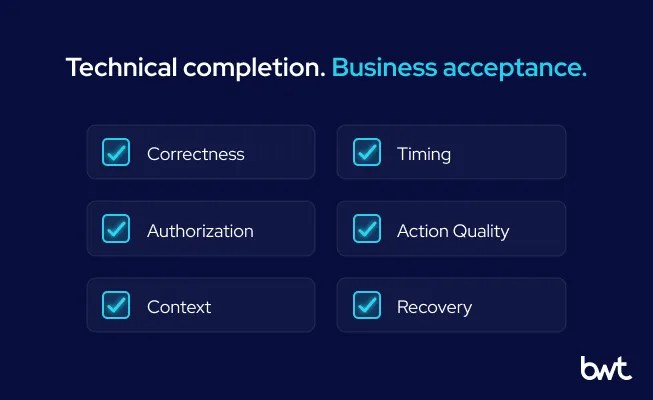
Define acceptance before the pilot:
| Evaluation dimension | Question | Evidence |
| Correctness | Did the output satisfy the documented task and agree with the authoritative evidence? | Reviewed cases and traceable source evidence |
| Authorization compliance | Did every read and write stay inside policy? | Access and action logs |
| Context quality | Did the agent use the right sources at the required freshness? | Source timestamps, lineage, and retrieval trace |
| Operational timing | Did the result arrive while the decision was still useful? | End-to-end latency by case type |
| Action quality | Did the owner accept, edit, or reject the proposal? | Workflow decision record |
| Recovery | Did the system stop or escalate correctly when a tool failed? | Exception, recovery, and escalation tests |
Use separate datasets for development and acceptance. The team can tune prompts, policies, and orchestration against development cases. A holdout set, kept outside that tuning loop, gives a cleaner production-readiness check. Live shadow mode adds another view: the agent prepares recommendations, but the existing process remains authoritative while reviewers compare outcomes.
Failures matter. Track unsupported tool requests, policy blocks, stale-data cases, conflicting records, reviewer edits, timeouts, retries, and escalations. A high completion rate can hide an agent that keeps sending the hardest work back to people without enough context.
Test the recovery path as deliberately as the successful path. Remove one tool, return an expired credential, delay a source feed, and present two systems that disagree on the same asset. The expected result is not a clever answer. The agent should stop at the documented boundary, preserve the evidence and current state, avoid unsafe further writes, and route the case through the defined recovery or escalation path. That test shows whether recovery is part of the workflow or merely an instruction in the prompt.
The business measure should follow the workflow. Maintenance coordination may track alert-to-approved-plan time and the share of plans accepted without material correction. Documentation may track time to assemble a complete evidence package and the number of missing-source exceptions. Avoid one generic agent-success score.
Oleg Boyko frames the operating test this way: “A pilot succeeds when the result meets the acceptance criteria inside the decision window and the audit record explains every material step. Completion is a system metric; acceptance is an operating metric.” — Oleg Boyko, CCO at GroupBWT
Case Study: Two AI Agents Cut Unplanned Downtime by 31%
A European industrial pump manufacturer had live equipment readings in SCADA, repair and parts history in SAP ERP, and production commitments in Siemens Opcenter MES. The information existed. Maintenance teams still learned about some failures only after a line stopped because no workflow connected the signals to repair planning.
GroupBWT built an anomaly-detection layer and two connected agents without replacing those plant systems. When the model flagged an anomaly, the maintenance-planning agent checked parts, work orders, service instructions, and the maintenance roster before drafting a work order. A production-scheduling agent checked open orders, deadlines, and available production capacity, then recommended a repair window.
The agents shared one case record. They could query SAP and MES and prepare recommendations, but they could not stop equipment, release a work order, or change the schedule without engineer approval. The audit log retained the alert, evidence, proposal, approver, and system change.
GroupBWT connected the warning to maintenance planning and production scheduling. Over six months, unplanned downtime hours fell by 31% across the 14 monitored lines compared with the previous six-month period, according to the AI agents for predictive maintenance case. The same engagement recorded 27% fewer emergency repairs and 18% lower maintenance spend. Those figures describe one system and comparison period. They are not general benchmarks for agentic AI manufacturing programs.
The case separates two production responsibilities. The anomaly-detection layer flags abnormal equipment behavior. The agents coordinate the approved response after that warning is validated: what context to gather, which repair option to prepare, who approves it, and which system records the result.
Move One Controlled Agent Workflow Into Production
AI agent development for manufacturing should begin with a recurring handoff whose owner, evidence, delay, and safe action can be stated in plain language. Document the trigger, systems opened, judgment calls, exceptions, approvers, and final record before selecting a model or framework. This shows which steps fit deterministic rules and which require contextual interpretation.
Then define the action contract: what the agent may read and draft, which actions require approval, which bounded actions it may execute, what remains prohibited, and what evidence accompanies every recommendation. Test that contract against ordinary work, edge cases, missing data, unavailable tools, and conflicting records. A holdout set and live shadow mode let owners compare results while the existing process remains authoritative.
Production readiness requires clear answers to four questions:
- Which accepted result improves the current process?
- Which evidence proves the agent stayed inside policy?
- Which failures stop execution, and what recovery or escalation path follows?
- Who may change the workflow, tool permissions, and acceptance rule?
Treat each answer as an operating artifact, not a slide. The accepted-result definition becomes an evaluation criterion tested against representative cases. Evidence that policy checks were applied belongs in the audit trail. Stop conditions belong in integration tests and runbooks. Change authority belongs in access control and release management. If a critical control exists only as an instruction in the model prompt, the production system does not yet enforce it.
Deployment should preserve a route back to the existing process. During shadow mode, compare the agent’s proposal with the decision the team actually made and record why they differ. After controlled release, keep an operator-controlled way to disable the agent, an escalation queue, and enough retained context for the owner to finish the case without reconstructing it from scratch. Recovery is part of the service design because unavailable tools and conflicting records are foreseeable operating conditions, not exceptional laboratory events.
An internal team may be able to handle a read-only assistant or one stable workflow when source access, ownership, integration, evaluation, and review are already in place. External engineering support becomes more useful when several systems, identities, approval domains, or recovery paths must operate as one process. GroupBWT’s AI agent development services cover workflow and permission design, integration, evaluation, deployment, and support.
AI agents for manufacturing are ready to scale only after the first bounded workflow produces reliable, accepted results without hiding authority.

The best candidates have variable steps, require contextual decisions, and produce a measurable operational result. They often span several systems or teams. Common examples include maintenance coordination, production exceptions, quality investigations, and document-heavy procurement.
RPA executes predefined rules and branches, while copilots normally assist a person with retrieval, analysis, drafting, or recommendations. AI agents can choose among permitted next steps and use tools toward a defined goal.
AI agents use approved APIs, events, or constrained integration services under dedicated identities. Read and write paths require separate access rules, validation, and logging; high-impact writes may also require approval.
The agent needs authentication, least-privilege access, policy checks before protected tool calls, audit records, and a tested recovery path. High-impact actions should remain approval-gated.
Skip the agent when predefined rules already cover the conditions and exceptions. The same applies when nobody owns the result, the source data is not governed, acceptance cannot be measured, or failure has no safe recovery path. In those situations, a rules engine, RPA workflow, predictive model, or copilot does the job with less operational machinery.
Not in the controlled architecture described here. Safety-critical equipment and its interlocks stay outside the agent’s authority. The agent can assemble approved evidence, draft a recommendation, or hand a request to an authorized control workflow. It cannot command the equipment itself.
Cost and timeline depend on integration count, permission domains, exception variety, evaluation scope, observability, and recovery requirements. Read-only workflows over one governed source are smaller than approval-gated workflows spanning ERP, MES, and CMMS. For planning ranges from proof of concept through production, see how long does it take to build an AI agent.
Read summarized version with
Related AI & Data Services
Put One ManufacturingWorkflow Under Control
GroupBWT designs bounded AI-agent workflows that connect approved plant systems without handing critical decisions to a black box.
The engagement can cover:
- Workflow and permission design
- ERP, MES & CMMS integration
- Evaluation, audit & recovery controls