
Read summarized version with


Picture one Snowflake table. Three consumers hit it: a batch job that retrains the fraud model on Sunday, a RAG layer that pulls contract paragraphs on demand, and an agent that books refunds the second a customer asks. Warehouse RBAC was written for none of them. The first two either copy the rows or carry the rules forward; the third one writes back.
Gartner’s 2025 write-up on generative AI project failures says about half of tracked initiatives were abandoned after the proof of concept. A February 2025 Q&A found 63% of respondents lacked, or could not confirm they had, the data practices AI needs. IBM’s Institute for Business Value found 43% of COOs put data quality first. The diagnosis is consistent: weak data foundations, unclear value, runaway cost, and missing controls stop AI before production.
The operational questions are simple: which dataset fed the model, who could see each retrieved paragraph, and was the row still true when the agent acted? We map those answers to the pipeline – training, fine-tuning, retrieval, inference, prompts, logs, monitoring, retirement – and show how to wire the controls.
Build the Data FoundationYour AI Models Need
We develop and manage custom data solutions, powered by proven experts, to ensure the fastest delivery of structured data from sources of any size and complexity.
We offer:
- Custom Web Scraping & Development
- 15+ Years of Engineering Expertise
- AI-Driven Data Processing & Enrichment
Key Takeaways
- Training pulls rows. Retrieval pulls paragraphs. Agents pull actions. Every handoff is a place a control has to fire – most programs only watch the first one.
- This is the data layer of AI governance. Model evaluation, application security, and human accountability live in other layers – the data layer cannot answer them.
- A RAG layer needs permission and freshness checks before the prompt is built. An agent needs a separate check before the tool fires.
- Unstructured files, third-party feeds, synthetic data, and user-generated content all need catalog, lineage, and retention rules before any of it lands in a model.
- KPIs are the only thing that turns a slide-deck policy into something an auditor can read.
Why Traditional Data Governance Breaks Inside AI Workflows
Mature governance usually covers ownership, access, lineage, retention, unstructured data, and BI. The gap is runtime retrieval, prompt context, vector indexes, and agent actions: the controls exist in spirit, but not on the new data paths.
A flawed training batch can shape tomorrow’s outputs after the source is corrected. AI lineage has to connect source systems, transformations, dataset and index versions, retrieved context, feature sets, prompts, and model versions. Retrieval also needs a fresh access check before a passage reaches the prompt; agents need one more check before context becomes an action.
Quarterly review is too slow for systems that act during a live request. The working controls are lineage, access, freshness, and ownership wired into the path, not appended to a PDF.
Where Data Governance Must Follow the AI Lifecycle
Governance controls have to travel with the data through every stage an AI system puts it through.
| Lifecycle stage | Primary governance question |
| Acquisition | Are we allowed to use this data? |
| Preparation | Is it accurate, complete, and representative? |
| Training | Can every dataset and transformation be traced? |
| Deployment | Is access restricted to the right users and use cases? |
| Runtime | Is the AI receiving only the necessary context? |
| Monitoring | Are quality, drift, access, and policy violations visible? |
| Retirement | Can data and derived assets be removed when required? |
Five terms matter most. Boundary controls define who can read, write, retrieve, or act. Dataset provenance records source, change history, and live version. Entitlement filtering fires before a model sees a retrieved document. Chunk metadata – owner, sensitivity, source, freshness – makes a vector-index passage governable. Without it, retrieval cannot decide what may surface.
Those terms map to four zones: intake, preparation, runtime, retirement. The EU AI Act’s Article 10 sets the floor for high-risk systems: training, validation, and testing sets must be "relevant, sufficiently representative, and to the best extent possible, free of errors and complete." Teams building AI-ready data pipelines can reuse the same controls instead of bolting them on later.
Core AI Data Governance Controls
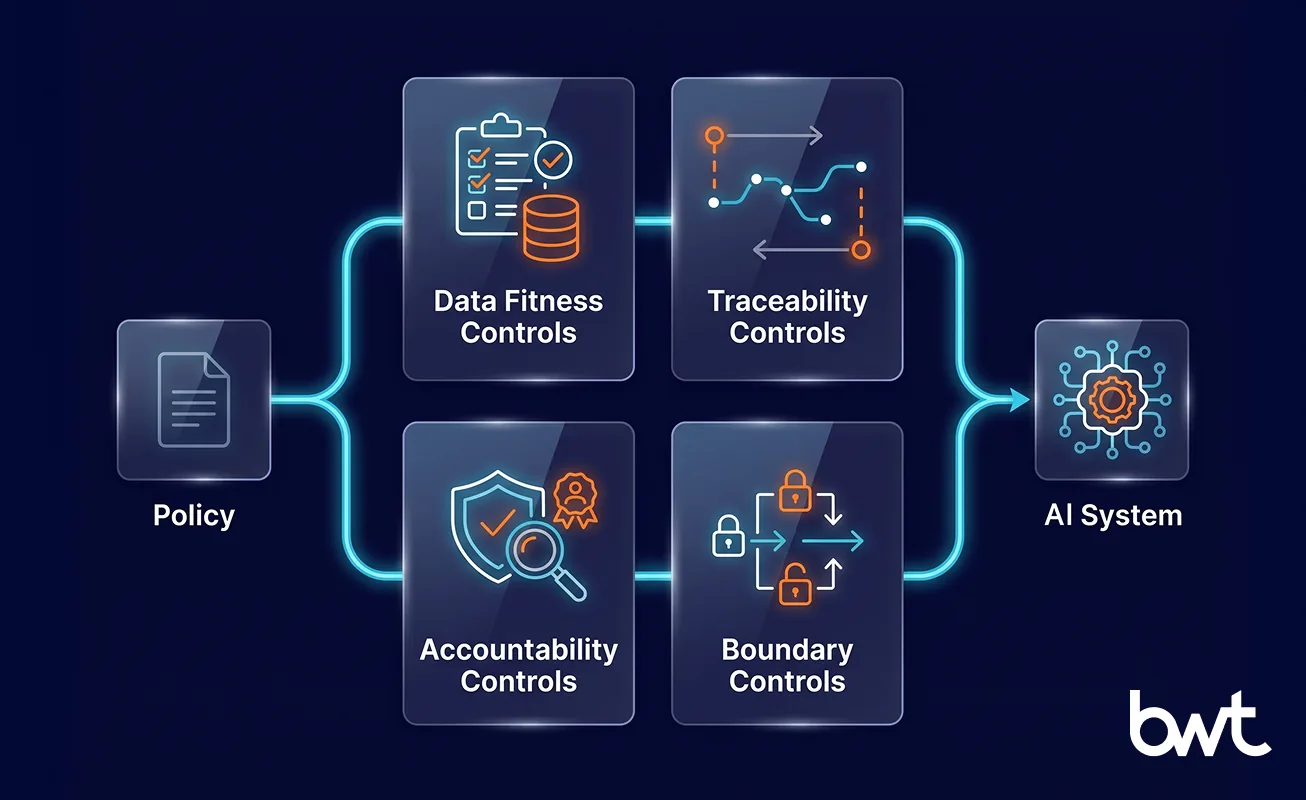
Four control families turn AI data governance from policy into system behavior.
Data Fitness Controls
Quality, integrity, bias, and representativeness checks decide whether data can feed a model: completeness, schema validity, duplicates, label quality, and freshness.
Trust and Traceability Controls
Metadata, cataloging, lineage, and provenance show where a record, passage, prompt context, or governed output came from. The trail must survive vector indexes, prompts, and monitoring logs.
Accountability Controls
Ownership, stewardship, monitoring, and incident management put a human name against every critical dataset and policy decision. If no one owns the dataset, no tool can govern it.
Boundary Controls
Privacy, access, consent, licensing, and retention rules decide what AI may read, output, and delete. Without them, a sensitive record can leak through retrieval – we have seen it in SharePoint and vector indexes.
How to Stand Up the AI Data Governance Framework in 9 Steps
An AI data governance framework becomes real one inspectable deliverable at a time.
| Step | Deliverable |
| Use-case classification | AI risk register |
| Data inventory | AI data-flow map |
| Classification | Labeled data catalog |
| Ownership | RACI matrix |
| Policy | Machine-testable control rules |
| Enforcement | Quality and access gates |
| Runtime | Retrieval and action controls |
| Monitoring | Governance KPI dashboard |
| Retirement | Deletion and decommissioning workflow |
Start with use cases that touch regulated, proprietary, or customer-facing data. Map how data enters, moves, and reaches models. Classify sensitive, regulated, and licensed fields before training, retrieval, or prompts. Then assign owners for source approval, quality rules, access policy, use-case approval, runtime monitoring, and incident response – in the RACI, on a real calendar.
| Governance activity | Accountable role | Supporting roles |
| Data-source approval | Data owner | Legal, privacy, security |
| Quality rules | Data steward | Data engineering |
| Access policy | Security owner | Data owner, platform team |
| AI use approval | AI governance board | Product, legal, risk |
| Runtime monitoring | AI product owner | MLOps, data engineering |
| Incident response | Risk owner | Security, legal, engineering |
This is where "how to implement data governance for AI" becomes an engineering backlog: catalog jobs, quality gates, lineage capture, policy engines, retrieval filters, tool-approval gates, monitoring dashboards, and deletion workflows, each with an owner and a date.
Check Whether Your Data Governance for AI Can Support Enterprise AI
Before AI moves into production, find gaps while they are cheap. Our data governance consulting work assesses sources, lineage, metadata, access controls, architecture, and AI use cases. GroupBWT pairs the assessment with pipeline work, so findings become controls rather than slides.
Runtime Governance for Generative AI, RAG, and Agents
Runtime is where AI touches live data and may act on it. Not every control needs to ship on day one, so the first priority should follow the system type.
| AI system | Initial control priority | Why it comes first |
| Batch ML | Dataset provenance and quality | The model inherits the training set’s history and defects. |
| RAG | Entitlement filtering and freshness | Retrieval can expose stale or unauthorized context in a live request. |
| Fine-tuning | Consent, licensing, dataset records | Training data becomes part of the model’s behavior. |
| AI agent | Tool permissions and approval gates | Data access can turn into an action. |
| Third-party LLM | Data retention and vendor boundaries | Prompts and logs may leave direct control. |
Governing RAG at Retrieval Time
Some retrieval stacks keep ACLs live: Pinecone metadata filters, OpenSearch parent-child ACL, Elastic DLS. Others copy documents in and leave rules behind. Enforce controls before retrieval: authoritative sources, chunk metadata, entitlement filtering, retrieval-to-response logs, refresh, re-indexing, deletion. The MAIN-RAG paper reports a 2-11% accuracy lift from pre-generation filtering on noisy documents – the same problem, measured.
Those controls match data-engineering patterns we have shipped. A public procurement platform carried {value, source, original} provenance across hundreds of portals. A digital shelf platform scored brand-approved source content against retailer pages. Both controls run before retrieval exists. Informatica covers the same Helia case: governance as an AI value foundation.
Governing AI Agents at Action Time
Agents raise the stakes because context can become an action. We separate read permissions from tool permissions; reading a record and changing it are different grants. Scope access to the task, entity, and user. Run policy and freshness checks before action. Require approval for high-risk actions. Keep replayable retrieval-to-action logs. Amazon Bedrock Guardrails shows the reference pattern: filtering, masking, and grounding across models.
AI Data Governance Metrics and KPIs
Each KPI below points to the evidence that proves a control worked.
| Governance KPI | How to measure it | Evidence source |
| AI-ready data coverage | % of AI-facing datasets with owner, sensitivity, freshness SLA, and allowed-use tag | Catalog and metadata export |
| Quality-gate pass rate | % of records, batches, or pipelines that pass validation before the trusted layer | Pydantic, Great Expectations, or observability logs |
| Retrieval-to-response traceability coverage | % of RAG answers with stored retrieved sources, prompt, model/version, timestamp, and response id | Retrieval and application logs |
| Access and policy violation rate | Count of blocked unauthorized retrieval, prompt, or tool-action attempts per period | Policy engine and SIEM logs |
| Freshness SLA compliance | % of AI-facing sources refreshed inside the approved window | Pipeline orchestration and monitoring logs |
| Incident resolution time | Median time from governance alert to verified fix | Incident register and postmortems |
| Retention and deletion compliance | % of deletion, consent, and licensing requests completed inside policy | Privacy workflow and audit records |
These KPIs avoid confusing forecasts with controls. A Gartner forecast can justify urgency; it is not a KPI. A governed analytics platform can prove a control worked, but its metrics still need source notes.
“A model can sound confident while handing the pipeline a structurally invalid or policy-breaking record. Validation is the stop that catches it before downstream systems trust it”
— Oleg Boyko, COO, GroupBWT

AI Data Governance Tools and Technology Layers
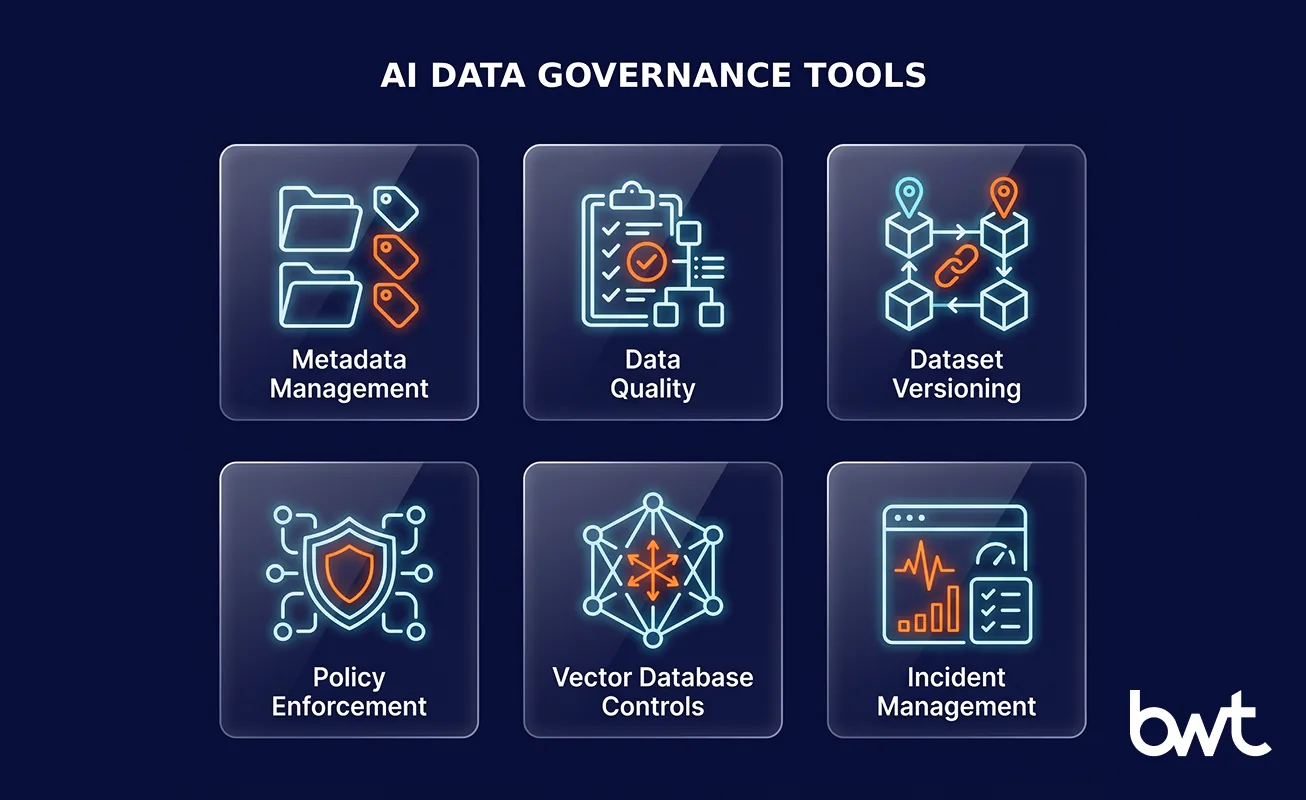
AI data management and governance works when tools give policy a place to run, log, and prove itself.
Data Catalog and Metadata Management
The catalog stores owners, sensitivity labels, allowed-use tags, source systems, definitions, and freshness expectations. Without it, every other layer guesses.
Data Quality and Observability
Pydantic and Great Expectations check structure, completeness, ranges, and policy-breaking outputs; Grafana, Monte Carlo, and Soda alert when quality drifts.
Lineage and Dataset Versioning
Lineage records source, transformation, feature, dataset, vector-index, and prompt-context versions so an answer or incident can be traced to the exact data slice that produced it.
Access and Policy Enforcement
OPA, Cedar, Rego, IAM, RBAC, ABAC, and entitlement filters depend on what each system supports. Keep the rule in policy and in the source system, then test that it survives retrieval and agent tool calls before sign-off.
RAG and Vector Database Controls
Vector indexes need chunk metadata, refresh jobs, delete propagation, source ranking, and retrieval logs. Otherwise a model can cite a passage the source already corrected – we have seen it in production.
Monitoring, Audit, and Incident Management
SIEM, orchestration logs, dashboards, and incident registers answer the audit question: which control fired, which policy was violated, who owned the fix, and when compliance returned.
Security, Privacy, and Compliance Controls for AI Data
This is where a governance gap can become a HIPAA, GDPR, or SEC disclosure.
Boundary Controls
Boundary controls decide what enters, what is masked, what leaves the trust boundary, and what must be deleted. In AI, that boundary spans inputs, retrieved context, prompts, outputs, fine-tuning corpora, vector documents, agent actions, and third-party model calls. The NIST AI RMF vocabulary – Govern, Map, Measure, Manage – survives an audit.
Sensitive-Data Handling
AI consumes more sensitive data than reports. Prompts can carry patient opinions, retrieval can carry PII, and synthetic data can leak ground truth. On a US healthcare integration engagement, we preserved clinical field formats, logged every connected tool, and blocked changes that would break compliance-sensitive workflows. Classification, masking, access logs, and retention rules must exist before patient, billing, or support data reaches prompts, retrieval, or fine-tuning.
Data Residency and Cross-Border Processing
Residency controls are about where source records, retrieved context, prompts, logs, and derived datasets sit. In healthcare or insurance workflows we define allowed regions, encryption, access review, retention, and escalation before traffic starts. Vendor logging and retention terms belong in the same review.
Common AI Data Governance Challenges and Failure Modes
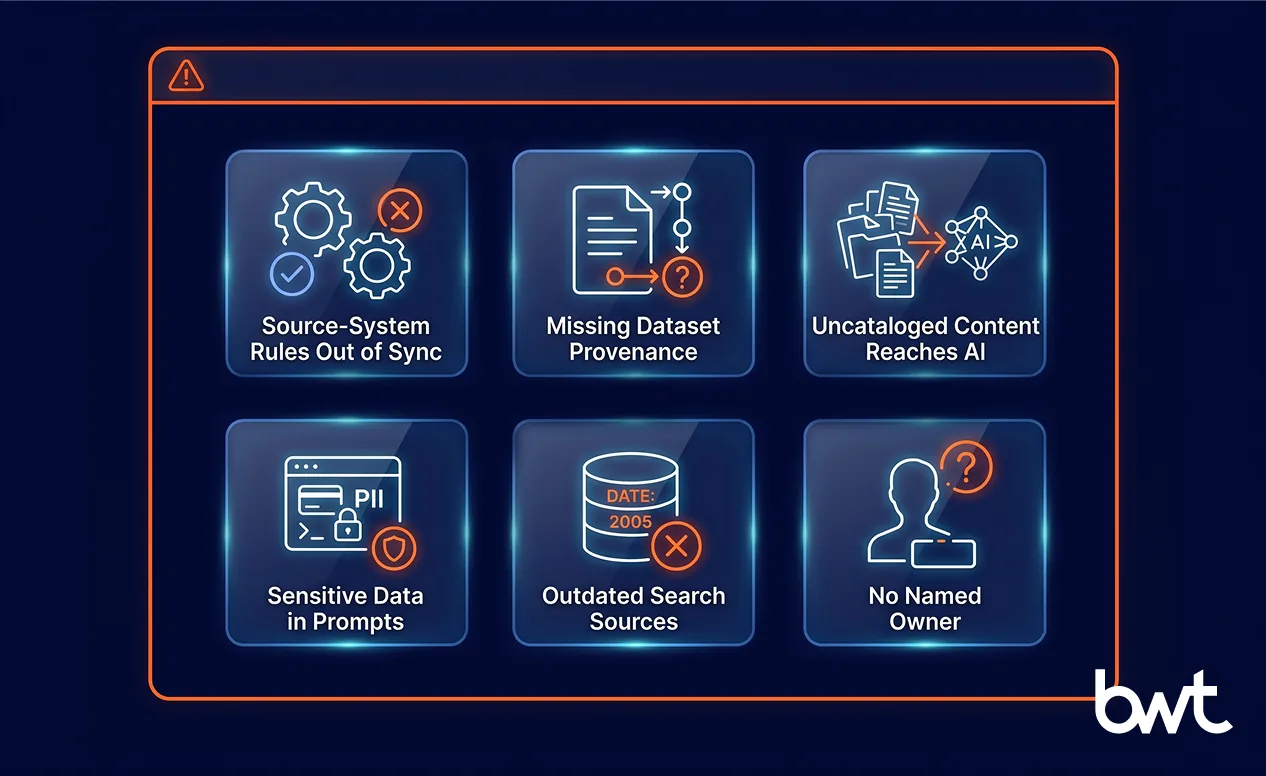
The failures are usually small: a stale source gets indexed, an owner leaves, or SharePoint access rules fail to reach a vector index.
Permission Drift
Source-system and retrieval-layer rules fall out of sync, so a user can retrieve a passage the original system would block.
Missing Dataset Provenance
Training data, feature sets, or indexed documents cannot be tied back to a source, version, owner, and transformation history – so the audit trail stops at the model.
Ungoverned Unstructured Data
Contracts, tickets, PDFs, chats, or clinical notes enter prompts or vector stores without labels, retention rules, or quality checks. The model absorbs them anyway.
Sensitive Data in Prompts
Runtime prompts carry PII, regulated fields, or proprietary data without masking, retention limits, or retrieval logs. The leakage usually surfaces only when a regulator asks.
Stale Retrieval Sources
A source record is corrected or removed, but the vector index keeps serving the old passage. Customers see outdated policy text before the team notices.
Unowned AI-Facing Datasets
No named owner approves the data, responds to alerts, or decides when it must be removed. Shared accountability turns into shared silence.
AI Data Governance Best Practices
AI data governance best practices stick when they are wired into the path the team already uses, not added as a separate workflow.
Govern Data Before Model Access
Block unclassified, unowned, or unlicensed data before it reaches training, retrieval, prompts, or fine-tuning. A single gate at the data layer is cheaper than an after-the-fact audit.
Apply Minimum-Necessary Permissions
Limit each model, app, retrieval call, and agent action to the task, entity, user, and time window it actually needs. Re-authorize on a fixed cadence.
Preserve Source and Retrieval Lineage
Record source, transformation, dataset, index, retrieved context, prompt, model/version, timestamp, and response id where those artifacts exist. The point is evidence, not full model explainability.
Treat Unstructured Data as Governed Data
Apply cataloging, sensitivity labels, ownership, quality checks, and deletion workflows to documents, chats, images, and voice records before AI consumes them. The same controls work for text, images, and audio.
Assign Named Owners
Put a data owner, steward, security owner, product owner, and incident owner against each high-risk system. Shared accountability still needs a named person for each decision.
Combine Pre-Deployment Controls With Runtime Monitoring
Pre-release checks cover catalog, quality, consent, and licensing. Production monitoring covers retrieval, freshness, access violations, and tool actions. Either layer alone is incomplete.
AI Data Governance Implementation Roadmap
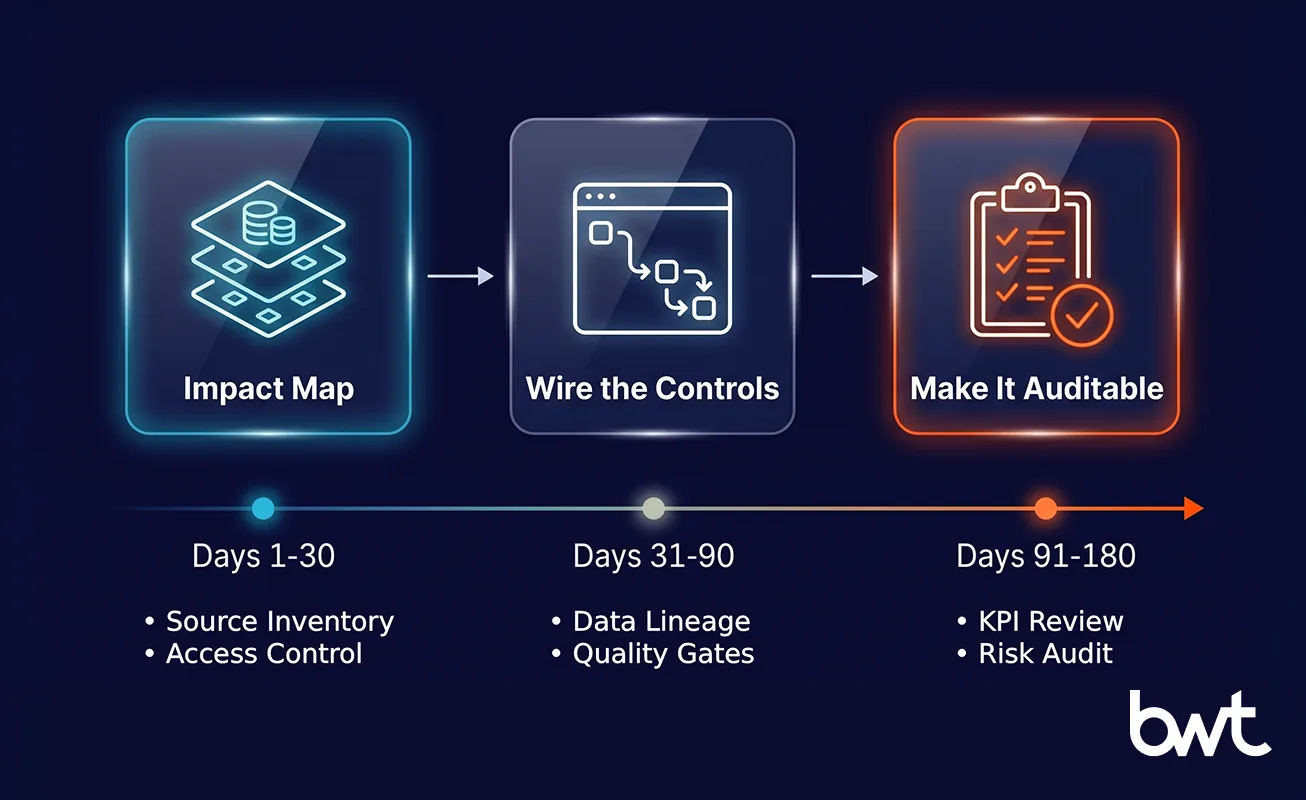
Use this roadmap as sequencing, not a universal checklist.
Days 1-30: Map the Exposure
- Inventory every AI-facing source by owner, sensitivity, allowed use, and freshness.
- For retrieval-based systems, add entitlement filtering before any retrieval call.
- For production LLM apps, turn on prompt, context, and output logging with retention boundaries.
Days 31-90: Wire the Controls
- Build catalog, lineage, and metadata layers around critical datasets.
- Enforce quality gates at insert with Pydantic, Great Expectations, or equivalent checks.
- If fine-tuning or licensed corpora are in scope, wire consent and licensing checks into preparation pipelines.
Days 91-180: Make It Auditable
- Stand up runtime monitoring dashboards against the KPIs above.
- Run a mock audit for one high-risk AI use case end to end.
- Confirm retention, deletion, escalation, KPI reporting, human oversight, and tool-action approvals for production systems.
At that point, governance is a running system, not a slide.
AI Data Governance vs AI Governance
Clean data is not proof of safe AI. The practical boundary for data governance for artificial intelligence is the data layer: quality, access, lineage, consent, retention, and source evidence. AI governance is the wider operating model around models, applications, human oversight, ethics, vendors, and risk. Data governance gives that wider layer evidence it can inspect.
AI can support discovery, classification, metadata enrichment, lineage inference, anomaly flagging, PII detection, and policy-drift alerts. It produces evidence for review; it does not decide policy. A model can propose a sensitivity label, but a human decides what it requires and what a wrong call costs.
Why Our Team Starts AI Governance With Data Engineering
These are data-engineering controls that transfer into AI-ready foundations: provenance, validation, controlled releases, monitoring, and quality contracts. Three GroupBWT engagements show the pattern.
Transferable control: governed pipeline releases. For a cosmetics enterprise, we layered a Data Vault warehouse from raw to business to marts, added validation gates, and moved releases through Lab, Stage, and Production with client UAT. Every transformation had a known stage, validation point, and approval step.
Transferable control: source provenance. For a public procurement intelligence platform, we normalized hundreds of portals into a standard schema with per-field {value, source, original} provenance. Each value carried its origin, and validation ran before insert. An AI retrieval layer could reuse that evidence instead of treating the feed as a black box.
Transferable control: runtime quality. For a tier-1 e-commerce company, we ran hourly vendor-quality checks with automated throttling, monitored through Great Expectations and Metabase, and moved a batch feed toward near-real-time sync. A downstream retrieval layer would inherit a documented quality story instead of inventing one later.
This data-first approach is the AI data governance strategy we see teams repeat as one use case becomes a fleet, and it is an enterprise AI data governance pattern an auditor can inspect in production.
Final Thoughts: Trusted AI Starts With Governed Data
A model trained on bad data does not earn trust. Trust lives in a catalog entry, a lineage record that still parses six months later, an access rule that fired in the SIEM, and a deletion workflow that deletes when a regulator asks. Ship AI on data you can trace, control, refresh, and remove.
Also Read: AI-Ready Data Pipeline: Architecture, Components, and Best Practices
Build an AI Data Foundation You Can Trace, Control, and Scale
If your AI roadmap is moving faster than your data controls, the gap is the risk. Our enterprise AI development services start from the catalog, lineage, access, and monitoring that make production AI auditable – and build up from there.
Talk to a Data Engineering Architect
Controlling data quality, access, lineage, and use across everything an AI system does with data: training, fine-tuning, retrieval, inference, prompts, logs, deletion.
Traditional governance reviews predictable transactions. AI systems retrieve context or act during live requests, so controls have to fire at runtime.
Data governance for AI is the data layer: quality, access, lineage, consent, retention, and source evidence. AI governance is the wider operating model around models, applications, human oversight, ethics, vendors, and risk.
Controls applied at retrieval and generation time: authoritative sources, chunk-level metadata, entitlement filtering, retrieval-to-response traceability, refresh jobs, and deletion workflows.
Accountability is shared but named: data owners approve sources, stewards set quality rules, security owns access, an AI governance board approves use cases, and AI product owners own runtime monitoring.
Fragmented ownership. Unknown training sources. Missing lineage. Uncataloged unstructured data. Inconsistent access rules in vector indexes. Unenforced policies. Silent quality failures.
Read summarized version with
Build the Data FoundationYour AI Models Need
We develop and manage custom data solutions, powered by proven experts, to ensure the fastest delivery of structured data from sources of any size and complexity.
We offer:
- Custom Web Scraping & Development
- 15+ Years of Engineering Expertise
- AI-Driven Data Processing & Enrichment