Read summarized version with



An AI consultancy is supposed to change a business result, not merely add AI. For one organization, that means fewer hours spent reviewing cases. Another needs faster forecasts or lower service costs. Modernizing the workflow is only half the job; someone still has to control risk, cost, and day-to-day ownership. The partner can push the investment past strategy and pilot work into an operation the business can measure. The result also depends on the client’s ownership, data readiness, and ability to change the workflow.
This guide examines 12 top AI consulting companies with public capability and delivery evidence relevant to strategy, data, integration, governance, implementation, or live operations. The field includes consultancies and top IT companies offering AI consulting, but this is a selection guide rather than a league table. Start with the business goal, program scale, risk, existing systems and data, and who should own the result. Those factors determine which firms belong on a shortlist.
Key Takeaways for a Defensible AI Consultancy Shortlist
- Name the business result first. A model, agent, or platform is not one.
- Read the cases. They show whether the firm’s offer has reached production in comparable work.
- Set the logo aside and test the people in the proposal against your workflow, data, risks, and ways of working.
- Raise the bar for high-impact work. Ask who gets access, which records remain, how results are tested, who handles incidents, and who may approve or override an action.
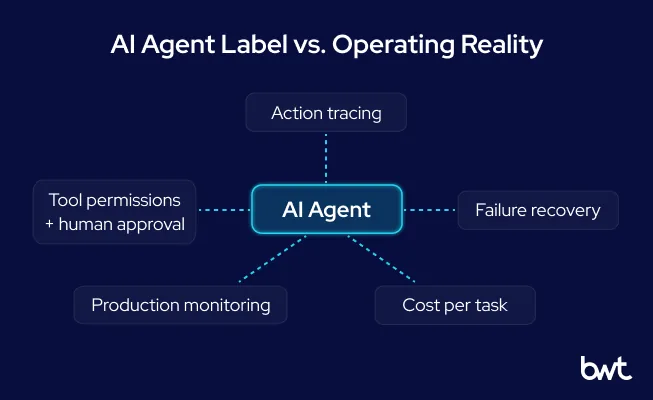
- Treat an AI-agent label as a starting point. Inspect tool permissions, traces, recovery, monitoring, and the cost of each completed task, case, or interaction.
- Turn each profile’s watchpoint into an interview question. Missing public detail creates work for due diligence; it does not prove the capability is absent.
Twelve AI Consulting Firms at a Glance
This table states the clearest fit supported by the public material reviewed. “Best for” means a well-supported starting point for evaluation, not superiority over every alternative.
| Company | Best for | Public evidence signal | Watchpoint to test |
| Accenture | Multinational AI transformation | Evidence spans data, platforms, governance, workforce change, and operations | Name the responsible team and define acceptance before kickoff |
| BCG X | Custom AI products paired with redesigned business processes | GenAI platform case plus a build-operate-scale-transfer offer | Pin down the assets, assigned people, and handover terms |
| GroupBWT | Data-heavy AI workflows requiring enterprise integration, traceability, and human-controlled decisions | Vendor-published production cases across agents and human-controlled AI workflows | Verify how results were measured and who remains responsible from strategy through delivery |
| Capgemini | AI in software engineering, operations, and enterprise workflows | Data and AI portfolio plus an engineering pilot | Separate achieved pilot results from projections |
| Cognizant | AI adoption alongside enterprise data modernization | Broad capability scope and management-system certification | Request AI-specific production outcomes |
| Deloitte | GenAI programs where data quality, lineage, and governance are prerequisites | Financial-services case connecting GenAI to lineage and quality | Verify baselines and production status |
| EPAM | Enterprise agent systems that must move into production and remain manageable by the client | Production telecom deployment with client ownership of the strategy layer and prompt IP | Request quality and cost per completed task, case, or interaction |
| EY | AI within wider platform transformation | EY.ai scope and a broad process-transformation case | Isolate AI’s contribution to outcomes |
| IBM Consulting | Governed AI and agent integration | AI-ready data, watsonx, governance, and production assistant case | Separate platform proposition from case proof |
| Infosys | Scaling AI across large, complex enterprise technology environments | Topaz assets and a software-lifecycle case | Validate the exact assets proposed |
| PwC | Finance-led AI transformation | Forecasting, agents, and operating-model change | Test transferability beyond one AWS-linked case |
| QuantumBlack, AI by McKinsey | AI-led operating and workforce change | Strategy, engineering, and deployed coaching tools | Confirm implementation and measurement ownership |
How the 12 Firms Qualified for This Comparison
The 12 firms were selected to represent the main delivery models an enterprise team is likely to compare for the same enterprise AI initiative: strategy-led consultancies, large professional-services transformation firms, global systems and engineering providers, and specialist implementation partners. The aim is to compare credible routes to an outcome, not companies of equal size.
A candidate needed an official AI consulting proposition and enough first-party material to define a specific client situation and a firm-specific question to test. Inclusion did not require a public case for every claimed capability.
Hyperscale cloud providers and pure software vendors sit outside this scope because the buying decision here is a consulting and delivery engagement that may span business, data, integration, and operations. Those companies may supply essential platforms or products, but comparing a product license or cloud service with a consulting engagement would mix different procurement categories. The list is not exhaustive and does not claim to identify every qualified firm.
Profile order carries no score. We reviewed official capability pages and first-party cases available on September 1, 2026, then grouped the decision guidance by business need.
Evidence was classified before fit was assigned
An official service page establishes what a firm says it offers. A first-party case shows only what the vendor reports for that client, scope, delivery stage, and result. A prototype remains a prototype, a planned expansion remains planned, and one client’s metric is not a cross-market benchmark.
We use that test for global consultancies and specialist firms alike. Public evidence varies too much in depth for a weighted score to be credible, so the comparison uses qualitative fit.
Unless a source says otherwise, outcomes are first-party reported. The sources reviewed rarely explain in full how results were measured, and a company-wide offer says little about the depth of the people assigned to one account. Each profile therefore ends with a specific question to test.
Editorial and commercial disclosure
GroupBWT authored this comparison and is included as one of the evaluated firms. We applied the same test to it as to every peer: what the company offers, what its cases document, where it fits, and what a prospective client still needs to verify. The article does not claim independence from the author’s commercial interests.
“A shortlist becomes useful when it tells you what remains unverified. If every profile ends in praise, the comparison has stopped doing procurement work.”
— Oleg Boyko, CCO at GroupBWT
Profiles of 12 AI Consulting Companies for 2026
Use the profiles as a source check, not a ranking. Begin with the situation named under Best fit. Next, see whether the linked material describes an offer or documents delivered work. Finish with the watchpoint: the unanswered question to carry into the proposal meeting.
Accenture
Best fit: multinational programs combining AI delivery, data modernization, governance, and workforce change.
The Accenture AI and data portfolio covers strategy, data foundations, generative AI, and workforce change. That is the offer. The Best Buy client story supplies narrower delivery evidence: its customer-support tools are live, though the page gives no service or financial result.
Watchpoint: name the lead, staffing, acceptance criteria, and a reference from a comparable production use case.
BCG X
Best fit: custom AI products combined with business-process redesign, venture building, or a new digital business.
BCG X brings product designers and engineers into BCG’s consulting work. Its offer includes a build-operate-scale-transfer model for clients that intend to take over. Reckitt is the clearest public example: the GenAI platform case says everyday tasks took up to 70% less time. BCG publishes other efficiency figures across different programs, but their scopes and measurement methods differ, so we do not compare them directly.
Watchpoint: establish which named team, reusable asset, operating phase, and transfer obligation will appear in the contract.
GroupBWT
Best fit: custom AI for data-heavy workflows requiring enterprise integration, traceability, and human-controlled decisions.
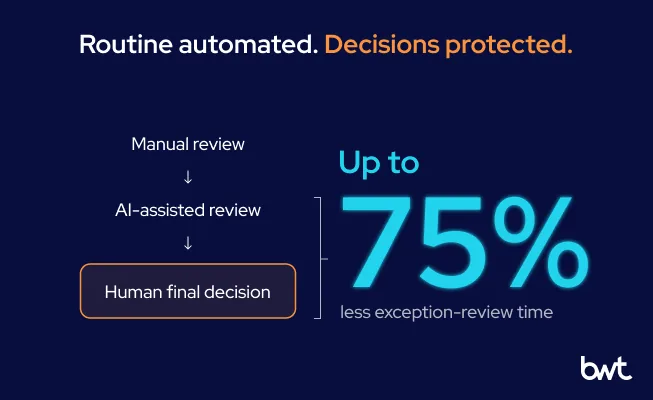
The strongest fit is a team whose staff still assemble data from several systems by hand, inspect exceptions, and explain each decision afterward. Its AI technology consulting covers readiness through implementation and handover. No single public case documents that entire journey, but several show its production work. For a US lender, the team connected five AI credit analyst agents with human review to extraction, scoring, and loan systems. The analyst kept the final credit decision, while the case reports up to 75% less time spent reviewing exceptions. Other cases document an analytical AI agent connected to 14 data sources and an insurance AI chatbot with escalation and monitoring. These outcomes are vendor-reported.
Watchpoint: confirm who will own readiness and strategy, which production evidence transfers to the proposed scope, and whether that ownership will continue into delivery.
Capgemini
Best fit: AI implementation across operational and software-engineering workflows where modernization and data foundations belong in the same program.
Capgemini’s Data and AI services reach from strategy and customer experience into operations, software engineering, modernization, and IT. It also names the Resonance AI Framework, the RAISE foundation, and a modular asset suite. Those assets matter only if they shorten the proposed work in the client’s environment. The Penske engineering case separates the measured pilot from the forecast: Capgemini reports a 10% to 12% productivity gain, while the 18% to 20% figure is future potential.
Watchpoint: keep achieved pilot results, projected gains, and scaled production results separate in proposal evidence.
Cognizant
Best fit: organizations introducing AI while modernizing existing enterprise data platforms.
Data modernization, governance, and master data sit beside generative and agentic AI in Cognizant’s AI services. ISO/IEC 42001:2023 covers Cognizant’s management system. It does not certify that a proposed client system will be safe. Public case depth is thinner on the exact AI question. The GSK and Amref case documents integration and analytics. AI-specific production delivery is not clear from that case.
Watchpoint: request a production case for the intended workflow.
Deloitte
Best fit: generative AI programs where weak definitions, lineage, quality, or software-delivery controls must be repaired before scale.
Deloitte’s Artificial Intelligence and Data practice covers strategy and design as well as construction and operation. The offer includes generative AI, agents, data engineering, analytics, DataOps, and edge intelligence. Its anonymous financial-services case gets more specific: glossaries, lineage, data-quality checks, synthetic data, and supporting software practices. During pilots, Deloitte reports that generating glossaries, critical data elements, and lineage took up to 80% less time. It publishes other pilot efficiency figures, but their scopes and measurement methods differ, so we do not compare them directly.
Watchpoint: ask for a reference from a similar production engagement, then verify the production status, baseline, measurement period, and attribution.
EPAM
Best fit: enterprise agent systems requiring production deployment and transfer to the client.
EPAM emphasizes production engineering and transfer. Its AI services combine transformation support, reusable blueprints, talent development, and DIAL, an orchestration platform for deploying and scaling GenAI applications. The 1&1 customer-service case shows a live deployment on a different scale: more than 20 agents handle over 100,000 calls per week. The client retains the AI strategy layer and prompt-related intellectual property. The case gives no resolution, satisfaction, or cost result.
Watchpoint: require quality measures and cost per completed task, case, or interaction alongside deployment volume.
EY
Best fit: business transformation programs where AI, an enterprise-platform rollout, process changes, governance, and staff adoption have to move together.
The EY.ai offer reaches from strategy and architecture into data integration, automation, analytics, program operations, risk, and trustworthy-AI controls. It fits programs where AI is one workstream inside a wider business change. Daikin also shows why attribution matters. The Daikin case reports 10% better counter efficiency and a 20% faster financial close after a broader SAP and process transformation. Separately, EY credits AI-assisted code generation and automated testing with making implementation about 30% faster. The first two gains cannot be assigned to AI alone.
Watchpoint: separate AI, platform, process, and change-management scope, with an owner and acceptance measure for each.
IBM Consulting
Best fit: enterprises seeking one route through responsible-AI governance, AI-ready data, watsonx implementation, and agent integration with operational systems.
IBM Consulting’s AI practice covers strategy, governance, data preparation, watsonx, and agents. For an enterprise already committed to IBM technology, that breadth may reduce coordination. Yet the strongest cited production example used Microsoft Power Virtual Agents. In the Virgin Money case, IBM reports more than 2 million interactions, 57% containment at peak, 94% satisfaction among surveyed users, and over 50 application programming interface (API) calls to connected systems. That documents a customer-facing production system, not watsonx or multi-agent delivery. Expansion using OpenAI was still planned.
Watchpoint: confirm whether platform selection is open and keep the cited case architecture distinct from IBM’s broader platform proposition.
Infosys
Best fit: large organizations trying to scale AI across tangled engineering, data, and operational systems.
The Infosys Topaz portfolio covers generative AI, analytics, agents, and responsible AI. Infosys lists more than 12,000 AI assets, over 10 AI platforms, and more than 150 pretrained AI models. The total says little about fit on its own. A software-development lifecycle case reports effects on productivity and cloud costs, but a proposal still needs to identify the assets that would enter the client’s build.
Watchpoint: ask which assets enter the build, where they have run in production, what their licenses permit, how much tailoring they need, and who owns them after handover.
PwC
Best fit: finance teams rebuilding forecasting, scenario planning, executive decision support, and the operating model around them.
PwC groups strategy, generative AI, enterprise implementation, governance, industry solutions, and alliances in its AI consulting proposition. Finance is where the cited evidence becomes concrete. The Lucid case describes 14 use cases, cross-functional AI pods, AI-enabled forecasting tools, intelligent agents, and an executive concierge. The jointly presented Lucid and AWS implementation supports applied finance work and operating-model change, although it lacks enough measurement detail for cross-company benchmarking.
Watchpoint: ask which results came from AI, which came from process redesign, and how the approach transfers beyond the case’s AWS environment.
QuantumBlack, AI by McKinsey
Best fit: AI-enabled operating and workforce transformation where technical delivery must move with process redesign and organizational change.
QuantumBlack places AI engineering inside McKinsey’s strategy and industry practices. Its official client-services page names AI and data transformation, digital twins, and implementation assets from QuantumBlack Labs. The production evidence comes from Deutsche Telekom. The Deutsche Telekom case says its personalized coaching and training tools reached 8,000 employees, and McKinsey reports 10% more first-time resolutions, 2% fewer call transfers, and a 14-point rise in customers’ likelihood to recommend the company. Those vendor-reported figures indicate operational and customer effects associated with the program. The page does not supply an independent measurement method.
Watchpoint: confirm who owns data, implementation, evaluation, and post-launch operation, plus how outcome baselines were defined.
Also read: Enterprise-Ready Generative AI Solutions: How to Move From PoC to Production
Which AI Consulting Company Fits Your Business Need?
Match the firm to the business need, not the logo. The same AI consulting label can hide three very different jobs: changing how a multinational works, putting an agent into production, or modernizing the data beneath it. Each calls for different people and proof. Identify the job before the first sales call, then use the table to trim the shortlist. A firm appears in several rows only when its public record supports more than one situation.
| If your main need is… | Prioritize evidence of… | Relevant profiles to examine |
| Enterprise strategy and operating-model change | Executive alignment, function redesign, adoption, and implementation ownership | QuantumBlack, BCG X, Accenture, EY |
| Custom AI products | Product engineering, integration, evaluation, deployment, and transfer | BCG X, EPAM, Capgemini |
| Production AI agents | Tool integration, permissions, human approval, tracing, recovery, and monitoring | EPAM, GroupBWT |
| Data modernization for AI | Source integration, definitions, lineage, quality, governance, and operations | Deloitte, Cognizant, Accenture |
| Regulated or high-risk AI | Who gets access, what evidence is retained, who reviews decisions, and who handles incidents | Deloitte, IBM Consulting |
| AI governance and responsible AI | Policies translated into working controls, evaluation records, named accountability, and audit evidence | IBM Consulting, Deloitte, Accenture, EY |
| Production operations and scaling | Live monitoring, failure recovery, a staffed support model, operating costs, and transfer to the client | Accenture, EPAM, Infosys |
| Finance-led transformation | Forecasting evidence, controlled decisions, and changes to how the finance team operates | PwC, Deloitte, IBM Consulting |
| Multinational transformation capacity | Governance across regions, usable alliances, enough change capacity, and managed operations | Accenture, Deloitte, IBM Consulting, Capgemini, Infosys |
The table is a route back to the profiles, not another ranking. A parent company’s credentials do not reveal which office, practice, employees, or subcontractors will do the work. Nor should every use case face the same test. Software drafting internal notes needs a lighter track record than a system influencing credit, care, or a production line.
Test the Proposed AI Consulting Team Before You Hire It
The checks below are not a universal architecture checklist. A credit decision deserves more scrutiny than an internal note draft. Ask each firm to support its claims and name who will make the important decisions. A simpler workflow may need a smaller test.
Start with the decision and workflow
Ask what measurable decision, task, or service level will change, then identify where the model must make a judgment. Google Research found that multi-agent designs improved performance on parallelizable tasks but reduced it on sequential planning tasks. A credible team should recommend rules or existing software when they are safer and sufficient.
Ask for evidence at the same level as the promise
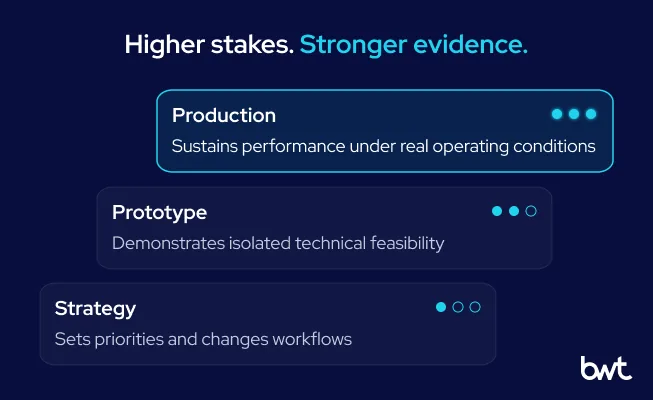
A strategy case can show how a firm sets priorities and changes the way teams work. It does not establish production engineering. A prototype can demonstrate feasibility within its boundary, but it does not show sustained performance under real permissions, source changes, user behavior, incidents, and cost.
Use five questions in proposal and reference reviews:
- Which case is closest in workflow, risk, and data, and was it a prototype, pilot, or live system?
- What was deployed, what remained planned, and what did another provider own?
- Which result was measured in production, over what period, and against which baseline?
- What evidence can the reference client confirm?
- Which members of that delivery team will work on this engagement?
Production operation extends beyond the model
Different gaps call for different partners. Strategy work may need a clear financial case and agreement among executives. A data-constrained program needs access to sources, shared definitions, and people responsible for fixing problems. A product program needs implementation, integration, testing, and a workable handover. Once the system is live, someone must monitor it, handle incidents, control costs, and provide support. The proposal should name that person or team and explain what completion means at each necessary stage.
Check whether governance changes how the system is built and run. Depending on the risk and applicable requirements, policy should affect access rules, approval paths, test records, release gates, or incident response. Support terms should name who deploys, recovers, and maintains the system. Certifications and branded accelerators do not substitute for comparable production evidence.
Agent claims need operating evidence proportionate to what the agent is allowed to do. Microsoft Research describes production concerns including message tracing, debugging, observability, interoperability, and benchmarking. These controls help an operating team find failures, compare quality, and restore service before errors spread. Anthropic reports that its multi-agent research system needed checkpoint recovery, deterministic safeguards, production tracing, automated evaluation, and human evaluation. When similar risks apply, ask how the proposed system will trace actions, recover from failure, and preserve the required human approval and override rights.
That operating question changes as soon as the system can act.
“A demo is judged by the answer it produces. A production agent has to be judged by what it was allowed to do, what happened when a tool failed, and whether the team can reconstruct the decision afterward.”
— Dmytro Naumenko, CTO at GroupBWT
The client’s legal and compliance teams should determine which obligations apply with the relevant risk and business owners. The consultancy can then translate those requirements into the access, review, evidence, and incident processes needed for that workflow.
Inspect data, integration, and operating ownership
Inspect how each firm handles the workflow’s sources, owners, definitions, access, refresh behavior, and known quality failures. For additional context, compare custom data engineering solutions and AI strategy consulting.
The production distinction matters because integration depth determines whether a promising model becomes usable work.
“The hard part is rarely connecting one model to one database. It is preserving access rules, source meaning, and a recoverable data path when the workflow crosses five systems and someone changes one of them.”
— Alex Yudin, Head of Data Engineering at GroupBWT
Request a map that names every source and its owner. It should show which system supplies each fact, how permissions carry through retrieval, what happens when a source fails, and who can correct it. For an agent, it should name each tool and what the agent may read, change, or approve.
Name who takes responsibility after launch. Put people or teams beside monitoring, escalation, approving changes, and rollback. After a handover, the internal team needs enough access and documentation to diagnose a failure and change the system safely.
Demand evaluation, governance, and human responsibility
Tests should mirror the workflow. Ask for development tests, a separate acceptance test set where appropriate, production monitoring, error review, and controlled prompt or threshold changes. This lets the business approve releases against known standards and catch performance drops after launch. For agents, evaluate tool selection and use, permission failures, recovery behavior, latency, and cost per task or interaction.
In scientific research, a Hastings Center Report paper on AI agents finds gaps around responsibility and verification. The proposal should name the person accountable for each decision or output the system can influence.
Make commercial assumptions explainable
The reviewed sources did not provide fixed prices or timelines that could be compared fairly. Ask each firm to explain what drives its estimate. Compare the work included for readiness, data repair, build, integration, testing, governance, deployment, adoption, and ongoing operation. Confirm what the client must provide, which external licenses or cloud costs sit outside the fee, who owns the assets, how work is accepted, and what is excluded.
Source access can delay a simple build; a fast prototype can take longer to reach production when permissions or evaluation were deferred. Team continuity affects cost and schedule too. Ask whether the people shaping the business case will remain through delivery and what happens when the work moves from pilot to operation.
Know when consulting is the wrong purchase
Do not hire an AI consultancy merely because leadership wants an AI initiative. An engagement is often unnecessary when an existing product meets the need, deterministic automation is safer, data access is unavailable, no measurable outcome exists, or no one can own the system after launch. Added complexity has to earn its place.

Conclusion: The Top AI Consulting Companies Solve Different Problems
There is no defensible universal ladder for these firms. The top AI consulting companies in this comparison suit different delivery needs and business problems. First choose the kind of partner the work requires. Then ask the people named in the proposal to show comparable delivery, explain how they measured it, and state who owns launch and operation – either the consultancy or the client team after a planned handover.
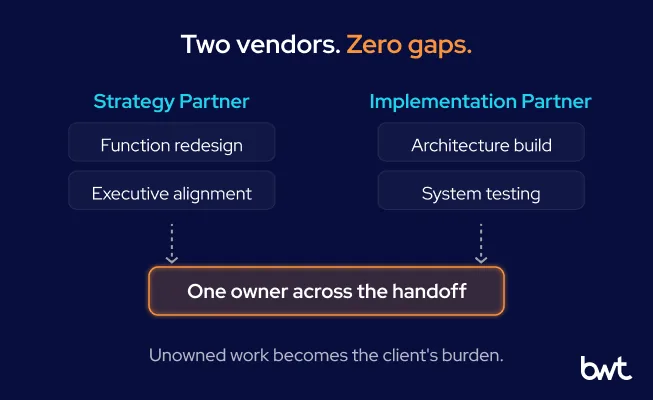
Yes. The split works when one party owns the shared outcome, decisions move between teams without reinterpretation, and the implementation team can challenge assumptions before architecture is fixed. Put responsibility for data, integration, evaluation, launch, and support into the contracts so a gap between suppliers does not become the client’s unowned work.
Ask the firm to describe a comparable engagement without revealing the client: the workflow, production status, scale band, risk level, systems involved, and results the reference can confirm. It can also demonstrate sanitized delivery artifacts or arrange a confidential reference call. If confidentiality restrictions limit what the firm can share, ask what alternative evidence it is permitted to provide and record any remaining verification gaps.
A large firm can reduce coordination risk across regions, functions, and alliances. It can also place more layers between decision-makers and builders. A specialist may offer direct engineering access but less change capacity, so compare the assigned team, references, subcontracting, governance, and post-launch ownership rather than company size alone.
Read summarized version with
Data Engineering: From Raw Web to Data Product
We develop and manage custom data solutions, powered by proven experts, to ensure the fastest delivery of structured data from sources of any size and complexity.
We offer:
- Custom Web Scraping & Development
- 15+ Years of Engineering Expertise
- AI-Driven Data Processing & Enrichment