Read summarized version with



Most orchestration problems do not announce themselves as platform problems. A source changes format on Tuesday night. A dashboard still refreshes, with stale numbers. A vendor bill climbs with every record. Or the only engineer who understands the scheduler goes on leave, and the “small script” looks like core infrastructure.
Build vs buy data orchestration is the decision between developing and operating an orchestration layer internally, using an open-source platform, purchasing a managed service, or combining these approaches. The right model depends on workflow complexity, control, engineering capacity, compliance, scale, and long-term cost.
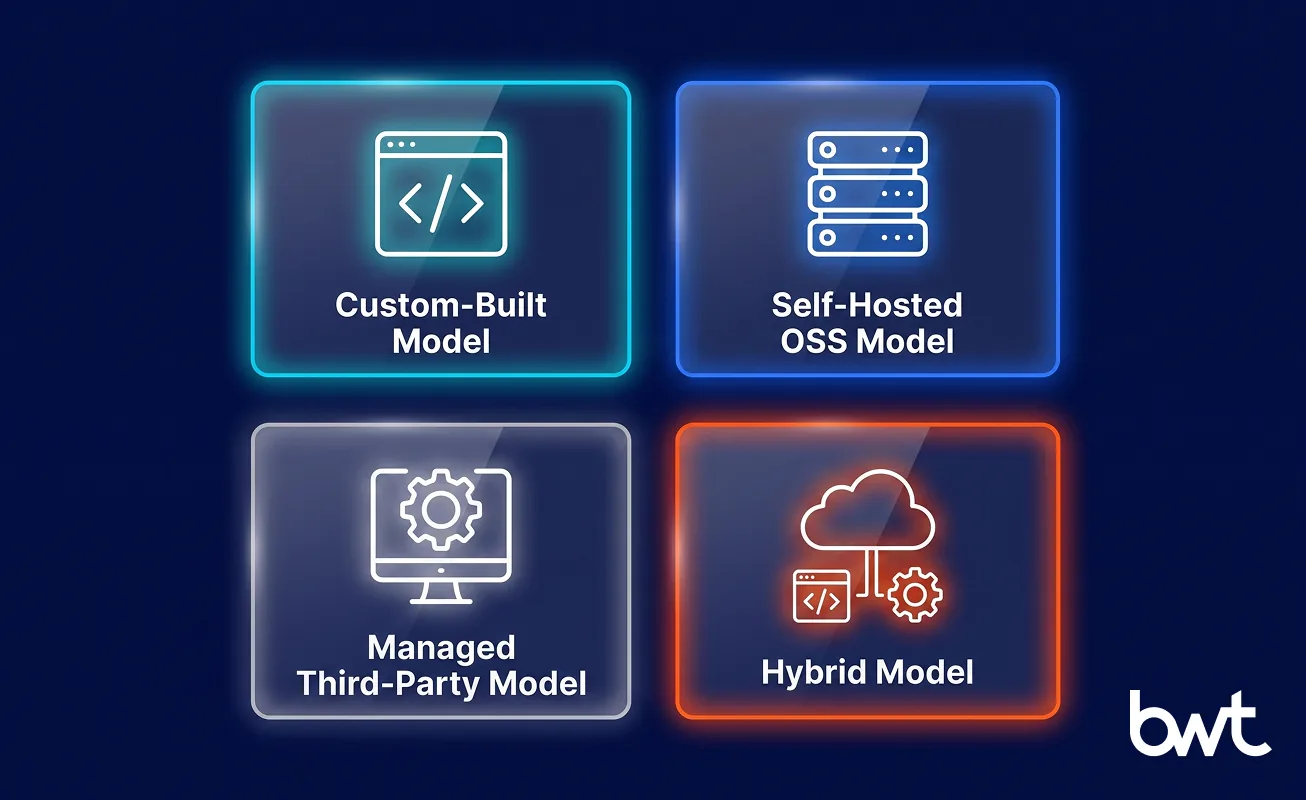
So the answer isn’t binary. The real choice has four models: custom-built, self-hosted open source, managed third-party, and hybrid. Pick the one your team can still operate when the first source breaks, not the one that looks cleanest in a vendor diagram.
Build the Data FoundationYour AI Models Need
We develop and manage custom data solutions, powered by proven experts, to ensure the fastest delivery of structured data from sources of any size and complexity.
- Custom Web Scraping & Development
- 15+ Years of Engineering Expertise
- AI-Driven Data Processing & Enrichment
Key Takeaways
- Custom orchestration gives the most control. It also needs the strongest ownership model.
- Managed platforms launch faster. Whether they stay cheap depends on pricing, metadata export, and exit terms, not the demo.
- Self-hosted open source removes the license fee. The cluster, the secrets rotation, the upgrades, and the on-call rotation are still on your tab.
- Hybrid can fit mixed estates. It adds coordination cost across tools, teams, monitoring, and SLAs, and that cost is easy to underestimate.
- Decide by workflow complexity, connector fit, compliance, team capacity, scale, reliability, lock-in, and time to value — in that order.
What the Build-or-Buy Orchestration Decision Actually Means
Orchestration is the layer that decides which job runs at 02:00, which one waits behind a failed source, which one retries, and which Slack channel gets woken up before a sales report or a model output goes stale. It sits between the source APIs, the warehouse, the dashboards, and the inference jobs. When this layer is wrong, the business acts on yesterday’s numbers before anyone notices.
Most teams frame the decision as “build vs buy data orchestration” and stop there. Four models actually fit on the menu:
- Custom-built. Your team owns the scheduler, the dependency rules, the recovery paths, the security controls, and the infrastructure. The 02:00 page is yours.
- Self-hosted open source. Airflow, Dagster, or Prefect runs in your cloud. The license is $0; the cluster, the secrets rotation, the upgrade calendar, and the pager are not.
- Managed third-party platform. The vendor runs the orchestrator and the standard connectors. You trade some control for launch speed and the catalog.
- Hybrid. Commodity feeds ride managed connectors. Proprietary, regulated, or cadence-sensitive logic stays under your control.
| Model | Ownership | Operational burden | Best for |
| Custom-built | Full | Highest | Unique, complex, long-lived workflows |
| Self-hosted OSS | High | High | Engineering-led teams that want control with less vendor lock-in |
| Managed third-party | Low | Lowest in-house | Standard workflows and fast launch |
| Hybrid | Split by layer | Medium to high | Estates mixing commodity and proprietary data |
Build vs Buy Data Orchestration: Key Decision Criteria
Workflow Complexity and Differentiation
Start with the workflows, not the tool. If the workflow contains freshness rules, source precedence, provenance, or recovery behavior that a vendor cannot express, custom work has a reason to exist. If the path is ordinary ETL/ELT, buying time is usually smarter.
Source and Connector Coverage
A managed catalog helps only when it reaches the sources that matter. Check today’s sources and likely additions. Portals, unstable APIs, partner formats, and scraping-heavy flows all raise the value of custom connector capacity.
Security and Compliance Requirements
Residency, audit, access, and evidence requirements decide how much control you need over the flow. Managed can fit, but only when the contract and platform controls match the rulebook you have to defend.
Team and Platform Engineering Capacity
Do not ask whether the team can build a first version. Ask whether it can own support when a source fails before a board report, model run, or regulatory export.
| Model | Minimum ownership capability |
| Custom | Platform/data engineers, on-call, security, DevOps |
| Self-hosted OSS | Orchestrator specialist, cloud infrastructure, upgrades |
| Managed | Data engineers and vendor-management ownership |
| Hybrid | Architecture governance across internal and vendor layers |
Scale and Pricing Model
Usage-based pricing can beat hiring until volume grows past the saving. Custom and self-hosted models shift cost into infrastructure and people; managed platforms shift it into contracts and usage meters.
Reliability and Recovery Requirements
If a failed job must be replayable or corrected before the business sees stale numbers, recovery logic is part of the architecture.
Vendor Dependency and Exit Cost
Before signing, ask how workflows, logs, lineage, metadata, and connector configuration export. A cheap platform becomes expensive if exit means rebuilding dependency maps.
Time to Value
Managed usually wins when launch speed matters most.
| Criterion | Custom | Self-hosted OSS | Managed |
| Unique workflow logic | Strong fit | Strong fit | Limited |
| Fast launch | Weak | Medium | Strong |
| Internal maintenance | Highest | High | Lowest |
| Compliance control | Highest | High | Vendor-dependent |
| Standard connectors | Requires work | Requires setup | Strong |
| Exit flexibility | High | High | Lower |
Hybrid needs a separate view because it combines managed convenience with custom control. Its value depends on whether that split reduces ownership burden or merely adds another operating boundary.
| Criterion | Hybrid |
| Unique workflow logic | Strong fit |
| Fast launch | Medium |
| Internal maintenance | Medium |
| Compliance control | High |
| Standard connectors | Strong |
| Exit flexibility | Medium–high |
Why Most Build vs Buy Decisions Go Wrong
Most wrong choices start before engineering begins:
- Picking the tool before mapping the workflows. The orchestrator then fights the dependency graph instead of supporting it.
- Treating open source as free. A $0 license still needs infrastructure, upgrades, secrets, monitoring, and a specialist.
- Building commodity features from scratch. If standard connectors already solve the work, custom code adds maintenance without advantage.
- Comparing subscription cost with development cost only. The real comparison includes years of support, migration, and exit cost.
- Confusing uptime with reliability. A green dashboard can still hide stale data.
Each is avoidable when the criteria above are answered before vendor demos.
Custom-Built Orchestration: Benefits and Trade-Offs
Build custom only when a vendor abstraction would cost you the thing that makes the product work — a freshness rule a platform cannot expose, a source the connector catalog will never reach, or provenance that has to survive an external audit. The critical detail is rarely “another pipeline.” It is the rule that turns a feed from “probably right” into “we can defend it.”
That control has a bill attached, and the bill does not arrive all at once. You need people who own the scheduler, the secrets rotation, the retry logic, the cloud invoice, the boring upgrades, and the recovery drills. Security and governance are design work — data residency you can prove, lineage a reviewer can follow, role-based access, secrets management, encryption in transit and at rest.
Third-Party and Self-Hosted: Managed vs Open-Source
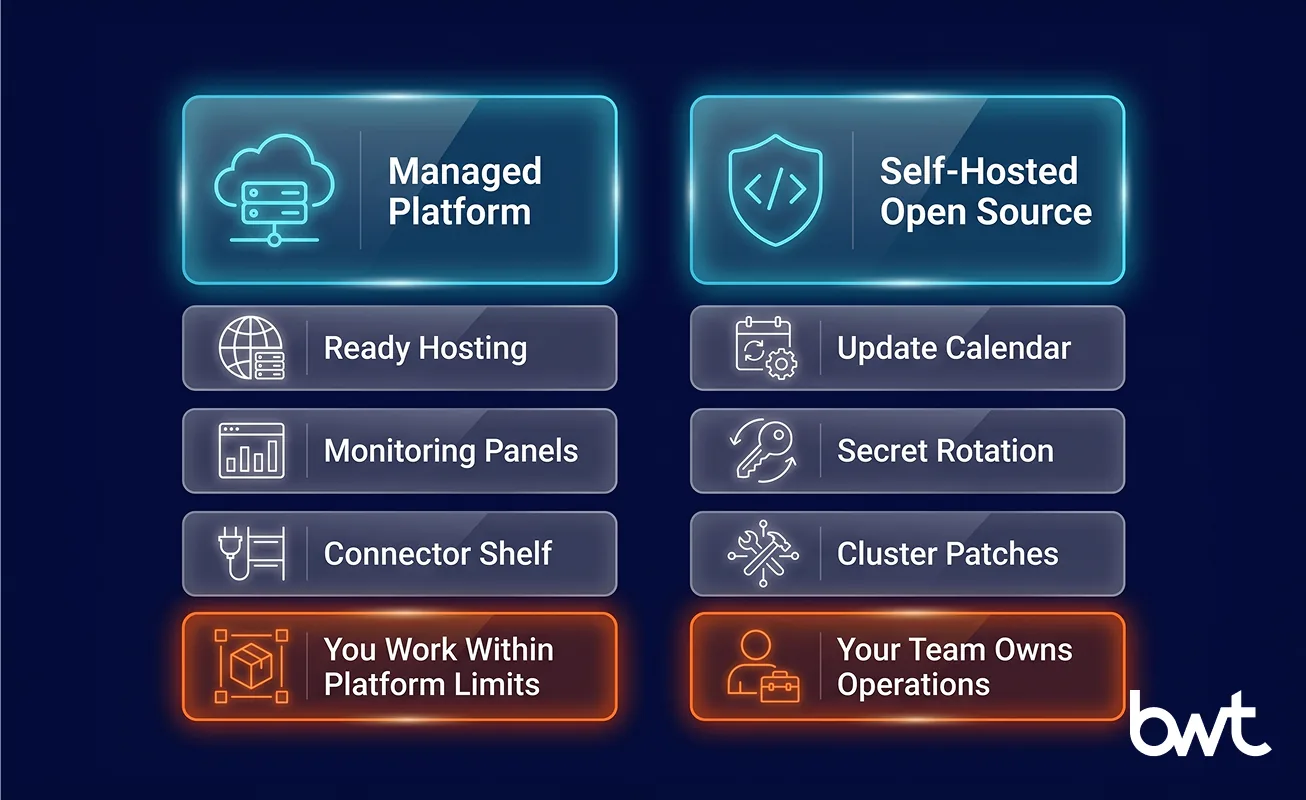
The “buy” side splits in two. A managed platform hands you the host, the dashboards, and a shelf of connectors — and then sets the rules about what you can reach. Self-hosted open source puts you back in charge, but the upgrade calendar, the secret rotation, the cluster patching — that is yours at 2 a.m. Google’s engineering team runs Apache Airflow at scale and is blunt about the cost: “often a complex undertaking, with many hours spent wrestling with reliability, security, and efficient resource scaling,” per Cloud Composer 3 for Apache Airflow (Google Cloud, 2025).
Before signing anything, demand the answers on paper: connector coverage today and next year, custom connector cost, API and rate limits, retry behavior, metadata export, data residency, what the audit log captures, what the SLA covers, pricing escalators, exit terms, workflow portability, and the support response time at 03:00. Vague slides and an enthusiastic SE are not the same as written answers. For any custom-built vs third-party solution for data orchestration decision, treat the unanswered checklist as a no.
The opposite pressure shows up in a published GroupBWT Databricks migration for a US agribusiness. The legacy estate was roughly 20 databases and 6,000-plus tables held together by undocumented scripts. GroupBWT moved the warehouse layer to a governed Databricks architecture. The public case reports 30% lower infrastructure costs and report runtime cut from 10+ minutes to 3 minutes. The orchestration lesson: include documentation, ownership, and the migration path, not only the tool name.
Four Models Side by Side: Custom, Managed, Self-Hosted, Hybrid
For a custom-built vs third-party solution for data orchestration comparison, use this shorthand: custom for strategic logic, managed for speed, self-hosted for team-owned control, and hybrid for mixed risk. The familiar custom data orchestration vs third-party platform question and the data orchestration platform vs custom solution comparison are useful only after you separate commodity workloads from strategic ones. The data orchestration build vs buy math then settles into three numbers: control, three-year cost, and ownership capacity.
When You Should Build Custom Data Orchestration
Also Read: Data Orchestration as a Managed Service
Build when the business would lose value if the platform could not express its data rules. Four signals:
- Workflow logic is the advantage — freshness controls, source precedence, or recovery rules a vendor cannot expose.
- Standard connectors cannot reach critical sources — the data lives behind portals or cadences no catalog covers, where custom web scraping reaches what a managed tool misses.
- Compliance forces ownership — residency, provenance, or audit rules must be designed into the flow.
- Scale changes the economics — usage pricing grows faster than the value.
A UK public-sector procurement intelligence platform shows the decision. A third-party feed could not fetch records by creation date, replaced missing publication dates with collection dates, and mixed international data into a UK workflow. GroupBWT rebuilt ingestion on client-owned infrastructure across 100-plus procurement sources, with OCDS-aligned data, field-level provenance, and data ready by 05:00 UK time daily. As of July 2026, the system had run daily for more than three and a half years. Build when freshness, source control, and provenance are the product.
“The build-or-buy question is not about ideology. If a managed connector solves the commodity part, keep it. Build only where the data, control, governance, or refresh cadence becomes part of the client’s advantage.”
— Oleg Boyko, CCO at GroupBWT
When You Should Buy a Third-Party Platform
Buy when speed and lower in-house platform ownership matter more than control. The strongest managed fit is standard ETL/ELT, common SaaS sources, moderate customization, documented compliance controls, and a team that should spend time on analytics or product work.
At scale, the lesson is standardization, not buying for its own sake. Meta moved off fragmented custom pipelines to a centralized ingestion service because the distributed approach “functioned effectively at a small scale” but destabilized under stricter data-landing-time requirements, per Migrating Data Ingestion Systems at Meta Scale (Engineering at Meta, 2026). The point is to standardize commodity movement before local pipeline freedom breaks SLAs.
The True Cost of Ownership
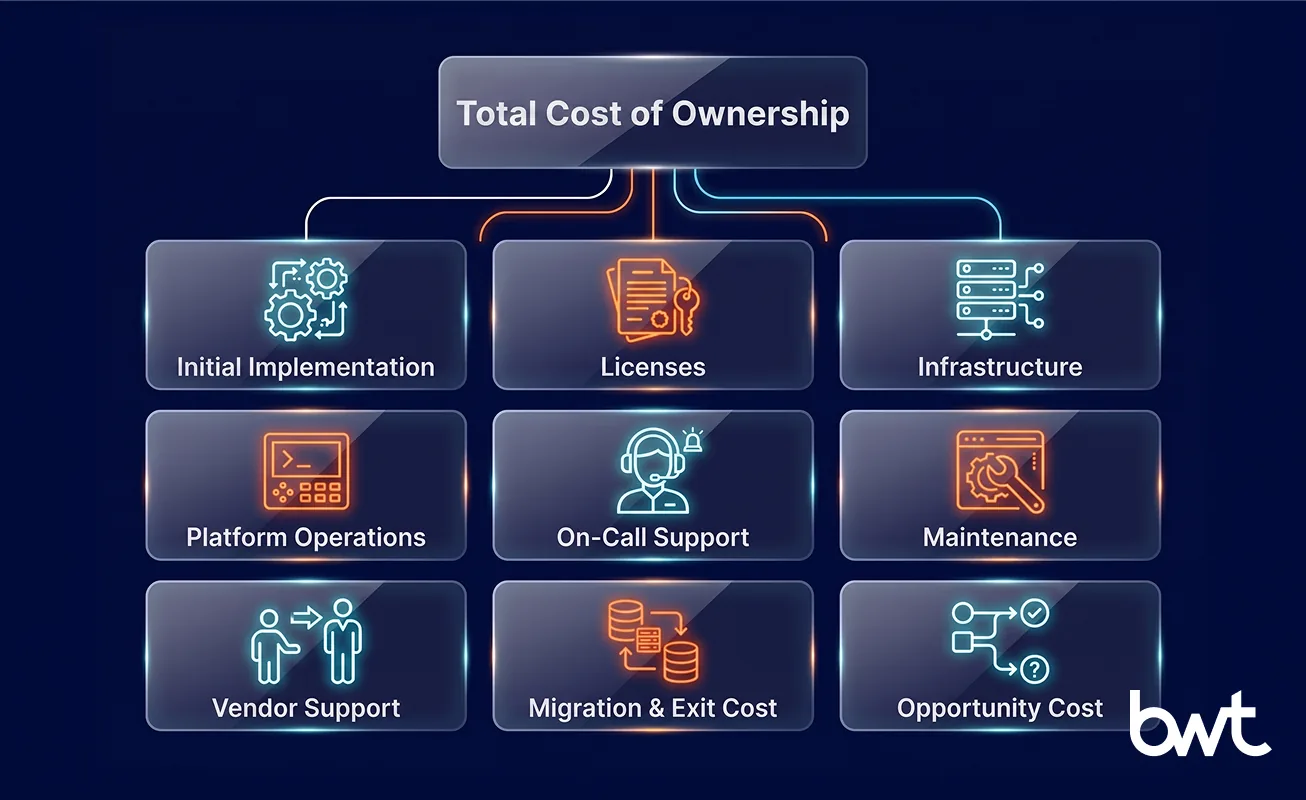
Most build vs buy pitches quote the launch year. That is the wrong number. The bill lives in years two and three. Upgrades nobody scheduled, schema drift that quietly broke a join, a vendor API that deprecated the connector your team has wrapped around it, the 02:00 page nobody wants — and the engineer you pulled off the roadmap for two days to fix the cascade. A federal IT benchmark is not specific to data orchestration, but it warns any long-lived production system: US agencies reported about 80 percent of IT budgets going to operations and maintenance of existing systems, per Agencies Need to Plan for Modernizing Critical Decades-Old Legacy Systems (U.S. Government Accountability Office, 2025).
Run the same math against orchestration. Three-year TCO = implementation + licenses + infrastructure + platform operations + on-call support + maintenance + vendor escalation + migration/exit cost + opportunity cost. Use ranges from past projects. A made-up number is worse than an empty cell.
| Cost category | Custom | Self-hosted | Managed |
| Initial implementation | High | Medium | Low |
| Infrastructure | High | Medium–high | Included |
| Internal operations | High | High | Low |
| Usage fees | Low | Low | Potentially high |
| Exit cost | Medium | Medium | Potentially high |
| Specialist dependency | Internal | Internal | Vendor |
Hybrid spreads these costs across internal and vendor-owned layers rather than removing them. Compare the combined operating model, including the coordination work between both sides.
| Cost category | Hybrid |
| Initial implementation | Medium |
| Infrastructure | Split |
| Internal operations | Medium |
| Usage fees | Mixed |
| Exit cost | Medium |
| Specialist dependency | Both |
“The hidden cost is rarely the first scraper or first connector. It is the source change six months later, the silent failure, the retry logic, and the person who has to know what broke before the client does”
— Alex Yudin, Head of Data Engineering at GroupBWT
Reliability, Retry, and Disaster Recovery
Reliability is designed failure behavior. It answers what happens when a source changes, a transfer stops, or a “job completed” flag lies.
- Cost of downtime. A retail intelligence platform routed failed collection units into dead-letter queues, so a broken unit became visible and replayable. This supports a custom or hybrid decision when pricing depends on freshness.
- Retry and failure recovery. An HR and job-market data platform with a 21-month track record sent five ingestion and delivery alerts into Slack. A healthcare data-compliance workflow caught a silent upload failure of two archives totaling about 100 GB by reconciling expected against actual records at the destination. Monitoring belongs in the model decision.
- Disaster recovery and failover. A legal IP-enforcement data platform operated for 6-plus years with documented snapshot and restore procedures. Recovery protects chain of proof.
“A pipeline is not production-ready because it runs once. It is production-ready when failures are visible, retries are designed, recovery is documented, and the business can trust yesterday’s data without asking the engineering team.”
— Dmytro Naumenko, CTO at GroupBWT
When Hybrid Wins — and When You Should Not Build at All
Hybrid works when the workflow map shows different risk by layer. Keep commodity sources on managed connectors. Own the proprietary logic, the regulated workloads, and the cadence-sensitive flows. AWS describes the same split in its orchestration guidance: the options “are not mutually exclusive… many organizations use both,” per Choosing the right workflow orchestration service (AWS Big Data Blog, 2026). Build does not have to mean custom-everything.
The Operational Cost of a Hybrid Model
Hybrid reduces dependency on a single platform, but it can raise coordination cost across several platforms. Watch for multiple orchestration environments, fragmented monitoring, harder cross-platform lineage, duplicated skills, unclear responsibility between internal and vendor teams, mismatched security models, slower incident response, and SLAs that don’t line up. Hybrid works only when that coordination cost is lower than forcing every workload into one platform.
The harder call is stopping a build before it becomes a badge of pride. In one manufacturing advisory engagement, the better architecture was smaller than the pitch: keep the existing system as the source of truth, extract only searchable metadata, and let a federated search layer point back to the original engineering files. You probably do not need custom orchestration yet if volume is small and stable, standard connectors cover the sources, and nobody is ready to own monitoring and recovery.
If You Already Have a System: Migrating and Modernizing
Few of these decisions start from a blank page. You may already run a managed platform you have outgrown or scripts that predate the data team. The real question is whether to migrate, modernize, or leave it alone.
Modernizing rarely means a clean cut. Move the layer that hurts first, run old and new side by side, then retire the old path. That is the practical way to handle migrating between orchestration platforms.
When is it time to move? Two of the most common triggers are spend that stops buying value and a platform wall. The payoff lands after launch, in lower support load and fewer data incidents.
How to Choose: A Simple Decision Tree
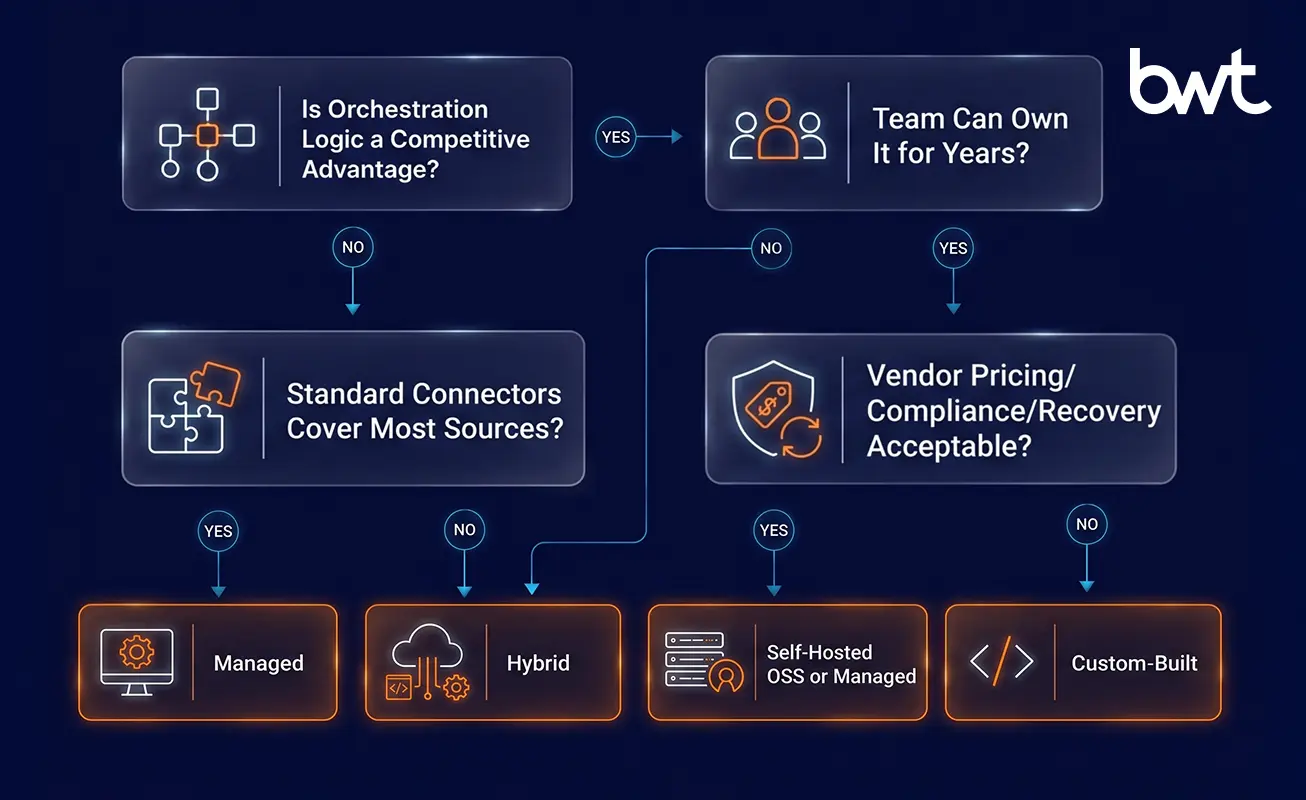
Use the matrix as a starting point, then break ties. The build vs buy data orchestration platform choice comes down to five questions:
- Is orchestration logic part of your product advantage?
- Do standard connectors cover most critical sources?
- Do compliance rules require direct control of residency, audit, lineage, or recovery?
- Does vendor pricing still make sense at expected scale?
- Does your team have the ownership capability for the model?
If the answer to #1 and #3 is no, managed is usually enough. If #1 or #3 is yes and the team can own production support, custom or self-hosted can fit. If the answers differ by workload, hybrid is the safer architecture.
Ready to turn this into a plan? The Data Orchestration Roadmap turns the model choice into target architecture and workload split.
Our Approach to Data Orchestration
GroupBWT starts by splitting workloads by risk. We keep the managed layer where a connector solves the commodity part, and build custom only where data, control, governance, or refresh cadence becomes the client’s advantage. That posture comes from operating pipelines after release across Manufacturing, E-Commerce, Retail, Travel, and public-sector programs.
The stakes rise when the pipeline feeds models. See data readiness for AI and ML workloads and orchestrating AI and ML data pipelines — the backbone of any AI consulting engagement.

Build vs Buy Data Orchestration: What to Do Before You Commit
Buy when workflows are standard and speed beats customization. Build when orchestration logic is part of your advantage. Self-host when a platform team can carry the work. Use hybrid when the estate mixes commodity feeds with proprietary or regulated data.
GroupBWT assesses orchestration requirements, compares custom and managed options, designs target architecture, and builds reliable data workflows across cloud, legacy, analytics, and AI environments.
Neither by default. The real choice has four models: custom-built, self-hosted open source, managed third-party, and hybrid. Buy when the pipeline follows a standard ETL or ELT path and speed matters more than control. Build when the orchestration logic is the product advantage and a vendor cannot expose the rule. Use hybrid when commodity and proprietary workloads genuinely need different ownership.
Often, yes — the build is the smallest piece. The bill keeps arriving through infrastructure, on-call rotations, schema drift, vendor deprecations, and engineers pulled off roadmap work. Managed can also become expensive once the usage meter overtakes the headcount it saved. The honest comparison is a three-year TCO.
It can. Connectors, lineage metadata, and platform configuration rarely export cleanly. Read the exit clause, ask for a sample data export, and keep transformation logic in open formats where possible. Custom-built orchestration avoids vendor lock-in, but it can still lock you into the engineers who understand it.
It can happen. Sources change, vendors deprecate APIs, the original architects move on, and the layer you built five years ago starts behaving like the brittle system it was meant to replace. The defense is documentation, monitoring, recovery drills, and a small owning team.
Hybrid fits estates that mix commodity sources with proprietary or regulated ones. Keep managed connectors for standard feeds, build custom logic where governance, provenance, or cadence requirements demand it, and hold sensitive workloads inside controlled environments. The benefit is reduced single-platform dependency. The cost is real: extra monitoring, harder cross-platform lineage, more security models to keep in sync, and mismatched SLAs between layers. Use hybrid only when that split is genuinely simpler.
Read summarized version with
Build the Data FoundationYour AI Models Need
We develop and manage custom data solutions, powered by proven experts, to ensure the fastest delivery of structured data from sources of any size and complexity.
- Custom Web Scraping & Development
- 15+ Years of Engineering Expertise
- AI-Driven Data Processing & Enrichment