
Read summarized version with


Buying an AI tool creates access. Work can carry on exactly as before. Employees may test the tool on isolated tasks, then fall back to the process they trust. A deliberate adoption plan closes that gap inside a specific workflow: it defines who uses AI, which decisions stay human, what managers reinforce, what users must learn, and what evidence would justify keeping the change.
We separate the evidence into access → usage → adoption → value → scale. This is GroupBWT’s explanatory model for separating five questions that teams often combine. It is not a universal industry taxonomy or a fixed project sequence.
AI Workflow and Implementation Support
Review Your AI-Enabled Workflow
A focused review of the workflow, technical, and operating gaps that determine whether an AI capability can become part of normal work.
We assess:
- Whether the workflow and AI capability are ready for operational use
- Gaps in role definitions, manager routines, and documented workflows
- Trust, feedback, measurement, and technical blockers
This article stays on the human and operational side of enterprise AI adoption. Architecture, data readiness, and production engineering matter when they block the intended behavior, but they do not prove adoption.
Key Takeaways
- Access only shows that intended users can reach an approved tool. Adoption changes how they complete work.
- Track usage, output quality, adoption, business value, and scale separately.
- Manager routines and process ownership matter as much as end-user training.
- Role-based practice, visible feedback, and clear fallback rules earn trust.
- Retire old steps once the workflow owner accepts the evidence.
- Scale only after sustained use and acceptable outcomes. Not every viable capability should expand.
What Is an AI Adoption Strategy?
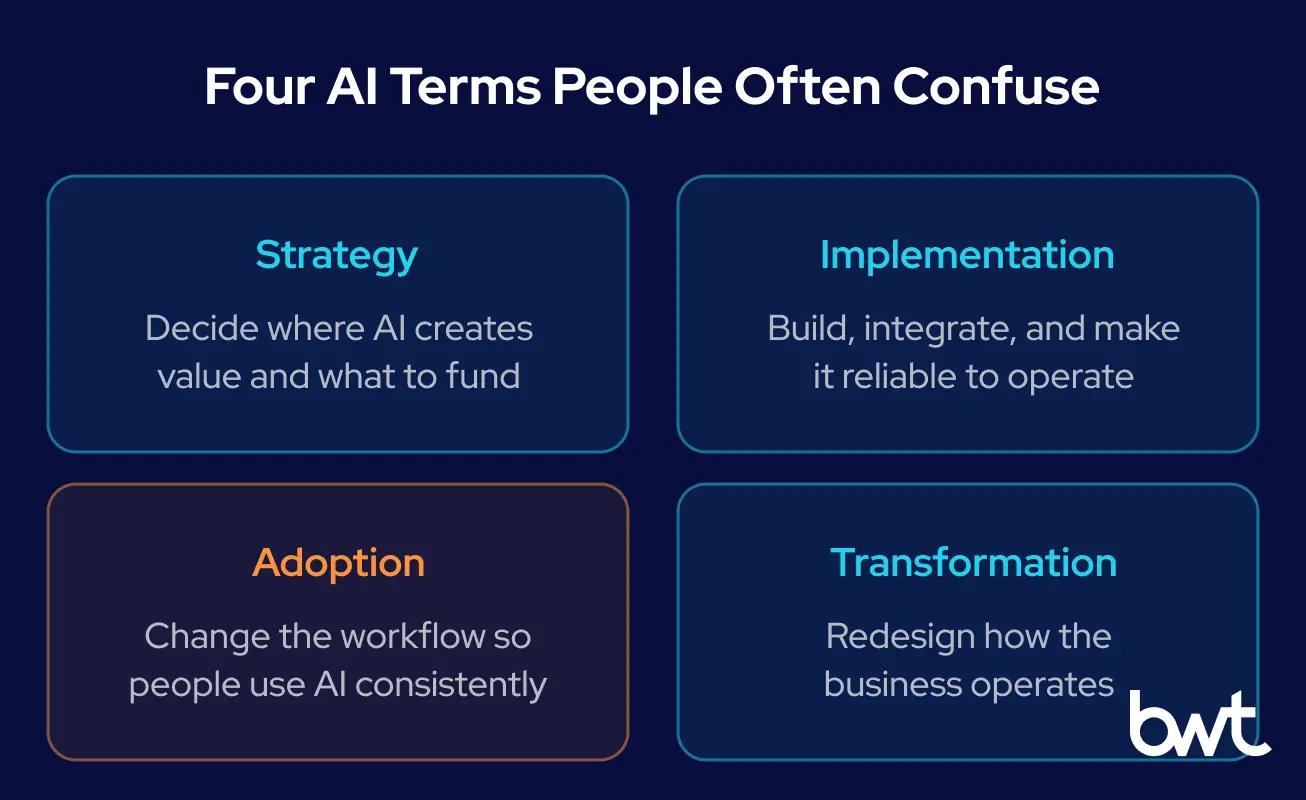
An AI adoption strategy is a plan for making an approved AI capability part of normal work. It defines whose behavior changes, how the documented workflow changes, which decisions remain human, what managers reinforce, how users challenge errors, and which operational result justifies continued investment.
That definition creates useful boundaries:
- AI strategy decides where AI could support business priorities and which opportunities deserve funding.
- AI implementation builds or configures the capability, connects data and systems, and makes it reliable enough to operate.
- AI adoption changes the workflow so intended users employ that capability consistently within an approved operating process.
- AI transformation redesigns several parts of the operating model, potentially changing decision rights, organization structure, products, or business economics.
A company can implement AI without adopting it, or adopt one workflow without enterprise transformation. Effective AI adoption strategies keep a technically working release separate from a business result.
Permissions, data access, integration, and reliability matter here when they stop the approved process. Deeper architecture choices belong to AI implementation solutions. A read-only search assistant can be fully adopted when people rely on it in a recurring workflow. Write-back may reduce friction, but adoption does not require it.
AI Adoption Framework: Access → Usage → Adoption → Value → Scale
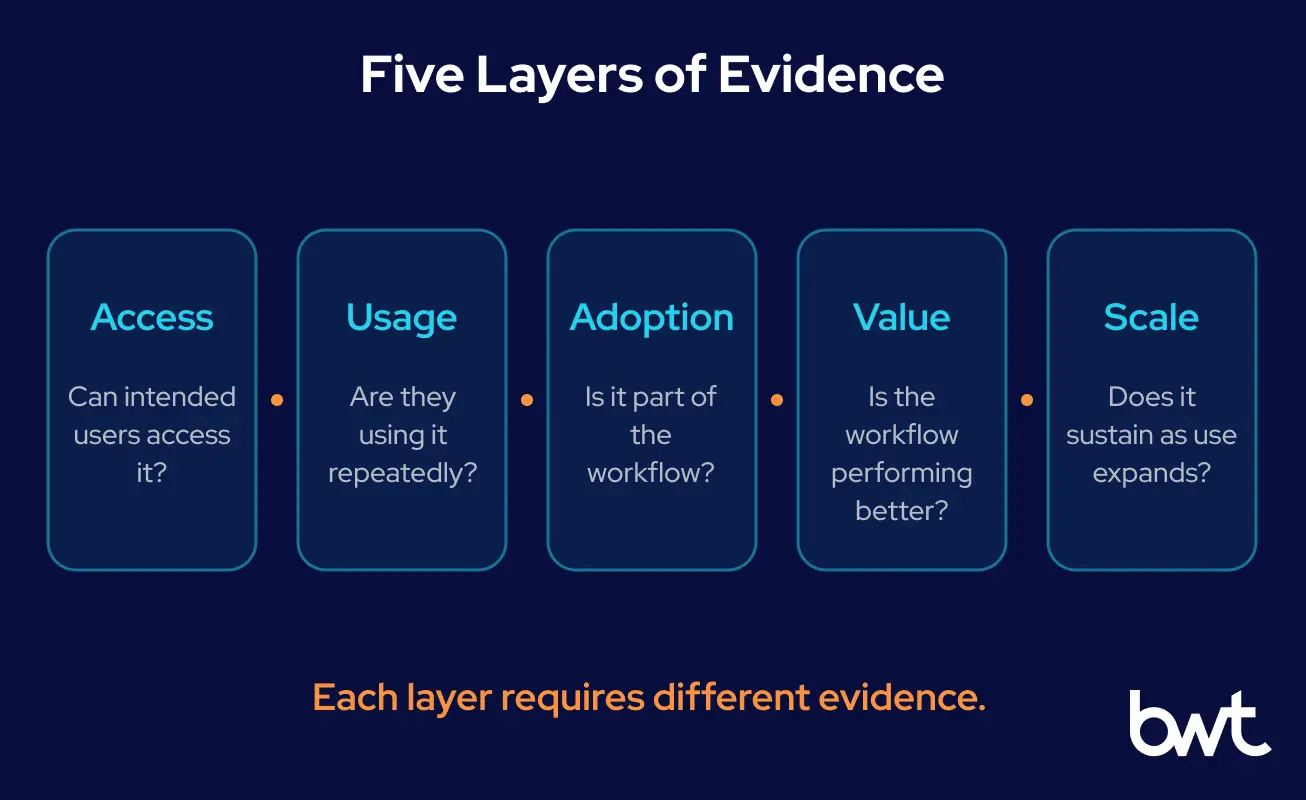
The five layers below represent different evidence. They often develop in this order, yet a controlled pilot may show early value before sustained adoption has been established.
| Evidence layer | Question it answers | Evidence for that layer |
| Access | Can intended users reach the approved capability? | Eligible users have working permissions, approved data boundaries, and a supported entry point. |
| Usage | Are they trying it for the intended task? | Activity is measured by role and workflow, not by licenses assigned. |
| Adoption | Has the AI step become part of normal work? | A documented workflow, operating procedure, or team playbook names the AI step, review, exception, fallback, and owner. |
| Value | Has the result improved? | A baseline changes in cycle time, throughput, quality, error rate, cost, or another owner-approved outcome. |
| Scale | Does the proven pattern hold as its scope grows? | Sustained use and acceptable outcomes continue across more eligible users, volume, teams, or workflows under appropriate controls. |
ACCESS – availability
↓
USAGE – activity
↓
ADOPTION – sustained workflow behavior
↓
VALUE – measurable improvement
↓
SCALE – controlled expansion
Each arrow is a question, not proof of progress. Licenses do not prove use, prompt volume does not prove adoption, output acceptance indicates quality rather than value, and expansion demand is not scale.
Ad hoc copying into a chatbot is usage, even when the answer helps. A temporary approved process may include manual transfer during learning; the distinction is whether the step, review, decision, and fallback are defined rather than improvised.
GroupBWT uses the model to keep reporting honest. Do not blend weekly users, accepted outputs, time saved, and additional workflows into one score. A leader should see exactly where the evidence runs out.
Why AI Adoption Fails After a Promising Launch
Many failures sit between a working capability and the behavior expected around it. The operating environment may give people sound reasons not to depend on the tool.
The new workflow gives the user no clear advantage
Executives may see a portfolio opportunity while an employee sees another screen, another transfer, and another review step. If nothing disappears or becomes easier, the old process remains rational.
Map the task from trigger to outcome. Identify which step disappears, which judgment gets easier, and what happens when the output is wrong. “More AI activity” is not an adoption objective.
Managers still reward the old behavior
One workshop will not outweigh Friday’s request for the old spreadsheet. Nor will people experiment safely if their manager treats review time as poor performance.
Managers need examples of acceptable use and a clear escalation line. Responsible error reporting must not feel like punishment. Regular reviews should inspect outcomes and exceptions, not prompt counts.
Trust is demanded instead of earned
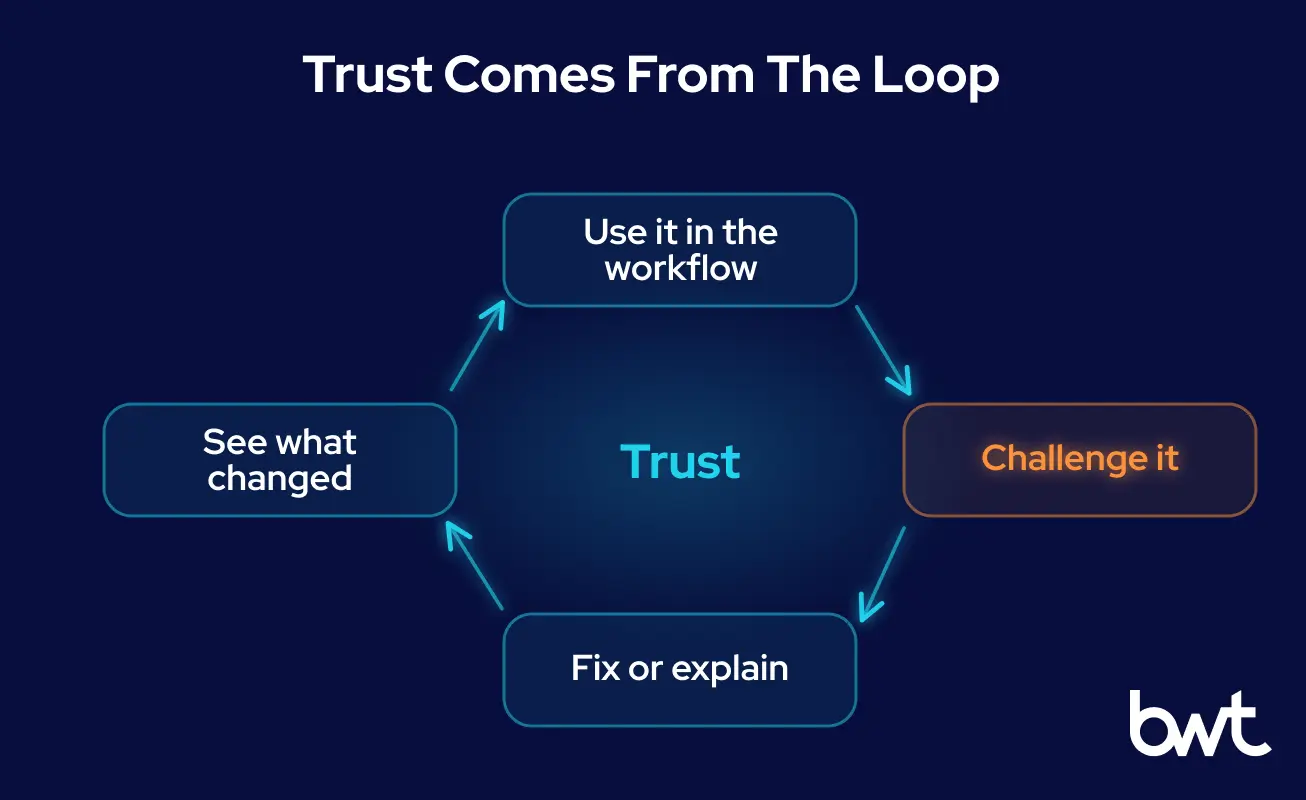
Trust shows up in ordinary actions: a user checks the source, corrects a bad output, reports the problem, and later sees what changed. Where an output cannot be challenged or traced, launch communication will not create dependable use.
Roles and decision rights stay vague
“Human in the loop” does not identify a responsible person. A usable process states who reviews each output, what they may change, which decision they own, and where an exception goes.
Name four responsibilities: the business outcome, documented workflow, data and system reliability, and post-launch feedback. One person may cover several, but each responsibility needs an owner.
Training explains the tool instead of the job
A claims analyst, sales manager, finance reviewer, and service agent need different practice. Generic prompt lessons teach experimentation, not behavior in an approved workflow.
Role-based enablement uses familiar work: a normal case, an imperfect output, an exception, and the fallback. An enterprise study of about 5.5 million anonymized M365 Copilot sessions found broad but uneven occupational usage. The preprint supports role-specific opportunity mapping, not a claim that access changed business performance.
Feedback has no visible outcome
People stop reporting issues when feedback disappears into a queue. A working route has a triage owner, response expectation, and visible outcome: fixed, accepted limitation, training gap, or out of scope.
Champions can interpret practice and surface friction, but a formal owner remains accountable for change.
Also Read: Data Readiness for AI: A Practical Guide for Data Leaders
Enterprise AI Adoption Roadmap: 10 Questions to Answer
The roadmap records decisions rather than a maturity score or fixed calendar. Its job is to move one approved capability into daily work without losing control. Answer the questions in the order the workflow and risk require.
1. Which workflow should change, and why?
Describe the trigger, current steps, recurring delay, and person accountable for the result. Pick work you can watch from trigger to outcome. “Use AI” is not observable.
2. Which user and manager behaviors must change?
Write observable behavior. “Use the assistant” is vague. “Review the suggested response in the case record, edit it when needed, and record the exception reason” is testable. Define what the manager reviews and which old report should stop.
3. How should the documented workflow change?
Update the operating procedure or team playbook before broad rollout. Mark the AI step in the procedure. Beside it, name the allowed information, reviewer, excluded cases, and fallback for an outage.
4. What are the review, escalation, and fallback rules?
Match control to consequence. Low-impact drafting may need light review. Credit, safety, employment, legal, or regulated decisions need controls appropriate to the organization and jurisdiction. State the excluded case, reviewer, escalation route, and fallback in plain language.
NIST’s healthcare-specific article on standards that support trustworthy AI shows why reliability needs defined, measurable characteristics. The measurable-trust lesson travels beyond healthcare. Its regulatory context does not.
In a delivered GroupBWT legal-intelligence project, a broad extraction approach failed to produce a reliable result. GroupBWT narrowed the paid proof of concept to explicit field assumptions, one data structure, and documented source limitations. The client could then inspect the bounded output within agreed field and source limits. This is implementation evidence for making the delivered output inspectable against an agreed scope, not proof of workforce adoption. The regulated AI prototyping case applies the same bounded-testing principle under financial constraints.
5. How will managers reinforce the process?
Managers should receive the business reason, workflow change, limits, and expected coaching behavior before the team is asked to adopt the capability. They also need permission to pause the workflow when controls fail.
6. What does each role need to practice?
Build short scenario sets from the team’s work: a normal case, a low-confidence output, a prohibited case, and a system failure. The learner completes the task. A feature recital proves nothing.
7. How will user feedback be handled?
Capture feedback close to the work. Separate errors, missing context, process confusion, permission problems, and feature requests. Close the loop visibly: fixed, accepted limitation, training issue, or out of scope.
8. Who should act as a local champion?
Choose people who understand the work and have colleagues’ trust. Give champions time to show responsible use, surface friction, and connect the team with people who can fix it.
9. When can the old process be retired?
Parallel processes can protect a learning period, but permanent duplication prevents adoption. The workflow owner decides when the evidence is good enough. Then remove obsolete steps and name the few cases that still require them.
10. What do the five evidence layers show together?
Ask whether the right roles use the capability for intended cases, complete the workflow, follow review rules, and improve the result. The answers point to better practice, process redesign, technical repair, continued rollout, or a stop.
AI Adoption Metrics: How to Measure Adoption Without Confusing It With Value
Give each metric one job. Report access, usage, adoption, quality, value, and scale separately.
Access metrics show whether intended users can begin: provisioning, working role permissions, and approved entry points.
Usage metrics show activity by role and workflow, including repeat use and the share of eligible cases where the capability opened. They reveal friction, not adoption.
Adoption metrics track completion through the approved path, adherence to review and escalation rules, fallback frequency, and whether managers use the output. Measure the workflow, not prompt volume.
Quality metrics sit beside adoption, not inside it: output acceptance, correction categories, material error rate, and incidents. In GroupBWT’s internal operating layer, a 95% no-edit rate on one bounded reply workflow is an acceptance measure. It does not establish client business value or enterprise-scale adoption.
Value metrics capture the result owned by the business. By assembling needed context automatically for another bounded internal workflow, GroupBWT reduced meeting preparation from 30 minutes to 5 minutes. That is workflow value because elapsed work changed. For a generative AI adoption strategy, the relevant business measure might instead be throughput, conversion, avoided rework, service level, or decision time.
Scale metrics show whether the pattern keeps working as users, volume, teams, or workflows expand. Track sustained use, performance at the larger scope, effort to enable the next group, and reuse of approved controls. Reliable AI data pipelines become part of that evidence when higher demand tests freshness, quality, and system performance.
A 2026 Google Cloud survey of 2,403 executives reported that 48% of organizations it classified as AI ROI Leaders had extremely clear ownership and decision authority. This vendor-sponsored result supports the ownership argument without setting a universal benchmark.
The split matters in practice. A team may open the tool often while using it only for easy cases, or accept many outputs while spending the same amount of time checking them. Those patterns call for different fixes. The first points to workflow coverage; the second to quality or review cost. One combined score would hide both.
AI Adoption vs Change Management
These disciplines meet inside the workflow, then part ways.
| Discipline | Main question | Typical scope |
| AI adoption | Will intended users employ this AI capability within an approved workflow and its controls? | Workflow behavior, user scenarios, review rules, feedback, measures, operating handover |
| Change management | How will the organization align people around a broader change? | Stakeholders, communications, incentives, role transitions, organization design, leadership alignment |
GroupBWT supports workflow and system design, instrumentation, controls, technical onboarding and operating guidance, feedback tooling, adoption measures, and operating handover. When source systems cannot sustain the workflow, GroupBWT’s data engineering services address that production constraint. This work surrounds an implemented capability; it does not replace the client’s change-management function. The client owns employment policy, incentives, internal communications, and manager accountability. Broader organization or role redesign belongs with the client’s change lead or a qualified change-management partner.
The boundary matters: integration does not create a habit, and an implementation partner does not own organization-wide change.
When You Should Pause or Stop an AI Adoption Program
Stopping can be responsible. Executive attention does not justify an ongoing operating burden.
The workflow produces no meaningful improvement
If the agreed baseline does not move after the team has had enough representative cases, revisit the use case. More training cannot rescue a capability that does not improve the work.
Human review removes the benefit
Review is necessary in many workflows. If checking and correcting costs as much as the old task, narrow the scope, improve the capability, or stop. Compare the completed workflow, not model response time.
Source data is not reliable enough
People should not be asked to trust outputs built on missing, stale, or contradictory source information. First determine whether the source systems are data ready for AI, then fix what the chosen workflow needs or select a use case with a sounder foundation.
Users avoid the workflow for valid reasons
Avoidance may expose extra steps, lost autonomy, unclear accountability, poor output quality, or a manager requesting the old result. Treat resistance as operational evidence before labeling it a cultural problem.
Control or compliance requirements cannot be met
Pause when the organization cannot provide appropriate access controls, review, traceability, escalation, or fallback. The client’s legal and compliance teams determine applicable obligations; the delivery team maps those requirements into the workflow and system.
The existing process remains better
Not every task needs AI. Low-frequency work, stable rules, or a standard product may solve the problem with less upkeep. Keep the better result, even when that means dropping AI.
Choose the First Engagement Around the Active Constraint
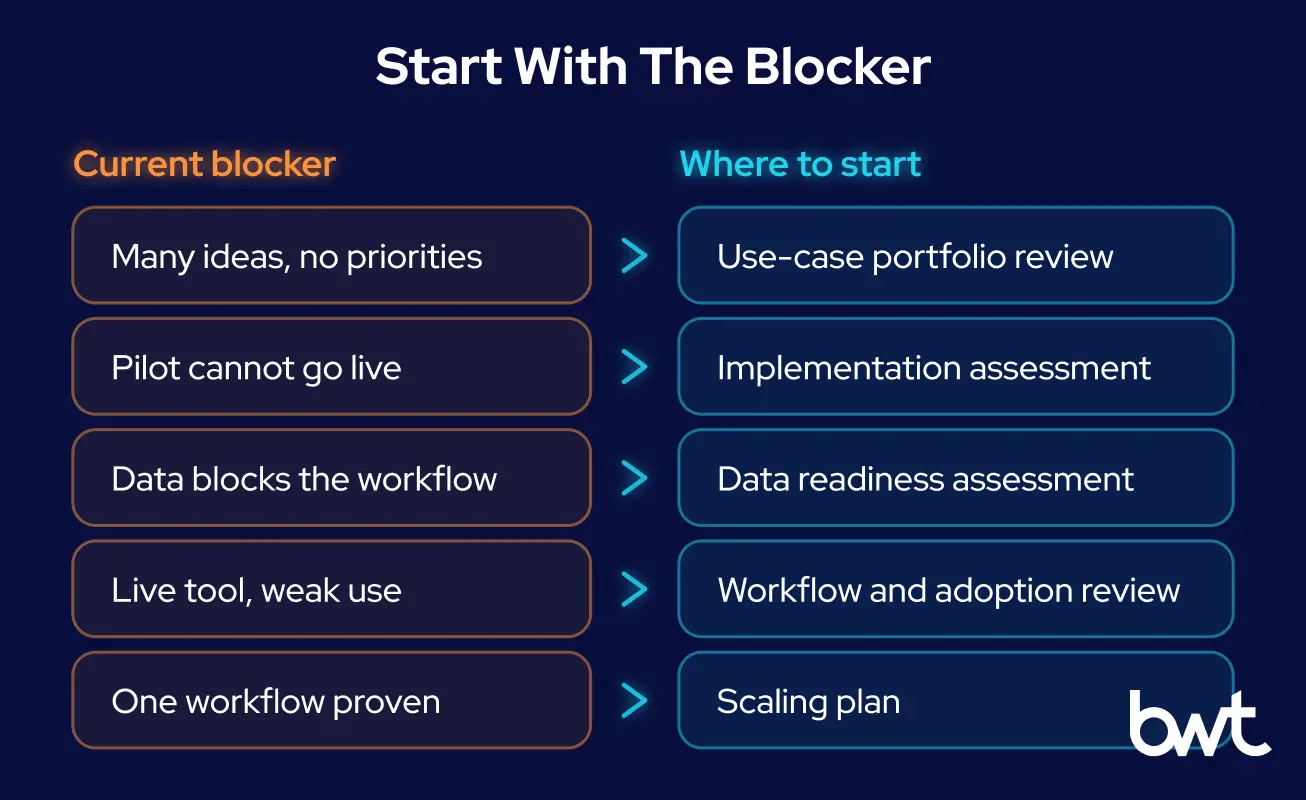
Start with the obstacle visible now, not a program that bundles strategy, implementation, adoption, and transformation.
| Current situation | Useful first engagement |
| Many AI ideas, no agreed priorities | Readiness and use-case portfolio |
| A pilot works but cannot enter operations | AI implementation assessment |
| Data quality or access blocks the workflow | Data readiness and architecture assessment |
| A live capability has weak or inconsistent use | Workflow and adoption review |
| One workflow has proven value | Production and scaling plan |
GroupBWT can connect adoption to implementation and data engineering where those dependencies are real. Its AI consulting services can help identify whether the active constraint sits in the use case, workflow, data, or production system. Scope may cover workflow and system design, instrumentation, controls, feedback tooling, and technical onboarding and operating guidance. A company with a suitable standard tool and capable change team may not need an external partner.
External support is useful when the workflow crosses systems and teams, ownership is fragmented, or the organization needs one accountable bridge between workflow design and production delivery. The strongest AI adoption strategies start with that active constraint rather than a generic enterprise program.

Conclusion
A strong adoption plan makes an approved capability part of a role’s normal work. Managers reinforce it, documented practice reflects it, training matches the role, and feedback changes the workflow.
Use access → usage → adoption → value → scale to identify what the evidence proves. When progress stalls, ask which layer is missing. The answer may be to improve the workflow, repair the implementation, continue, or stop.
Choose one workflow, define user and manager behavior, update documented practice, assign review and support, train by role, and measure each evidence layer. Resolve technical blockers that prevent the workflow.
They fail when the new path adds work, managers reinforce the old process, users cannot challenge outputs, ownership is unclear, or training misses the job. Any one can defeat a technically adequate system.
Measure whether intended users complete the approved workflow, follow review rules, and keep using it. Report access, usage, quality, value, and scale separately so activity is not mistaken for an outcome.
Make sources and limits visible, define human review, provide safe escalation, respond to feedback, and prove reliability on bounded tasks. Evidence and operating behavior build trust; launch messaging does not.
Scaled adoption means a proven workflow sustains acceptable use and outcomes as users, volume, teams, or workflows grow under control. Expansion requests and licenses are signals, not proof of scale.
Outside help earns its place when a workflow crosses systems and teams, nobody owns the seams, or implementation and daily work drift apart. If a standard tool fits and the internal team can manage the change, external support may be unnecessary.
Read summarized version with
AI Workflow and Implementation Support
Review Your AI-Enabled Workflow
A focused review of the workflow, technical, and operating gaps that determine whether an AI capability can become part of normal work.
We assess:
- Whether the workflow and AI capability are ready for operational use
- Gaps in role definitions, manager routines, and documented workflows
- Trust, feedback, measurement, and technical blockers