CLIENT STORY
An engineering and automation company delivers 15–20 turnkey dairy plants each year, often on different automation platforms. The goal was not to build a one-off monitoring system for a single plant: the company wanted a reusable predictive maintenance foundation it could adapt to future plants running different automation stacks, starting with 80–90 comparable motors at one Siemens-based site.
Its equipment already produced large volumes of PLC and SCADA data, yet engineers still lacked clear maintenance priorities, and maintenance remained reactive. GroupBWT implemented the Databricks architecture on the pilot plant: data moved through the pipeline, the anomaly workflow ran, and engineers reviewed results through a dashboard and a natural-language assistant.
| Service: | Data Engineering |
|---|---|
| Industry: | Manufacturing |
| Region: | APAC |
Read summarized version with


Currently, our dairy processing lines have no planned maintenance schedule. Equipment runs until something fails, and we have no way to see it coming. — Automation & Instrumentation Manager, Dairy-Plant Engineering Company
The solution only works if the data flow is uninterrupted, and it needs to work across the different automation platforms our projects use, not just one. — Automation & Instrumentation Manager, Dairy-Plant Engineering Company
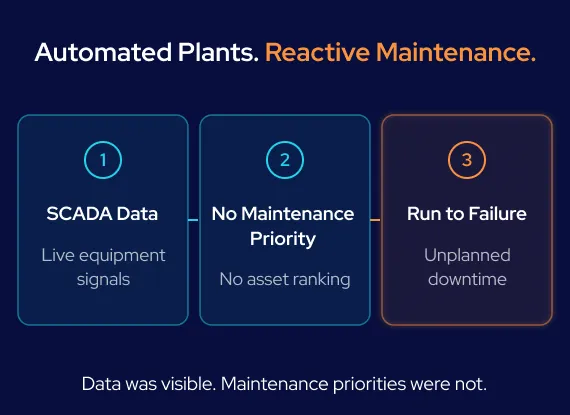
PLC Data Without Maintenance Decisions
The plants were highly automated, but equipment data remained inside PLC, SCADA, and reporting systems. Engineers could monitor production, but they could not identify which machine needed attention. Maintenance remained reactive, while existing records did not clearly show what failed, when, or what was replaced.
The available data included only three to six months of process history, with vibration monitoring limited to a few critical assets and not yet available for the target motors. The company also needed to determine how data would move from the automation layer to the analytics platform — through OPC UA, existing historians, database connections, APIs, or an edge integration layer.
Because the company delivers 15–20 plants annually using different automation vendors, the future solution had to be reusable rather than tied to one site or technology. A site-specific solution would have created a new integration and modeling project for every future plant.
Building Predictive Maintenance That Could Be Reused Across Dairy Plants
A Vendor-Neutral Data Foundation. GroupBWT designed the architecture so the analytics layer would not depend on a specific automation vendor. Site-specific integration paths would bring PLC, SCADA, historian, database, and sensor data into the Databricks platform. Connectivity was defined as the first delivery stage, with a separate path for high-frequency vibration data.
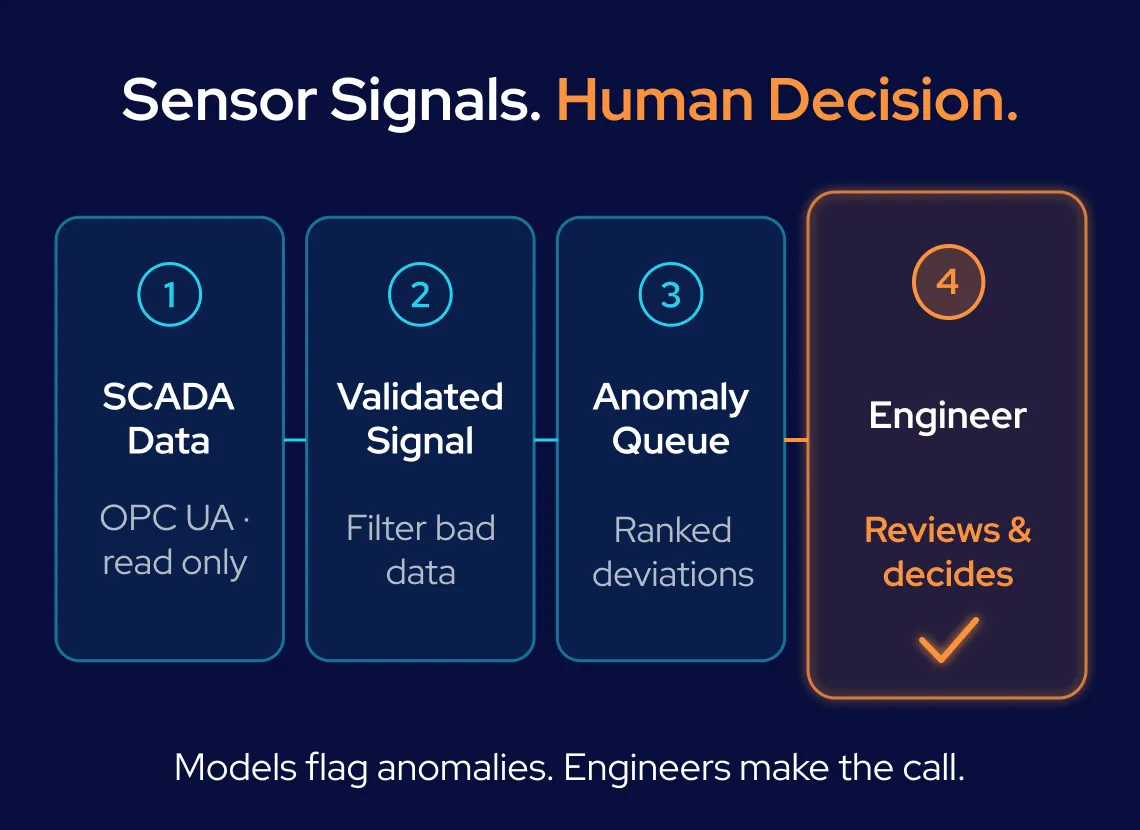
One Modeling Pattern for 80–90 Comparable Motors. The design added validation before model scoring, separating invalid sensor readings from valid operational anomalies. GroupBWT trained and compared candidate anomaly-detection models, then tracked experiments and model versions so the same pattern could be reused across future sites.
From Sensor Signals to a Maintenance Priority Queue. The dashboard gave engineers a plant overview, a ranked anomaly queue, and asset-level sensor history, so they could go straight to the flagged assets. A natural-language assistant was designed as an additional interface to the same data. A further agent layer, combining equipment signals with maintenance documents, was scoped as a future extension beyond this phase.
GroupBWT also recommended creating a structured failure log and defining minimum sensor requirements for each equipment class.
Tech stack: Databricks, MLflow, AutoML, PLC and SCADA data integration
A maintenance model cannot repair a missing data foundation. We designed and demonstrated the validation and anomaly layers first, because a precise failure forecast needs the failure history and service records that a new pilot has not collected yet.

Unplanned Downtime Down 20% With Earlier Anomaly Alerts
The team implemented one Databricks platform for data collection, validation, modeling, and reporting.
Engineers could now inspect each machine and trace its sensor history. Before any reading reached the forecasting model, data quality checks removed incorrect values. The team also compiled the plant’s failures, interventions, and replacements into a structured history for later decisions.
The architecture was designed so the same components and modeling pattern could be adapted to future plants, by configuring data-source connections and equipment settings instead of rebuilding the platform.
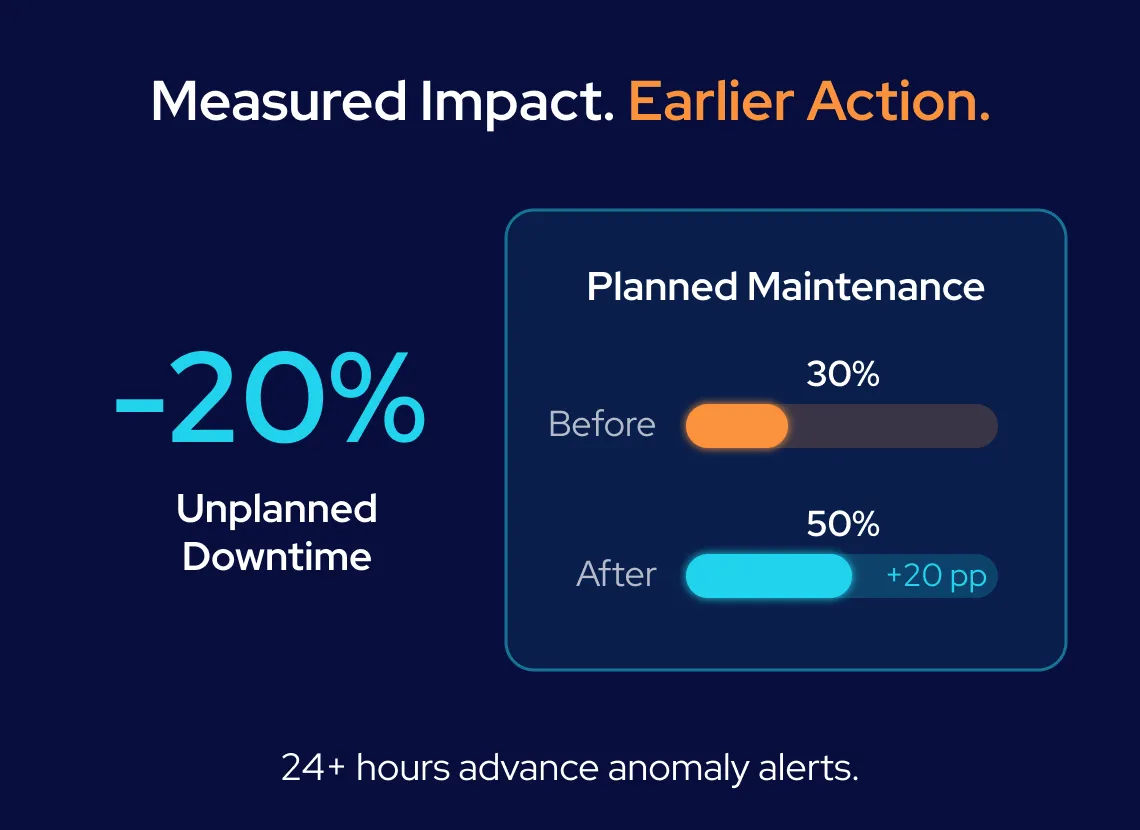
- By training anomaly-detection models to flag selected slow-developing failures at least 24 hours in advance, GroupBWT helped the plant cut unplanned equipment downtime by 20%.
- GroupBWT validated sensor readings before they reached the forecasting model, producing cleaner signals and more reliable anomaly alerts. Engineers acting on those alerts earlier contributed to a 10% rise in Mean Time Between Failures and a 10% drop in Mean Time To Repair.
- GroupBWT brought failures, interventions, and replacements into one structured record. That work shifted the ratio of planned versus reactive interventions by 20 percentage points and helped cut emergency spare-parts costs by 5%.
- GroupBWT designed the components and modeling patterns for reuse. The company could adapt them to new plants by configuring each site’s data-source connections and equipment settings instead of rebuilding the solution.
Looking to move beyond run-to-failure maintenance?
We assess your PLC, SCADA, historian, and maintenance data, then design and demonstrate a foundation that shows engineers where to investigate first—without promising more certainty than the data supports.



You have an idea?
We handle all the rest.
How can we help you?