
CLIENT STORY
The client is a serial entrepreneur running three independent businesses with a lean, distributed team.
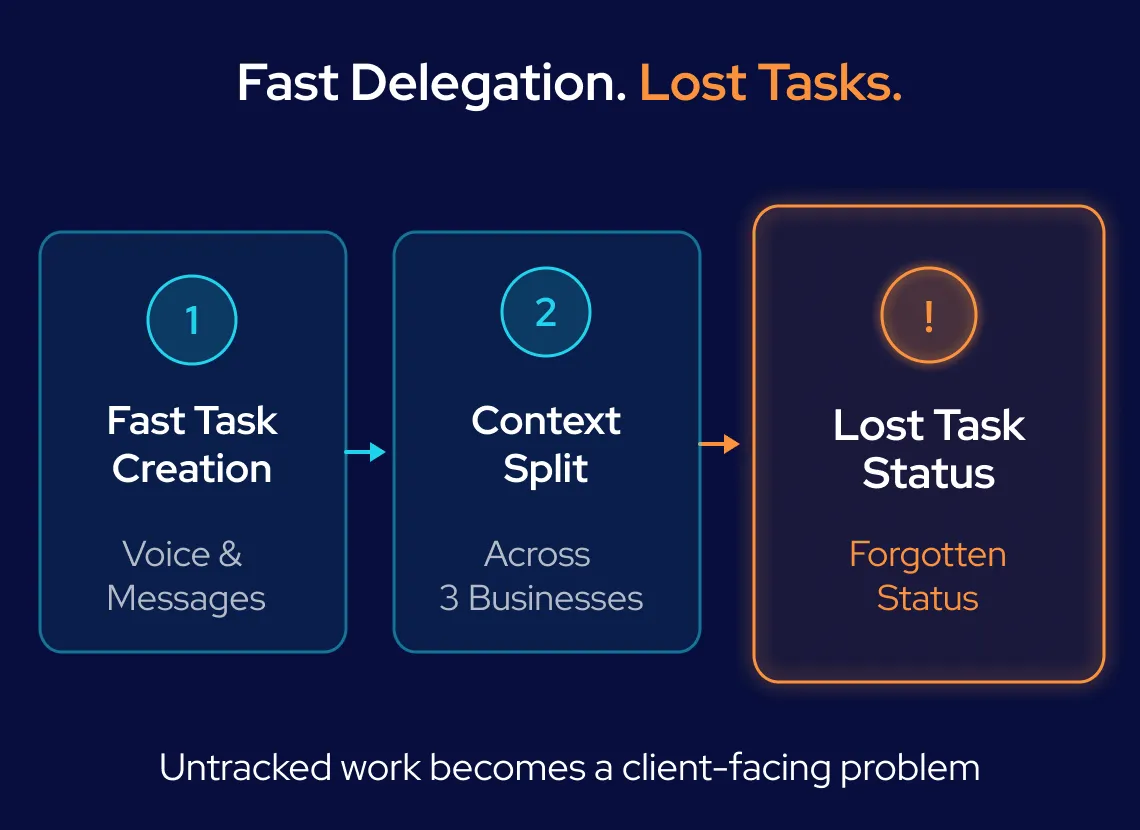
Delegating work was easy. Keeping track of what happened afterward was not. Tasks started in messages, voice notes, meetings, and different business systems. Once work was handed off, the founder often had to remember to check the status himself.
He had already tried different productivity tools and AI products. What was still missing? One place where tasks, conversations, decisions, and follow-ups stayed connected across all three companies.
The new system had to fit the way he already worked. It also had to recognize the business and person behind each request while leaving important decisions to people.
| Service: | AI Agent Development |
|---|---|
| Industry: | Professional Services |
| Region: | USA |
Read summarized version with


What I'm really good at is putting a task out there the moment I think of it. What I'm not good at is going back and making sure it actually gets done. — Business Owner
The most invaluable employees understand your business and the long-term context — how you got here, what's worked, what hasn't, and who your key clients are. It's got to be there from day one. — Business Owner
The Challenge: Delegating Was Easy. Following Up Was Not.
The founder could assign work quickly, but there was no reliable system for checking what happened next.
A task might be sent in a message or voice note, passed to a team member, and then disappear from view until someone remembered to ask about it. There was no consistent way to confirm ownership, spot an overdue task, or escalate a problem early.
The challenge became harder because the founder was managing three businesses at once. The system had to understand which company, team, client, and person each request referred to. In some cases, people in different businesses even shared the same name.
Standard automation could handle simple rules such as sending a reminder after a deadline. It could not reliably understand an unstructured message, identify the right business and owner, and decide what should happen next.
The client therefore wanted to test a more flexible approach without committing to a large implementation from the start.
Start With Three Workflows the Founder Used Every Week
Find Where Tasks Were Getting Lost. GroupBWT first mapped how work moved through the founder’s existing tools and team. We identified where ownership became unclear, where follow-ups were missed, and which decisions still required the founder’s approval.
Track Follow-Ups and Prepare Status Updates. The first workflows focused on delegated tasks and reporting. Instead of manually checking whether work had moved forward, the system could monitor status and surface overdue items automatically.
Test a More Complex Procurement Process. The third workflow covered purchasing across several people, approvals, and vendors. This showed that the system could manage a process with several steps and handoffs, not just send reminders.
Add Memory, Specialized Agents, and Automatic Triggers
Remember the Right Context. GroupBWT built a memory layer that kept track of people, businesses, previous decisions, and working rules. Access was separated by company, person, and user permissions so information from one business could not appear in the wrong workflow. The system could also distinguish between people with the same name.
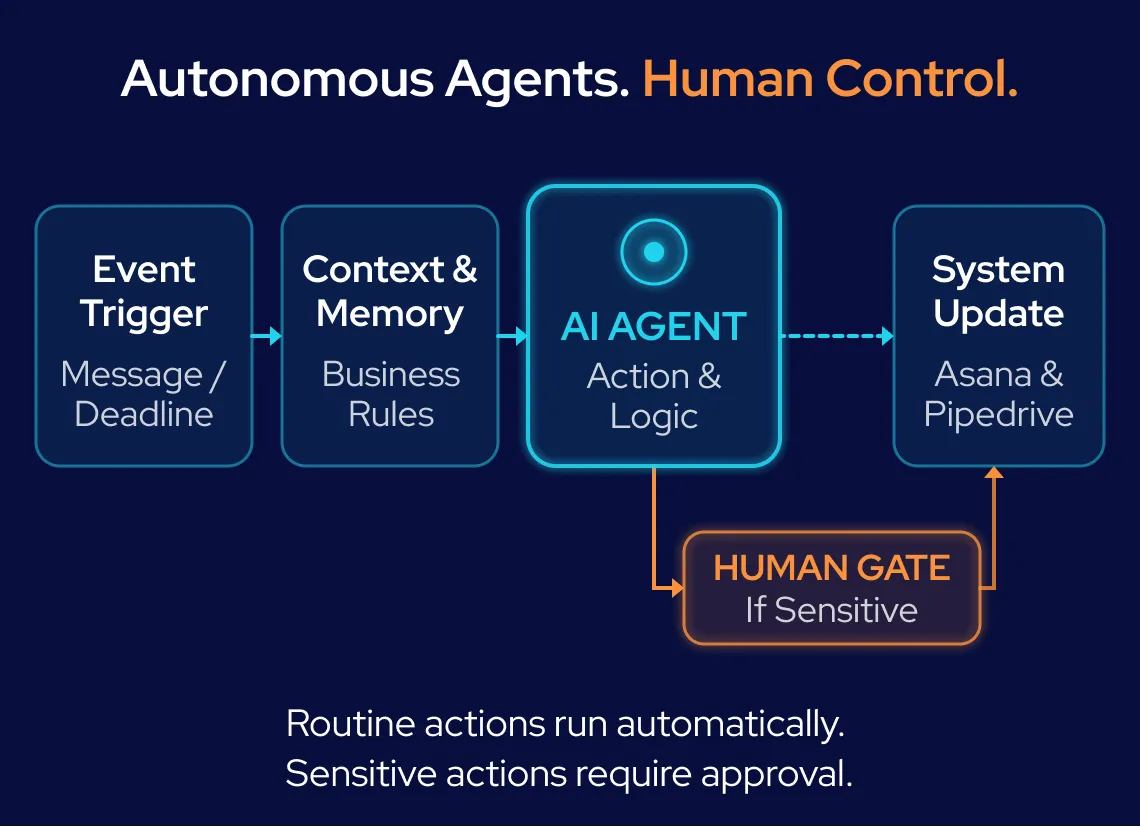
Use Different Agents for Different Jobs. Three agents handled the pilot workflows: one for follow-ups, one for reporting, and one for procurement. A LangGraph orchestration layer directed each new event to the right agent.
The system did not need the founder to start every interaction. A missed deadline, CRM update, new message, or task-status change could trigger the appropriate workflow automatically.
Keep Important Decisions With People. AI was used where the system needed to understand context, prioritize information, or choose a next step. Simple rules stayed automated without AI.
Sensitive actions such as investor updates, major partner messages, or financial commitments still required human approval. Actions were also logged so the team could see what happened and handle failures or retries.
Asana and Pipedrive remained the systems of record. A local cache kept frequently requested data close at hand. Once an update was approved, the system wrote it back to Asana or Pipedrive.
Tech stack: LangChain, LangGraph, vector database, structured data store, Asana, Pipedrive, Google Calendar, Gmail, WhatsApp Business, webhooks, queues, retries, local data cache, and audit logs.
The most important thing is memory — an agent is only as good as the memory and the harness around it. A mediocre LLM with a strong harness will outperform the best LLM without one.

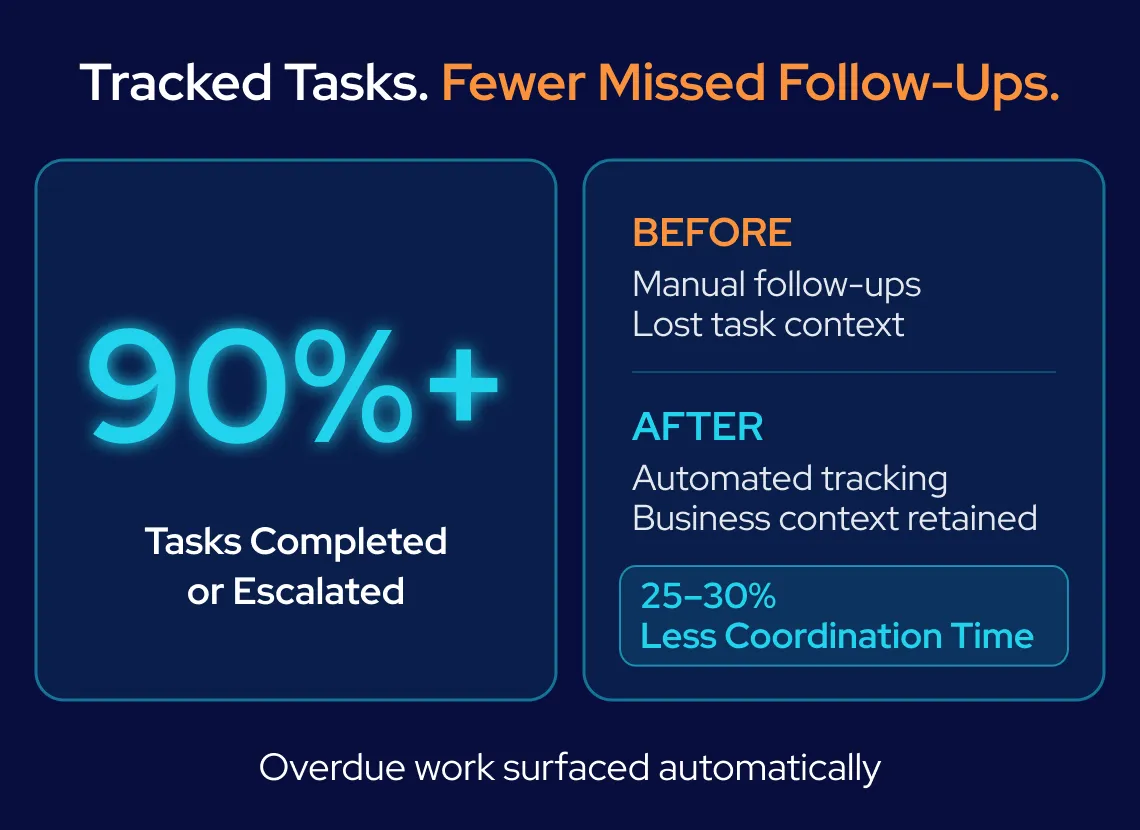
90%+ of Delegated Tasks Reached Completion or Escalation
- GroupBWT reduced time spent searching for context, checking statuses, and coordinating work across systems by 25–30%.
- More than 90% of delegated tasks reached either completion or escalation instead of remaining untracked.
- Automated follow-ups, status checks, and information retrieval saved the founder 1.5–2 hours each week.
- Overdue work was surfaced automatically, reducing the chance that the founder would learn about a missed deadline from a client or partner.
Managing Several Businesses and Still Chasing Tasks by Hand?
GroupBWT builds AI agents that track delegated work, remember the right business context, and flag overdue tasks automatically — while keeping important decisions under human control.



You have an idea?
We handle all the rest.
How can we help you?