Read summarized version with


Introduction
If you are tracking pricing across 50+ SKUs and 10+ retailers, manual benchmarking has already broken. If your distributor in Germany is quietly discounting 40% and you find out three weeks later, that is the gap this playbook is about. If your Amazon listings drift away from brand-approved copy faster than a monthly review cycle catches, the same gap. This is what replaces the spreadsheet.
A US CBD-beverage brand burned a year of failed in-house attempts trying to find out which retailers stocked its competitors. Reports came back outdated. Spreadsheets fell apart at fifty retailers. We built an AI agent setup with a Claude model driving a browser plug-in across 300+ store-finder pages and delivered roughly 19,000 verified retailer records in ten days, refreshable on a weekly cadence. That is the operational floor for AI-driven competitive intelligence for markets in 2026: a small team, a real model, ten days from contract to production data, and the buyer can act on the next morning.
What follows are four data layers in increasing engineering complexity. Pricing and MAP enforcement is the entry use case where most CPG conversations begin. Hyperlocal store-level coverage adds the per-postcode depth that national feeds hide; share of shelf and digital-shelf intelligence broadens beyond price into content and visibility; hyperscale collection covers what changes when the marketplace itself fights back. After that, what happens when the competitive feed sits next to the brand’s own sales and marketing data — and how GroupBWT delivers it.
Data Engineering: From Raw Web to Data Product
We develop and manage custom data solutions, powered by proven experts, to ensure the fastest delivery of structured data from sources of any size and complexity.
We offer:
- Custom Web Scraping & Development
- 15+ Years of Engineering Expertise
- AI-Driven Data Processing & Enrichment
Introduction to AI-Driven Competitive Intelligence for Markets in 2026
It is a data pipeline that reads competitor product pages, prices, and shelf positions on a schedule, validates each record with a language model, and writes the result back to a database the brand can query — a refreshable dataset, not a slide deck.
The FTC’s January 2025 surveillance pricing staff perspective describes how third-party pricing intermediaries can enable individualized prices and promotions based on detailed consumer data. AI-powered competitive intelligence is the buy-side mirror of that capability — without it, the brand cannot see what its retailers are doing in real time.
What changed in the last 18 months
Three shifts. AI agents now open pages that a regular scraper cannot — store-finder forms with no structure, marketplaces requiring identity verification, retailers changing layouts every quarter. Validation moved from “did the field arrive?” to “is the field correct?”, catching the silent failure mode where a scraper still runs but quietly returns the wrong data. And cost economics flipped: a small team running an AI-agent rig now ships in ten days a dataset that used to need a research consultancy on a year-long retainer.

Why CPG Buyers Can No Longer Ignore AI Competitive Intelligence
The pricing-data problem in consumer packaged goods is not “we need more data.” It is “the data is moving faster than the team.”
Three CPG buyer pains we hear week to week
- Distributors discount up to 40% in Europe; the brand does not see it for weeks, and margin leaks against quarterly forecasts.
- Amazon prices on hero products move in days, while the brand-side response cycle is monthly, and store-brand competitors enter without sharing barcodes, so cross-retailer matching breaks at a three-million-SKU scale.
- Tesco, Sephora, and Notino each run different promo windows per country; manual tracking covers two retailers, the rest are blind.
The question is no longer “what would AI do here?” but “which vendor can ship a refresh on hundreds of thousands of products across a dozen-plus retailers next Monday morning?”
Also Read: AI-Ready Data Pipeline: Architecture, Components, and Best Practices
Pricing Intelligence and MAP Enforcement: From Spreadsheet to AI-Validated Pipelines
Pricing is the entry point for most CPG conversations because the cost of getting it wrong shows up on the next P&L. AWS shipped Amazon Nova Act in 2026, an SDK for browser-driven automation — one signal among several that this engineering pattern has moved from exotic data science into mainstream cloud infrastructure. The hard part is not the scrape; it is trusting the number.
The hair-care brand is losing margin to silent distributor discounts
A premium hair-care brand sold through major US and UK beauty retailers came to us when Amazon prices on core products fell sharply over 72 hours, and European distributors started discounting unilaterally — both invisible to HQ until the next quarterly review, by which point a quarter’s margin was already gone. We built automated price monitoring covering the brand’s hero SKUs across major UK beauty and specialty retailers, plus store-finder coverage across the largest US salon-trade chains.
Multi-model AI validation, and why most teams skip it
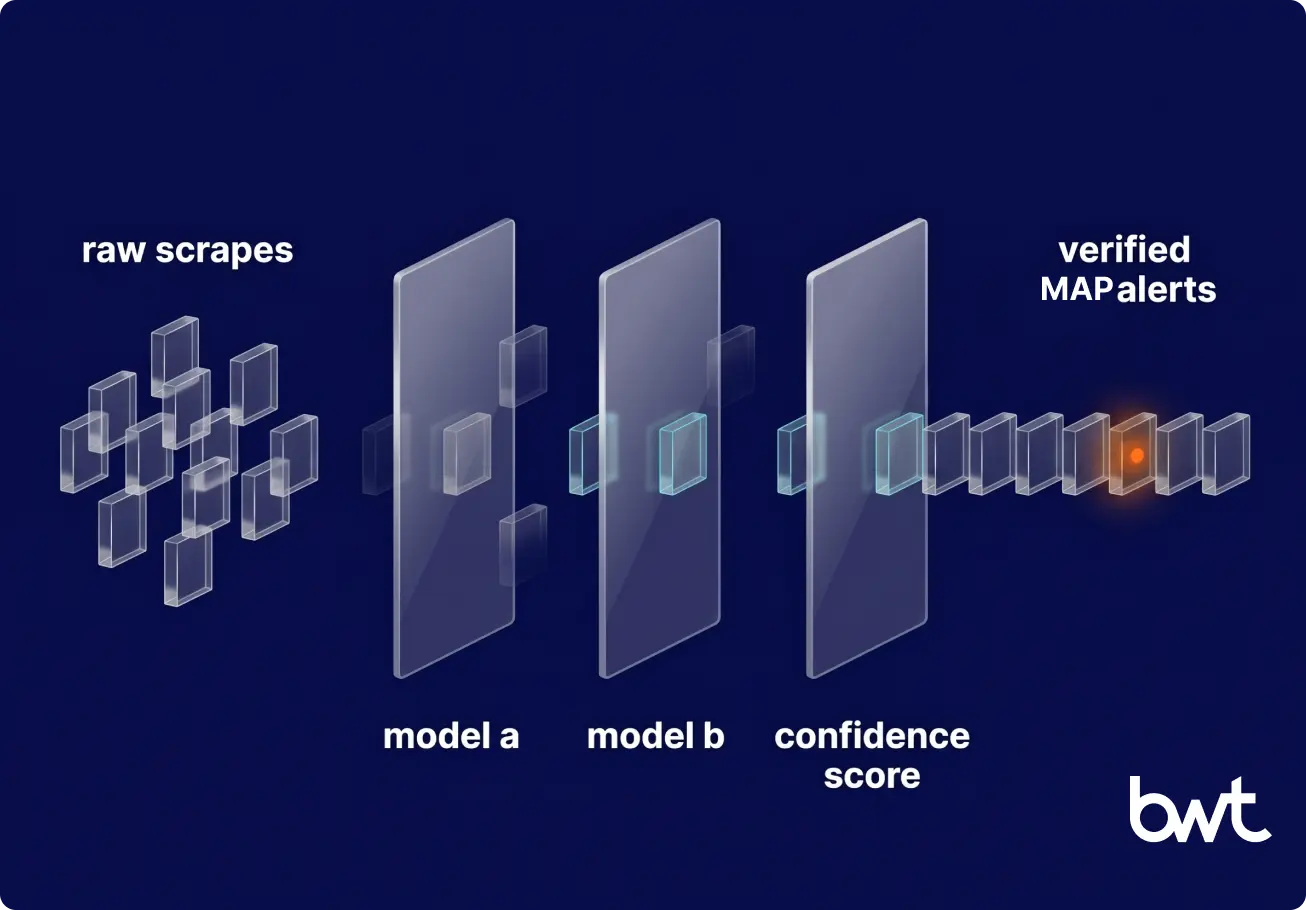
Every extracted record passes a multi-model validation step: independent language models cross-check the scraped record against expected attributes and emit a confidence score. Disagreement between models surfaces scraper drift before MAP-violation notices reach distributors. Most teams skip this tier when buying “AI analytics competitive intelligence capabilities” off the shelf, then pay later in lost distributor trust and false-positive escalations.
“The detection problem in MAP enforcement is not ‘is the price wrong?’ It is ‘is the price actually wrong, or did the scraper break, and we are about to send a false-positive notice to a distributor we cannot afford to lose?’ AI validation prevents the confidently wrong data, not the missing data.”
— Alex Yudin, Head of Data Engineering, Web Scraping Lead at GroupBWT
Capability matrix: manual vs generic CI vs AI-driven CI
| Capability | Manual ops | Generic CI tool | AI-driven CI |
| Real-time price detection | Weekly at best | Daily, no per-retailer logic | Hourly, with smart-schedule backoff |
| Same-product mapping across retailers | Spreadsheets, error-prone | Generic barcode join | Standard barcodes plus AI item matching |
| MAP-violation alerting | Email and screenshots | Threshold rules | AI confidence scoring filters scraper drift |
| Anti-bot resilience | None | Rotating proxies only | Stack tuned per retailer; 95–98% daily collection on the most defended surfaces |
Hyperlocal and Store-Level CI for CPG
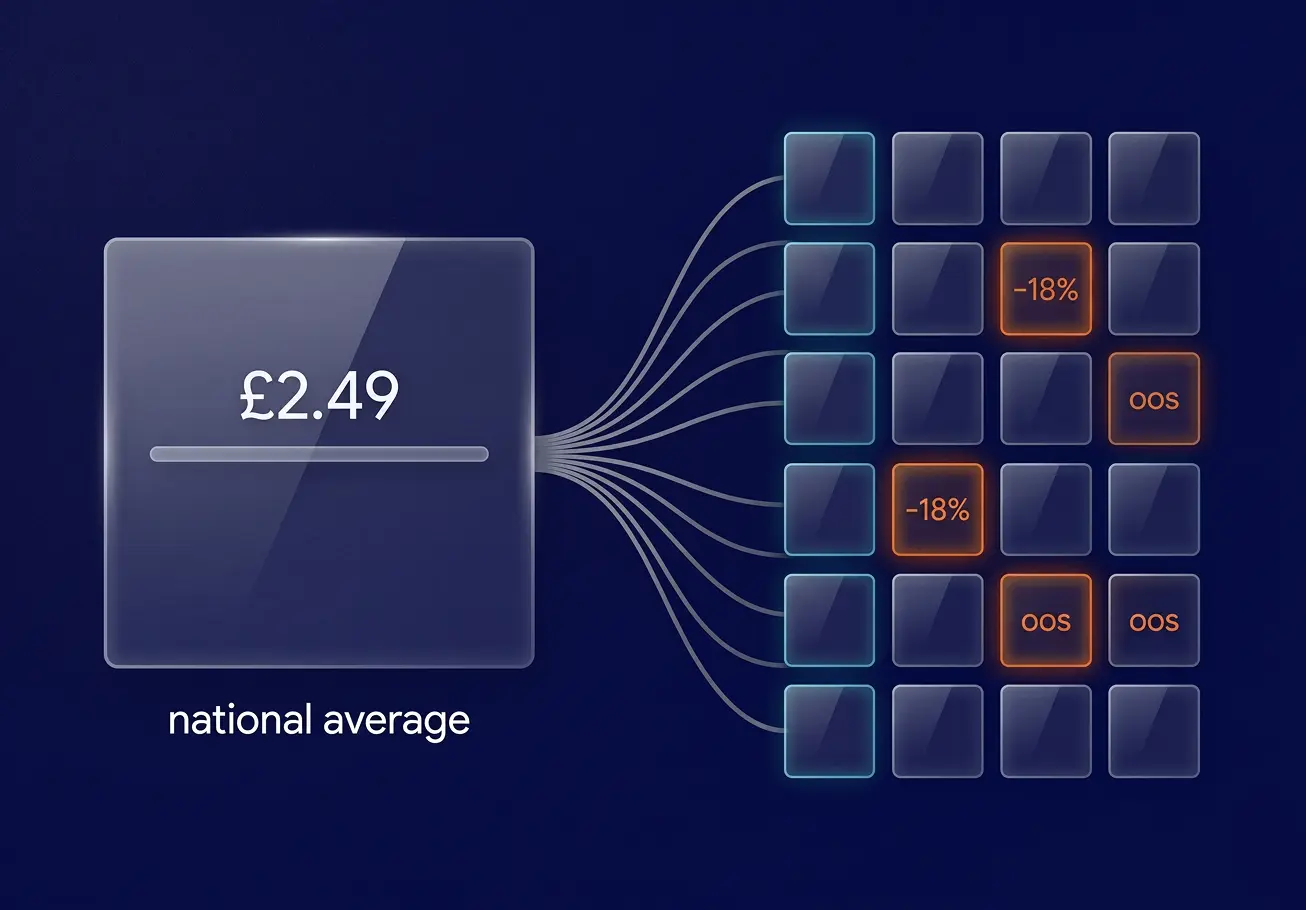
National averages are the wrong unit of analysis. The basket is won or lost in a single store on a single Tuesday at 7 pm.
Birmingham at 7 pm tells you what the national average hides
We learned this on a UK FMCG digital-shelf platform that needed Tesco.com scraping data per postcode for CPG-brand customers. The pipeline pins to a dozen-plus UK postcodes, pulling tens of thousands to over a hundred thousand SKUs per location — shelf price, per-store availability, attributes, and the local promo and loyalty signals that national feeds flatten out. Per-store accuracy holds above 99%.
Why per-postcode pinning kept the brand’s data infrastructure cost in the low hundreds
Per-postcode pinning kept the brand’s monthly data infrastructure cost an order of magnitude below open-bandwidth setups for the same coverage. The pattern combines browser automation only where login requires it with lighter backend calls elsewhere, delta-only updates between weekly audits, and per-geography session isolation. The buyer adds a new postcode in days, not weeks, and the per-postcode infrastructure cost stays flat as coverage scales past twenty locations.
Four hyperlocal questions a national feed cannot answer
- Which stores in this region are out of stock during competitor promos?
- Where is bundled or basket-level promo pricing pushing our effective shelf price below the level our distributor agreement assumes?
- Which postcodes show seasonal demand that we are not capturing?
- When competitors run flash promos, how many of our stores miss them?
This is what AI competitive intelligence CPG comes down to: the postcode where the brand actually loses the basket, not the national average that hides it. AI-powered competitive intelligence at this resolution turns a dashboard that confirms what you already think into one that changes how the trade team plans next week.
Share of Shelf and Digital-Shelf Intelligence
Pricing is one column of a competitive shelf. An FMCG brand losing on title length, image quality, or ingredient compliance loses the click before price is ever compared.
Seven years and 140+ production scraping pipelines on the digital shelf
Across 70+ retailers in 30+ countries over seven years of digital shelf monitoring — and 140+ production scraping pipelines still running today — the hard problem is consistent: not the data, the comparison.
Content Inclusion Score: live retailer page vs. your master content
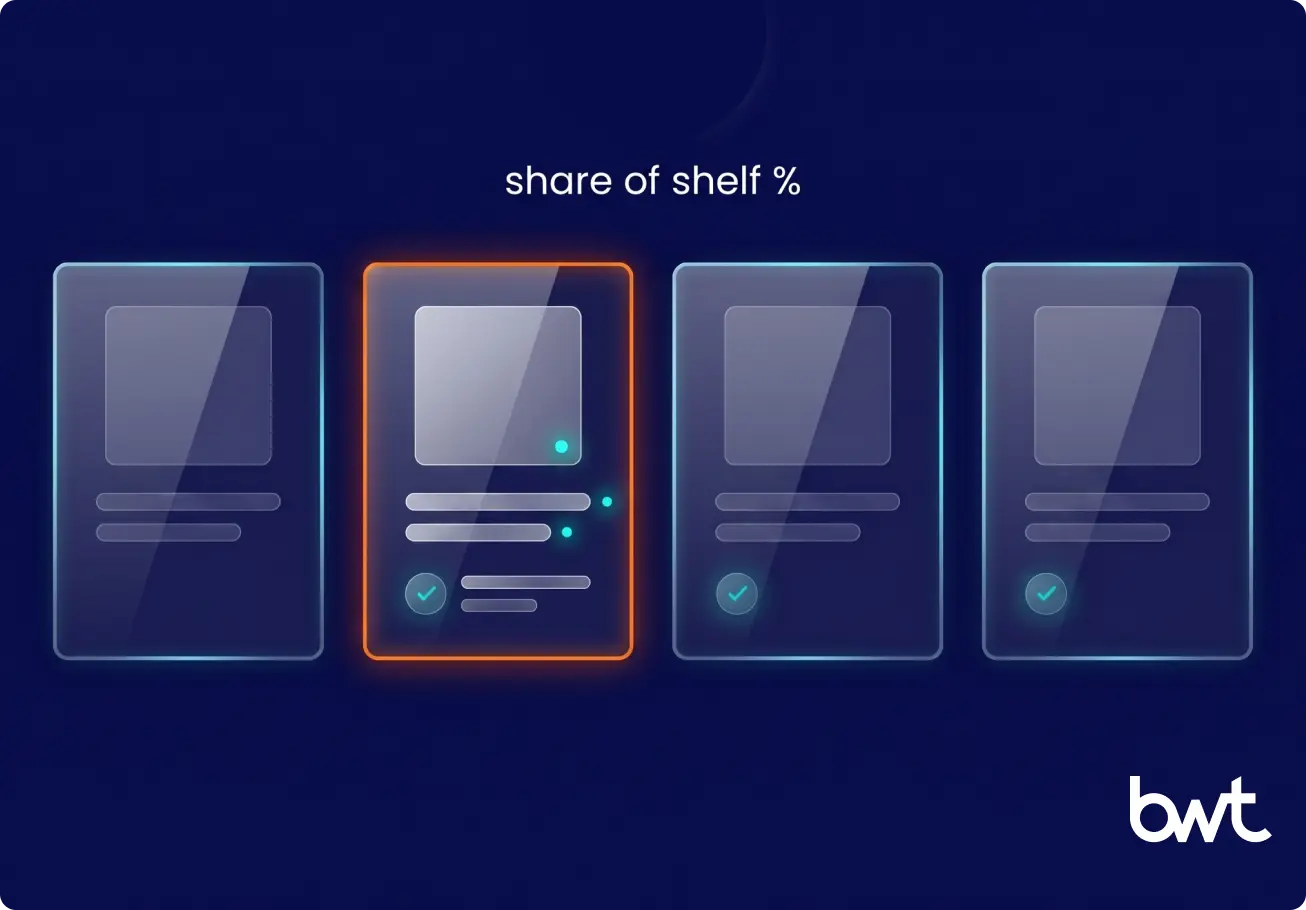
Our Content Inclusion Score is a side-by-side text and image comparison that flags ingredient mismatches, missing claims, wrong pack sizes, and image swaps. Stubborn retailers (Costco, Zoro) blocked traditional scraping for a year; the workaround was a browser extension running on a real browser.
From scraped data to a competitive position dashboard
A European cosmetics manufacturer runs the same digital-shelf data analytics architecture at scale: hundreds of thousands of products a week across a dozen-plus retailers and 30+ European country sites for over three years. Layering AI on top of the raw scrape (anomaly detection, packaging image comparison, review sentiment scoring) moved the brand from “scraped data” to “competitive position dashboard.”
Digital-shelf metrics that matter to CPG
| Metric | What it shows | Refresh cadence | Why CPG cares |
| Price + availability | Selling price, stock status per product per retailer | Hourly to daily | Direct MAP, out-of-stock exposure |
| Content compliance | Title, description, image vs brand-preferred copy | Weekly | Lost conversion from off-brand listings |
| Reviews + ratings | Bazaarvoice or native review feed | Daily delta | Voice-of-customer signal months before product launches |
| Share of Shelf | % visible inventory by category and search term | Daily | Category dominance trend |
“Most teams build the scraper first and bolt AI on later. By then, the record-level confidence data is gone, and the dashboard has nothing to defend itself with. Validation has to live at write time, not at read time — otherwise nobody trusts the dashboard six months later when the boardroom asks why a number changed.”
— Dmytro Naumenko, CTO at GroupBWT
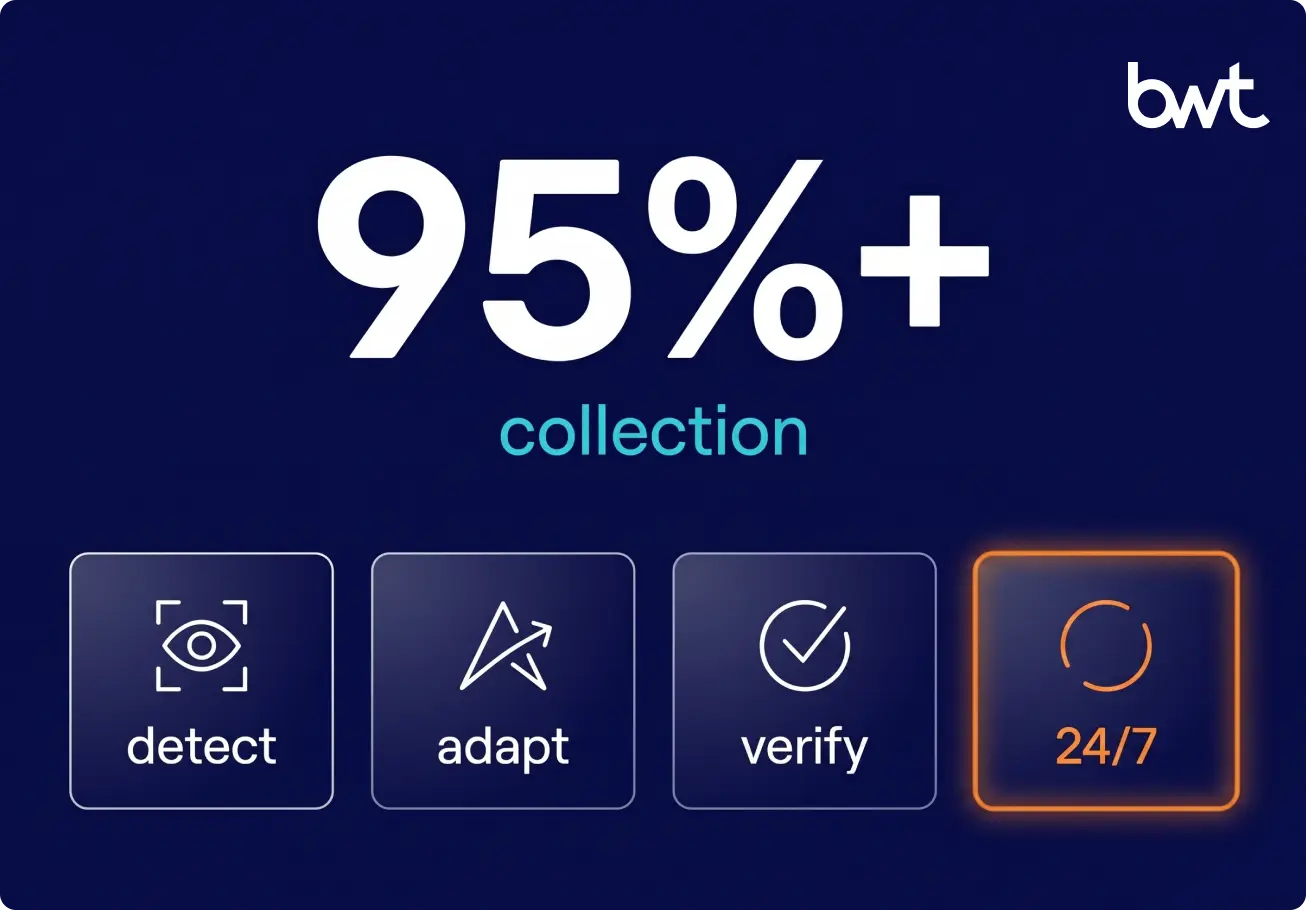
Competitive Intelligence at Hyperscale: Maintaining 95%+ Collection on Marketplaces That Fight Back
Hyperscale CI runs a million products a day, where the constraint is adaptation speed against marketplace defenses. The same engineering surface that makes hyperscale work on a regional marketplace is what holds CPG retailer collection above 95% when Amazon, Tesco, or category-leading marketplaces fight back.
A million products a day on a competitor’s marketplace
A large Asian marketplace operator asked us to monitor a competitor’s marketplace for coupons, vendor data, and discounts. Steady state: hundreds of thousands of products a day, peaking over a million on retail-event days. Roughly a year of architecture iterations grew throughput by more than two orders of magnitude — from a handful of products per minute on the first version to over a hundred thousand per hour on the final.
How the architecture absorbs marketplace defenses
Several engineering choices do most of the work. We handle access flows that block standard scrapers without enumerating their components in public copy. A lightweight language model resolves access challenges as they appear, so engineering is not paged on each event, and confidence scoring catches template changes the moment retailers ship them. The buyer sees a feed that holds 95%+ collection on the most-defended marketplace surfaces.
Peer-reviewed evidence that AI agents now beat single-shot tools
The methodology generalizes. An August 2025 arXiv paper from Optic Inc. shows AI-agent systems hit 83% recall on competitor mapping versus 65% for OpenAI Deep Research and 60% for Perplexity Labs. For a CPG brand mapping competitor SKUs across a dozen-plus retailers and 30+ country sites, that ~20-point gap is the difference between a feed that survives a quarterly retailer redesign and one that does not.
Beyond Pricing: How CPG Brands Connect Competitive Data to Sales and Marketing
Pricing answers what competitors charge. The harder question is whether your own sales, marketing, and sentiment line up with the competitive shelf. Beauty CPG is the test bed where data-driven competitive advantages compound fastest — more retailers per brand than any other category, more country sites per retailer, more products to track inside each one.
From a scraping engagement to a Customer Data Platform
We extended a European beauty manufacturer’s scraping engagement into a full Customer Data Platform: a dozen-plus pipelines feeding sell-out data, competitive scraping, and five social/sentiment sources into a layered cloud warehouse. After the first three pipelines, each new source landed in the warehouse in days instead of weeks — in time for the same quarter’s planning, not the next one.
The single question pricing alone cannot answer
How does competitor pricing × own sales × marketing spend × consumer sentiment combine into a forward demand signal? Only an AI-driven analytics layer answers it once those four feeds share the same warehouse and product key. When that join works, a buyer can see a competitor’s relaunch losing social-channel sentiment in the same week the brand’s own search-share rises — and shift trade-promo budget from defending shelf to expanding it before the next planning cycle.
How GroupBWT Delivers AI-Driven Competitive Intelligence for Markets
Three things that make this different from other CI vendors
- We ship engineering, not a SaaS dashboard. The pipeline lives in your AWS account and your warehouse; the dataset is yours from day one.
- Hyperlocal by default. Per-postcode, per-country-site, per-store — not the national average that off-the-shelf tools default to.
- Pricing is scoped, not vague. A one-retailer, ~500-SKU, ten-day pilot runs in the low thousands. A 13-retailer, 30+ country-site, weekly-refresh production program sits in the low-five-figure-per-month band. PerimeterX-class anti-bot defenses add roughly 2× scraper build cost; every number ties to retailer count, SKUs, deliverables, and cadence.
When this is not the right fit
Three cases where the answer is “stay on your spreadsheet.”
- For a retailer with under 200 SKUs, a monthly check is enough. A junior analyst with a structured template still beats the cost of a pipeline.
- No buyer is ready to act on the feed. If the dashboard has no owner inside the trade or category team, the data lands unread, and the investment looks like a tool, not a decision system.
- A directional report, not a refreshable dataset. Brand-positioning studies, qualitative landscape mapping, and one-off audits are still better served by a consultancy.
The pattern that works is the opposite: a named buyer, a decision that repeats weekly or monthly, and a dataset that has to refresh faster than the team can manually maintain.
Five steps from the buyer’s question to production data
- Scope the buyer’s actual question. Not “scrape Sephora,” but “tell me when loyalty pricing pushes our effective shelf price below our minimum advertised level, nationally.”
- Map retailer coverage. Define retailers, country sites, products, refresh cadence, and confidence thresholds before any code is written.
- Build with anti-bot resilience appropriate to each retailer’s defenses (dedicated treatment in the Hyperscale section above).
- Layer AI validation on every extracted record. Price, name, volume, and brand pass through confidence scoring before they land in the warehouse — so the dashboard is a defendable record by record.
- Deliver and tune. Output goes to the buyer’s stack — BigQuery, Snowflake, or the client’s own AWS account — where the competitive feed becomes a working layer inside the brand’s broader business intelligence services stack. Smart scheduling and per-account proxy scoping then cut steady-state cost 5–20× against the first version.
“The metric we care about is not ‘how much data did we collect.’ It is ‘how many decisions did the buyer make this month because of the data we collected?’ Giving the brand a named cause-and-effect — this distributor in this geography broke MAP on this product on this date — shifts the conversation from pipeline status to commercial action. That is what AI-powered competitive intelligence is for.”
— Oleg Boyko, CCO at GroupBWT.
Where Buyers Should Start
The fastest way to find out if AI-driven CI changes anything is not a vendor call. Pick one painful question — “Are my distributors honoring MAP in Germany?” or “What does Tesco look like at 7 pm in three postcodes I care about?” — and price what an answer would cost. A ten-day proof-of-value covers one retailer family, ~300–500 source pages, a delivered dataset, and one revision round. Production engagements scale to 13+ retailers, 30+ country sites, weekly refresh, AI validation, and warehouse delivery. AI-driven competitive intelligence for markets stops being a thought experiment the moment the first dataset lands in your warehouse.
Traditional CI is people reading reports. AI-powered competitive intelligence is a pipeline that reads hundreds of thousands of products a week and writes structured records back to a database the brand can query. On a real cosmetics program: 99% per-retailer accuracy, three years of weekly delivery, and days-not-weeks per new source after the initial pipelines.
Range, not a single number, with every figure tied to retailer count, SKU count, and refresh cadence. A standard scraper per retailer (a few hundred SKUs, daily refresh) lives in the low hundreds; the toughest sites run roughly 2× more because they require browser-level workarounds. Smart scheduling and per-account proxy scoping then cut the brand’s steady-state data infrastructure cost by 5–20× against an unoptimized first version.
Per-retailer product mapping, standard barcode matching, daily or faster refresh, and AI confidence scoring on every extracted price. On the US hair-care program, multi-model validation prevents false-positive MAP notices from reaching distributors. The trade-off is asymmetric: a wrong alert loses a distributor, a missed one leaks margin.
Yes, with trade-offs. The hardened-scraper pattern (one bespoke pipeline per retailer) wins on high-volume sources where collection has to hold above 95% week after week — the European beauty program runs this way across a dozen-plus retailers and 30+ country sites. The AI-agent pattern (a model driving a real browser through arbitrary sites) wins on the long tail, where each source is too small for a custom scraper — the CBD-beverage client hit roughly 19,000 records from 300+ store-finder pages in ten days. Volume, refresh cadence, and accuracy decide the choice.
Per-store availability, content (titles, descriptions, images, ingredients), reviews and ratings, search and category visibility, Buy Box on Amazon, Share of Shelf, and geo-specific promos like Tesco Clubcard per postcode. Joined with the brand’s own sales and marketing spend, the competitive feed becomes a decision model rather than a price report. The join is where the customer-data-platform architecture pays off, and where off-the-shelf tools stop.
Read summarized version with
Data Engineering: From Raw Web to Data Product
We develop and manage custom data solutions, powered by proven experts, to ensure the fastest delivery of structured data from sources of any size and complexity.
We offer:
- Custom Web Scraping & Development
- 15+ Years of Engineering Expertise
- AI-Driven Data Processing & Enrichment