
Client Story
A premium US hair care brand — ten years old, sold through hundreds of online distributors across North America and Europe, spanning major beauty retailers, regional chains, and marketplace storefronts — was losing control of its pricing. While American retailers were gradually raising prices, European storefronts were simultaneously slashing them by up to 40%, creating a cross-market gap the team couldn’t explain or contain. MAP violations were spreading unchecked across channels, eroding brand positioning and margin integrity.
The only person tracking any of it was a data analyst manually opening distributor pages one by one, writing down prices, and comparing them against last week’s numbers — a process that was slow, error-prone, and nowhere near the scale the problem demanded.
| Industry: | Beauty & Personal Care |
|---|---|
| Year: | 2025 |
| Location: | USA |
Read summarized version with


"Of course, we're looking to automate that because it would kill me if I had to do it manually for every product, every distributor, between every country, every day." — Head of Data, US Premium Beauty Brand.
"We really do want to have a whole understanding of why these prices are constantly changing, which distributors we can come after in terms of negotiating. Because right now we're facing, on average, in Europe, 40% discounts. Well, in America, we're facing prices that will go up more than 20%." — IT Operations, US Premium Beauty Brand.
Tracking Dynamic Prices Across Niche Regional Distributors
Off-the-shelf monitoring tools capped coverage at around 200 URLs and only indexed major international marketplaces. The regional beauty retailers that mattered most—like Sephora Sweden or Harvey Nichols—were completely ignored.
Amazon added another layer of unpredictability. By the time manual trackers caught a 7% drop on Amazon Sweden, the window to respond had closed, and other distributors had already followed suit. Furthermore, the brand lacked omnichannel visibility. They needed to align online pricing data with physical store availability to enforce a consistent MAP policy across both offline and online channels.

Custom Automated Price Intelligence for Regional Networks
From PoC to Production Automation
For speed to validation, GroupBWT temporarily leveraged SerpAPI to locate product pages and collect pricing across 7 key UK sites (Sephora, Space NK, John Lewis, Selfridges, Look Fantastic, Harrods, and Harvey Nichols). To eliminate search engine instability at scale, the production system transitioned to direct custom scrapers with SKU (where available), title normalization, and manual validation
Scalable Architecture & Integration
The architecture is built to grow without rebuilding. If a site deploys stronger anti-bot protection, the system flags it immediately so our engineers can intervene and implement source-specific scrapers. All clean data feeds directly into the brand’s existing Snowflake data warehouse.
Store Location Intelligence
To close the omnichannel gap, we also gathered physical store location data from major retailer store-finder pages, mapping exactly which regional distributors carried specific SKUs in brick-and-mortar locations.
Tech stack: Python, Custom scraper architecture, SerpAPI, Snowflake
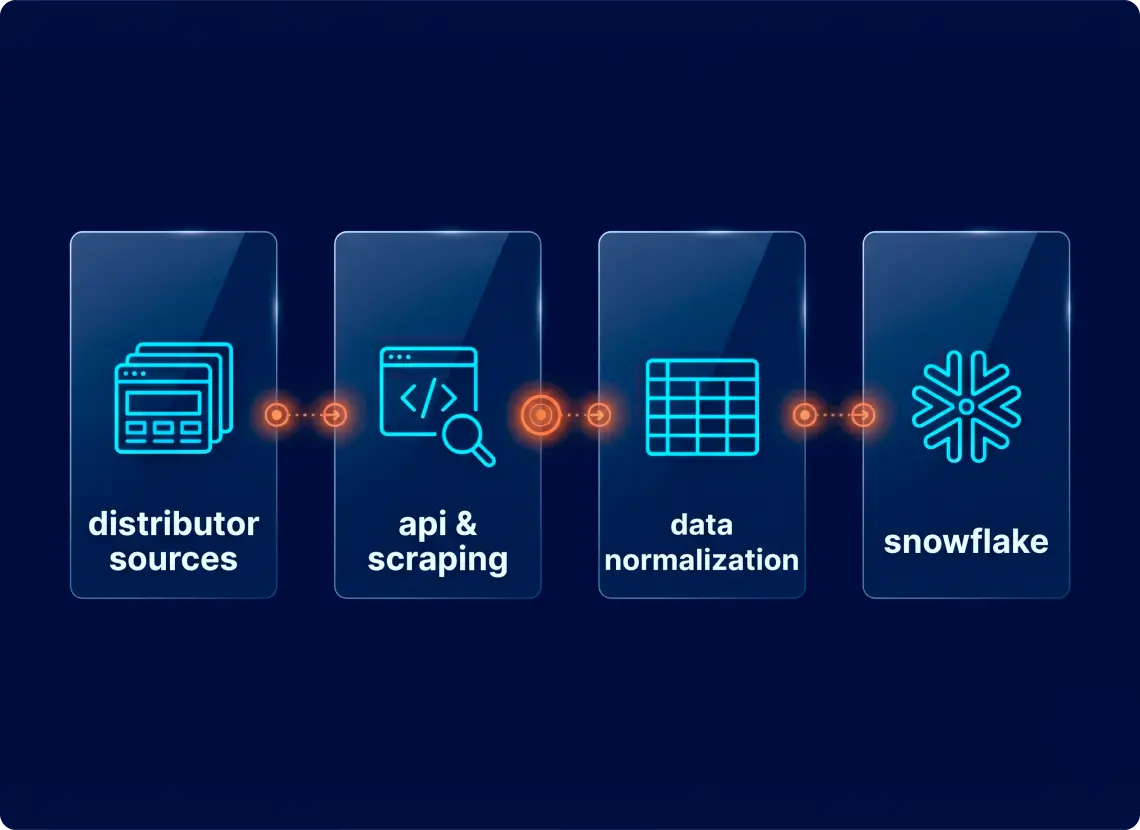
The problem with off-the-shelf price monitoring tools is that they're built for mass retail, not for a brand tracking its own SKUs across dozens of regional distributor storefronts in multiple countries. Once you go beyond the URL limit and need niche European retailers, you need something custom.

Shifting From Manual Tracking to Active Negotiation
Armed with precise data, the brand shifted from manual data gathering to active negotiation with distributors.
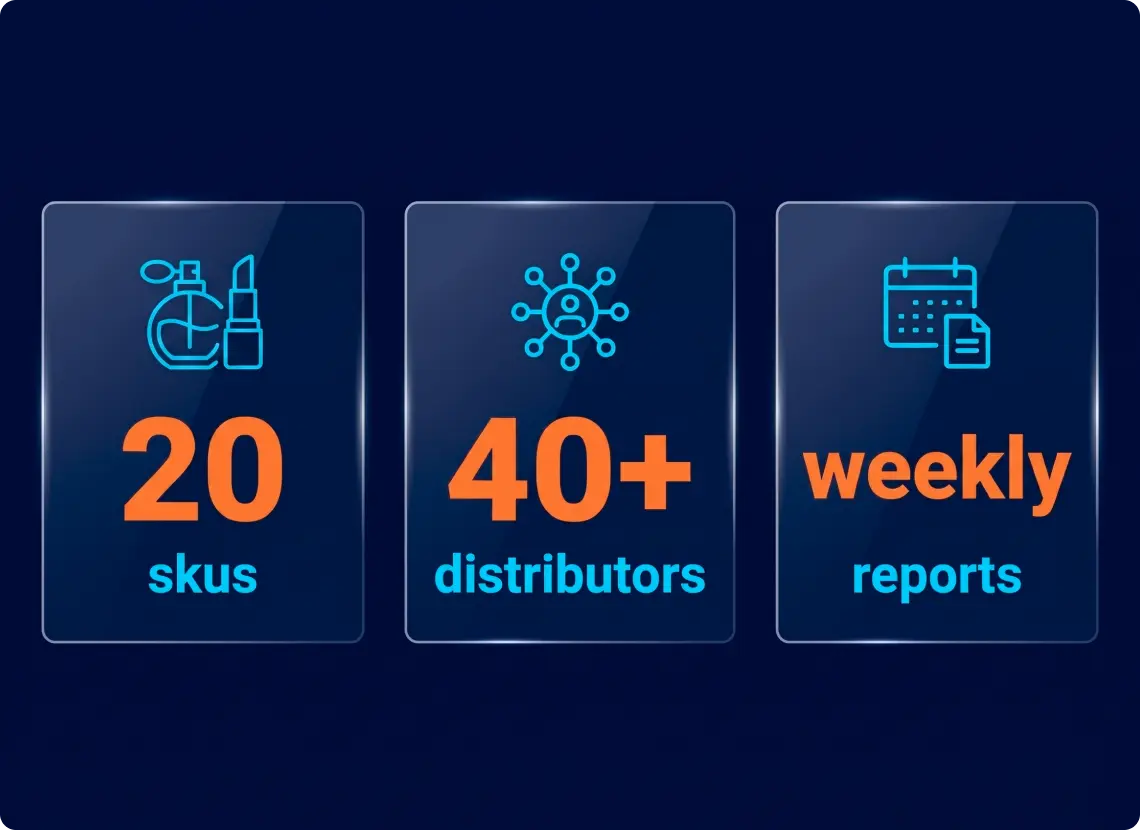
The PoC swiftly transitioned into an ongoing production partnership, automating the weekly collection of current prices and week-over-week deltas for the initial 20 SKUs.
- Insight to Action: MAP violations surfaced automatically, allowing the brand to enforce pricing policies and address the 40% European discount levels that previously went unnoticed for days.
- Niche Retailer Coverage: The system successfully tracks regional retailers completely ignored by standard subscription monitoring platforms.
- Validated Scale: The infrastructure grew from 7 UK sites to 40+ distributor sites across Europe, the US, and Canada without requiring infrastructure changes.
- Omnichannel Visibility: Store location data mapped the brand’s physical distribution accurately across international beauty chains.
Tracking Your Product's Prices Across Distributor Channels Manually?
We build competitive channel intelligence tools that cover the retailer mix your brand actually sells through — not just the platforms a subscription service was designed for.



You have an idea?
We handle all the rest.
How can we help you?