

Read summarized version with


Introduction
By the time a stock-out shows up in a weekly sales report, the lost revenue is gone. The customer is often gone, too. Closing the gap between what happened and what should happen next is where predictive analytics in ecommerce starts to matter for senior operators.
GroupBWT is a custom data engineering company. Our clients run ecommerce sites, retail chains, beauty labels, travel marketplaces, and automotive platforms. The work that keeps us busy is one layer below the model. Scraping pipelines. Validated inputs. The integration of a forecasting system actually begins once it leaves a notebook. We build the production data infrastructure that ML teams (in-house or partner) train on. Where clients have no ML resources, we build the models alongside the pipeline. The split is explicit at engagement: pipeline-only, pipeline + model, or model retraining on an existing setup.
This article covers where predictive analytics delivers measurable outcomes in ecommerce, what good implementation looks like, and where the build-vs-buy-vs-partner decision falls for senior teams. The intended reader is a CTO, VP of Data, or commercial leader sizing the investment.
Data Engineering: From Raw Web to Data Product
We develop and manage custom data solutions, powered by proven experts, to ensure the fastest delivery of structured data from sources of any size and complexity.
We offer:
- Custom Web Scraping & Development
- 15+ Years of Engineering Expertise
- AI-Driven Data Processing & Enrichment
Core Applications of Predictive Analytics in Ecommerce
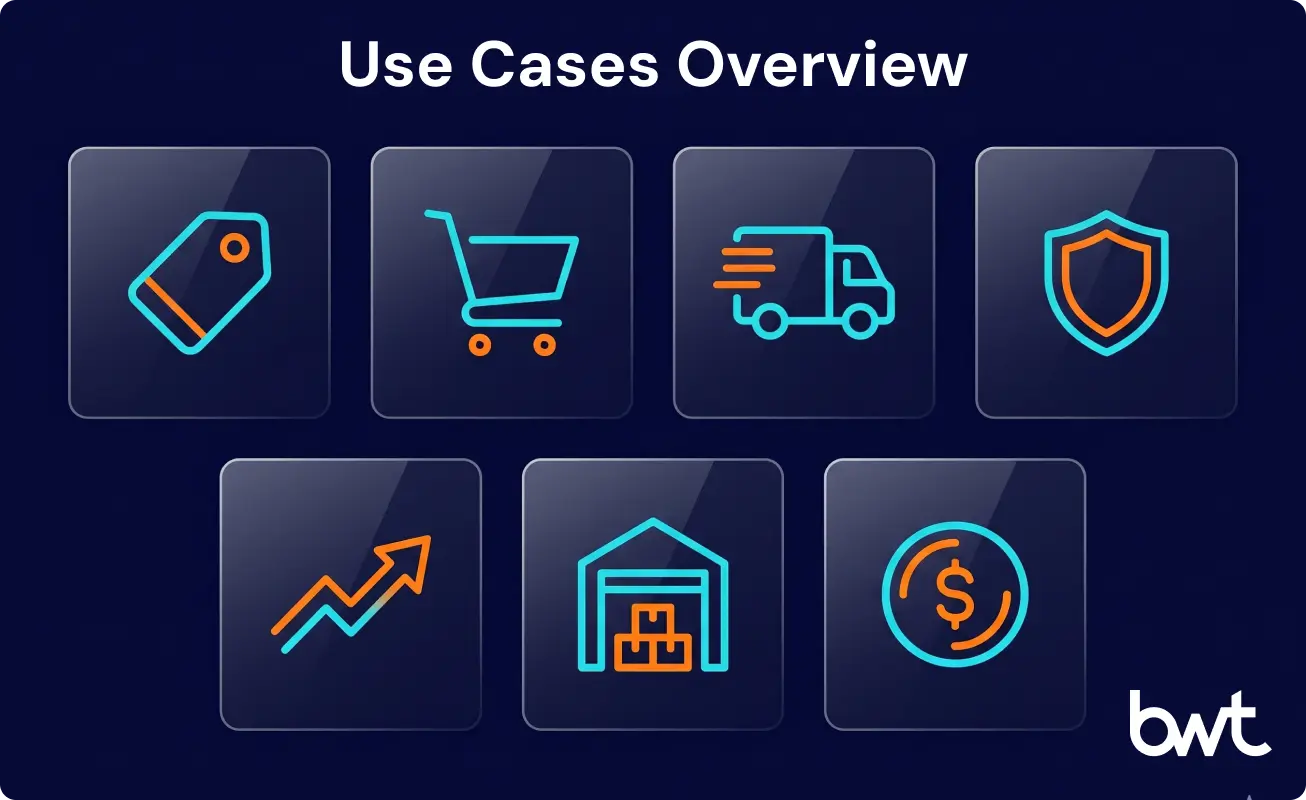
The use case range is wide, but not all applications deliver at the same confidence level or within the same implementation timeline. The seven below are the ones most consistently tied to measurable business outcomes.
Estimating Marketing Campaign Effectiveness
AI-powered predictive analytics in ecommerce can model expected revenue from a campaign before the budget is committed. Instead of allocating spend based on last quarter’s performance, teams simulate how a specific discount depth, segment, and timing combination will convert, using behavioral and transactional history as the input.
For a high-volume retailer running 30–50 seasonal promotions a year, the practical effect is split-testing only the highest-risk decisions and letting the model calibrate the rest. Campaign budgets stop being a guess.
Predicting Customer Behavior & Needs
Recognizing the importance of early behavioral signals (page sequences, dwell time, repeat-visit cadence, search refinements) lets platforms intervene before churn, lower the average discount depth needed for retention, and time upsells without adding friction.
The data side is harder than most teams plan for. Models trained only on checkout-stage events miss most of what actually predicts a purchase or an abandonment. The session window has to extend further back than standard analytics stacks usually capture. In plain terms: if your model only sees the last two clicks, it cannot tell you what the previous twenty clicks predicted. For a VP of Ecommerce, the operational ask is to expand session-level data capture before sponsoring a model build.
“The algorithm is rarely the bottleneck. We’ve seen clients spend months selecting between model types while their input data was refreshed weekly. In ecommerce, a pricing or churn model trained on week-old behavioral data is making decisions about a market that no longer exists.”
— Dmytro Naumenko, CTO at GroupBWT.
Inventory Forecasting & Replenishment Planning
Want to see how predictive analytics improves planning and optimization in ecommerce? Look at the inventory first. A stock-out on a high-margin SKU during peak season is two losses, not one. The lost sale is obvious. The customer who walks to a competitor and never comes back is the one nobody puts on the dashboard. Overstock costs the opposite: capital locked, markdown pressure, and warehouse overhead.
For a global FMCG manufacturer ranked among the world’s top consumer-goods groups, GroupBWT built a digital shelf monitoring system that scraped pricing, inventory, and availability across 100+ retailers daily. The system tracked thousands of SKUs with report generation under five seconds. What had been a multi-day manual audit became a real-time view. That makes inventory prediction actionable, not retrospective.
For a deeper technical context on the AI demand forecasting stack, the architectural decision that matters is refresh cadence, not which forecasting algorithm to use.
Shipment Planning
Delivery window prediction affects both customer satisfaction and carrier cost. Shipment models combine historical carrier performance by route, day of week, and season with current order volume and geography. The model then routes the order to the carrier mix most likely to honor the delivery window quoted at checkout.
For platforms promising same-day or next-day delivery, this model decides whether the checkout commitment is the one honored at the door. Churn comes after, by which point the cause is hard to trace. For a regional retailer pushing 50,000+ orders a day, even a two-point lift in on-time delivery moves the retention dial and shrinks the contact-center queue. The same model informs negotiation. Knowing which carriers underperform on which lanes gives the next contract review hard numbers to work from.
Price Setting
Among predictive analytics in ecommerce planning and optimization use cases, dynamic pricing carries the highest stakes. A price set too high loses the sale. A price set too low leaves a margin behind. Across thousands of daily transactions, that systematic loss compounds into real money.
GroupBWT built an AI-assisted pricing platform for a European vehicle rental company. The platform ingested listings from 18 ad aggregators across multiple countries and fed daily buy-and-sell decisions. By acting on daily market signals instead of periodic manual reviews, the client increased its average truck selling price by 6% and reduced purchase expenses by 14%. On a fleet of thousands, those percentages translate into meaningful operating-margin recovery.
The same logic applies to ecommerce SKUs. Manual competitor monitoring across dozens of categories is not scalable. Automated price intelligence feeds models that recommend adjustments with the margin impact precomputed. Architecture detail in digital shelf analytics.
Fraud Detection
Ecommerce fraud is a growing cost line. Juniper Research’s most recent projections put cumulative global merchant losses well above $100 billion over the coming five years. Attack vectors shift faster than rule-based systems can keep up. So the work shifts to behavioral models. They watch how a buyer normally shops, what device they use, and where they are. When a transaction breaks that pattern, the model flags it and blocks authorization.
The implementation detail most teams underestimate: fraud models decay fast. A pattern that blocks 95% of attempts at deployment may catch 60% within nine months as attackers adapt. Retraining cadence is not optional. It is the maintenance line item.
Financial Forecasting
Demand forecasting is not a marketing toy. It feeds straight into cash-flow planning. Better inventory models tighten the buying cycle. Working capital stops sitting in slow stock. Finance teams plan with narrower confidence intervals and spend less time revising forecasts mid-quarter. The connection between operational prediction and financial planning is direct and underused.
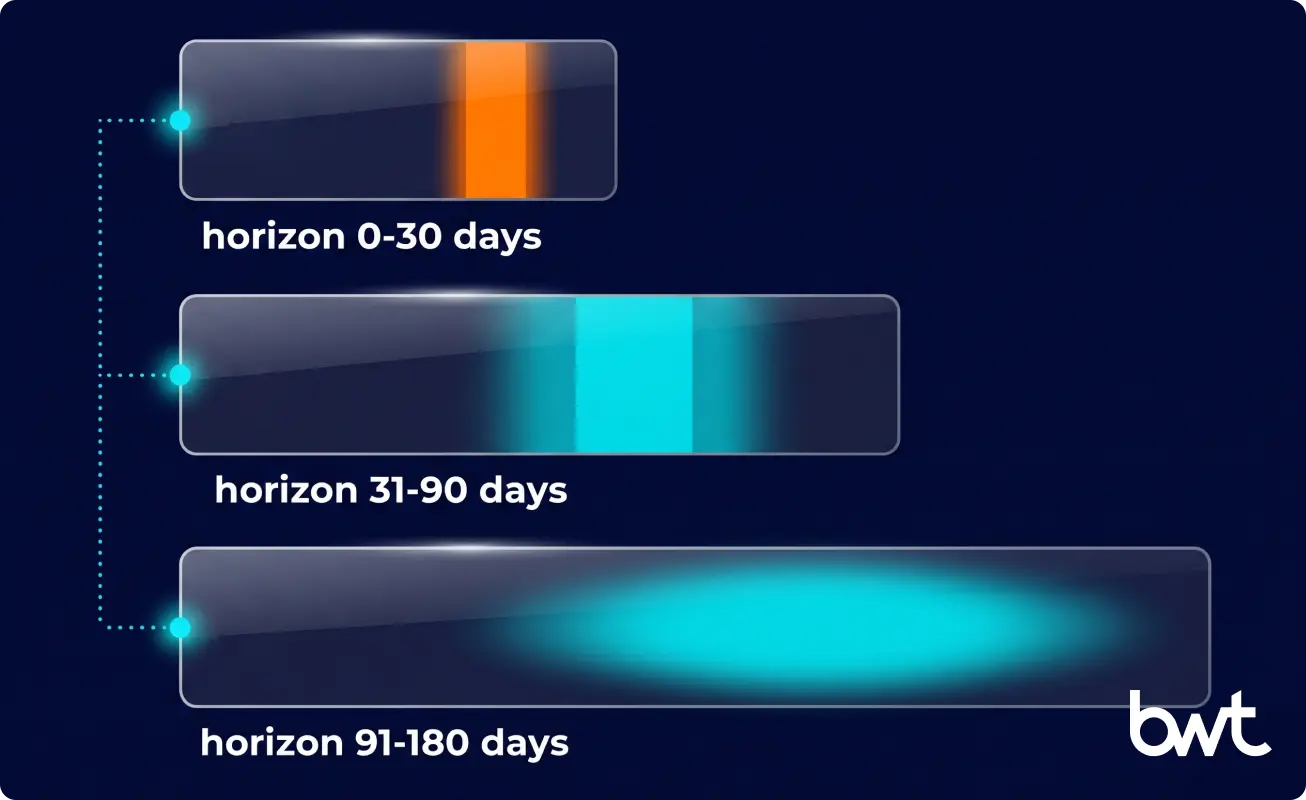
Across predictive systems GroupBWT has built for ecommerce and retail clients, achievable accuracy bands settle into roughly the following ranges, depending on data input quality and how often the inputs update. The numbers below are internal benchmarks from production engagements, not vendor marketing claims.
| Forecasting horizon | Primary data inputs | Typical accuracy range (GroupBWT internal benchmarks) |
| 0–30 days | Sales velocity, current stock, promo calendar | 85–95% |
| 31–90 days | Seasonal indices, category trends, supplier lead times | 70–85% |
| 91–180 days | Macro signals, market share data, and new product pipeline | 55–70% |
Longer-horizon accuracy improves measurably when external data (competitor pricing feeds, search trend signals, supplier lead-time changes) is incorporated alongside internal transaction data.
If your team is sizing a predictive build and wants to know whether the current data stack can support it, GroupBWT’s best data analytics outsourcing services start with an infrastructure review, not a model selection conversation.

Real-Life Examples of Predictive Analytics in Ecommerce
Zalando is one of Europe’s largest fashion platforms. Its predictive allocation system processes more than a million items every week. That system feeds the assortment-and-pricing engine, which is what shrinks markdown pressure and pushes full-price sell-through up. None of that runs on a SaaS subscription. It runs on dedicated data engineering.
A similar pattern shows up in GroupBWT’s client work. A global cosmetics manufacturer ranked in the top 10 worldwide needed product-line decisions before committing to six-month production cycles. GroupBWT built a platform that pulled SKU-level data daily from major retailers, including Sephora, Boots, and Douglas. AI-based product mapping matched items even where retailers used different IDs across catalogs. The quarterly manual audit was replaced with a daily operational feed, and the assortment decision moved from instinct-led to data-led.
“A prediction is only as current as the data feeding it. When we instrument scraping pipelines for e-commerce clients, the first question is not which model to use. It is how stale the training window can be before the model starts misleading the team. For pricing decisions, that window is often measured in hours, not days.”
— Alex Yudin, Head of Scraping at GroupBWT.
For a top-tier EU food delivery platform operating across 1,200 geo-zones, the problem was validation rather than initial prediction: confirming the primary data vendor’s daily scrape was accurate enough to drive real-time pricing and restaurant visibility. GroupBWT built a parallel validation system that completed each 1,200-location session in under two hours at 98.6% field-level accuracy. A meaningful fraction of records that the vendor flagged as correct were not.
Also Read: Digital Shelf Ecommerce Analytics: A Complete Guide to Winning Online Visibility & Sales
Main Benefits of Predictive Analytics in Ecommerce
The strongest case for prediction is the alternative. Reactive inventory. Fraud cleanup after the money is gone. Marketing spend is calibrated to a season that has already ended. Compare those costs against a working forecast, and the math tilts fast.
Business Agility — Faster Response to Market Signals
Operationally, “agility” means the time between detecting a market signal and acting on it. A retailer whose dashboards refresh hourly and whose models retrain weekly can reprice and reallocate budget within a day of a demand shift. A retailer working from weekly reports moves three to five days later. Across a peak season, that gap is the difference between capturing the upside and reading about a competitor doing it.
Reduced Financial Losses
Overstock and stock-out losses cost global retail an estimated $1.75 trillion annually, according to IHL Group. Tighter inventory models cut both ends: less capital tied up in slow stock, fewer lost sales from depleted fast movers. The improvement is small per SKU and accumulates across thousands.
Risk & Disruption Prevention
Supply-chain disruptions, price wars, and demand spikes are easier to absorb when the planning system already runs scenarios for them. Teams with predictive systems make contingency choices before the crisis. Teams without them make those choices under pressure with worse information.
Customer Retention Through Personalization
Salesforce’s State of the Connected Customer report puts the number at 73%. That is the share of buyers who now expect companies to treat them as individuals, up from 39% a year earlier. Personalization at that scale is not a copywriting problem. It is a prediction problem: who churns next, what product brings them back, what price holds margin. Retention math is dull until you do it. Then it becomes the most reliable line on the P&L. Keeping existing customers is cheaper than buying new ones, every quarter the model runs.
Better Budget Planning
Demand forecasting narrows the confidence interval on every budget line tied to volume. Marketing budgets, logistics capacity, headcount plans, procurement orders. All four get to plan against the same number instead of four different guesses. Finance reworks fewer mid-quarter plans because the original forecast holds up against actual demand.
Challenges & Guidelines for Ecommerce Predictive Analytics
Implementation of predictive analytics in ecommerce fails more often at the data layer than at the model layer. Three patterns appear consistently across GroupBWT engagements.
Data quality and completeness
Models trained on incomplete or inconsistent data don’t underperform gradually. They mislead confidently. Across the scraping projects GroupBWT runs, missing or incorrect attribute values appear in roughly a third of collected records before normalization. A model trained upstream of that correction produces systematically wrong outputs.
Model accuracy degradation
A model at 90% accuracy on day one may run at 65% six months later as customer behavior, competitor pricing, and market conditions shift. Teams that don’t budget retraining into the initial scope discover model decay through business outcomes. That is the most expensive diagnostic path.
Organizational data governance
Teams that get the most value out of predictive systems answer one question before any model runs. Who owns the data? When CRM lives in one platform, transactions in another, and marketing telemetry in a third, the model trains on a slice. It predicts on a slice, too.
“The projects that fail don’t fail because of the predictive model. They fail because the data infrastructure wasn’t designed for prediction. It was designed for reporting. Retrofitting a forecasting layer onto a reporting warehouse is a costly conversion.”
— Eugene Yushenko, CEO at GroupBWT.
Some gaps don’t automate out. Product categories with thin historical data, new market entries, and private-label SKUs without shared identifiers need human QA in any production system worth running. Saying that out front beats promising full automation. Leadership tends to discover the gap six months later, and that is the more expensive lesson.
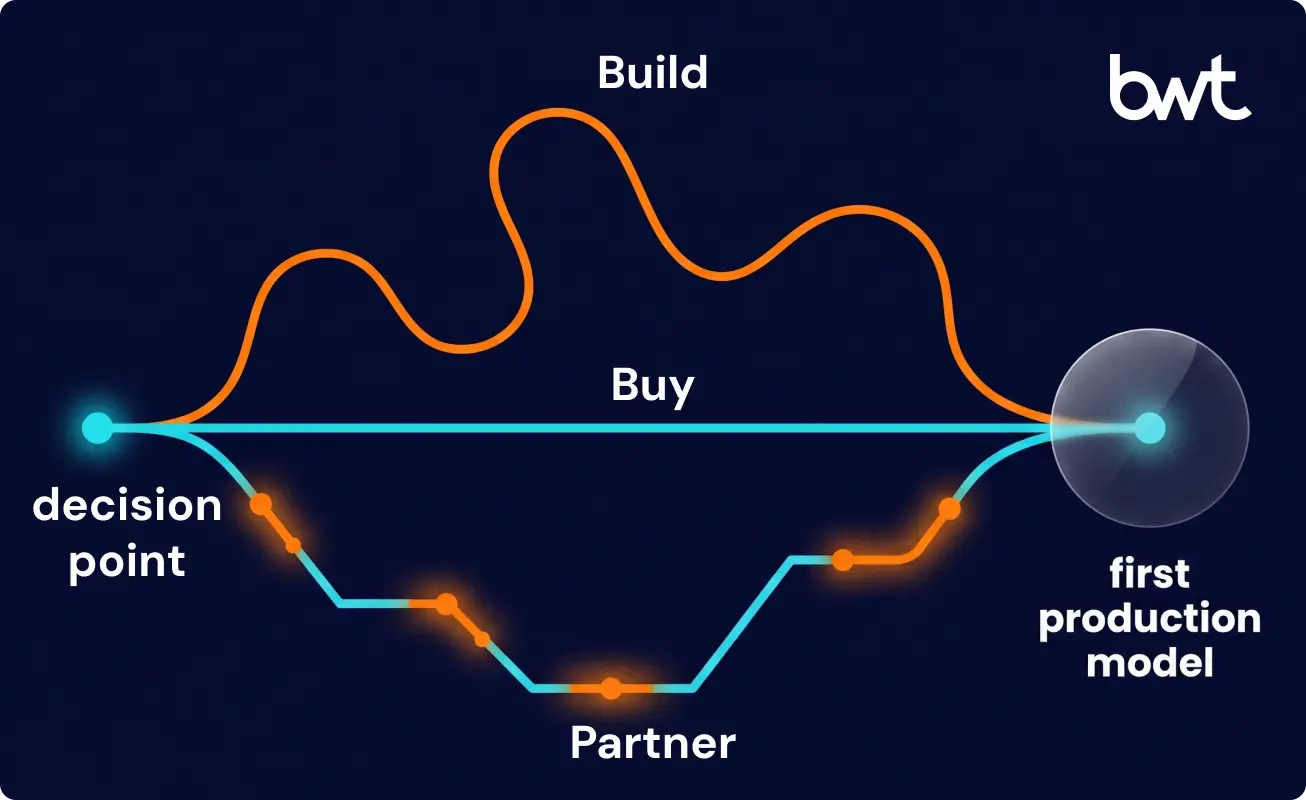
Build vs Buy vs Partner: How Senior Teams Decide
The commercial question most CTOs ask at this stage is which delivery model fits the company. The honest answer is that all three work for different starting positions.
Build (in-house)
Right when the company has a senior data-engineering team, an ML function, and a 12–18 month horizon. Full control, retained IP, customizable to internal data shape. The cost is the timeline and the senior hiring difficulty. Data engineers and ML engineers are scarce and expensive, and the first production model typically lands in quarter four, not quarter one.
Buy (off-the-shelf)
Right when the use case fits a standard SaaS pattern, such as a Shopify storefront with vanilla retention prediction needs. Deployment is fast, vendor maintains the model. The constraint is flexibility. SaaS predictive products are tuned for the median customer. Your data sources rarely match that median. Private-label products, multi-region pricing, supplier-feed integration: each one is a place where the SaaS will tell you to file a feature request. Custom work is what closes those gaps, and SaaS is exactly where custom work isn’t on the menu.
Partner (hybrid build)
Right when the pipeline is the gap, and the use case is bespoke. A partner team builds the production pipeline and either trains the models with the client’s ML function or delivers both. Time to first model is typically two to three quarters. Control over architecture is full. The engagement scales down to maintenance once the system is stable. The discipline required: a clear answer to “what decision does this model improve, and how often?” before scope is set.
GroupBWT operates as the partner option, and engagements are scoped around that question first. The model architecture is downstream of the answer.
Identify New Business Opportunities with Predictive Analytics
Predictive systems built well surface signals that rearview reporting does not reach. A handful of opportunity categories pay back fastest.
- Adjacent-category demand. Customers buying a primary product often signal interest in adjacent SKUs through search and browse behavior weeks before the purchase pattern consolidates. Models that watch the signal trigger inventory pre-positioning and category-launch decisions before the trend shows up in sales reports.
- High-value segment discovery. Behavioral clustering against lifetime value reveals customer cohorts that current targeting misses. One example: low-frequency, high-AOV buyers whose acquisition cost would justify the retention spend the marketing org is not running today.
- Pricing gap detection. Competitor pricing changes daily, and assortment overlaps unevenly. Predictive models flag two things: the SKUs leaving margin on the table, and the SKUs where a price cut would not move enough volume to pay for itself. The decision moves from reactive to systematic.
First-mover companies on these signals are not the lucky ones. They built a stronger data foundation. Then they refresh it on a tighter clock than the rest of the market.
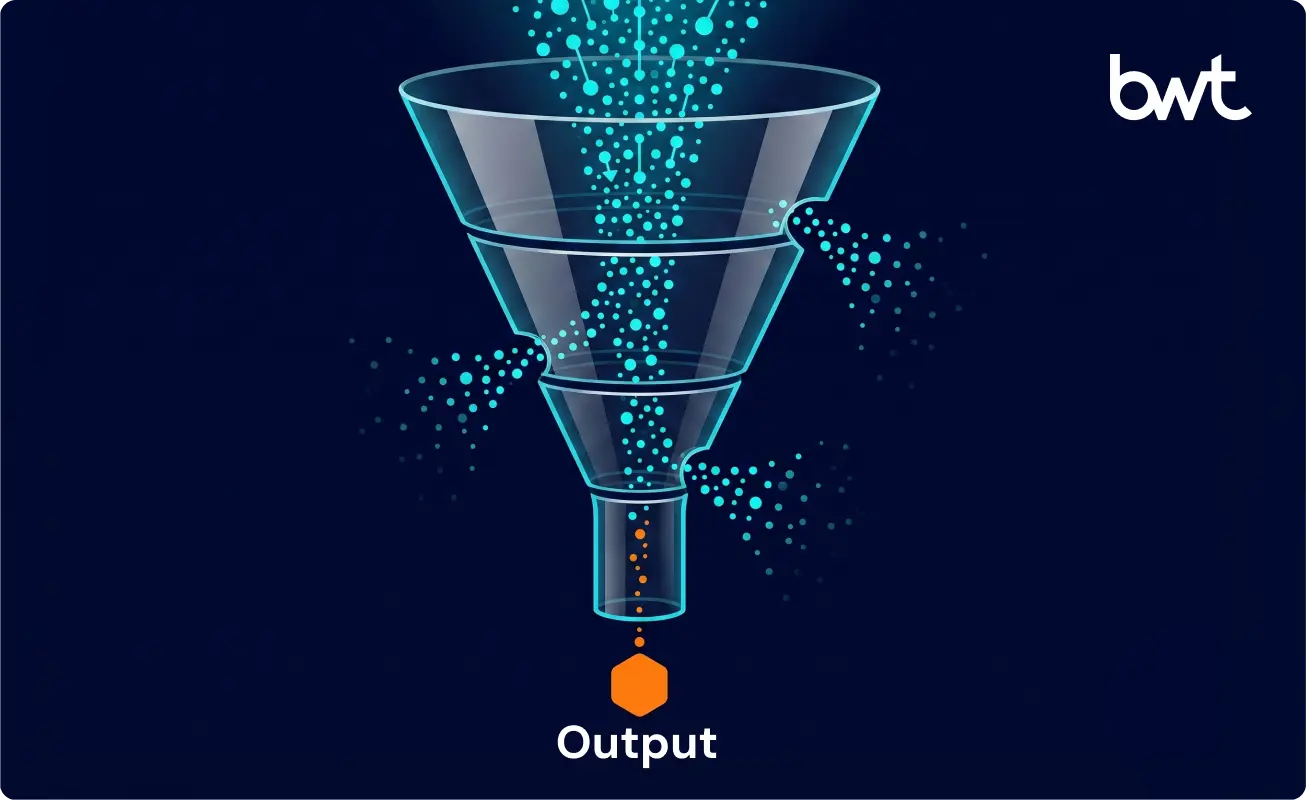
Predictive analytics systems read three kinds of data. Internal records: transactions, sessions, prices, stock levels. External feeds: market pricing, supplier signals, sometimes weather. Then statistical models turn that pile into forecasts with confidence levels attached. In ecommerce, the inputs that matter most are purchase history, session behavior, product pricing, and inventory. Outputs go two ways. Some trigger automation directly: reorder thresholds, fraud blocks, and on-the-fly personalization. Others surface a prioritized recommendation for a human to review. The accuracy bottleneck is rarely the model. It is the data feeding it.
Three windows, three different model jobs. Before purchase, behavioral models score visitor intent and trigger interventions on the fly: a recommendation here, a discount there, timed to how deep someone has browsed. At checkout, fraud models do their work in real time, sometimes inside a 200-millisecond budget. After purchase, churn prediction watches the gap since the last order. When a customer slips past their normal repurchase window, retention campaigns fire before the window fully shuts. The shift across the whole journey is the same: the business moves first, and the outcome follows.
It depends on where the data already lives. Mature stack? Cloud-native platforms like Google BigQuery ML, Amazon SageMaker, and Databricks handle model training and deployment without much fuss. Smaller operation, early validation phase? Shopify Analytics and Microsoft Power BI cover the basics. Once data volume outgrows the off-the-shelf options, or the use case starts including private-label SKUs, multi-region pricing, or supplier-feed integration, custom pipelines built around a deliberate refresh cadence usually become the right call. The picking criteria are simple.Volume, refresh needs, and team capacity. And before locking any model choice, make sure the upstream data flow is solid. A cleaner pipeline beats a fancier model every time.
Start with the decision, not the data. The first three questions: which business decision does the model improve, what accuracy threshold makes the output actionable, and who actually pulls the trigger on it. Audit the current data next. Completeness. Freshness. Consistency. Then pick a model architecture, not before. Retraining belongs in the initial scope, not as a phase-two ticket. Skip that step, and the model decays into a liability within six months. Pick a narrow, measurable use case for the first build so the ROI can be proven before anyone scales the approach.
ROI varies by use case and data maturity. McKinsey research on data-driven companies in consumer sectors found net sales increases of 3–5% and marketing efficiency improvements of 10–20% through analytics investment. In pricing, the GroupBWT-built platform for the European vehicle rental client produced a 6% increase in average selling price and a 14% reduction in purchase expenses. Those gains compound across thousands of transactions a year. The honest constraint: ROI is highest when the upstream data is solid. Models built on top of weak data plumbing tend to disappoint in the first 12 months because they are confidently wrong, not visibly broken.
Read summarized version with
Data Engineering: From Raw Web to Data Product
We develop and manage custom data solutions, powered by proven experts, to ensure the fastest delivery of structured data from sources of any size and complexity.
We offer:
- Custom Web Scraping & Development
- 15+ Years of Engineering Expertise
- AI-Driven Data Processing & Enrichment