

Modern commerce depends on clean, complete, and timely product data. Teams track prices, stock, reviews, and specifications to guide decisions in retail, analytics, manufacturing, and logistics. This drives a strong need for reliable Target scraping workflows. Many teams begin with the rise of web scraping for small businesses and then evolve into category-scale pipelines once pricing, stock, and review signals become key decision-making inputs.
Target ranks among the most valuable sources of structured product data in the US retail landscape; yet, the platform employs dynamic rendering, lazy loading, and strict blocking rules. These conditions create significant barriers for teams that want to learn how to scrape Target and design resilient Target data scraping systems. If your goal is consistent uptime and monitored delivery, a web scraping service provider can run the full pipeline layer (rendering, proxy control, retries, and exports) as an operating system, not a one-off script.
“Scraping systems fail because the architecture ignores platform behavior. To scrape Target effectively, you must stop treating it as a static document and start treating it as a dynamic environment that actively resists automation through behavioral profiling.”
— Alex Yudin, Web Scraping Lead
This guide unifies strategic, technical, operational, and comparative insights into a single comprehensive knowledge asset. It demonstrates best practices for product data scraping, assesses four proven approaches, evaluates outcomes, and delivers a repeatable blueprint for organizations seeking a stable, scalable Target pipeline.
Why Target Scraping Is Hard: The Root Technical Barriers
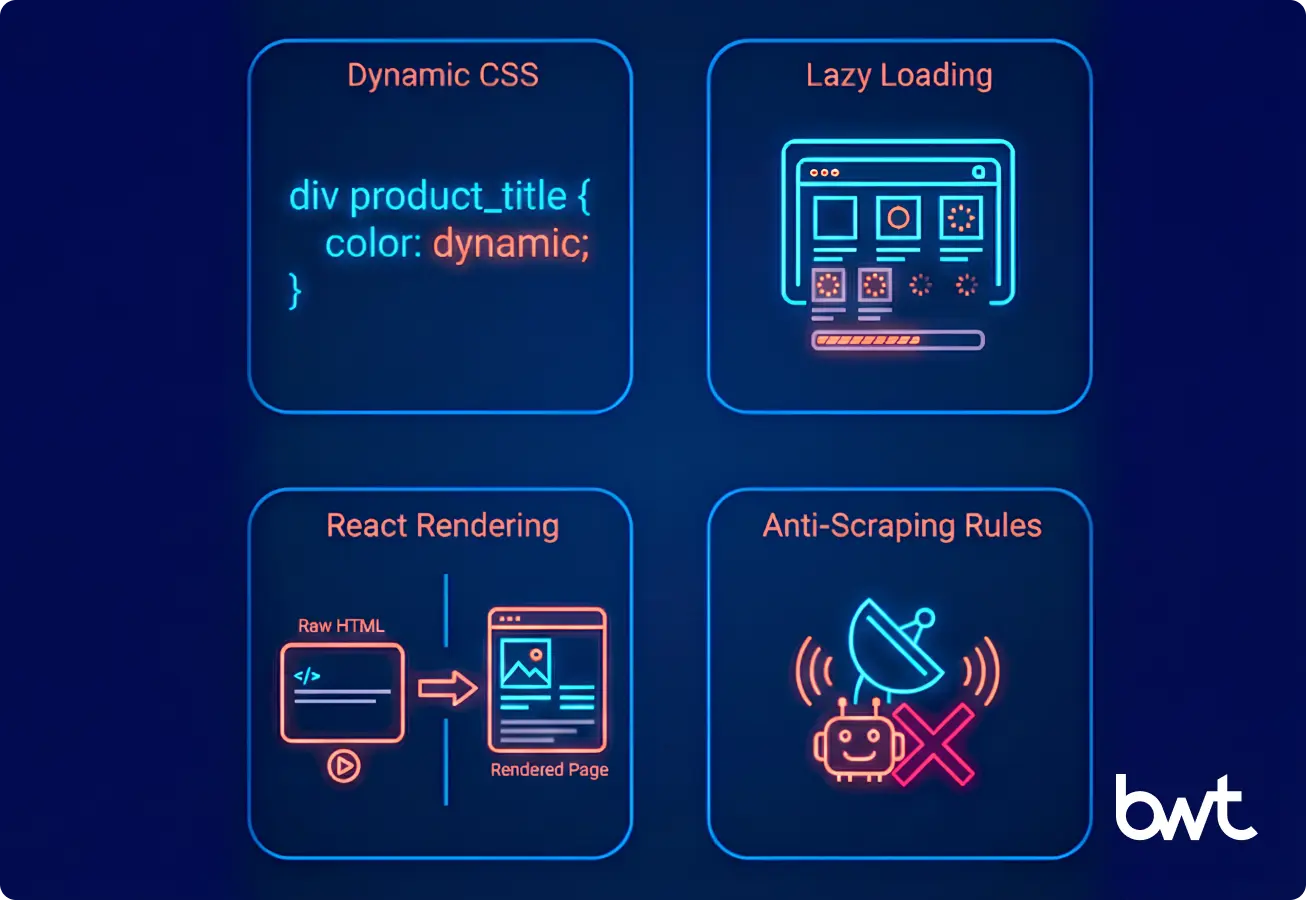
Compelling Target insights can be scraped by understanding the site’s architecture. Target uses a client-heavy front end. Product cards appear only after the browser completes JavaScript execution and scroll-triggered calls.
Teams face five core obstacles:
Dynamic CSS Selectors
Selectors change often. Hardcoded DOM paths fail rapidly. Scrapers must adapt.
Lazy Loading
Product data loads only when the browser scrolls. Static scrapers miss nearly everything.
React Rendering Paths
Critical product fields stay invisible until scripts finish. Raw HTML contains placeholders without prices, ratings, or stock details.
Strong Anti-Scraping Rules
Target uses request-profiling tools to track automation patterns. Fast polling triggers blocks.
Strict Traffic Filters
These blockers are a concentrated version of the broader web scraping challenge most teams face once dynamic rendering and behavior-based filtering enter the picture.
Unrotated IPs hit rate limits. Bots without proper headers trigger mitigation workflows.
Teams planning scraping need methods that address rendering, scrolling, and request-level blocking. These constraints define all the strategies discussed in this report
Methodology 1: Direct HTML Parsing (Requests + BeautifulSoup)
If your team is comparing stacks, web scraping in PHP vs. Python comes down to runtime ecosystem and browser control rather than syntax, especially on JavaScript-heavy retail targets.
Implementation
Python Requests downloads the initial HTML. BeautifulSoup parses it. The code targets div blocks with the @web/site-top-of-funnel/ProductCardWrapper identifier to pull simple fields: product title, link, and price.
Outcome
Only four products appear across typical tests. The scraper touches placeholders that don’t have real values. It cannot load JavaScript or reveal lazy-loaded cards.
Evaluation
Parsing saves time but fails to retrieve real data. It cannot support Target data scraping in any operational scenario. It offers low yield, low quality, and high error rates. The method is ineffective because it cannot run JavaScript or trigger lazy loading, resulting in placeholders that are not real product data and typically yielding only a few initial items.
For teams asking how to scrape Target effectively, this method should be avoided.
Methodology 2: Python Selenium (Headless Browser Rendering)
A stronger baseline for Target scraping, with higher overhead and maintenance costs.
Implementation
The scraper launches a remote browser. It waits for elements, scrolls by pixels, and triggers lazy loading. It extracts title, price, and link fields. Better coverage depends on precise waiting rules and scroll loops.
Outcome
Selenium retrieves eight products, twice the baseline from parsing, yet still far from complete coverage. It loads dynamic content, but scroll timing remains sensitive.
Evaluation
This approach renders the entire page and resolves missing DOM elements. It introduces complexity, heavy CPU use, and brittle scroll-state logic. Teams gain control but spend time maintaining selectors and timing rules.
Adequate for teams that know how to scrape Target.com product data with engineering depth, but inefficient at scale.
Methodology 3: Node.js Puppeteer + Cheerio + Proxy Rotation
A mature engineering approach with strong yield and structured output.
Implementation
Puppeteer controls a headless browser. It scrolls until no new items appear. It waits for full rendering and passes the HTML to Cheerio. The script extracts a richer set of fields:
- Title.
- Brand.
- Current price.
- Regular price.
- Rating.
- Total reviews.
- Product link.
Strong proxy rotation handles blocking. A final Excel file stores structured results.
For internal adoption, AI chatbot development solutions can expose the latest scraped catalog and changes through a controlled Q&A interface tied to your governed dataset.
Outcome
Puppeteer extracts all products displayed on the page and can reach the same full multi-page dataset (1000+ results) when pagination or deep scrolling is implemented.
Evaluation
This method balances control and depth. It requires steady maintenance, yet it performs well for production workloads.
A robust engineering path for long-term scraping pipelines.
“While Puppeteer introduces higher operational overhead compared to simple requests, it offers the granular control necessary to guarantee predictable outcomes when handling complex pagination logic and dynamic DOM injections.”
— Dmytro Naumenko, CTO
Methodology 4: AI-Driven Extraction (Claude + MCP Server)
A new paradigm that turns scraping into a natural-language workflow. This approach fits broader AI solutions patterns where models do the interpretation work while the pipeline enforces cost control, validation, and consistent output formats.
Complexity is moderate, not “very low,” due to the real setup and commercial cost of MCP proxies and LLM API usage.
Implementation
Configuration involves a one-time setup of Bright Data’s MCP server. Claude receives access to Target scraping tools. The user runs a prompt.
The Claude LLM manages scraping tools (such as the MCP Server) to handle complex rendering, scrolling, and parsing. The AI agent validates and structures the whole dataset, eliminating the need for manual CSS selectors or complex browser scripting.
Outcome
The AI agent identifies 1000+ results, covering all pages accessible from the entry query. The maximum number of results (1000+) is achievable but depends on the specific category size and available scroll depth. The output forms a detailed JSON file with:
- Pricing layers.
- Inventory details.
- Technical specifications.
- Ratings and review metadata.
- Sponsored and bestseller signals.
- Availability and shipping data.
Once the dataset is captured, Natural Language Processing (NLP) can turn review text into structured themes, sentiment signals, and defect clusters that are easier to track over time.
Evaluation
This method reduces development time and maintenance. It increases completeness and improves field richness. It shifts effort from coding to configuration and cost management. Teams executing scraping tasks reach maximum coverage with minimal manual work.
“We are seeing a shift from rigid selector-based logic to adaptive AI agents. By utilizing LLMs to interpret the visual structure of a page, we solve the problem of platform drift—ensuring the pipeline holds under pressure even when the target site continuously deploys new frontend code.”
— Alex Yudin, Web Scraping Lead
The most efficient approach for how to scrape Target product data at scale, with moderate operational complexity driven by external services.
Comparative Tables: Four Methods for Target Scraping
Below are three compact comparison tables. Each highlights a specific decision dimension: complexity, data outcomes, and operational characteristics.
Table 1: Method vs. Implementation Complexity
This table helps teams choose an approach based on available engineering resources and tolerance for operational overhead.
| Method | Core Stack | Complexity |
| Requests + BS | Requests, BeautifulSoup | Low |
| Selenium | Python, Selenium | High |
| Puppeteer | Node.js, Puppeteer, Cheerio | High |
| Claude + MCP | Claude LLM, MCP tools | Moderate |
Table 2: Method vs. Data Outcomes
This table focuses on the scale and depth of Target data that each method can extract under optimal configuration.
| Method | Data Yield | Data Richness |
| Requests + BS | 4 products | Very low |
| Selenium | 8 products | Low |
| Puppeteer | 1000+ results with pagination | Medium |
| Claude + MCP | 1000+ results | Very high |
Table 3: Method vs. Operational Behavior
This table highlights practical characteristics that matter during real scraping workloads, including stability and control.
| Method | Operational Notes |
| Requests + BS | Cannot load JavaScript; fails on dynamic content |
| Selenium | Heavy waits, scroll logic, fragile selectors |
| Puppeteer | Strong engineering control; stable with tuned proxies |
| Claude + MCP | Best multi-page coverage; depends on external MCP and LLM APIs |
Deep-Dive: Proxy Rotation for Target Scraping
Target uses aggressive request profiling. A functioning proxy layer needs more than simple IP rotation. A practical baseline is to design rotating proxies for web scraping around sessions, pacing, and fingerprint consistency, since IP rotation alone rarely stabilizes scroll-based collection.
Core components:
- Residential IPs for realistic traffic distribution.
- Mobile IPs for mobile user agents.
- Session stickiness for multi-step scroll and fetch chains.
- Header randomization for browser fingerprints.
- Timed pacing aligned with human browsing.
- Low parallelism to avoid pattern detection.
- Separate pools for scrolling vs data extraction.
Target reacts to micro-patterns. Stable Target scraping requires a proxy architecture with absolute session control.
Short Practical Code Examples
These snippets provide minimal scaffolding for scroll automation and parsing.
Puppeteer: Scroll Automation
| async function scrollPage(page) {let height = await page.evaluate(() => document.body.scrollHeight);
while (true) { await page.evaluate(() => window.scrollBy(0, 800)); await page.waitForTimeout(500); const newHeight = await page.evaluate(() => document.body.scrollHeight); if (newHeight === height) break; height = newHeight; } } |
Selenium: Wait for Product Cards
| Pythonwait = WebDriverWait(driver, 20)
wait.until(EC.presence_of_element_located( (By.CSS_SELECTOR, “[data-test=’@web/site-top-of-funnel/ProductCardWrapper’]”) [cite: 194] )) |
Note: The example uses the [data-test=’@web/site-top-of-funnel/ProductCardWrapper’] selector. While Target can change selectors, using data-test attributes is generally a more resilient approach than relying on generic DOM paths.
Puppeteer + Cheerio: Extraction
| const html = await page.content();const $ = cheerio.load(html);
const items = $(“[data-test=’@web/site-top-of-funnel/ProductCardWrapper’]”) .map((_, el) => ({ title: $(el).find(“a h3”).text().trim(), price: $(el).find(“[data-test=’current-price’]”).text().trim(), })) .get(); |
Technical Barriers and How Effective Tools Overcome Them
Rendering
Target uses client-side rendering. Only headless browsers or AI agents that emulate them reveal real data.
Scrolling
Lazy loading demands repeated scroll actions. Scrapers load new cards only when the page registers deeper scroll points.
Proxy Rotation
Target filters traffic by behavioral patterns. Rotation avoids blocks and keeps throughput stable for web scraping Target workflows.
Selector Stability
Dynamic selectors require resilient extraction logic. Puppeteer and AI tools handle changes better than static parsers.
What Data Matters When Teams Scrape Target
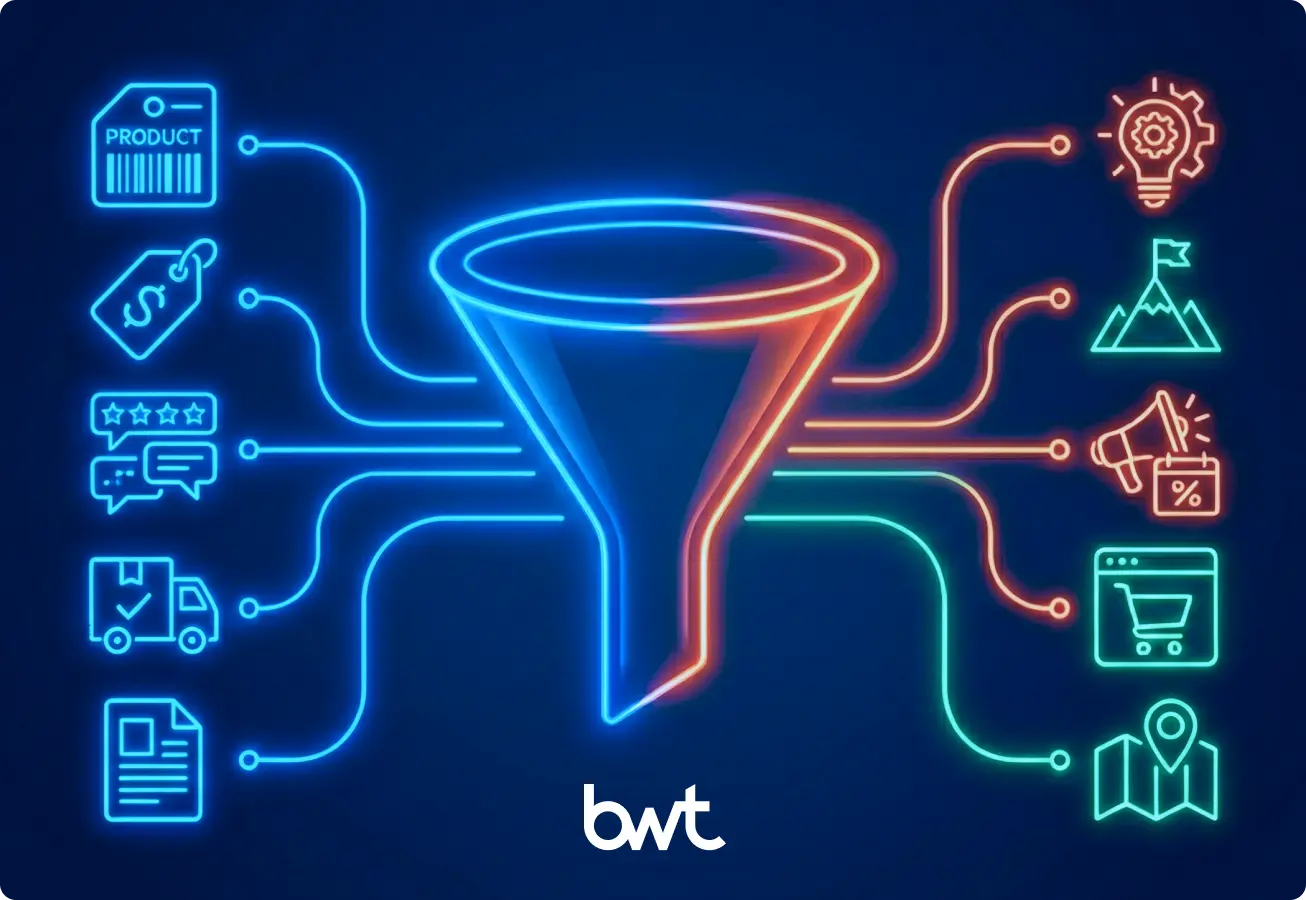
Teams extract five strategic categories when they scrape:
- Product basics.
- Pricing.
- Customer signals.
- Availability and logistics.
- Specifications.
If key signals are richer in native experiences than on web pages, mobile app scraping solutions can close gaps in pricing, inventory, and localized offers that do not fully surface on desktop.
These support scrape Target product prices, competitive analysis, product planning, and retail intelligence.
How Target Data Supports Strategy Across a Business
Target is a core input for retail product data scraping because the same dataset can power pricing governance, assortment decisions, and promo validation across regions.
- Product development.
- Market positioning.
- Promotion planning.
- E-commerce optimization.
- Regional intelligence.
These same field groups are the baseline for ecommerce product data scraping, where comparability across retailers depends on consistent schemas for price layers, availability, and review metadata.
For teams with Asia coverage needs, pairing Target with Naver scraping can improve regional discovery and competitive context when sources differ by market.
If your research scope includes ads, demos, or influencer content alongside product pages, how to extract data from video can add structured signals that sit outside standard HTML product fields.
Legal and Responsible Use Considerations
Target’s terms prohibit automated extraction. Public pages remain visible, yet traffic must follow responsible guidelines:
- Avoid fast polling.
- Avoid personal identifiers.
- Avoid authenticated paths.
- Use proxies responsibly.
Organizations should review internal compliance before launching scraping operations.
Strategic Recommendations for Modern Target Data Scraping
When to Use Code
Select Selenium or Puppeteer when teams need complete control, custom transformations, or complex pipelines.
When to Use AI
Use Claude with MCP when teams need fast extraction, deep field coverage, and minimal scripting, with moderate initial configuration.
If your constraint is operations capacity rather than engineering skill, web scraping as a service can keep SLAs, monitoring, and exports stable while your team focuses on analytics and downstream decisions.
When to Avoid Parsing
Avoid Requests + BeautifulSoup for any Target page with dynamic rendering.
Practical Blueprint: How to Scrape Target Product Data Safely
This blueprint aligns with how to build a resilient web scraping infrastructure: separate workers by workload type, track failure modes, and treat scraping as an observable production system.
- A stable architecture uses:
- AI-powered extraction for rapid, deep capture.
- Puppeteer for engineering-specific workflows.
- Cheerio or BeautifulSoup for final parsing.
- Proxy rotation to avoid traffic blocks.
- Scroll automation for lazy-loading execution.
When the workflow includes downstream actions (ticketing, catalog updates, or vendor follow-ups), a robotic process automation services company can connect scraped outputs to repeatable operational steps without manual handling.
This integrates efficiency, stability, and scale for all Target scraping use cases.
FAQ
-
What are the estimated ongoing costs for AI-driven extraction and proxy services at production scale?
Costs depend on traffic volume, page depth, and the number of categories scraped. AI-driven extraction uses variable LLM tokens, while MCP or residential proxies charge per-request or per-gigabyte fees. Teams usually run cost simulations before deployment, mapping target pages, scroll depth, and result density to expected monthly usage.
-
How should teams monitor, log, and recover from scraping failures or selector changes?
Monitoring requires structured logs for page load times, scroll iterations, blocked responses, and element-matching rates. A recovery loop can rerun failed tasks using a fallback method or an alternate proxy pool. Selector drift detection improves reliability by triggering an automated DOM snapshot and highlighting breaking changes for a quick patch.
-
Which architectural patterns support scaling these pipelines to thousands of concurrent queries?
Scaled pipelines rely on message queues, containerized workers, and separate pools for rendering, extraction, and post-processing. Horizontal scaling works best when scroll logic and proxy selection happen at the worker level. Batching queries by category or time window helps balance throughput and control load on upstream systems.
-
Are there frameworks or internal checklists for ensuring legal compliance during Target scraping?
Compliance checks start with a clear purpose statement for each dataset, documentation of allowed fields, and a separation of public product data from sensitive attributes. Teams maintain rate-governance rules, internal reviews of traffic patterns, and audit trails that record each extraction session.
-
How frequently can teams scrape Target stores without triggering blocks or violating terms?
Safe frequency depends on category size, result depth, and proxy diversity. Teams use pacing rules that follow human-like intervals, rotate user agents, and distribute load across multiple time slots. A gradual increase in scraping volume helps identify safe operating thresholds before reaching full production speed.