
Introduction
A client comes in with a “simple” cloud migration — roughly 100 Power BI reports, one SQL Server, straightforward timeline. Three weeks into discovery, the team finds a second SQL Server nobody mentioned and 295 reports instead of 100. The migration estimate triples overnight. That’s not a hypothetical. That’s a real engagement from our practice — and it’s the kind of surprise that sinks projects when there’s no discovery phase to catch it.
Based on our experience running discovery engagements across 50+ projects at GroupBWT — spanning healthcare, fintech, government, and AI — the discovery phase in software development exists to surface exactly these unknowns before they become expensive problems. It’s a structured, time-boxed engagement that happens before a single line of production code gets written — a foundational step in any software development services engagement. The importance of project discovery phase in software development comes down to this: validated scope, realistic estimates, identified risks, and a technical architecture that holds up once the team starts building.
Definition and Purpose of the Software Development Discovery Phase
So what is a discovery phase in software development, exactly?
It’s a pre-development engagement — typically lasting two to six weeks — in which a cross-functional team maps business requirements to technical reality. The output is a set of documents, prototypes, and architecture decisions that serve as the contract between what the business wants and what engineering will build.
The discovery phase in software development sits at the very beginning of the SDLC. Before sprints. Before backlog grooming. Before anyone picks a framework or provisions a server, it’s the phase where you decide what “done” looks like — and whether it’s achievable within your budget and timeline.
“Most projects don’t fail during development. They fail during planning — or more accurately, because planning never happened. Discovery isn’t optional prep work. It’s the foundation that everything else stands on.”
— Dmytro Naumenko, CTO, GroupBWT
Discovery Phase vs Product Discovery
These two terms get confused constantly. They’re not the same thing.
| Aspect | Discovery Phase | Product Discovery |
| Timing | Pre-development, one-time engagement | Ongoing throughout the product lifecycle |
| Focus | Technical feasibility, scope definition, architecture | User needs, market fit, hypothesis validation |
| Output | Project roadmap, cost estimates, tech blueprint | Validated hypotheses, user research insights |
| Participants | Dev team, BAs, solution architects, stakeholders | Product managers, UX researchers, data analysts |
| Duration | 2–6 weeks | Continuous |
The discovery phase answers: “Can we build this? How long will it take? And what will it cost?” Product discovery answers the question: “Should we build this, and will users care?” Both matter. But they happen at different stages and serve different decision-makers.
Why the Discovery Phase Matters Before Development Starts
The cost-of-change curve is well documented: fixing a requirements error during development costs significantly more than catching it during discovery, and fixing it post-launch can be orders of magnitude more expensive. As CIO.com’s 2025 analysis notes, one in five enterprise projects still fails to meet its business goals — and the root cause is almost always inadequate upfront scoping, not engineering execution. The Tricentis 2025 Quality Transformation Report reinforces this from the testing side: 63% of organizations ship code without completing all necessary testing — a pattern that often starts with incomplete requirements defined during scoping.
In practice, skipping discovery doesn’t save time. It shifts scoping work into sprint cycles — where it competes with actual development, creates blockers, and generates ambiguity, leading to scope creep. PMI’s 2025 Pulse of the Profession confirms this: projects led by teams that invest in upfront business analysis achieve 73% budget adherence — compared to 68% for those that don’t.
That’s not a marginal improvement. That’s the difference between a project that ships and one that gets “restructured” six months in.

Goals of the Discovery Phase in a Software Development Project
Every discovery phase of a software development project should produce four strategic outcomes. Not documents — outcomes. The documents are just proof that these outcomes were reached.
Defining Business Objectives and Success Metrics
Before your team selects a tech stack or draws a wireframe, they need to answer one question: what does success look like? That means translating vague goals like “we need a platform” into measurable targets — user adoption rate above X%, transaction processing time under Y seconds, cost reduction of Z% within 12 months.
Identifying Technical Requirements
Business goals hit engineering reality here. The team digs into what tech stack makes sense, which existing systems the new product needs to connect to, how data should flow, and what you’ll need for growth down the line. For projects involving data pipelines or warehouse migrations, this work often overlaps with data engineering services. In our projects, this step regularly turns up constraints that force a scope change — a legacy database that can’t handle live data, an API with rate limits that torpedo the business model, or hosting costs that make the original approach a non-starter.
Risk Assessment and Feasibility Analysis
Not every project should proceed. That’s a valid discovery outcome. The team identifies technical risks (unproven technology, complex integrations), market risks (insufficient demand, regulatory barriers), and resource risks (talent gaps, timeline conflicts). The output is a go/no-go framework — not a vague “risk register” but a decision matrix that tells stakeholders exactly what’s at stake.
Aligning Stakeholders and Product Vision
Conflicting priorities kill projects faster than bad code. The discovery phase creates a single, documented product vision that all stakeholders sign off on. On a fintech platform we worked on, the compliance team required full KYC/AML rescreening on every transaction, while the product team was designing for a frictionless one-tap payment flow. These two requirements were architecturally incompatible — you can’t have both without a middleware layer that neither team had accounted for. Discovery surfaced this conflict in week two. Without it, the team would have discovered the problem mid-build, when both features were half-implemented and neither worked.
Also Read: Why Project Management for Software Development Is Failing Most Teams
Discovery Phase Steps in Software Development
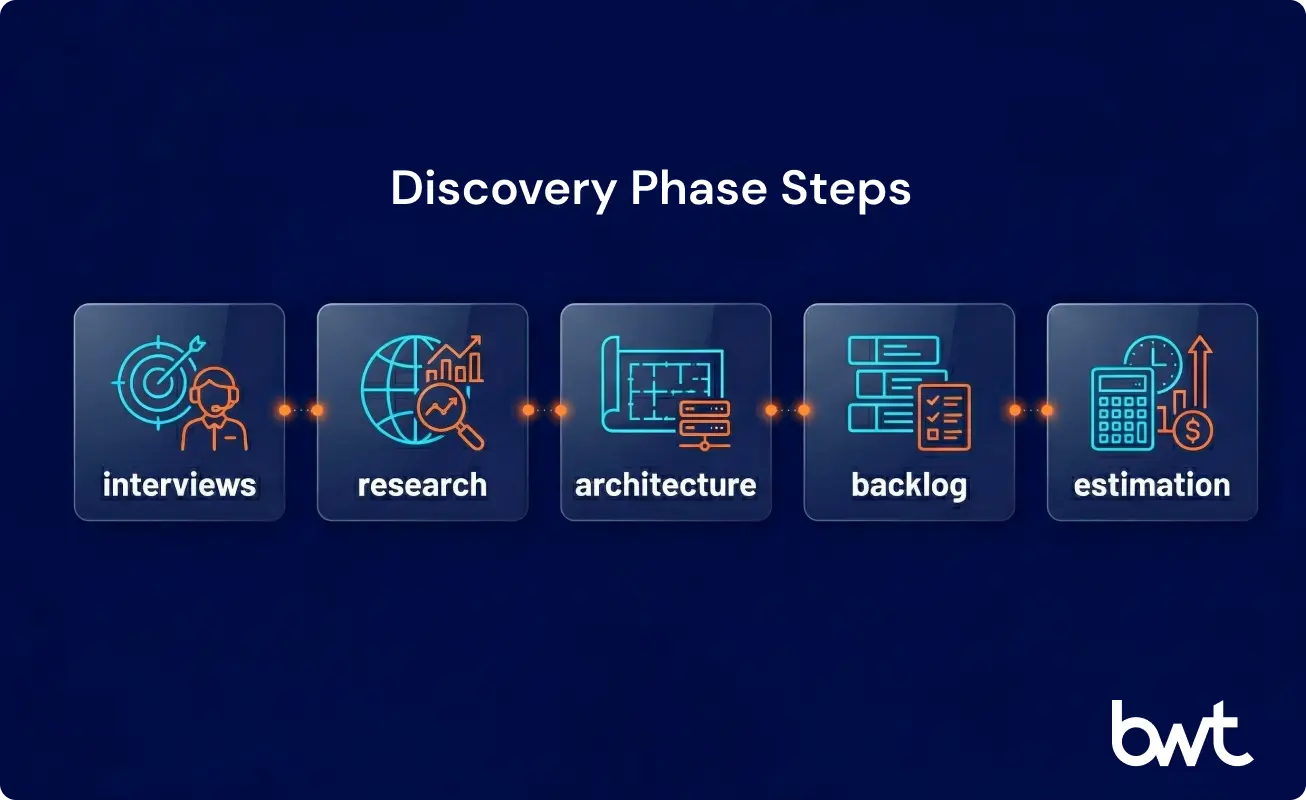
We’ve run this process enough times to know what actually works. The discovery phase steps below aren’t theoretical — they come from dozens of real engagements. Five steps, each with specific inputs and outputs. This is how a discovery phase of a software project looks when it’s done right.
Step 1: Stakeholder Interviews and Business Analysis
You sit down with the people who actually own the outcome — C-level sponsors, product owners, end users, technical leads — and ask hard questions. Not “what features do you want?” That gets you a wish list. The real goal: what constraints exist, what’s actually a priority versus a nice-to-have, and what specific business problem does this software need to fix?
The questions that matter most:
- What’s the actual business problem here — in plain language?
- How are you measuring success right now, and what should change?
- Which existing systems does this thing need to talk to?
- Is there a hard deadline — and what’s behind it?
- If this project stalls or fails, what’s the fallout?
Output: stakeholder requirements summary with prioritized business objectives.
Step 2: Market and Competitor Research
Nobody builds in a vacuum — or at least, nobody should. Your team looks at who else has tackled this problem, what their product actually does, how they’ve priced it, and what tech they appear to be using under the hood. Market sizing matters too: is the audience large enough to justify what you’re about to spend? And where are the gaps nobody’s filled yet?
Most teams underestimate this step. Here’s why it earned its place: on a PropTech project, we found that every major mortgage comparison player relied on the exact same data provider. One vendor, one dependency, across the whole industry. That single finding reshaped the integration strategy and turned into a talking point in investor meetings.
Output: competitive analysis report, market positioning summary, feature gap analysis.
Step 3: Technical Architecture Planning
Now engineers get their hands on the requirements from Step 1 and figure out how to actually build the thing. What languages and frameworks fit? How will APIs connect? Where does data flow, and how do you keep it secure? Every decision here — from database choice to hosting model — gets documented at enough depth to produce a real cost estimate, not a rough guess.
“Architecture decisions made during discovery determine 80% of your project’s long-term maintenance cost. Choose the wrong database, the wrong hosting model, or the wrong integration pattern — and you’ll be paying for it every quarter for years.”
— Dmytro Naumenko, CTO, GroupBWT
Output: technical architecture document, tech stack rationale, integration map.
Step 4: Backlog Creation and Feature Prioritization
Once you’ve nailed down requirements and architecture, the team puts together the product backlog. We classify every feature using the MoSCoW method — a simple framework for deciding what’s critical versus what can wait:
| Priority | Features (Example) | Rationale |
| Must Have | User authentication, core workflow, payment processing | Essential for MVP launch |
| Should Have | Notifications, dashboard analytics, reporting | Important but not launch-blocking |
| Could Have | Social sharing, advanced filters, bulk export | Nice-to-have for v1 |
| Won’t Have | AI recommendations, marketplace, third-party plugins | Deferred to v2+ |
This classification prevents scope creep by establishing clear boundaries before development begins. The MVP scope becomes a contract — not a suggestion.
Output: prioritized feature backlog, MVP definition, and user story map.
Step 5: Cost Estimation and Timeline Planning
Finally, the team produces a detailed cost estimate and project roadmap. Estimation approaches range from high-level sizing (quick categorization, such as small/medium/large, to get early ballpark figures) to detailed task-level breakdowns for granular planning, to comparisons with similar past projects when historical data is available. The roadmap includes milestones, resource allocation, and a risk buffer — typically 15–20% contingency for unknowns that will inevitably surface during development. For more on how these roadmaps fit into the broader delivery lifecycle, see our overview of project management for software development.
“An estimate without a discovery phase isn’t an estimate. It’s a guess with a dollar sign. We’ve seen projects quoted at $200K without discovery come in at $500K. The discovery would have cost $25K and predicted that range within 15%.”
— Oleg Boyko, COO, GroupBWT
Output: detailed cost estimate, project timeline, resource plan.
Key Deliverables of the IT Project Discovery Phase
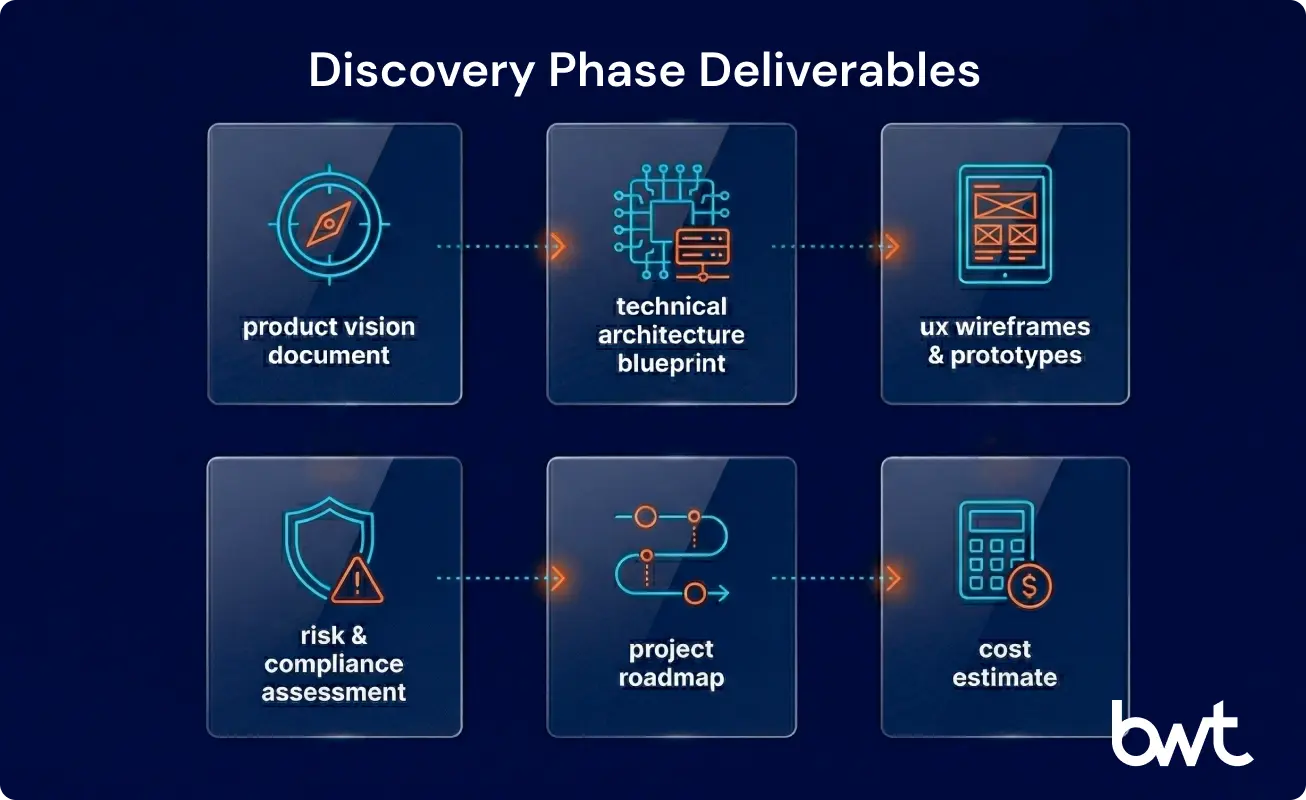
The IT project discovery phase produces a specific set of artifacts. These aren’t abstract documents that sit in a shared drive. They’re working tools that guide every decision during development. Here’s what a complete discovery phase in software development should deliver.
| Deliverable | What It Contains | Why It Matters |
| Product Vision Document | Business goals, target audience, core features, and success metrics | Gives every stakeholder a single source of truth — eliminates “I thought we agreed on something different” conversations |
| Technical Architecture Blueprint | System design, tech stack, integrations, data flow, security model | Prevents costly mid-project pivots when the chosen technology can’t handle real-world requirements |
| UX Wireframes & Prototypes | User flows, screen layouts, clickable prototypes | Way cheaper to redesign a wireframe than to rip out a half-built feature — this is where you test how the product feels before anyone writes code |
| Risk & Compliance Assessment | Risk register, mitigation strategies, regulatory checklist | Catches the blockers — compliance gaps, broken integrations, missing data — before they blow up your timeline |
| Project Roadmap | Timeline, milestones, resource allocation, dependencies | Gives your team and leadership a realistic schedule they can plan around |
| Cost Estimate | Budget breakdown by phase, team, and feature set | When the CFO asks “how much?” you have a real number — not a finger in the air |
If you’re in a regulated industry, this assessment gets specific fast. GDPR data processing agreements if you handle EU user data. HIPAA safeguards for health records. PCI DSS scoping if payment cards are involved. SOC 2 mapping for SaaS products touching customer data. The point? Compliance gets baked into the architecture on day one — not duct-taped on six months after launch.
Benefits of the Discovery Phase in Software Projects
The benefits of discovery phase in software projects aren’t theoretical. They’re measurable.
Reduced Development Risks
We’ve tracked this across our own projects: thorough discovery cuts change requests by up to 60% during development. And the benefits of a discovery phase compound as the project moves forward — you stop having those “we need to rebuild this” conversations, the emergency calls about missed requirements, the awkward deadline extensions. Every expensive rework we’ve seen? It traces back to something a two-week discovery would have caught.
More Accurate Cost Estimation
Without discovery, budget estimates are often far less reliable — scope gaps and missed integrations compound into overruns that nobody planned for. Discovery helps narrow that range by validating scope and constraints early. The difference isn’t precision for its own sake — it’s the difference between a board that approves your project and a board that shelves it because the numbers keep changing.
Faster Time-to-Market
Sounds backwards, but we’ve seen it play out again and again: spending 2–6 weeks on discovery actually gets you to launch faster. Skip it, and your team burns more weeks in rework, scope arguments, and “wait, what did we agree on?” meetings than they ever saved by jumping straight into code. The numbers back this up — projects with structured discovery hit their deadline 40% more often.
Improved Stakeholder Alignment
Here’s what actually happens: discovery produces shared documents — product vision, architecture blueprint, prioritized backlog — and those documents become the thing everyone points to when disagreements start (and they always start). Instead of reopening old arguments, you pull up the signed-off blueprint. Not opinions. Not recollections. Documentation. On the fintech platform mentioned earlier, discovery documentation resolved three scope disputes in the first quarter alone — each time, the team pointed to the signed-off architecture blueprint rather than reopening the debate.
Making the Business Case for Discovery
If you’re a project manager or technical lead trying to get budget approval for a discovery engagement, here are the arguments that work — based on what we’ve seen close the deal in real conversations with CFOs and VPs of Engineering. (For a deeper look at evaluating vendors, see our guide on how to choose the right software development company.)
Frame it as insurance, not overhead. Discovery typically costs 5–10% of the total project budget. Projects that skip it see budget overruns averaging 45–65%. On a $300K project, that’s $135K–$195K in unplanned spend versus a $15K–$30K discovery engagement. The math sells itself.
Show what you’ll get. Discovery isn’t a research phase that produces a report nobody reads. It produces six working artifacts — from a product vision document to a defensible cost estimate — that your team will reference every week during development.
Point to the go/no-go value. Discovery sometimes reveals that a project shouldn’t proceed as planned. That’s not a failure — it’s the most valuable outcome possible. Killing a $500K project in week three costs $25K; killing it in month six costs $250K.
Common Mistakes During the Software Discovery Phase
The software discovery phase can fail too — usually not because of the method but because of the execution. These are the four patterns we see most often.
Skipping Technical Validation
Accepting a technical approach based on assumptions rather than proof. Two days of validation during the discovery phase in software development prevent two months of rework during delivery.
Poor Requirement Documentation
Vague requirements that mean different things to different stakeholders. “The system should be fast” isn’t a requirement. “Page load time under 200ms at 10,000 concurrent users” is.
Underestimating Scope
Planning for the happy path while ignoring integrations, edge cases, and data migrations. A real example: an agriculture-sector data company (2025) engaged us for a cloud migration, estimating roughly 100 Power BI reports. Discovery revealed 295 reports across two SQL Servers — the second server hadn’t even been mentioned. Without that discovery, the migration estimate would have been off by a factor of 3.
Ignoring Compliance and Security
Treating compliance as a post-development checkbox. Retrofitting HIPAA safeguards or FCA compliance into an existing architecture is five to ten times more expensive than designing for them from the start. In a 2025 mental health EHR platform, the discovery audit found that HIPAA requires a dedicated Logger Service with a full audit trail. On an FCA-regulated fintech platform (2025), discovery mapped KYC/AML rescreening requirements that affected the entire middleware architecture. In both cases, compliance was a structural constraint designed into the foundation.
When to Invest in a Discovery Phase Service
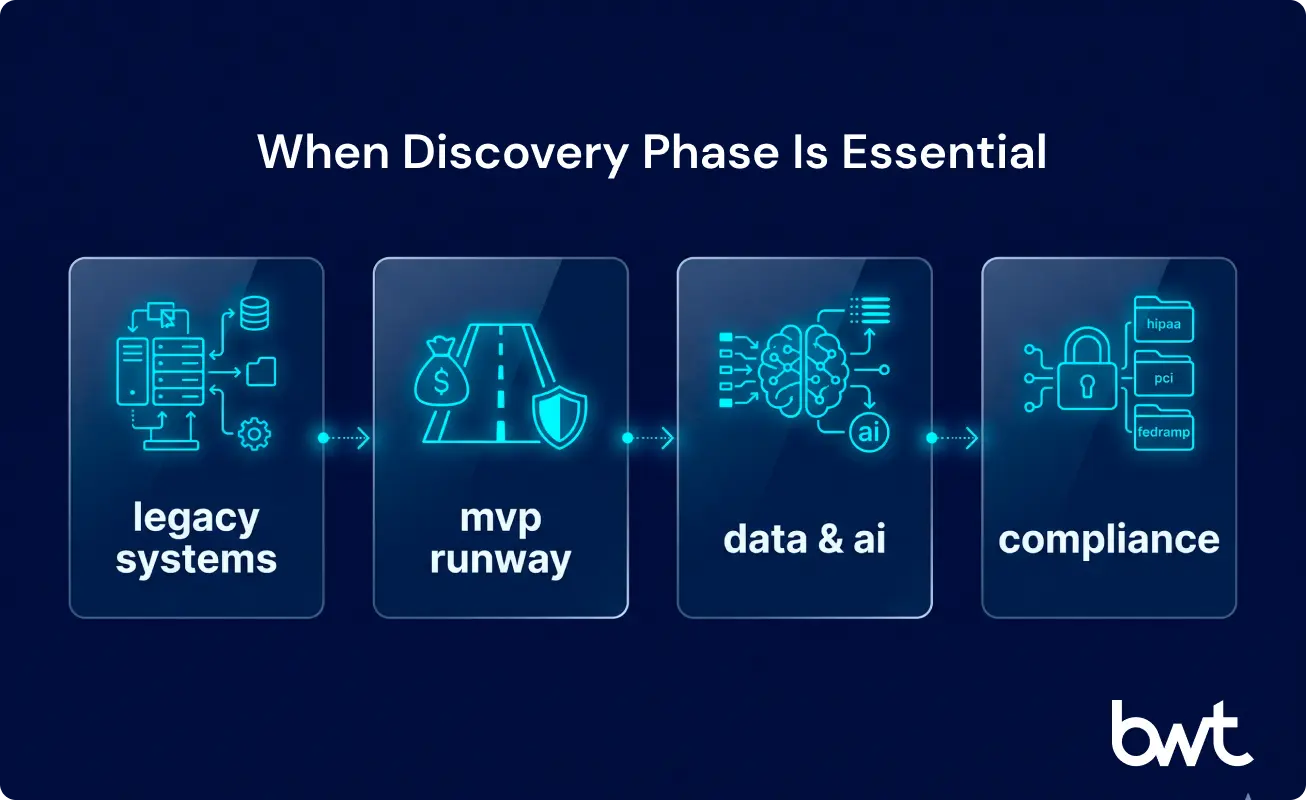
Not every project requires a formal discovery phase in software development. A small internal tool or a well-understood feature addition can often start with a sprint planning session. But there are clear signals that discovery is non-negotiable — and skipping it will cost more than running it. If you’re evaluating discovery phase services or looking for a discovery phase service for software development, here are the situations where the investment is essential.
When your project touches multiple systems or legacy infrastructure
Enterprise systems involve multiple integration points, legacy infrastructure, and stakeholders with competing priorities. If your project needs to connect to existing databases, third-party APIs, or legacy platforms, discover those complexities before they become sprint blockers.
A UK-based government procurement intelligence company (2025) engaged us for a three-month discovery under NDA. The discovery mapped 300+ procurement portals running on different technologies. It produced a six-milestone roadmap with OCDS (Open Contracting Data Standard) compliance — a framework that standardizes the publication and sharing of government procurement data. Without that upfront mapping, the team would have started building against assumptions that didn’t match the actual technical landscape. Three and a half years and 6,000+ Jira tickets later, the platform runs independently of the third-party vendor the client originally depended on.
When you’re building an MVP and can’t afford to waste runway
Startups operate under resource constraints. That makes discovery more important, not less. When every dollar and every week matters, a focused 2–4-week engagement validates the technical approach before you commit months of development to the wrong stack or architecture. It also produces the kind of documented scope and estimates that investors expect. This is especially true for teams pursuing MVP development services where every sprint counts.
A PropTech startup (2025) building a mortgage comparison platform invested $6,000 in a four-week discovery. The deliverables — information architecture, user flows, Figma wireframes, and a development estimate — gave the founder bank-ready documentation for investor conversations. Discovery also found that the planned AWS infrastructure was unnecessary for MVP scale, prompting a pivot to DigitalOcean, which cut monthly hosting costs by over 80%. For a startup burning runway, that single finding paid for the entire discovery engagement several times over.
When your product depends on data or AI
AI projects fail most often because of data problems — not model problems. If your product relies on machine learning, NLP, or data pipelines, discovery assesses data readiness, evaluates infrastructure requirements, and identifies feasibility constraints before the team commits to a training approach that the available data can’t support.
An AI-powered travel platform (2025) — similar to our hotel rate scraping project in the travel sector — ran a five-week discovery at €6,000. The engagement evaluated nine data sources, selected an NLP stack, and produced a cost model breaking down 1,929 development hours. Critically, discovery identified that two major API providers had refused access — the team pivoted before development started, not after.
When compliance is a hard requirement, not a nice-to-have
Healthcare (HIPAA), financial services (PCI DSS, SOX), and government projects (FedRAMP — the US federal security standard for cloud services) carry compliance mandates that affect every architectural decision. If your industry has regulatory requirements, those rules need to be designed into the architecture from day one — not retrofitted after launch.
A California mental health clinic with 50+ therapists needed a HIPAA-compliant EHR system. The discovery engagement (2019) — an architecture audit conducted before development began — revealed the need for a dedicated audit trail service, automated billing via web scraping (the insurance provider had no API), and an Anti-Corruption Layer — a design pattern that isolates legacy systems from new code so modernization doesn’t break what’s already working. Development spanned from 2019 to 2026 across 2,726 Jira tickets — and the architectural foundation laid during that initial discovery held for 7+ years without a major redesign. The system now handles scheduling, billing, payroll, and video sessions daily. That kind of longevity doesn’t happen by accident. It happens because the structural decisions were made before the first sprint, not during it.
Discovery Phase vs Starting Development Immediately
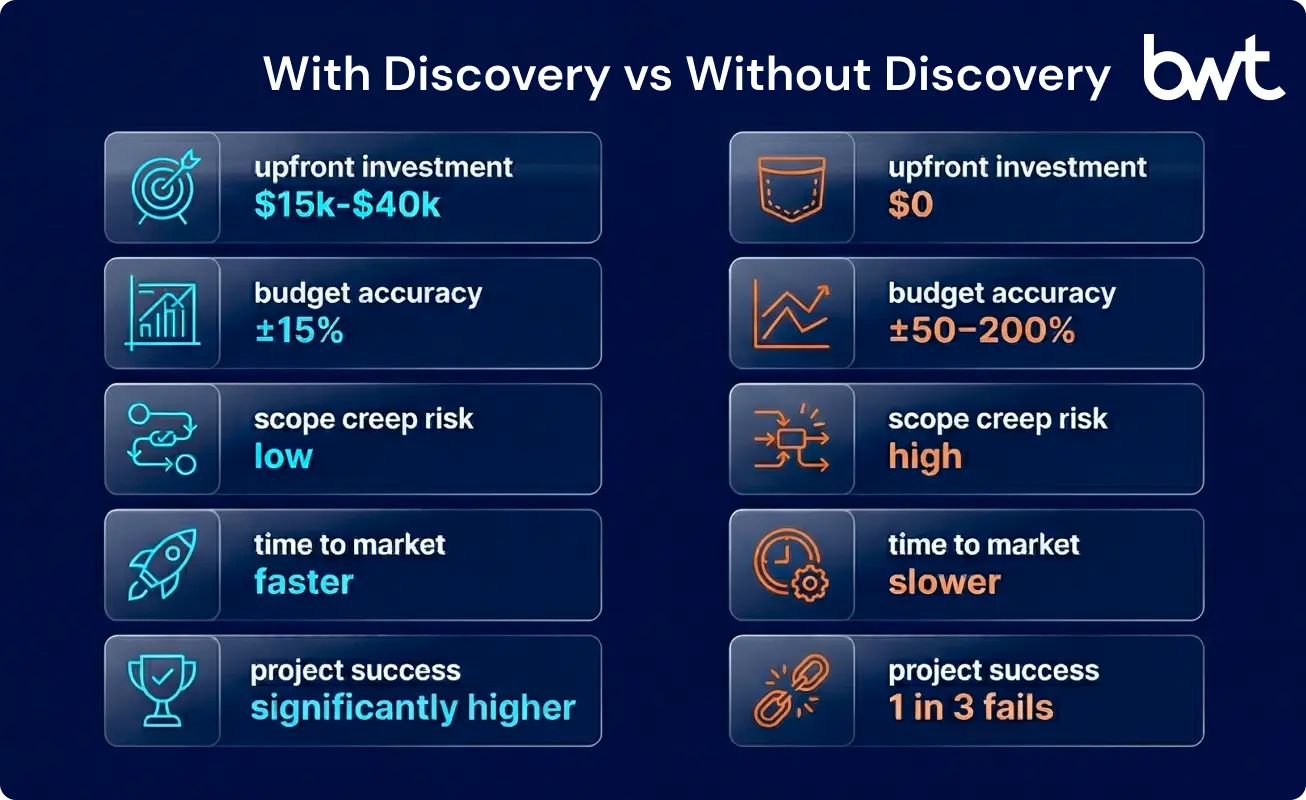
This is the comparison most teams need to see before committing to either path. The software development discovery phase adds upfront cost and timeline — but the downstream economics aren’t close.
| Factor | With the Discovery Phase | Without the Discovery Phase |
| Upfront Investment | $15K–$40K (2–6 weeks) | $0 (no upfront cost) |
| Budget Accuracy | ±15% variance | ±50–200% variance |
| Scope Creep Risk | Low — scope is documented and signed off | High — boundaries are undefined |
| Time to Market | Faster — fewer pivots and rework cycles | Slower, more frequent course corrections |
| Stakeholder Alignment | Strong — shared documentation as a reference | Weak — assumptions diverge over time |
| Compliance Risk | Low — requirements mapped in architecture | Retrofitting becomes expensive and disruptive |
| Project Success Rate | Significantly higher | Industry average: 1 in 3 projects fails to meet original goals (CIO.com, 2025) |
The discovery phase for a mid-sized project typically costs $15,000–$40,000 — roughly 5–10% of the total project budget. Here’s what that investment looks like across three real engagements:
| Project | Discovery | Key Risk Discovered | Business Outcome |
| Agriculture Data Platform (2025) | 3 weeks | Second SQL Server + 295 reports (not ~100) | Realistic migration roadmap to Databricks Lakehouse |
| AI Travel Platform (2025) | 5–6 weeks, €6K | Two major OTA providers refused API access | Pivot to alternative providers before dev started |
| Procurement Intelligence (2025) | 3 months, NDA | 300+ portals with different technologies | 3.5+ years, 6,169 tickets, full vendor independence |
“Every one of these projects would have hit a wall without discovery. Not a minor delay — a structural failure. The common pattern is always the same: the risk that matters most is the one nobody mentioned in the first meeting.”
— Alex Yudin, Head of Data Engineering, GroupBWT
How to Choose a Software Development Partner for the Discovery Phase
If you’re evaluating a discovery phase service for software development, here are six questions worth asking any vendor before you sign. These come directly from what we’ve learned running discovery at GroupBWT across healthcare, fintech, government, and AI projects — and from watching what goes wrong when teams skip this due diligence.
- “Who runs the discovery — a business analyst or a solution architect?” A BA documents requirements. An architect evaluates whether those requirements are technically feasible, catches integration conflicts, and flags infrastructure constraints. You need both. If the vendor only sends a BA, your discovery will produce a wish list, not an architecture.
- “Can you show me a discovery deliverable from a past project?” Redacted is fine. You’re looking for specificity — system diagrams, cost breakdowns by phase, risk matrices with mitigation plans. If the sample reads like a slide deck summary, that’s a warning sign.
- “What technology decisions have you recommended against — and why?” Any vendor who says “yes” to everything during discovery is not doing discovery. The ability to say “this approach won’t work for your constraints” is the single most valuable thing a discovery partner brings.
- “How do you handle scope changes that surface mid-discovery?” Discovery exists to find surprises. The question is how the team communicates those surprises and adjusts the plan. Look for a defined escalation path and a cadence of deliverable reviews — not a “we’ll figure it out” answer.
- “What’s your estimation methodology — and what’s the typical variance?” “Based on experience” is not a methodology. You want to hear about task-level breakdowns, historical comparisons with similar past projects, and a contingency buffer with a rationale behind the percentage.
- “Do you have domain experience in my industry?” A team that has run discovery for HIPAA-regulated healthcare platforms will spot compliance constraints in week one that a generalist team might miss entirely. Domain knowledge doesn’t replace technical skill — but it compresses the learning curve by weeks.
When evaluating any software development and discovery phase service, remember: the vendor’s willingness to tell you “no” during discovery is worth more than their willingness to tell you “yes” to everything. At GroupBWT, we’ve run discovery engagements across 50+ projects — from a four-week, $6K startup MVP to a three-month government platform under NDA. The process described in this article is how we actually work, not a theoretical framework.
Conclusion: Why the Discovery Phase Is Critical for Software Success
The discovery phase software development teams rely on isn’t a formality — it’s where the real risks get found. A proper discovery phase in software development helps teams find critical risks before development begins and before those risks turn into budget and delivery problems. In every case covered in this article — from a cloud migration that tripled in scope to a government platform with 300+ data sources — the pattern was the same: the most expensive surprise was the one nobody mentioned in the first meeting. Discovery is how you find it before it finds your budget.
We don’t just run discovery — we’ve done it across healthcare, fintech, AI, and government platforms, and we’ve learned what breaks. That experience is what makes the difference between a discovery that produces a checklist and one that produces an architecture your team can build on for years.
GroupBWT runs structured discovery engagements as part of our custom software development practice. Contact our team to discuss your project scope and get a transparent estimate.
Two to six weeks for most projects. Startup MVPs tend to wrap in 2–4 weeks. Larger enterprise projects — the ones with legacy systems, multiple stakeholders, and regulatory hoops — can stretch to 6–12 weeks. More moving parts means more time, which shouldn’t surprise anyone.
Anywhere from $5,000 to $40,000 depending on scope — that’s roughly 5–10% of your total project budget. To put it concretely: a PropTech startup paid $6,000 for four weeks of discovery. A government procurement platform needed a three-month engagement under NDA. Big range, but the scope difference is enormous.
You start building based on assumptions — and those assumptions get tested in production instead of on paper. The most common consequences are: the scope expands mid-project because nobody mapped the real requirements, the architecture doesn’t fit once edge cases surface, and the team spends more time on rework than on forward progress. In our experience, the projects that skip discovery don’t save 2–6 weeks. They lose months.
Six artifacts that your team will actually use during development: Product Vision Document, Technical Architecture Blueprint, UX Wireframes & Prototypes, Risk & Compliance Assessment, Project Roadmap, and Cost Estimate. Engineering cares about the blueprint. Finance wants the cost estimate. Legal looks at the compliance assessment. Everyone references the roadmap.
On the vendor side: a solution architect (not just a BA), a UX designer, a project manager, and a technical lead. On the client side: whoever owns the product, a C-level sponsor who can make budget calls, and the subject-matter experts — meaning the legacy quirks, undocumented processes, and real constraints that never make it into the brief.
Data Engineering: From Raw Web to Data Product
We develop and manage custom data solutions, powered by proven experts, to ensure the fastest delivery of structured data from sources of any size and complexity.
We offer:
- Custom Web Scraping & Development
- 16+ Years of Engineering Expertise
- AI-Driven Data Processing & Enrichment