

This guide is specifically designed for:
- CDOs and VP of Analytics: To understand the business logic and the ROI model.
- CTOs and Architects: For a deep dive into real-time pipelines and the technology stack.
- Strategy & Finance: To evaluate implementation timelines and operational benefits.
Telecom operators generate petabytes of events daily, yet most still drown in “yesterday’s reports.” At GroupBWT, we offer end-to-end implementation projects followed by optional managed services support. As a specialized big data services company, we focus on the deployment of production-ready Data Lakehouse environments. We deliver actionable pipelines that connect insights directly to your network or CRM endpoints.
Executive Onboarding: Telecom Glossary
To ensure Finance and Engineering speak the same language, we must define the core technical pillars:
- OSS/BSS: Systems managing network operations (OSS) and business/billing/customer relations (BSS).
- RAN (Radio Access Network): The hardware (towers/antennas) connecting devices to the core—the primary source of QoE issues.
- IMSI/MSISDN: Unique IDs for the SIM card and the phone number.
- MNP (Mobile Number Portability): The protocol allowing users to keep numbers when switching providers; essential for maintaining historical data accuracy.
- XDR/CDR: Records of data sessions (XDR) and calls (CDR)—the raw material for revenue assurance.
- VoLTE (Voice over LTE): High-speed wireless communication for mobile phones and data terminals.
- SIM-box: A gateway used to route international calls as local ones, often used in bypass fraud.
The Reality of Implementation Pain
Most analytics projects fail not because of weak models, but because they ignore the operational reality of the telco floor. To achieve a true data-driven telecom state, we must first address three chronic industry pains:
- NOC Alert Fatigue: Your engineers are bombarded with thousands of alarms hourly. When everything is “critical,” nothing is. We focus on real-time event correlation to filter noise and surface the root cause.
- Silent KPI Drift: On paper, the network looks “green,” but subscribers in a specific cluster are already experiencing drop-offs. Traditional BI misses this until the churn report arrives.
- Over-discounting as a Strategy: Instead of fixing a poor QoE (Quality of Experience) issue at a VIP customer’s location, companies offer blanket discounts. This erodes margins. Smart analytics should trigger a technical fix, not a financial “band-aid.”
“The industry is obsessed with ‘99% network availability,’ but that’s a legacy vanity metric. I’ve seen deployments where the dashboard stayed green while 12% of high-ARPU roamers in a specific sub-region were experiencing silent 400ms latency spikes during VoLTE handovers. True data-driven operations start when you stop trusting the averages and start monitoring the tail latency of individual subscriber journeys.”
— Oleg Boyko, COO at GroupBWT
Reference Architecture: From Data to Action
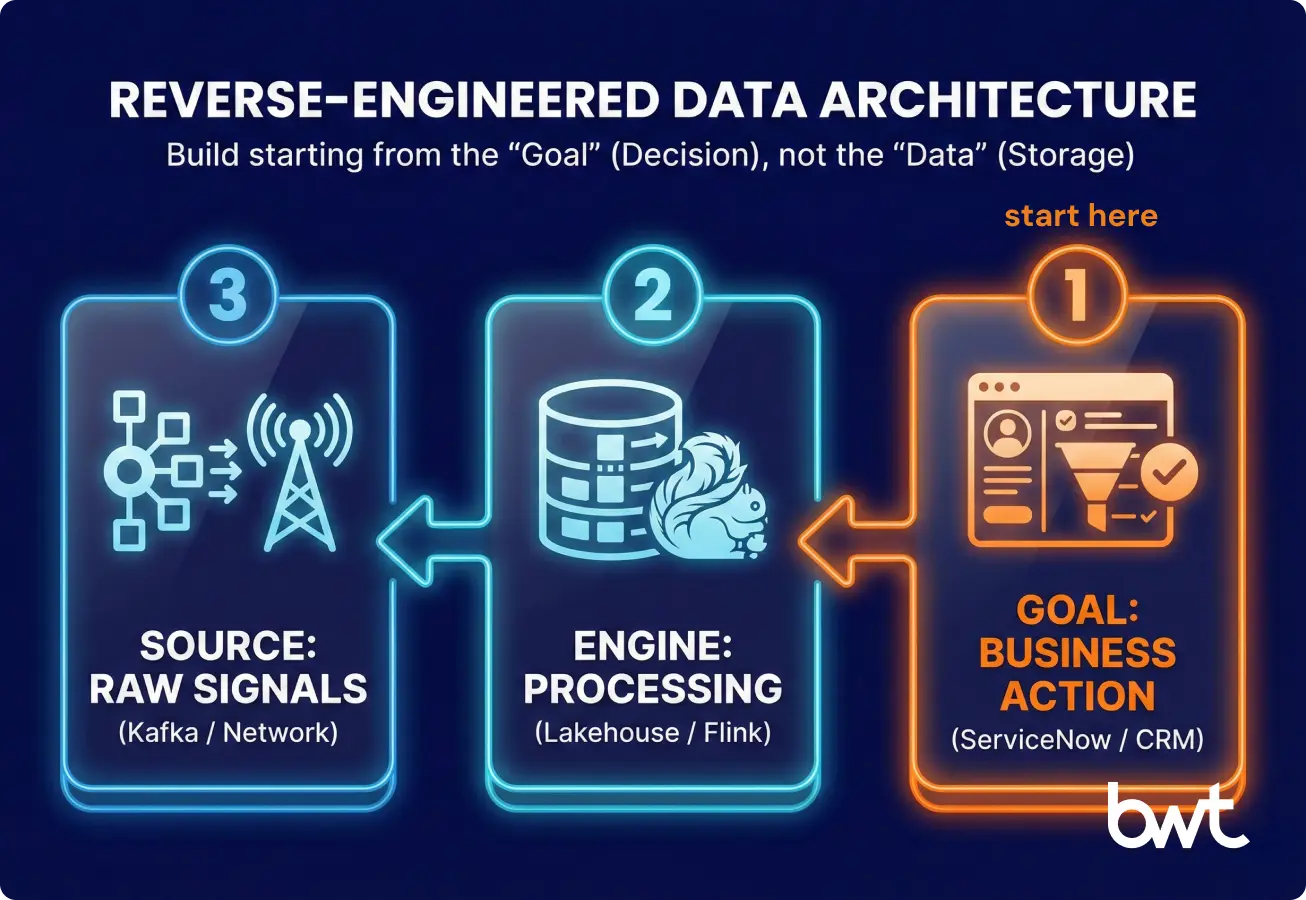
Our data-driven telecom approach is “action-first.” We start by defining the decision endpoint—whether it’s an automated ticket in ServiceNow or a policy update in the RAN—and build the ingestion layer backwards.
The Technology Stack
For a high-performance implementation, we typically deploy:
- Ingestion: Apache Kafka or Redpanda for high-velocity event streaming.
- Processing: Apache Flink or Spark Streaming for “on-the-fly” transformations.
- Storage: A Unified Lakehouse (Databricks, Snowflake, or ClickHouse for low-latency queries).
- Orchestration: Airflow or Dagster to manage complex data contracts.
- Action Endpoints: Direct API integrations with BSS/OSS (Amdocs, Ericsson) or CRM platforms.
“The ‘everything-in-real-time’ dream is a fast way to bankrupt a project. I’ve seen operators ingest petabytes of raw events into high-performance storage only to realize that 90% of those logs lose their ‘decision value’ within minutes. The real engineering challenge isn’t just the throughput—it’s the data lifecycle. You need a Lakehouse that knows exactly when to offload massive RAN traces to cheap cold storage while keeping critical fraud and VIP-experience signals in the hot tier. If you don’t solve for cost-per-query on day one, the cloud bill will outpace your ROI by month six.”
— Dmytro Naumenko, CTO at GroupBWT
| Category | Typical Examples | Velocity | Scale (Events/Day) | Privacy Risk |
| Network | RAN signals, throughput | Seconds | 10 Million – 1 Billion | Low |
| Faults | Error codes, alarms | Real-time | 100,000 – 10 Million | Low |
| CDR / XDR | Data/Call records | Minutes | 10 Million – 10 Billion | Med-High |
| BSS Billing | Payments, bill shock | Daily/Stream | 100,000 – 10 Million | High |
| Location | Cell-ID, handovers | Seconds | 100 Million – 10 Billion | Very High |
Establishing a data-driven telecom environment requires a robust Semantic Layer so that Finance and Engineering finally speak the same language.
High-Impact Use Cases
To justify the investment in implementing big data, operators must focus on high-margin scenarios:
- Network Digital Twin: Creating a virtual replica of network topology. In practice: One Tier-1 operator used this to simulate power outages, reducing emergency truck rolls by 14% via pre-emptive battery checks.
- AI/ML in Telecom Churn: Moving beyond simple tenure data. In practice: We helped a regional provider identify “silent churners” who had high signal drops but never called support, increasing retention by 8%.
- Telecom Data Monetization: Packaging anonymized mobility insights. In practice: Selling foot-traffic data to retail chains for optimized store placement based on real subscriber movement.
- Real-time Analytics Telecom Fraud: Detecting “SIM-box” or roaming fraud in seconds. In practice: Auto-throttling suspicious accounts before they could rack up thousands in fraudulent international transit costs.
“The biggest mistake I see is treating analytics as a research project rather than an operational tool. We once worked with a client who had a ‘perfect’ churn model, yet their churn rates stayed flat for a year. The problem? They were sending ‘at-risk’ lists to the call center once a week. By the time the agent actually called, the customer had already switched providers. You don’t need a perfect algorithm; you need a fast one that talks directly to your CRM. Real ROI happens in the minutes after a problem occurs, not in a weekly report.”
— Eugene Yushchenko, CEO at GroupBWT
Defending the ROI: CFO-Ready Math
Every big data analytics in telecommunication efford must be measured by its impact on the bottom line. GroupBWT provides big data consulting services & solutions to help calculate precise returns.
$$ROI (\%) = \left( \frac{\text{Annual Benefits} – \text{Annual Costs}}{\text{Annual Costs}} \right) \times 100$$
The Retention Loop Case Study (Anonymized):
- Base: 2,000,000 subscribers.
- Impact: A 0.2% reduction in preventable churn (4,000 users saved).
- LTV (Net): $120.
- Gross Benefit: $480,000/year.
- Implementation/Platform Cost: $150,000/year.
- Result: 220% ROI.
12-Week MVP Roadmap
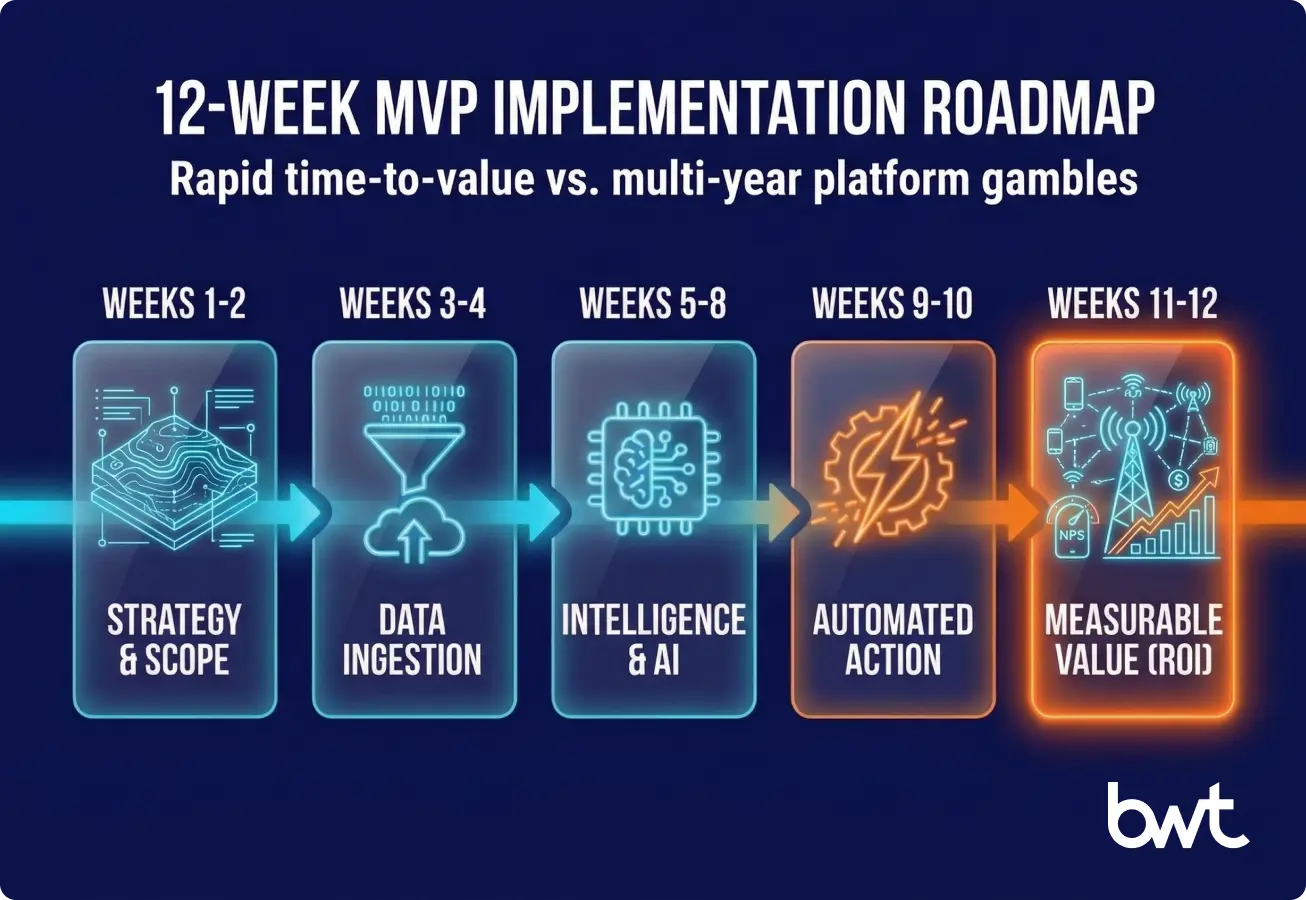
We don’t believe in multi-year “platform first” gambles. GroupBWT builds in cycles:
- Weeks 1-2 (Strategy): Define the loop owner and KPI baseline.
- Weeks 3-4 (Ingestion): Land the first RAW datasets. This includes telecom data scraping for market benchmarks.
- Weeks 5-8 (Intelligence): Build the curated layer and train big data and predictive analytics models.
- Weeks 9-10 (Action): Integrate with the endpoint via API (Salesforce, ServiceNow).
- Weeks 11-12 (Value): Measure uplift and transition to big data testing and managed services.
Summary: The impact of big data analytics in telecommunications
In a competitive landscape, big data analytics for telecom is a survival mechanism. GroupBWT bridges the gap between massive data ingestion and immediate operational action. We help you move beyond “report-heavy” cultures to create a robust data analytics telecom ecosystem that executes decisions in the critical minutes after a network event or customer friction occurs. By focusing on real-time telecom research, we ensure your infrastructure becomes a proactive revenue protector rather than a reactive cost center.
FAQ: Big Data Analytics for Telecom
-
Why choose GroupBWT for data analytics consulting for telecoms?
GroupBWT specializes in navigating the complexity of big data analytics in telecommunications industry environments, ensuring that your data analytics for telecom projects delivers measurable ROI within the first quarter. We have mastered the specific requirements of big data analytics for telecom industry players, from legacy system integration to modern cloud scaling.
-
Can you provide an example big data analytics for telecom case that improved QoE?
A primary example for telecom success involved a regional operator tracking “Silent Dropped Calls.” By correlating RAN signals with subscriber billing tiers in real-time, they identified that 5% of their high-value enterprise users were experiencing packet loss during handovers in a specific industrial zone. By automatically re-routing traffic through an adjacent cell via a “closed-loop” API update, they restored service quality within 3 minutes, preventing a projected 12% churn rate for that account.
-
What is the “Golden Data” for Churn?
The best predictors are behavioral “stress” signals: frequent data drops, repeated helpdesk calls, and bill shock. Our big data and predictive analytics for telecoms strategy prioritizes these friction points over static demographics.
-
Real-time vs. Batch: Where do you draw the line?
The line is drawn at the “Action Threshold.” If the problem involves network configuration or fraud, you need big data analytics for telecommunications running in real-time. Even for retention, waiting for a weekly batch is often too late; however, if your CRM workflow requires a human agent to review a case, a 15-minute micro-batch is often the sweet spot between performance and cost.
-
How telecom firms use data analytics for personalized offers?
The most successful operators are moving from static monthly segments to event-driven triggers. For instance, by correlating real-time data consumption (XDR) with billing limits, a system can trigger a tailored “Data Booster” SMS exactly when a user hits 90% of their quota. Furthermore, by analyzing location history, firms can send roaming packages the moment a subscriber’s IMSI is detected at an international airport terminal, increasing upsell conversion rates by over 25%.