
Introduction
Think about what kills an online sale. The product? Rarely. The price? Not usually. Forrester research puts the number at 53%: more than half of shoppers walk away from a purchase because they couldn’t get a quick answer. The store went quiet at the worst possible moment.
And when a basic chatbot does respond? It makes things worse half the time. Hallucinated discounts. Out-of-stock recommendations served up with cheerful confidence. Shipping policies from a different continent. Each failure eats into the trust that took months of marketing spend to build.
The market sees money here. DemandSage pegs the chatbot industry at $10.3B in 2025, on track for $29.5B by 2029. Aggregate market size tells you nothing about whether your build will generate returns or become an expensive headache. That gap, between a chatbot that compounds revenue and one that compounds frustration, is what this piece gets into.
How AI Chatbot Solutions for E-Commerce Actually Work
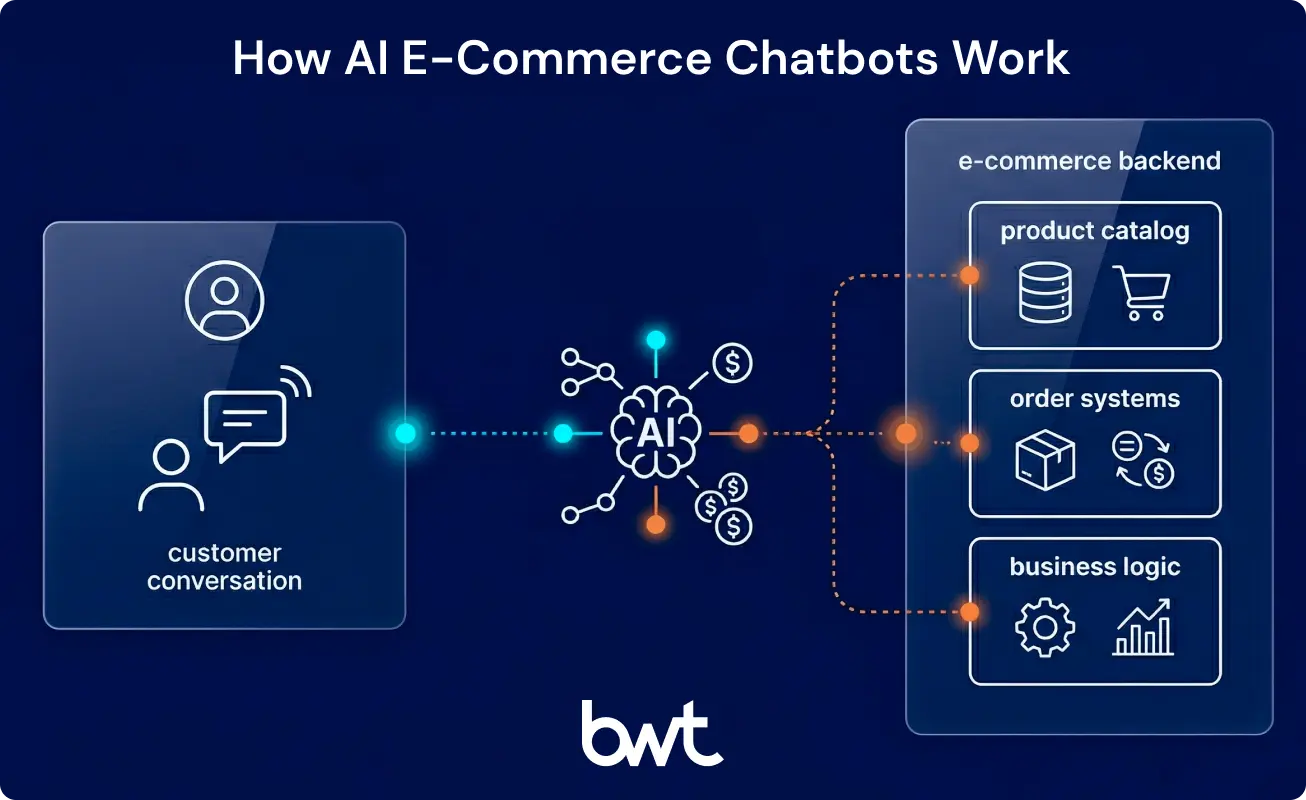
Vendors dress it up differently, but under the hood? Same machinery. Natural language understanding, a retrieval layer, a generative model, all wired into one pipeline. AI chatbot solutions for e-commerce run these components to hold customer conversations on your site and messaging apps, so not every question lands on a human agent’s screen.
RAG (Retrieval-Augmented Generation) before the AI model writes a word, the system fetches real data: your catalog, shipping policies, and the customer’s actual order history. Thats is how the model generates responses based on what the retrieval step found, not what it “thinks” it knows. That constraint is what turns vague helpfulness into grounded, reliable answers.
Every serious ecommerce chatbot follows the same four-step pipeline. Break any one step, and everything after it falls apart.
Intent classification is the starting point. The system determines what the customer actually wants. “Where’s my order?” routes to tracking. “Do you have this in blue?” goes to inventory. Transformer-based classifiers now handle messy input well: typos, slang, half-formed questions. “Yo, where’s my stuff?” gets routed to order tracking without a single hand-coded rule.
Entity extraction is where human language becomes something a database can work with. “I ordered the specific model in size 11 last Tuesday.” Four facts buried in one sentence: brand, model, size, date. The system catches all four and matches them against your order records. Drop one, and the response falls apart.
The Router (some teams call it the Orchestrator) decides what happens next: deterministic API call, RAG-grounded generation, or human handoff. Mess up routing, and you burn compute on questions that should be a database lookup, or cram complex problems through a decision tree that can’t handle them.
Response generation closes the loop. Deterministic handlers return structured data (tracking numbers, order status) with zero ambiguity. RAG-grounded handlers fetch relevant chunks from your knowledge base, then write a response tethered to what they found. Cut that tether, and your bot starts inventing things. We’ve seen models tell customers shipping was free when it wasn’t, and quote return windows that expired two years ago. Confidently, every time.

Rule-Based vs. AI: Why Production Chatbots Are Hybrid
Nobody ships a pure rule-based bot anymore. Nobody ships a pure AI bot either. Production deployments in 2026 are hybrid. The craft is in knowing which tool to grab for which situation.
| Interaction Type | Best Approach | Rationale |
| Order tracking | Deterministic API call | Zero tolerance for errors |
| Product recommendations | RAG + generative AI | Requires natural language flexibility |
| Return eligibility | Rule-based checks within the hybrid system | Financial operations need hard logic |
| Sizing questions | RAG over product specs | Must reference accurate, structured data |
| Escalation-worthy complaints | Sentiment detection → human agent | Emotional situations need human judgment |
| Price inquiries | Direct catalog lookup | Prices must come from the source of truth |
When we say “rule-based” here, we mean deterministic logic operating within the hybrid Router. Rule-based handlers are one option alongside AI-generated ones.
Also Read: AI Chatbot for Business: How Intelligent Automation Drives Growth Across Industries
Real ROI: Why E-Commerce Is Investing in AI Chatbots
Nearly 90% of retailers are actively using AI or evaluating AI projects, according to Shopify’s 2025 AI trends report.
At scale, AI chatbot solutions for e-commerce go well beyond “where’s my package.” One enterprise client, a $33B+ online retailer, needed automated product classification and real-time substitutes when items went out of stock. Started as a proof of concept at 500 products per hour. Scaled to a Kubernetes pipeline spanning three regions: 959,000 products classified daily at 60,000 to 130,000 per hour. Independent audit ranked it top 3 among 6 vendors, 83% precision, 78% recall. When something goes out of stock, the chatbot pulls verified substitutes from the same pipeline. The ecommerce web scraping services that feed classification also provide real-time availability data behind those recommendations.
Right-sizing your investment: Under 500 daily visitors? A SaaS chatbot at $50 to $200/month may deliver better ROI than a $30K custom build.
When SaaS Is Enough, and When You Need a Custom Build
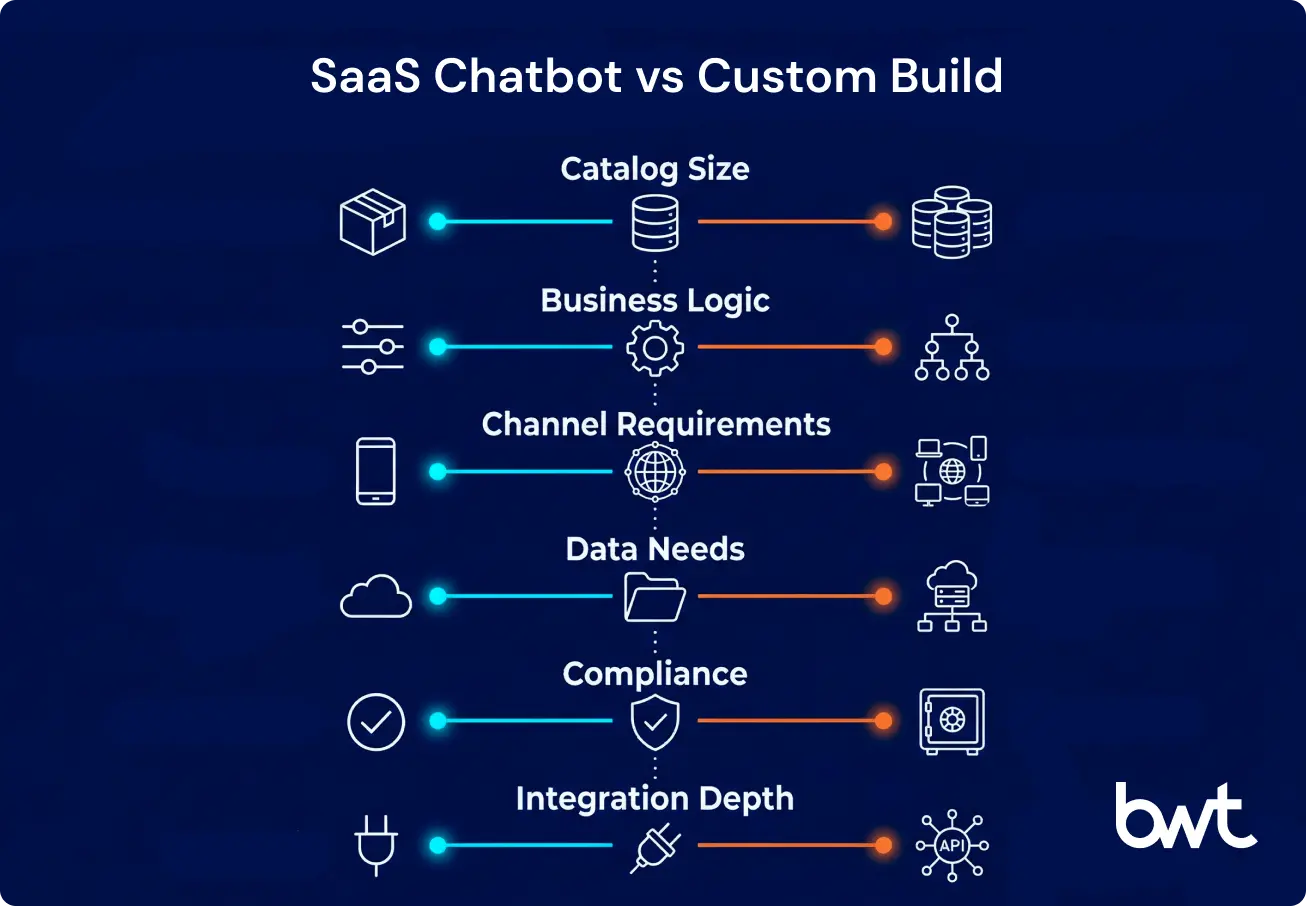
Not every store needs a custom build. Here’s the framework we apply with clients:
| Criteria | SaaS Chatbot ($50–$1,000/mo) | Custom Build ($10K–$50K+ dev) |
| Catalog size | Under 10,000 SKUs | 10K+ SKUs, frequent rotation |
| Business logic | Standard returns, shipping, FAQs | Custom return rules, dynamic pricing, and multi-warehouse |
| Channels | Website + 1–2 messaging apps | Omnichannel with Identity Stitching across 5+ touchpoints |
| Data requirements | Platform defaults work | Needs RAG over proprietary data (reviews, specs, policies) |
| Compliance | Standard e-commerce | Industry-specific (pharma, regulated goods, financial) |
| Integration depth | Shopify/WooCommerce plugin | Custom middleware, legacy ERP, multi-system orchestration |
10,000 SKUs is a rough heuristic. We’ve seen stores with 5,000 SKUs that needed custom builds because their return logic or pricing rules broke every SaaS platform they tried. Business logic complexity matters more than catalog size.
The test: if you can describe your chatbot needs inside a platform’s settings page, SaaS will work. The moment you catch yourself saying “but our process is different because…” you are probably looking at a custom build with a dedicated AI team behind it.
AI Chatbot Use Cases That Move Revenue
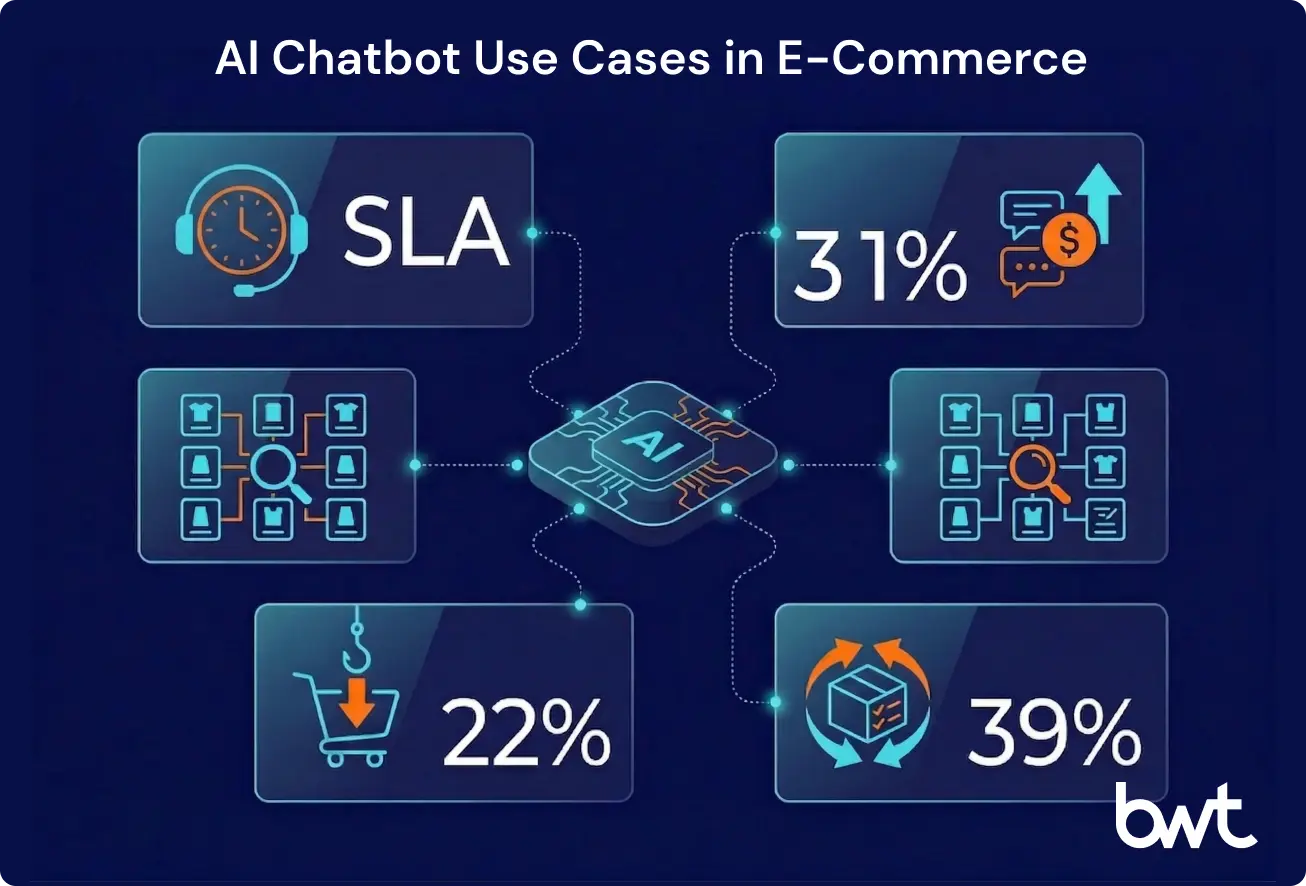
24/7 automated support keeps the store open around the clock. But a bad bot that runs 24/7 does more harm than silence. The bots that perform well share three things: a visible “Talk to human” button from message one, the bot identifies itself as AI upfront, and sentiment scoring that flags frustration and triggers handoff to a person with full chat history.
Conversational commerce shows up in the numbers. Shoppers who interact with AI chatbots convert at 12.3% vs. 3.1% without chatbot engagement. GroupBWT built an AI search layer for one client that turns messy natural-language queries into structured product filters. “Red dress under $100 for a party” maps to category, color, price ceiling, and occasion without the customer touching a filter menu.
Product recommendations grounded in real data beat statistical guesswork. We built an NLP-powered review intelligence system, powered by retail scraping services: 70+ retailers, 550,000 products across 11 sites, and deduplication in five languages. After 7+ years of running, this system answers “Which mattress is best for back pain?” using verified customer opinions, not purchase correlations.
Cart abandonment recovery deserves its own mention. Baymard Institute’s 2025 meta-analysis reports an average of 70.2% abandonment. AI-driven chatbot solutions for e-commerce counter this through exit-intent interventions, WhatsApp follow-ups, and personalized recovery offers. Documented reductions in abandonment range from 20% to 30%.
“A team spent $40K on a sophisticated bot that couldn’t answer ‘do you ship to Canada?’ because nobody had loaded the shipping policy into the knowledge base. The first thing we do on any project is audit the 50 most common queries in the support inbox. That list determines what data the bot needs before anyone writes a single prompt.”
— Olesia Holovko, CMO at GroupBWT
Returns management looks straightforward on paper, but a fully automated refund flow with no human review is an open invitation for fraud. The bot gathers details, checks eligibility, and prepares the case. The final call comes from a person.
Costs That Vendors Won’t Tell You About
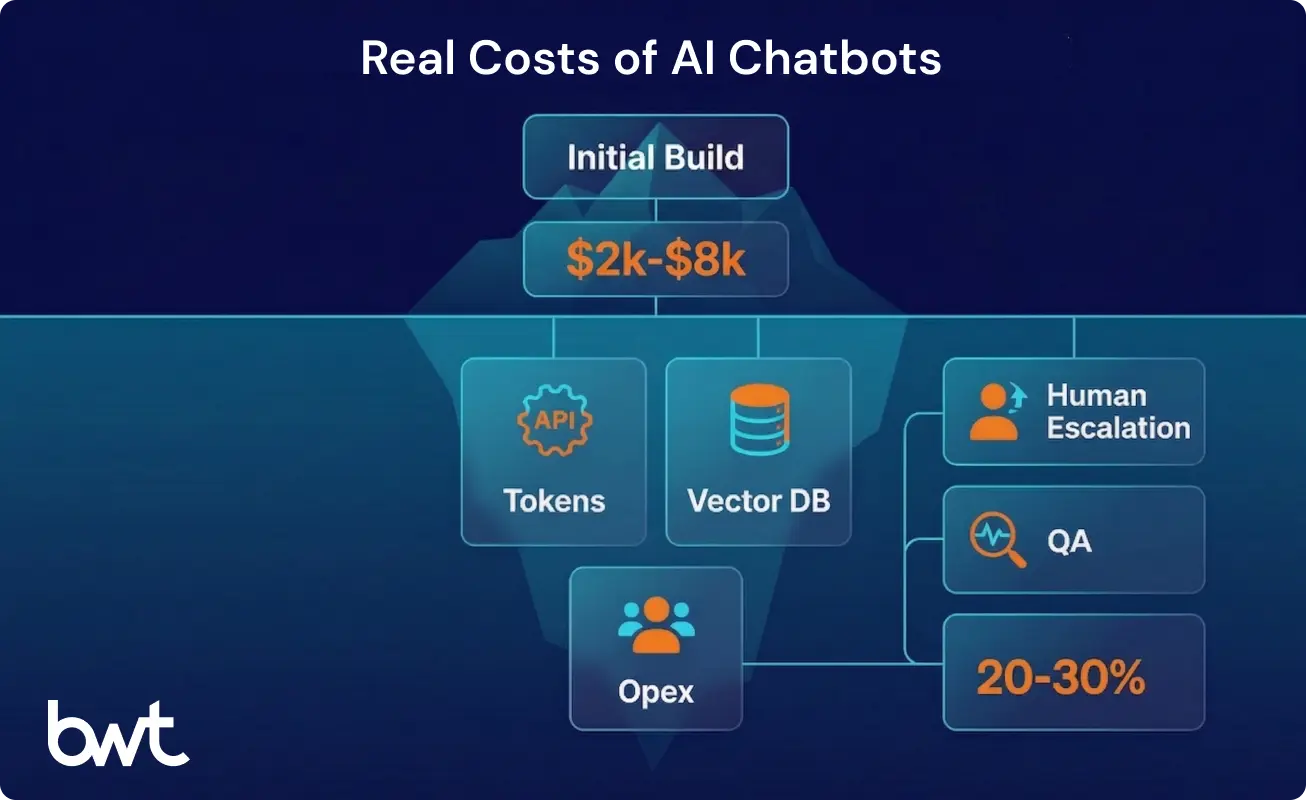
Businesses report saving up to 30% on support costs, with an ROI of around $3.50 per dollar invested. Real numbers, but so are the costs vendors skip:
| Cost Component | Typical Range | Context |
| LLM API tokens | $2.50–$10 per 1M tokens | A few cents per conversation |
| Vector database (for RAG) | $70–$300+/month | Scales with catalog size |
| Human escalation handling | 20–30% of conversations | The portion AI can’t handle alone |
| QA and monitoring | Ongoing | Reviewing logs, catching hallucinations, updating the knowledge base |
For mid-market stores ($5M to $20M annual revenue): expect $2K to $8K/month in real operating costs. Compare against your current support team costs and resolution rates to determine ROI.
“One client’s bot worked perfectly for three months, then their catalog rotated 40%, and the bot started recommending products that no longer existed. We’ve since built a knowledge base refresh cycle into every contract. The chatbot that works on launch day won’t be the same chatbot you need on day ninety.”
— Oleg Boyko, CCO at GroupBWT.
Building Your AI Chatbot: Features and Integration That Matter
Without strong NLP, your chatbot is a search bar wearing a conversation bubble. Quality natural language processing development services handle misspellings, colloquial language, and vague queries. Layered with RAG architecture, it grounds every response in your actual product data.
But here is the uncomfortable truth most vendors skip: RAG is only as good as the data it retrieves.
“On our largest product classification pipeline, 80% of the time went into normalizing product attributes, not tuning the model. Teams burn months fine-tuning prompts when the actual fix is spending two weeks enriching product descriptions and structuring attributes.”
— Dmytro Naumenko, CTO at GroupBWT
Before investing in AI, invest in data enrichment. Detailed product descriptions. Structured attributes. Thorough FAQ content.
Your chatbot talks to customers, but it reads from your systems. If it can’t pull live catalog data, inventory, pricing, and promotions from Shopify, WooCommerce, or Magento in real time, the answers will be wrong. Digital shelf ecommerce analytics keeps that data consistent so the bot isn’t quoting one price on the web and another on Instagram.
CRM is where it gets personal. Hook your chatbot into customer records, pair that with models from a dedicated data science consulting company, and the bot knows who it’s talking to: past orders, return history, browsing patterns. Recommendations sharpen with each interaction.
Multichannel is the other headache. Customers bounce between websites, WhatsApp, and Instagram, sometimes mid-conversation. The hard part is Identity Stitching: is this the same person across three touchpoints, or three different people? Enterprise setups solve it with a Customer Data Platform (CDP) that stitches profiles into one record.
If you sell at volume, data-extraction infrastructure for Amazon, eBay, and Walmart can pipe competitive pricing and stock data straight into chatbot responses.
How to Implement an Ecommerce AI Chatbot
Audit your customer experience
Map where people drop off. What questions flood support? Which pages have the highest exit rates? AI consultancy and services help cut through vendor noise and match the right approach to your actual situation.
Choose the right approach
How deeply it connects to your existing stack, how many channels it covers, what the real total cost looks like once you add API fees, vector database hosting, and ongoing training, and whether guardrails against hallucinations and prompt injection are baked in or bolted on later.
Train the model with your data
Feed it product descriptions, FAQs, return policies, sizing guides, and real support logs. Getting training data for AI right is the main task; everything else depends on it. Expect 2 to 4 weeks for initial training.
Plan for scale from day one
Black Friday will come. Your catalog will double. If the architecture can’t absorb that, you’ll rebuild under pressure. Context window management, latency reduction through caching, PII masking: build these in now. Retrofitting costs 3x more.
Launch, monitor, iterate
What we track on every deployment: resolution rate (aim for 70%+), hallucination rate (under 2%), CSAT gap between bot and human agents (within 10%), escalation latency (under 30 seconds). After launch, it’s weekly conversation log reviews, knowledge base updates as products rotate, and A/B tests on response strategies. Teams that iterate fast win. The “set and forget” crowd loses customers quietly.
Where E-Commerce AI Is Heading
AI shopping agents are evolving from single-turn Q&A to multi-step autonomous workflows: finding products, comparing alternatives, applying promotions, initiating checkout, all from a single customer request. Adobe tracked a 1,200% year-over-year increase in generative AI traffic to retail sites, with AI-referred visitors converting 31% higher than other traffic sources.
Multimodal interactions are when a customer sees a jacket on the street, snaps a photo, sends it to the chatbot, and gets three similar items from your catalog. That’s image-to-product search using embedding similarity, and it’s already live on major platforms. For fashion and home decor, especially, photos answer questions that text queries can’t even form properly.
Partner with Experienced Builders
GroupBWT has built AI-driven chatbot solutions for e-commerce across the full stack, from NLP and data science to production infrastructure serving enterprises with $33B+ in annual revenue. Our custom AI chatbot development services cover the whole lifecycle: architecture, training, deployment, and ongoing tuning.
Beyond the $33B retailer case above: pipeline infrastructure handling 335M records/month at 99.5% accuracy across 772 locations. For a global beauty brand (300K+ products weekly), our orchestration layer cut manual classification from 27 hours/month to 6 to 10 hours, 99% automation rate. Plus review intelligence across 70+ retailers, Shopify integrations for 1,000+ merchants over 5+ years, and market intelligence solutions on the same data extraction architecture.
The gap between well-built AI-driven chatbot solutions for e-commerce and poorly built ones is the difference between a compounding asset and a compounding liability. Every serious retailer is already investing or planning to.
Depends on what you’re building. SaaS on Shopify? $30 to $100/month, plug it in, connect the catalog, you’re live. Need intent recognition and CRM hooks? $200 to $1,000/month. Going custom for enterprise? Development runs $10,000 to $50,000+. That’s the part people plan for. What they skip: $2K to $8K/month after launch for LLM (Large Language Model) API tokens, vector database hosting, monitoring, and QA. The build is the smaller line item. Operations is where the real money goes. Most businesses recoup in 3 to 6 months, but that only holds if the budget covered the full picture from day one.
Most platforms claim 50+ languages. For the big ones (English, Spanish, French, German), they perform well with minimal tuning. Languages with limited NLP training data (Thai, Vietnamese, certain Arabic dialects) need custom work. We built multilingual review intelligence handling deduplication across five languages; it works, but it took deliberate effort. Test accuracy for your target languages before launch. Vendor claims about language support rarely survive real queries.
SaaS on Shopify? You can live in days. Once you add RAG (Retrieval-Augmented Generation), CRM hooks, and multi-channel support, that stretches to 4 to 8 weeks. Enterprise with compliance requirements on top? Three months is pretty standard. Most of that calendar time isn’t code. It’s data prep, testing, and grinding down hallucinations. You can get to 85% accuracy in about a week. The grind from 85% to 97%? That takes six more.
No. And you wouldn’t want them to. The most effective AI chatbot solution for e-commerce picks up 60 to 80% of the repetitive stuff: order status, specs, shipping, and stock. The rest goes to human agents who see the full conversation, so nobody repeats themselves. There’s a psychological angle too. Researchers call it “autonomy bias.” People need the final decision to feel like theirs. They’ll ask a bot about delivery windows or fabric composition all day. A refund dispute on a $2,000 laptop? They want a person. The best systems escalate on emotional stakes, because that’s what the customer actually cares about.
Tech Stack
Data Engineering: From Raw Web to Data Product
We develop and manage custom data solutions, powered by proven experts, to ensure the fastest delivery of structured data from sources of any size and complexity.
We offer:
- Custom Web Scraping & Development
- 16+ Years of Engineering Expertise
- AI-Driven Data Processing & Enrichment