

Accessing accurate Tesco data is critical for UK retailers. The site’s real-time prices, promotions, and stock information are essential for competitive strategy.
GroupBWT provides a stable data extraction service. We transform raw public information into predictable, structured data feeds.
This clean data directly powers your automated pricing and inventory systems. Our controlled process ensures that you receive complete and accurate Tesco data, helping you maintain your competitive edge.
Tesco Data Scraping for Market Alignment
Frequent data extraction links a company’s view with the current market. Scraping Tesco data enables you to compare your decisions with those of a leading competitor. Effective extraction reduces pricing delays and enables faster, more effective market reactions.
Why Businesses Require Tesco Data for Insights and Automation
Once you decide Tesco data is essential, remember it powers analytics and automation. Securing Tesco data provides insights unattainable through manual work or generic feeds.
| Strategic Area | Data Value Statement | Business Result |
| Dynamic Pricing | Provides validated, current competitor prices to power instant price adjustment algorithms. | Reduces margin loss and secures sales immediately./day |
| Inventory Control | Predicts shifts in market demand (stock-outs, new listings) to inform supply chain requirements. | Lowers warehousing costs and prevents product shortages. |
| Sales Projection | Enriches predictive models with competitor promotional activity, a significant factor in sales volatility. | Increases the accuracy of quarterly sales forecasts by over 20%. |
The value demonstrated in the table lies not only in data collection but also in the compression of time.
In retail, data freshness is a margin protector. We don’t just collect prices; we deliver a guaranteed service level (SLA) on data delivery. Outsourcing the technical burden transforms an engineering liability into a predictable commercial asset.
— Alex Yudin, Head of Web Scraping Systems
Automated data collection shortens analysis time. You receive market insights in hours, not days. This speed allows for immediate reaction. You can launch a counter-promotion or instantly adjust a price, without waiting for next week.
This flexibility directly increases profitability. Your prices remain optimized for the best margin. Your inventory levels align with actual customer demand.
We provide clean, structured data. This data integrates directly into your existing planning and management systems. It synchronizes and automates your key processes.
GroupBWT recommends a small pilot project. It is the best way to test the benefits before a full rollout.
Gains from Tesco Scraping for Retail and Market Analysis
Extracting high-quality Tesco data gives businesses tactical advantages in a competitive market. The actual worth lies in timely, granular insights that allow teams to outmaneuver rivals faster than traditional analysis ever could.
Real-Time Access to Product and Pricing Information
In the retail sector, speed is crucial. Swift responses to price fluctuations can significantly boost sales and profit margins. Tesco’s comprehensive data allows companies to act with agility. Scraping systems fetch fresh data at regular intervals, enabling near-instant price adjustments and promotion tracking. Companies need to strike a balance to maximize swift actions and business advantage.
Sophisticated Tesco scraping uses geo-targeted proxies to monitor prices across UK postcodes. These systems build historical price data, which helps spot trends and predict when Tesco might start a major price campaign. They also measure each product’s visibility score, which reflects digital shelf space, and ensure that pricing data is always up to date. Decisions depend on the latest market information.
Up-to-date Tesco data scraping directly influences business actions and outcomes. Building on this, let’s explore how this data fuels competitive intelligence in the market, enabling you to make informed decisions and shape outcomes.
Tesco Grocery and Food Scraping for Competitive Intelligence
Grocery and food data help manufacturers and competitors understand product choices and performance. Monitoring Tesco’s grocery data tracks rivals; it helps brands maintain strength and guides research and development (R&D) spending.
- Private Label Analysis: Tesco grocery store scraping provides continuous metrics on the growth, pricing, and customer perception of Tesco’s own-brand products. This helps national brands accurately assess their direct competitive threats and formulate effective defense strategies.
- Ingredient Monitoring: Using Tesco food scraping, manufacturers can track minute changes in ingredients and nutritional declarations. This ensures immediate identification of shifts in competitive product formulations.
- Vegan/Free-From Trends: Scraping rapidly quantifies the expansion rate and success metrics (ratings, reviews) of niche dietary categories.
- Supplier Performance: Suppliers use the scraped data to independently audit Tesco’s execution of their contracts. They verify the accuracy of imagery, descriptions, and adherence to negotiated promotional schedules.
- Product Reviews Depth: Moving beyond the average star rating, the system captures and categorizes the specific sentiment within review text, such as comments on ‘value’ or ‘packaging. This provides critical qualitative insight.
The intelligence gathered supports decisions ranging from short-term promotional counter-tactics to long-term investment in R&D and product formulation. With this intelligence in hand, teams can examine real-world applications spanning the retail lifecycle.
Use Cases — From Price Comparison to Demand Forecasting
Tesco data scraping delivers savings and insight at every retail stage. The key is sharp analysis: some companies saved £200,000 per quarter in overstock costs by acting on timely data, demonstrating a measurable bottom-line impact.
| Use Case | Core Insight Provided | Operational Benefit |
| Market Share Simulation | Simulating anticipated share change from rival price/promo moves. | Minimizes risk by testing competitive maneuvers before execution./day |
| Product Recommendation | Analyzing frequently bundled products at Tesco. | Improves internal cross-selling logic, boosting Average Order Value (AOV). |
| Category Health | Aggregating data on total product count, average price, and average rating. | Provides a holistic benchmark on the category’s competitiveness and saturation. |
Tesco data supports retail audits, price tracking, competitor stockout identification, and loyalty program analysis. These points enhance product recommendations and risk identification, showing critical business applications.
The actual return on investment (ROI) for data scraping is realized when this information drives automated, prescriptive, and targeted responses across distinct commercial sectors. Understanding this effect, let’s see how the actual data extraction process works.
How Does Scraping Data from Tesco Work?
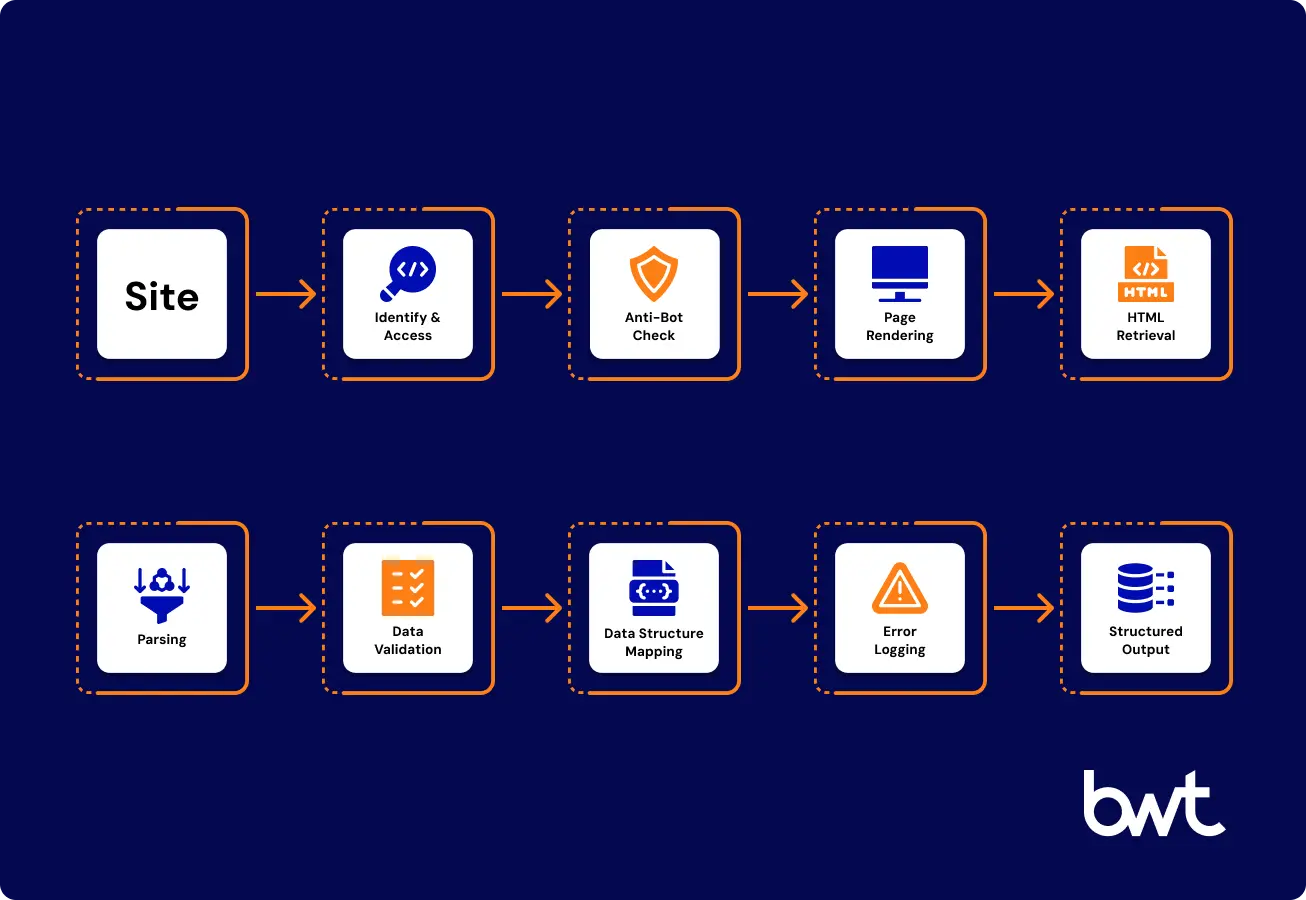
To bridge theory and practice, it’s essential to understand that data scraping from Tesco is a multi-stage process designed to emulate human behavior while effectively circumventing automated defenses.
Step-by-Step Overview of Tesco Product Data Extraction
Scraping Tesco data involves navigating complex e-commerce websites and ensuring the accuracy of the information obtained.
Our method consists of four stages to transfer data from Tesco to your systems.
- Target Identification and Access
We map all target data points, like price and the stable TPN (Tesco Product Number). Our system accesses the site through an extensive, UK-based proxy network. This ensures all requests appear as legitimate local users. It prevents geo-blocking and maintains uptime. - Full Page Rendering
Tesco loads critical prices using JavaScript. Simple scrapers fail. Our system utilizes headless browsers to render the whole page, capturing dynamic data such as promotions and stock levels. This step guarantees complete data accuracy. - Parsing, Validation, and Structuring
This stage turns raw content into a commercial asset. We extract the required fields, like price and stock. Each field is subjected to automated validation rules. We then map this validated data into a consistent JSON structure. This step shields your downstream tools from any site changes. - Quality Assurance and Logging
A robust logging system monitors the entire process. This provides a transparent audit trail. It enables proactive quality assurance, rather than reactive troubleshooting.
This structured process defines our data service. We manage the technical complexity. You receive a simple, reliable data feed.
Tools and Technologies Used for Tesco Scraping
To keep scraping running smoothly, you need strong technology that can handle defenses and process data quickly.
| Tool Category | Primary Function | Example Technology |
| Request & Access | Emulate a human user, bypass IP blocks, and retrieve raw data. | Python Requests, Residential Proxies, Headless Browsers. |
| Parsing & Cleaning | Locate, isolate, and structure key data points from raw content. | BeautifulSoup, Scrapy, and Validation Functions. |
| Storage & Analysis | Preserve data integrity and optimize for retrieval and querying. | PostgreSQL (for Time-Series Tables); Data Lake solutions (S3 + Glue/Snowflake) for massive SKU and long-term analysis. |
The key is a resilient technology stack: Python (Scrapy) provides a scalable framework, while Headless Browsers (Playwright) are mandatory for simulating user interaction on dynamic sites. Third-party (3rd-party) scraping API services are the commercial choice for outsourcing this entire complex technical layer.
Example: Extracting Tesco Grocery Data at Scale
Running Tesco product scraping at an enterprise level requires careful planning and goes far beyond basic scripts. Basic scripts fail when monitoring 50,000+ SKUs in real-time. Our system provides a controlled, full-scale data operation. We guarantee reliable, ongoing data collection.
This process is built on a resilient infrastructure designed for three core outcomes:
- Controlled UK Access
We use a large, specialized pool of UK-based residential proxies. Our system dynamically rotates these proxies based on success rates. This prevents blocks and ensures all data reflects accurate UK pricing and availability. - Scalable Infrastructure
We manage a distributed infrastructure built for high-volume requests. Our system handles thousands of concurrent requests. This architecture provides scalable data extraction without service interruption. - Prioritized Data Freshness
We schedule data collection logically by category. Critical, high-priority SKUs are refreshed hourly to ensure maximum data freshness and accuracy.
Tesco Scraping Challenges and How to Overcome Them
Delivering reliable Tesco data requires managing two factors: website defenses and data accuracy. Our process is designed to handle both. We ensure your data feed is stable, predictable, and delivers trustworthy, consistent data.
When scraping Tesco, the failure is the architecture’s inability to manage hundreds of unique UK residential IPs, render dynamic JavaScript, and auto-remediate. That’s the difference between a brittle script and a resilient feed.
— Dmytro Naumenko, CTO
Navigating Anti-Bot Protections
We engineer our system to navigate automated website defenses. This provides a stable and undetected service
- Rate Limiting: We manage request volume and timing to avoid predictable, high-volume patterns that trigger suspicion
- IP Blocking: Tesco servers block high-volume IP addresses. We manage this by rotating all requests through an extensive, controlled, UK-based proxy network to maintain continuous access.
- User-Agent Filtering: We cycle our User-Agent strings to ensure all requests appear as standard, legitimate browser traffic.
- JavaScript Challenges: We render dynamic JavaScript on the page. This ensures that we capture critical data, such as pricing and stock levels, that simple scrapers often miss.
- CAPTCHA Challenges: We integrate automated solving for any CAPTCHA tests. This prevents our scripts from being blocked.
Ensuring Data Accuracy and Reliability
Technical stability is not enough. Your data must be trustworthy. Our multi-layer validation process ensures all Tesco data is reliable and provides maximum business value.
- Selector Resilience: We use multiple, redundant selectors for each data point. This maintains a continuous data flow, even if Tesco updates its site layout.
- Validation Rules: We apply strict validation rules to all incoming data. This process confirms price fields are numeric and product names are complete, ensuring your systems receive clean, usable information.
- Data Diffing: We compare every new record against the previous one. This “data diffing” flags anomalies, such as a 10x price change, for verification before the data can skew your analysis.
- Schema Enforcement: We enforce a predetermined internal data schema for all output. This ensures consistency, enabling the data feed to integrate seamlessly into your pricing models or ERP.
This combined focus on access and accuracy makes our system reliable. We keep your data flowing and protect its business value.
Tesco Data Scraping Use Cases by Industry
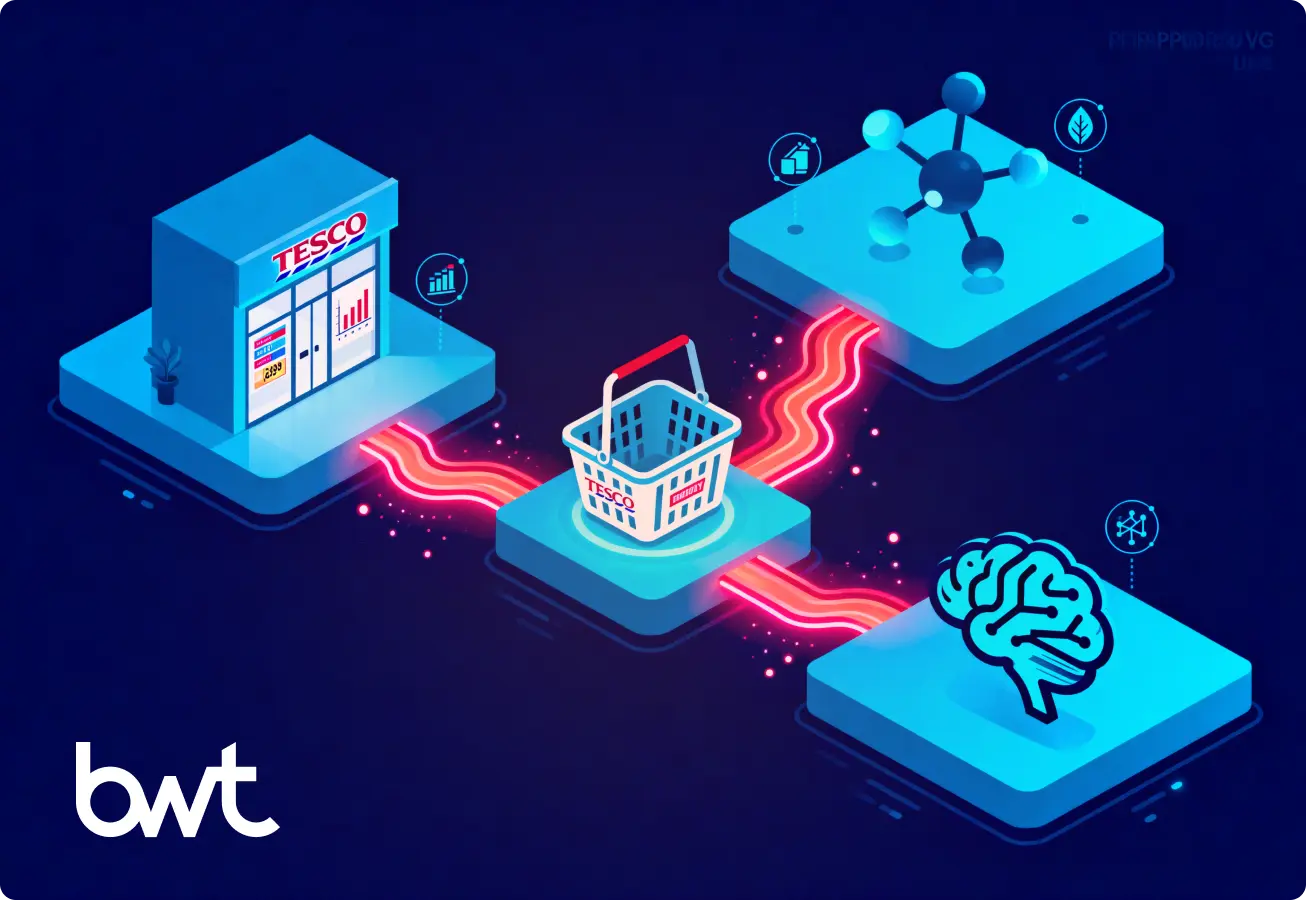
Tesco scraping is most valuable when you turn general data into specific, high-impact actions for different industries. This demonstrates how a single robust dataset can address multiple business challenges.
eCommerce and Retail Price Monitoring
Data scraping provides retailers with quick and actionable insights, enabling them to boost sales and protect their market share. The primary objective is to increase short-term revenue.
Pricing teams run Tesco products scraping to extract data and feed engines that react to real market tempo. The data stream updates price boundaries, shows where demand moves, and supports revenue targets for the current cycle.
Category managers track Tesco’s digital shelf to measure spacing, adjacency, and product grouping. The signals help refine their own layout logic and raise product discovery levels.
Competitor teams map assortment overlap by checking which sellers carry the duplicate SKUs. The view highlights exclusivity gaps and directs assortment actions.
Market expansion teams read price tiers and brand distribution before entering a new region or category. The dataset shortens validation time and sets realistic margin expectations.
Promo leads watch the timing and weight of Tesco’s campaigns. They plan counter-moves where promo pressure peaks and shift spend toward periods with the highest conversion potential.
Food and Grocery Market Intelligence
Brand teams run Tesco product scraping to extract insights and read how the retailer positions each SKU. The view shows shifts in rating velocity, image quality, and placement. Leaders use these signals to protect equity and correct weak representation before it hurts revenue.
Innovation groups track the speed and reception of new competitive listings. They watch early price anchors and the first review patterns. The data shapes counter launches and limits exposure to fast-moving rivals.
Regulatory managers review ingredient strings and label language. They compare contractual requirements with Tesco’s current product pages. This control loop prevents misrepresentation and protects compliance in every category.
Strategy teams quantify dietary trends by counting organic, keto, and plant-based labels across Tesco’s whole catalog. The numbers highlight where demand expands and where volumes slow.
Commercial units study Tesco’s private label lines. They inspect ingredients, pack sizes, and price steps. The analysis shows where private label encroaches and where national brands must adjust margin strategy.
AI-Driven Insights and Product Recommendation Systems
Data engineers train forecasting models on the long time series collected through Tesco data scraping. Each signal informs volume planning and helps teams react before the shelf moves.
Pricing analysts predict upcoming Tesco campaigns by analysing historical triggers. They adjust their own boundaries ahead of major shifts and protect short-term revenue.
Product teams build personalization engines that use Tesco’s cross-sell and bundle patterns. The model recommends items that follow real shopper behaviour, not static assumptions.
Supply leads track signs of churn risk by reading delisting patterns and promotion cycles. The alerts help them prepare inventory moves and avoid disruption.
Review analysts’ score sentiment across millions of comments. NLP highlights themes with the strongest pull or the sharpest drop. The output shapes messaging and guides reformulation.
Best Practices for Undetected and Efficient Tesco Scraping
A truly stable operation hinges on precise technical strategies. GroupBWT’s engineers orchestrate these to manage server load and optimize data flow. These standards are what maintain long-term, predictable system stability.

Core Anti-Bot Evasion Techniques
These strategies are foundational for managing anti-bot systems, a standard requirement for any stable Tesco scraping project. The objective is singular: to obtain complete and accurate data. This outcome is achieved by emulating human user behavior with precision and accuracy.
- Frequency Control: Requests must incorporate randomized, non-uniform delays. This approach mimics human browsing, preventing detection by simple pattern-based systems.
- Proxy Rotation and Diversity: A vast residential proxy network is deployed. These are geographically anchored to the UK, which is paramount for ensuring that the collected data reflects relevant pricing and availability. Any IP that returns a block signal is immediately and automatically removed from the active pool and quarantined.
- User-Agent Management: The system maintains and rotates an extensive list of authentic, non-blacklisted User-Agent strings to bypass rudimentary filtering.
- JavaScript Rendering: Dynamic data is a common hurdle. The system executes all necessary JavaScript using headless browsers (e.g., Playwright). This action passes all environment checks and ensures every dynamic data point is captured.
- CAPTCHA Integration: The system integrates directly with CAPTCHA-solving APIs. These APIs resolve any challenge, returning it to the script for automated entry. This ensures zero interruption.
Load Balancing: All scraping tasks are intelligently load-balanced across the proxy network. This protocol distributes computational and request volume evenly, guaranteeing stable performance at scale
Using APIs to Extract Tesco Data
Enterprise requirements prioritize stability and scalability. Commercial APIs are the preferred method for sustained data extraction. This approach fundamentally reduces operational overhead by outsourcing complex infrastructure management.
- API Preference: For enterprise-level reliability, specialized commercial APIs are the most stable choice. The service provider handles all complex, backend maintenance. Your team does not.
- Structured Output: The API returns data in a clear, predictable format, so teams work with ready inputs instead of spending hours fixing broken selectors.
- Cost Efficiency & Uptime: Engineering teams rely on SLAs to ensure stable uptime and avoid the high expenses associated with maintaining internal scraping infrastructure.
- Simplified Integration: Developers connect through straightforward HTTP endpoints that seamlessly integrate into existing systems without additional adaptation.
Data Cleaning and Storage Recommendations
Data processing and storage are critical. Raw data is not yet an asset. Proper storage protocols ensure your data is clean, organized, and ready for analysis. This is what protects its ultimate business value.
- Normalization: Analysts convert all pricing units into a single metric, such as price per kilogram, which ensures accurate comparisons and eliminates noise from mixed units.
- Schema Design: Architects store the dataset in a time-series-friendly database, such as PostgreSQL, so that long-range queries run efficiently and updates are applied to the correct location.
- Data Diffing: Automated data diffing is implemented. This logic compares new records against old ones. Any abnormal change (e.g., a 10x price increase) triggers an immediate alert for verification. This prevents data pollution.
- Categorization: Scraped product categories are mapped to the business’s internal taxonomy. This vital step enables unified analysis across various internal systems.
- Quality Checks: Automated, daily quality assurance checks run on the stored data. They ensure absolute completeness and statistical correctness.
Effective operations adhere to these technical standards. This keeps your system stable and maximizes the value of your data.
Final Thoughts: Scaling Your Tesco Data Scraping Strategy
The final decision is transitioning from planning to a scalable, ongoing operation. Using unreliable scraping methods leads to failure. It is essential to focus on strong partnerships and durable technical approaches.
Choosing the Right Scraping Partner
Its stability measures the ROI of a data project. Our goal is to make the entire anti-bot, proxy, and data validation layer invisible to the client’s engineering team.
— Dmytro Naumenko, CTO
Choosing the right partner is crucial. They become the primary source of your market data. Careful selection reduces operational risks.
- Proven Track Record: Vetting potential partners requires verifying successful, long-term experience specifically with the challenges of high-volume, reliable data.
- Scalability: Confirm the partner can scale the request volume from a minimal pilot basket to the entire Tesco catalog without a drop in data quality or latency.
- Data Quality: Request substantial data samples. Conduct rigorous quality testing (including accuracy, completeness, and freshness) before signing any long-term agreement.
- Cost Model: Choose a transparent pricing model, for example, per successful record retrieved. This aligns the partner’s interests with data quality, rather than request volume.
Future of Grocery Data Scraping and Automation
The environment is changing rapidly. You need to adapt and look ahead to new technical challenges continually. The top companies of the future will be those that can effectively utilize these new technologies.
- Increased AI Defense: Future scraping of Tesco will face sophisticated AI systems designed to monitor human behavior cues, demanding highly realistic bot emulation.
- Shift to API Solutions: The increasing cost and complexity of anti-bot defense will compel the industry to adopt specialized API solutions. This trend will render custom scripts entirely unsustainable.
- Hyper-Targeted Data: Future scraping will focus on obtaining local, store-specific inventory and pricing data in real-time to support hyperlocal marketing strategies.
- Semantic Analysis: The focus will shift from what is scraped (price, name) to what it means. AI will perform advanced semantic analysis on review text and product descriptions.
- Full Automation: Scraping will become an entirely hands-off utility. Data will flow autonomously into machine learning models and dynamic execution systems.
To lead the market, you must adopt API-based approaches quickly. You must combine outside data with your own business insights. Success depends on employing clever technical tactics and utilizing the appropriate APIs for accurate data processing. By focusing on these steps, businesses can use Tesco scraping to set dynamic prices, enhance product selection, and stay ahead in a rapidly changing market.
FAQ
-
What criteria matter when selecting a Tesco scraping provider?
Procurement teams seek partners who have successfully handled heavy Tesco workloads and maintained stability during peak traffic periods. They review sample datasets, check timestamps, and confirm how the provider scales under load. A vendor who avoids showing real extracts or rejects uptime terms signals risk before the relationship even starts.
-
How do pricing models differ, and where do hidden costs appear?
Finance leaders favour models where the fee matches the volume of valid records rather than attempts. This structure shifts anti-bot, proxy, and maintenance expenses to the vendor’s side. Other models hide spending in retries, proxy bursts, or add-on support hours. Contracts work smoothly when both sides agree on the exact definition of “valid record” and how costs change when extraction volume increases.
-
How can we verify the accuracy and freshness of the data we receive?
Data teams run small control scrapers to compare several SKUs against the feed. They check timestamps, source URLs, and whether extracted Tesco data arrives within the agreed latency window. They also run statistical checks on price patterns to catch movements that fall outside normal category behaviour and point to extraction drift.
-
What challenges appear when linking Tesco data with ERP systems, and how should we address them?
Integration teams build a reconciliation layer that maps Tesco’s TPNs to internal SKUs, as these identifiers follow different rules and can create collisions during processing. They also keep pipelines flexible, as Tesco updates its structure often and breaks rigid selectors. A stable JSON API with TPN or GTIN as the core key simplifies mapping and supports consistent time-series analysis.
-
How should our Tesco scraping strategy evolve as anti-bot and AI defences grow stronger?
Technical leads move away from simple scripts and rely on systems that adapt to fingerprint checks, behavioural gates, and region-specific logic. They look for providers who treat adaptation as a continuous process, not an emergency patch. Teams also demand store-level accuracy, since future commercial decisions depend on hyperlocal data rather than broad national snapshots.