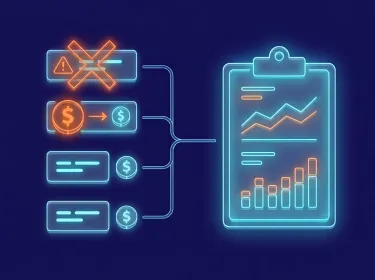
Big data analytics in finance is a regulated system that turns high‑volume and ‑velocity data into insight for decisions and actions like fraud blocks, credit limits, pricing updates, liquidity alerts, and compliance reports.
The fastest route to value is one decision → one KPI → one audit trail. The “data lake first” plan usually stalls when risk, legal, or model governance asks: “What data is this based on, and who approved it?”
What we see in delivery:
- A lake or warehouse gets funded, but no one can name the first production decision it will drive.
- Fraud/risk/compliance teams keep separate metrics because definitions are inconsistent.
- The platform ships, but the bank can’t reproduce a past report or decision under audit.
Our delivery-first framing:
- Define the decision (fraud stop, credit limit, AML alert, capital report).
- Establish evidence (datasets + provenance).
- Control compliance (PII, retention, purpose limitation).
- Integrate + engineer features (reusable contracts).
- Deploy + monitor (latency, drift, incidents).
- Explain (audit trail, approvals, model cards).
Need delivery help from GroupBWT?
That is how we can help:
- Big data consulting: Scope definition, architecture blueprints, and governance frameworks suitable for regulatory audits.
- Big data implementation: Building automated pipelines (ETL/ELT), lakehouse setup, and real-time processing infrastructure.
- Big data testing company: Independent data QA, automated reconciliation frameworks, and regression testing suites.
- Big data solution services: End‑to‑end delivery + managed services)
- Data science consulting: ML model development, model risk management (MRM) artifacts, and drift monitoring setup.
GroupBWT provides full big data analytics in financial industry, ship the first pipeline, test it like a product, and then operate it with clear ownership and SLAs. If you’re framing the cross‑industry business case, start with: what is big data used for in business.

Data types decide your architecture (and your governance burden)
The technical “shape” of data is also a compliance constraint. In the big data in finance industry, treat data types as both an engineering design input and a risk-management input.
Structured data is your decision backbone
It lives in tables/schemas and is easiest to validate and audit. Typical big data in finance sector sources include payments/cards/ledger entries, trades/positions/market feeds, and regulatory returns.
Controls we implement early:
- Reconciliation totals (by day/product/channel)
- Null/duplicate thresholds
- Canonical definitions (data dictionary)
Unstructured and semi-structured data
This data adds context—but increases risk. For big data in financial services, text/audio/logs can reduce false positives or speed up reviews, but only if provenance is tight.
Controls that matter:
- Source attribution + quality scoring
- Redaction for sensitive fields
- Role-based access and purpose limitation

Table: big data in finance examples by type
| Data type | Best for | Common pitfall | Control to add |
| Structured | Reporting, scoring, forecasting | Inconsistent definitions across systems | Canonical model + data dictionary |
| Semi-structured | Behavioural patterns, real-time alerts | Schema drift | Schema registry + versioning |
| Unstructured | Intent/sentiment, anomaly context | Noise + weak provenance | Source attribution + quality scoring |
The Tech Stack We Trust for Big Data Analytics in Finance
Financial workloads fail differently: when a number changes, you don’t get to say “we re-ran the job.” You must prove what the data was, what code ran, and who had access at that time—often months later.
Our default “Audit‑First Stack” is a 5‑layer system:
- Analytical store: Snowflake or Databricks.
- Ingestion: Kafka/Confluent + batch landing.
- Orchestration: Airflow or Dagster.
- Transformation: dbt turns SQL logic into versioned, testable code, meaning you can prove what ran when, and roll back safely if an error occurs.
- Quality & observability: Great Expectations or Monte Carlo (data observability).
The goal is simple: ensure complete traceability of data, maintain a history of all logic changes, and automatically stop processing if data quality drops.
This stack is not a universal default. It breaks down when:
- You need microsecond latency: Certain trading systems require speed that standard analytics stacks cannot provide.
- Strict boundary requirements: If data cannot leave your environment and SaaS observability tools are disallowed, prefer self-hosted testing/monitoring.
- Operational constraints: If your team can’t sustain Kafka ops, choose managed services or simplify the ingestion patterns.
Audit‑Ready Implementation Checklist
Use this as a strict go/no‑go gate for finance production. If any item is No, do not ship.
- Immutable inputs: An append‑only raw zone must exist, and the pipeline must be replayable from it.
- Time travel/versioning: Must be enabled, and retention must cover your audit window.
- RBAC + separation of duties: Access must be granted via roles (no ad‑hoc user grants), with dev vs prod access separated.
- Change control: All transformations must be in Git, deployed via CI/CD, and peer‑reviewed.
- dbt tests: Critical models must have tests for keys, nulls, ranges, and accepted values.
- Circuit breakers: Pipelines must stop on freshness, schema, or volume anomalies.
- Run traceability: Run logs must capture run_id → inputs → commit hash → outputs.
- Audit drill: A reconstruction drill must be documented (e.g., “rebuild KPI X as‑of date T”).
Generative AI in Finance: Retrieval-Bound (RAG) and Privacy-Isolated
In regulated environments, the question is not “Can we use GenAI?”—it’s “Can we force it to answer only from trusted evidence, with citations, inside our perimeter?”
- LLM (Large Language Model): A generative model optimised for language understanding.
- RAG (Retrieval-Augmented Generation): An architecture that injects retrieved, approved documents into the model context. This ensures outputs are grounded in your evidence, not the model’s training memory.
Rule: If your LLM output cannot cite internal sources (policy PDFs, investment memos, compliance logs), it is not production-ready for finance.
Top GenAI use cases that stay compliant:
- Smart Compliance Search: Ask “show me clauses related to cross-border transfers in Q3 contracts” and return cited passages.
- Automated EDD (Enhanced Due Diligence): Summarise adverse media and sanctions screening into a structured analyst narrative.
- Code Migration Assistant: Translate legacy COBOL/SAS logic into Python/PySpark with unit-test scaffolds.
Non-negotiable constraints:
- PII stays inside your perimeter: Never send raw PII to public model APIs.
- Prefer private endpoints: Use private Azure OpenAI endpoints or self-hosted open-weight models (e.g., Llama family) with network isolation.
- Log everything: Prompt, retrieved docs, model output, user, timestamp, and policy version must be captured for audit.
Where RAG fails (and how to mitigate it):
- Stale documents → wrong answers: Enforce document freshness and ownership (policy versioning).
- Prompt injection → data exfiltration: Add input sanitisation + retrieval allowlists + output filters.
- Weak retrieval → confident nonsense: Measure retrieval precision and require citations for every claim.
Hyper-personalization: A Low-Latency Data Product

Risk pays the bills, but personalisation funds growth. You cannot ship “Segment of One” experiences using batch pipelines.
- Instead of: Mailing a generic credit card offer.
- Do this: Triggering a push notification for a travel insurance add-on seconds after an airline ticket purchase.
The architecture requirement:
If a customer is at a checkout counter now, a “run it tonight” batch job is a failed design.
- Analytical store: Snowflake/Databricks for long-range analysis and offline training.
- Operational/online store: Redis/DynamoDB for sub-second reads in live journeys.
- Event stream: Capture transactions, clickstream, and merchant categories in near real-time to trigger logic while the customer session is still active.
FinOps: A Data Engineering SLO
“Bill shock” happens when cloud cost is treated as an afterthought. To maintain sustainable big data analytics in finance, treat cost like latency: as a first-class engineering metric.
FinOps is the operating model that makes cloud cost visible, owned, and optimised through engineering controls and governance.
FinOps controls we recommend before production scale:
- Tagging strategy: Every dataset/compute resource must have an Owner and Cost Center. Untagged resources are automatically stopped.
- Auto-suspend policies: Warehouses should not run 24/7 for reporting; use aggressive timeouts (e.g., 5–10 minutes of inactivity).
- Storage tiering: Automatically move historical audit logs from hot storage to archive tiers (e.g., AWS Glacier) after 90 days.
- Query cost observability: Track cost per query, top cost drivers, and cost by team.
The Cost Formula for Engineers
Before scaling, apply this estimation model:
Cost = (Avg Scanned GB) × (Query Frequency) × (Compute Unit Price)
If the output represents >5% of the feature’s expected revenue, refactor the data model (e.g., move from full scans to incremental clustering).
Models rarely fail audits—undefined ownership and untraceable data changes do
Models are rarely the blocker. Operational truth is. Even with advanced big data analytics in financial services, when teams bring projects to us, the same issues show up:
- Fragmented identities (customer/account/merchant IDs don’t match across products).
- Unknown dataset ownership (no one can approve retention, access, or definition changes).
- Quality without tests (“cleaning” lives in notebooks, not in versioned pipelines).
- No monitoring loop (a model ship, but drift and false positives aren’t owned).
The fix is boring and effective:
- Assign an owner per critical dataset.
- Add automated tests to every transformation.
- Treat every definition change as a release (with approvals + rollback).
Use cases that survive audit are the ones tied to a measurable decision
The best starting point for big data analyticsis the decision that already hurts: fraud losses, manual reviews, bad approvals, or slow reporting.
High-ROI use cases we ship most often:
- Fraud detection and case prioritisation (streaming)
- Credit decisioning and limit management (near real-time)
- AML monitoring (batch + graph features)
- Compliance reporting with reproducible definitions (batch)
- Forecasting for liquidity and demand (batch + ML)
In big data analytics in financial services, the first win is usually “reduce losses without raising customer friction.” That means lower fraud loss at the same approval rate, or fewer false positives at the same loss rate. This is a standard goal for the big data in financial services industry.
Where forecasting fits: connect it to a single KPI and a deployment path. Related read: AI based demand forecasting.
Use-case selection table
| Use case | Typical latency | KPI you can defend | Main risk |
| Fraud blocking | Seconds | Loss rate, false-positive rate, review time | Customer friction, bias |
| Credit decisioning | Minutes | Approval rate, default rate | Explainability, fairness |
| AML monitoring | Hours/days | Alert quality, investigation time | False positives, privacy |
| Compliance reporting | Daily/monthly | Cycle time, error rate | Lineage gaps |
A reference architecture that is fast to ship and easy to audit has four layers

For big data analytics in finance, we aim for an “evidence pipeline” that can reproduce any decision or report as-of a point in time.
- Evidence ingestion (batch + streaming)
- Capture raw payload + timestamp.
- Record source, version, and licensing metadata.
- Log failures/retries.
- Governed storage (lakehouse + warehouse)
- Lake/lakehouse for raw + semi-structured history.
- Warehouse for governed reporting and BI.
- Decision driver: governance (access, definition versioning, reproducibility). Related blueprint: data warehouse architecture for enterprise.
- Decisioning and feature serving
- A feature store or governed feature tables.
- Real-time scoring service where needed (fraud/limits).
- Case management integration for human review.
- Monitoring and explainability
- Data quality SLAs + lineage.
- Model monitoring (drift, stability, bias checks where required).
- Audit artefacts: model cards, change logs, approvals.
Compliance is easier when you build an “audit pack” alongside the pipeline
In big data analytics in finance, compliance isn’t a review step—it’s an engineering requirement. This applies to the entire big data in financial industry.
Baseline references we align to (always with your counsel and policies):
- GDPR (EU): https://gdpr.eu/
- PCI DSS: https://www.pcisecuritystandards.org/
- BCBS 239: https://www.bis.org/publ/bcbs239.htm
- SR 26-2: https://www.federalreserve.gov/supervisionreg/srletters/SR2602.htm
SR 26-2 superseded SR 11-7. It is supervisory guidance, does not establish enforceable standards, and is expected to be most relevant to Federal Reserve-regulated banking organizations with more than $30 billion in total assets. It does not apply to generative or agentic AI models.
Boundaries (important):
- If your use case processes PII, define purpose limitation and retention before you scale.
- If the output triggers adverse actions, plan explainability and human override.
- If you rely on third-party data, document licensing, and provenance.
Web scraping helps as an external-signal channel, but it increases operational and legal risk

We use scraping as an optional enrichment for big data analytics in finance—not as the core data strategy.
If you’re assessing whether it’s worth building, see:
Compliance and tracking notes:
- Review ToS + robots directives, and log your interpretation.
- Rate-limit, identify user-agents transparently, and keep provenance logs.
- Be careful with tracking/identifiers; relevant update: google fingerprinting policy change.
Decision matrix: acquisition method
| Method | Best for | Pros | Cons | Governance must-have |
| Internal feeds | Decisions + reporting | Highest trust, richest context | Silo friction | Lineage + access controls |
| Vendor/API | Market/alt data | SLAs, licensing clarity | Cost, coverage limits | Contract + provenance |
| Web scraping | Public signals | Fast to prototype | Maintenance + legal risk | ToS review + logging + throttling |
Our delivery model is “decision-first engineering” with clear ownership and managed services
Here’s what “delivery-first” looks like when clients ask us to implement big data analytics in banking and finance.
Phase 1 — Scope and architecture (1–3 weeks)
- Decision brief (action, KPI, approval path)
- Evidence map (sources, owners, refresh, PII classification)
- Draft controls (retention, access, lineage, incident process)
Phase 2 — Minimum viable pipeline (4–8 weeks)
- Ingestion jobs (batch/stream)
- Governed “gold” dataset + baseline rules/models
- Data tests as code (schema, reconciliation, duplicates)
Phase 3 — Hardening and audit pack (4–6 weeks)
- Lineage and versioning for definitions
- Monitoring dashboards (quality, drift, latency)
- Audit pack (approvals, change log, model card)
Phase 4 — Go-live + managed services (ongoing)
- Named owners for datasets, pipelines, and decision services
- SLAs for freshness/latency, data quality, and incident response
- Release notes + regular control reviews
A 30–60–90 day plan keeps scope honest and makes value measurable
A practical way to start big data analytics in finance is a 30–60–90-day plan with one decision and one KPI.
- Day 0–30 (Define + govern): Pick one decision and one KPI. Map sources + owners + PII classification + retention. Set quality SLAs and minimum lineage requirements.
- Day 31–60 (Build the minimum viable pipeline): Ingest internal feeds + one external signal source (if justified). Implement tests (schema, nulls, duplicates, reconciliation). Publish a governed “gold” dataset + a baseline model/rule set.
- Day 61–90 (Operationalise + prove value): Deploy scoring/alerts into a real workflow (ops queue or API). Add monitoring: drift, quality, latency, and false positives. Produce an audit pack: lineage, approvals, model card, and change log.
If you’re evaluating a partner, ask for SLAs, an incident process, and an audit trail
Buying big data analytics in finance without ownership is buying a prototype.
The fastest way to de-risk big data analytics in financial industry is to demand specific operational answers:
- Who is on call when ingestion fails at 02:00?
- What are the data quality SLAs, and how are they measured?
- How do definition changes get approved and rolled back?
- Can you reproduce the exact dataset behind a decision from 6 months ago?
Interactive sanity check: false-positive cost calculator
Monthly FP cost = (false positives per month) \times (avg handling minutes) \times (cost per minute)
Example SLA fields to put in writing
| Metric | What it protects | How it’s measured |
| Data freshness | Late feeds that break decisions | Max lag vs expected arrival |
| Pipeline success rate | Silent failures | % successful runs by job |
| Latency (stream) | Fraud prevented vs detected | P95 event-to-decision time |
| Incident response | Long outages | Time to acknowledge + time to restore |
The role of big data & analytics in banking and finance
Competitive advantage is shortening the path from signal → decision → verified outcome while staying compliant.
If you want this to drive leads (not applause), make sure your content and your delivery model answer the same question: “Who owns the result in production?”
FAQ
-
What is big data analytics in finance?
It’s the disciplined use of large, fast, and diverse datasets to support or automate financial decisions with measurable KPIs and audit-ready governance.
-
How is big data used in finance?
It’s used to detect fraud, improve credit decisions, forecast risk, personalise servicing, and automate compliance monitoring—when data quality and governance are strong.
-
When is web scraping acceptable in regulated environments?
When it targets public, non‑PII signals, respects Terms/robots/rate limits, and is governed with provenance logging and retention controls.
-
What usually breaks big-data programmes in banks?
Data silos, unclear ownership, weak lineage, and launching models without monitoring and model risk processes.
-
What’s the safest way to start?
Start with one decision, one KPI, and one governed dataset—then scale. Many successful projects begin simply by focusing on a single pain point in big data in finance.